Introduction
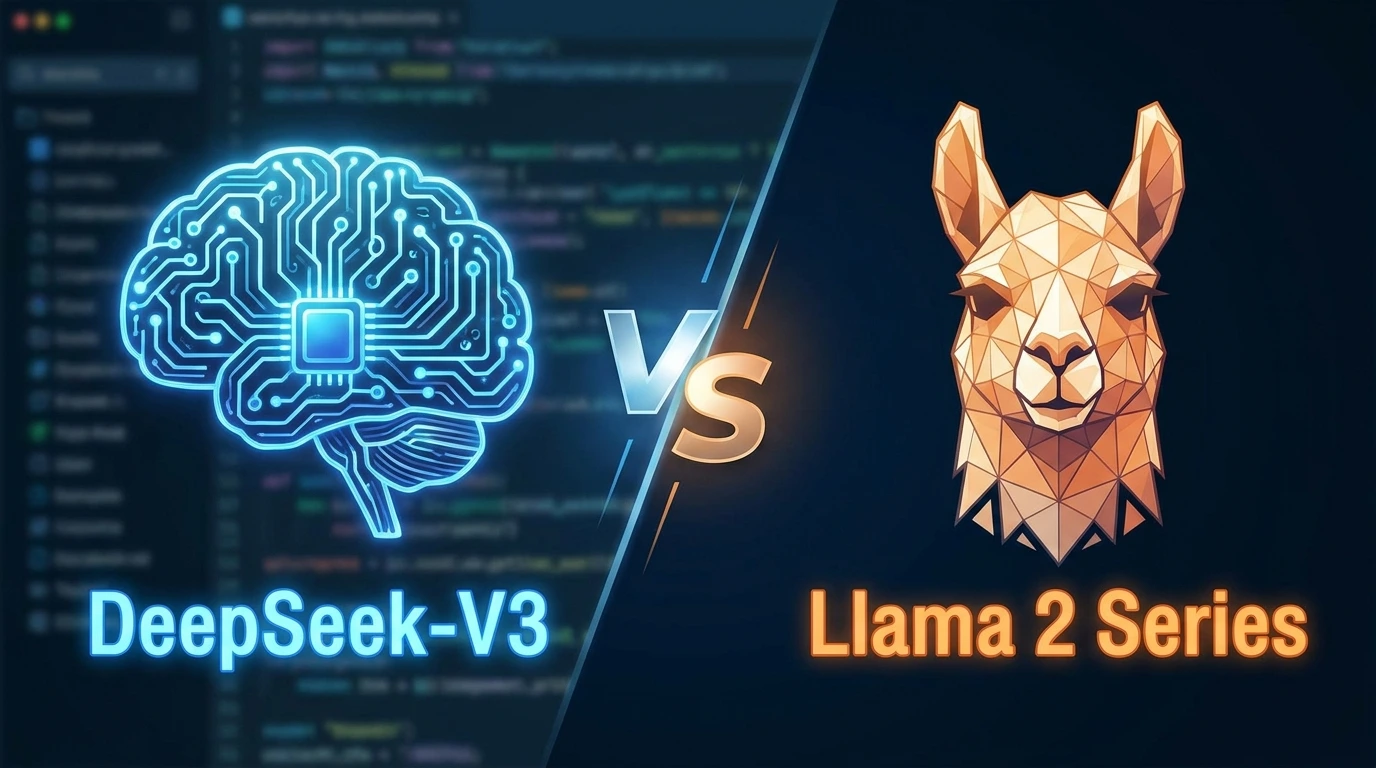
The open-source artificial intelligence ecosystem has undergone a remarkable transformation over the past few years. Technologies that were once considered groundbreaking quickly become obsolete as innovation accelerates. This rapid evolution is clearly visible in the comparison between DeepSeek-V3 vs Llama 2, where generational advancement has created a significant performance and capability gap.
Back in 2023, Llama 2 emerged as a dominant force in the open-source large language model (LLM) space. It provided developers, researchers, and organizations with a robust, adaptable, and cost-effective alternative to proprietary AI solutions. Its flexibility and accessibility made it a preferred choice for building conversational systems, automation tools, and lightweight AI applications.
However, by 2026, the landscape will have shifted dramatically. Newer architectures, particularly models like DeepSeek-V3, have redefined expectations around efficiency, scalability, reasoning ability, and computational optimization. These next-generation systems are not merely incremental improvements—they represent a fundamental shift in how AI models are designed and deployed.
For developers, startup founders, and enterprise leaders, especially in technologically progressive regions such as Europe, choosing the right AI model is no longer just about raw performance. It involves evaluating cost-effectiveness, scalability, adaptability, infrastructure requirements, and long-term sustainability.
This comprehensive, in-depth guide provides a detailed breakdown of everything you need to understand—from architecture and benchmarks to pricing structures and real-world applications—so you can make a confident, strategic decision when selecting between DeepSeek-V3 and Llama 2.
What is DeepSeek-V3?
DeepSeek-V3 is a cutting-edge, next-generation large language model built using a Mixture-of-Experts (MoE) architecture. It is engineered to deliver high computational efficiency while maintaining near-frontier intelligence levels.
Core Characteristics
- Approximately 671 billion total parameters, with around 37 billion active per token
- Trained on nearly 14.8 trillion tokens, providing extensive knowledge coverage
- Supports a 128K context window, enabling long-form reasoning and document processing
- Utilizes a Mixture-of-Experts framework for selective activation
- Excels in logical reasoning, coding tasks, and agent-based workflows
Why DeepSeek-V3 is Important
DeepSeek-V3 introduces a paradigm shift toward what can be described as efficient intelligence. Instead of relying on brute-force computation, it strategically activates only relevant portions of the model during inference. This significantly reduces computational overhead while preserving high-quality output.
This balance between performance and efficiency makes it particularly attractive for startups and enterprises aiming to optimize operational costs while maintaining competitive AI capabilities. In regions where infrastructure and energy efficiency are crucial considerations, this model provides a strong advantage.
What is the Llama 2 Series?
Llama 2 is a dense transformer-based model family introduced in 2023. It quickly became one of the most widely adopted open-source LLMs due to its accessibility and versatility.
Key Attributes
- Available in 7B, 13B, and 70B parameter variants
- Trained on approximately 2 trillion tokens
- Fine-tuned using reinforcement learning from human feedback (RLHF)
- Designed for general-purpose natural language processing tasks
Why Llama 2 Still Matters
Although Llama 2 is considered a legacy model by 2026 standards, it continues to serve important roles in the AI ecosystem. Its simplicity, lower hardware requirements, and strong community support make it suitable for:
- Lightweight deployments
- Offline or local AI systems
- Budget-conscious environments with limited infrastructure
Its reliability and ease of use ensure that it remains relevant, particularly for smaller-scale applications.
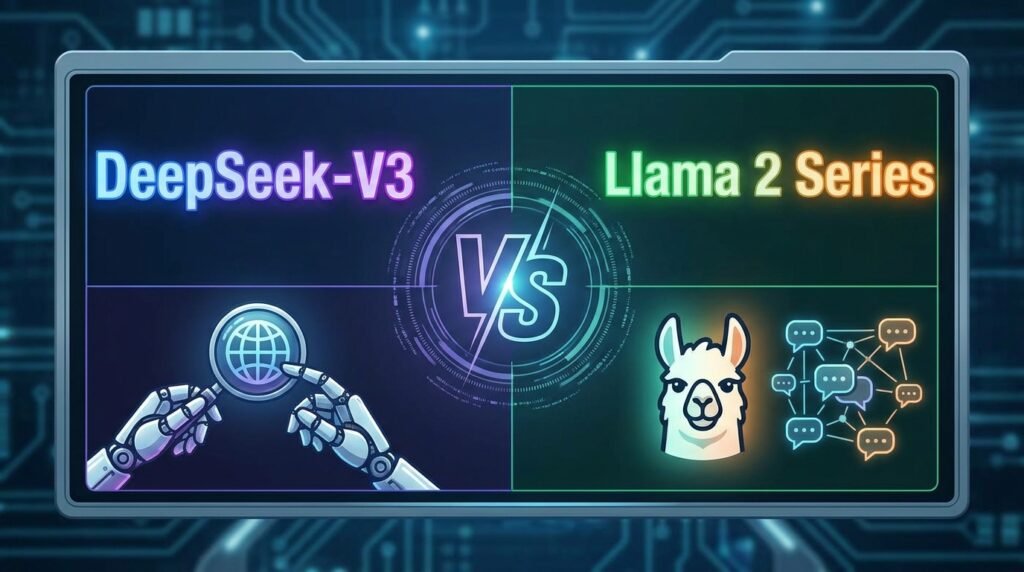
DeepSeek-V3 vs Llama 2: Core Differences
| Feature | DeepSeek-V3 | Llama 2 |
| Release Period | 2024–2026 | 2023 |
| Architecture | Mixture-of-Experts | Dense Transformer |
| Training Data | ~14.8 trillion tokens | ~2 trillion tokens |
| Context Window | 128K | ~4K |
| Performance Level | Near-frontier | Mid-tier (2026) |
| Efficiency | High (selective activation) | Lower (full computation) |
Benchmark Comparison: Real Performance Insights
Many comparison articles present raw benchmark figures without meaningful interpretation. Here, we focus on practical implications rather than just numerical scores.
DeepSeek-V3 Performance
- Achieves strong results in benchmarks such as MMLU (~87%)
- Demonstrates excellent multi-step reasoning capabilities
- High accuracy in coding and debugging tasks
- Competes with some proprietary frontier models
Llama 2 Performance
- Provides stable baseline performance
- Effective for straightforward, single-step tasks
- Struggles with complex reasoning and extended context handling
Interpretation
The difference is not just incremental—it is structural. DeepSeek-V3 is designed for complex cognitive workloads, while Llama 2 is better suited for simpler, linear tasks.
If your application involves AI agents, automation pipelines, or advanced decision-making systems, DeepSeek-V3 offers a significant advantage.
Architecture Breakdown: MoE vs Dense Models
DeepSeek-V3: Mixture-of-Experts
- Activates only a subset of parameters for each query
- Reduces computational demand
- Enhances scalability and efficiency
- Enables higher performance without proportional cost increase
Llama 2: Dense Transformer
- Uses the entire model for every inference
- Simpler and more predictable design
- Higher computational cost per request
Practical Impact
- DeepSeek-V3 = Intelligent resource allocation + scalability
- Llama 2 = Simplicity + consistency but lower efficiency
Coding and Developer Performance
DeepSeek-V3 for Developers
- Advanced code generation across multiple languages
- Strong debugging and error detection
- Handles system-level design and architecture reasoning
- Suitable for building complex SaaS products and AI systems
Llama 2 for Developers
- Basic code generation capabilities
- Limited reliability in complex scenarios
- Better suited for small scripts and simple automation
Verdict
For startups and development teams:
- DeepSeek-V3 = developer-centric innovation
- Llama 2 = entry-level assistance tool
Cost, Pricing, and Efficiency
| Factor | DeepSeek-V3 | Llama 2 |
| Training Efficiency | High | Moderate |
| Inference Cost | Lower (MoE optimization) | Higher |
| Deployment Cost | Medium–High | Low |
| ROI | Excellent | Moderate |
Key Insight
DeepSeek-V3 achieves higher output quality per unit cost, making it ideal for scaling applications where efficiency directly impacts profitability.
Use Case Comparison
Choose DeepSeek-V3 If You Need
- AI agents and autonomous workflows
- Advanced reasoning systems
- Coding assistants and development tools
- Enterprise-grade AI solutions
Choose Llama 2 If You Need
- Lightweight chatbots
- Offline/local deployments
- Simple automation tools
Pros and Cons
DeepSeek-V3
Advantages
- Superior performance
- Efficient scaling capabilities
- Advanced reasoning and coding
- Future-proof architecture
Disadvantages
- More complex infrastructure
- Higher system requirements
Llama 2
Advantages
- Easy deployment
- Lightweight design
- Strong ecosystem support
Disadvantages
- Outdated performance
- Limited reasoning ability
- Restricted scalability
How to Use These AI Models
Step-by-Step Implementation Guide
- Define your primary use case (chatbot, coding assistant, AI agent)
- Select infrastructure (cloud-based or local deployment)
- Choose the appropriate model based on complexity
- Fine-tune the model if required
- Deploy using APIs or local frameworks
Tips for Choosing the Right Model
- Start with simplicity → Use Llama 2 for testing
- Scale intelligently → Transition to DeepSeek-V3
- Optimize expenditure → Focus on token efficiency
- Plan → Choose a model aligned with future needs
European Market Relevance
In Europe, where regulatory compliance, data privacy, and cost optimization are essential, AI adoption is accelerating rapidly.
- DeepSeek-V3 supports enterprise digital transformation.
- Llama 2 remains useful for SMEs and localized systems
Countries such as Germany, the Netherlands, and Sweden are increasingly adopting efficient AI frameworks, making advanced models like DeepSeek-V3 highly relevant.
FAQs
A: Yes, DeepSeek-V3 significantly surpasses Llama 2 in reasoning, coding, and efficiency. However, Llama 2 remains useful for lightweight applications.
A: DeepSeek-V3 is more suitable for scaling startups due to its superior performance and optimized cost efficiency.
A: Yes, especially for local deployments, simple workflows, and environments with limited resources.
A: Its Mixture-of-Experts architecture enables high performance while minimizing computational costs.
A: DeepSeek-V3 is far more capable in coding, debugging, and complex logic tasks.
Conclusion
Selecting between DeepSeek-V3 and Llama 2 ultimately depends on your objectives, technical requirements, and long-term vision. While Llama 2 provides a stable and accessible entry point into AI Development, it lacks the sophistication needed for modern, large-scale applications.
DeepSeek-V3, on the other hand, represents the evolution of intelligent systems—combining efficiency, scalability, and advanced reasoning into a single architecture. For organizations aiming to build robust, scalable, and future-proof AI solutions, it offers unmatched strategic value.