Introduction
Llama 2.13B stands out as one of the most influential open-source large language models in 2026, developed by Meta AI to bridge the gap between performance and practicality. With 13 billion trainable parameters, it achieves a rare balance, powerful to handle complex reasoning, coding, and natural language tasks, yet efficient enough to be deployed without extreme computational overhead. This balance makes it especially compelling for teams that want strong AI capabilities without enterprise-level infrastructure costs.
What truly sets it apart is its open-source nature. Developers, researchers, and enterprises gain full control over the model, enabling deep customization, fine-tuning for niche domains, and seamless integration into existing workflow all without restrictive licensing barriers. Unlike closed systems, Llama 2 13B empowers users to innovate freely, experiment faster, and tailor AI behavior precisely to their needs.
What is Llama 2 13B?
Llama 2 13B is a transformer-based generative language model engineered to handle a remarkably wide range of intelligent tasks from question-answering and text summarization to translation, code generation, and advanced text classification. At its core, the transformer architecture on self-attention mechanisms enables the model to understand context, relationships, and meaning across long passages of text. This allows Llama 2 13B to produce responses that feel coherent, informed, and context-aware rather than purely reactive.
Technical Specifications & Architecture
| Attribute | Description |
| Parameters | 13 billion trainable weights |
| Context Window | 4,096 tokens (~3,000 words) |
| Training Data | Mixed licensed and publicly available data |
| Architecture | Transformer with self-attention and feedforward blocks |
| Licensing | Open-source under Meta AI license |
| Use Cases | Chatbots, code generation, summarization, |
Performance Benchmarks
| Benchmark Task | Llama 2 13B | Purpose |
| MMLU | ~54.8 | Knowledge recall and multi-task reasoning |
| HellaSwag | ~80.7% | Commonsense reasoning |
| HumanEval | Lower | Programming and code generation tasks |
Interpretation
- General Performance: Strong baseline performance for chat and general reasoning.
- Coding Limitations: Not as proficient as GPT‑4 in solving complex programming tasks.
Strengths & Key Advantages
- Open-Source Freedom: No licensing restrictions, full access to model weights.
- Robust Baseline Performance: Effective for many tasks with competitive quality.
- Multi-Domain Applications: Supports chatbots, content generation, coding assistance, and domain-specific knowledge extraction.
Limitations & Weaknesses
- Reasoning Limitations: It struggles with highly complex logical reasoning compared to GPT‑4.
- Hallucinations & Bias: Can produce inaccurate information or biased outputs without proper oversight.
- Safety Considerations: Requires careful guardrails and fine-tuning to reduce toxic or unsafe outputs.
How to Fine-Tune Llama 2 13B
Fine-Tuning Methods
| Method | Advantages | Disadvantages |
| LoRA | Efficient, requires less memory | Slightly lower peak accuracy |
| QLoRA | Very low VRAM requirements | Complex setup and tuning |
Fine-Tuning Workflow
- Dataset Selection: Use high-quality, domain-specific text.
- Preprocessing: Tokenize, clean, and normalize text.
- Adapter Application: Use LoRA or QLoRA for parameter-efficient tuning.
- Training & Validation: Train on domain-specific examples and evaluate performance.
- Deployment & Continuous Evaluation: Monitor model behavior, adjust parameters as needed.
Deployment & Cost
Llama 2 13B can be deployed in cloud environments or on-premise servers, depending on data sensitivity and cost considerations.
Cloud Deployment
- Platforms: AWS Bedrock, Azure AI, Hugging Face Spaces.
- Pros: No heavy hardware investment, scalable.
- Cons: Ongoing monthly cost.
On-Premise Deployment
- Pros: Full control, data privacy, and cost-effective long-term.
- Cons: Requires GPU infrastructure upfront (A100, H100).
Cost Estimates
| Deployment Type | Cost Range / Month |
| Cloud GPU | $500–$1,500 |
| On-Premise | $1,000+ hardware upfront |
| Managed API | Subscription-based, variable |
Best Real-World Use Cases
- AI Chatbots & Virtual Assistants: Customer support, help desks, internal assistants.
- Internal Knowledge Systems: Semantic search for enterprise documents.
- Content Generation: Summaries, blogs, product Descriptions.
- Coding Assistance: Programming help, code snippets, debugging hints.
- Custom AI Models: Legal, medical, or financial text analysis with domain-specific.
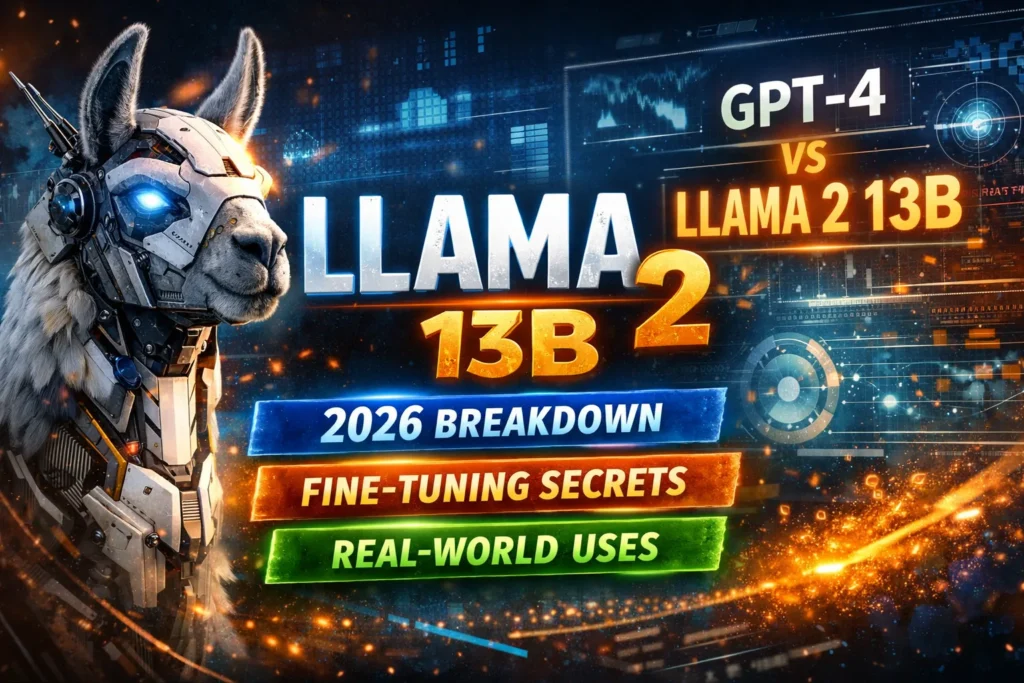
Llama 2 13B vs Other Models
| Model | Size | Best Uses | Advantages | Disadvantages |
| Llama 2.13B | 13B | Chat, NLG | Open-source, cost-effective | Weaker on complex reasoning |
| GPT‑4 | ~100B | Deep reasoning, | Accurate, | Expensive, closed API |
| Llama 2 70B | 70B | Enterprise AI | Top open-source performance | Very high compute |
Llama 2 13B occupies the sweet spot for small-to-medium enterprises that require performance without exorbitant costs.
Future Outlook
In 2026, Llama 2 13B remains relevant because of its flexibility, efficiency, and open-source nature. Anticipated developments in future Llama series iterations include:
- Larger context windows for long-document understanding.
- Enhanced reasoning and logic capabilities.
- More efficient transformer architectures for lower-cost inference.
For many developers and companies today, Llama 2 13B delivers the right combination of power, affordability, and adaptability.
FAQs
A: Not in advanced reasoning or coding — GPT‑4 still outperforms it. However, Llama 2.13 B is open-source, flexible, and significantly cheaper.
A: Yes. Use LoRA or QLoRA to adapt it to domains like legal, healthcare, or finance.
A: Moderate GPUs like A100 suffice for inference; fine-tuning may need additional VRAM depending on dataset size.
A: Its 4,096-token context window requires splitting or summarizing very long texts.
A: Cloud platforms such as AWS, Azure, Hugging Face, or on-premise GPU servers.
Conclusion
Llama 2 13B emerges as a highly versatile, open-source large language model that strikes a rare balance between cost efficiency, strong performance, and operational flexibility. Its adaptability allows it to power everything from intelligent and content generation systems to coding assistants and highly specialized, domain-specific applications. Whether deployed in startups or enterprise environments, offers a level of control and transparency that closed models simply cannot match.
What makes this model especially compelling is its compatibility with efficient fine-tuning Techniques. These methods enable organizations to customize the model for niche tasks without massive computational overhead, unlocking tailored intelligence at a fraction of the usual cost.