Introduction
The LLaMA 1 Series represents a transformative milestone in the evolution of large language models (LLMs). Unveiled by Meta AI in early 2023, LLaMA 1 challenged the prevalent assumption in the AI community that “larger is always better” when it comes to generative language models. Before LLaMA 1, models such as GPT‑3 (175B parameters) dominated the landscape, creating a belief that high parameter counts directly translated into superior performance.
However, the LLaMA 1 Series demonstrated that architectural efficiency, judicious optimization strategies, and high-quality public datasets could produce competitive outcomes with a fraction of the parameters. This shift was pivotal for democratizing AI research and experimentation, making advanced language models accessible without the need for colossal computational resources.
This guide provides a comprehensive deep dive into the LLaMA 1 architecture, its performance benchmarks, how it compares with GPT‑3, its core advantages and limitations, and why it retains significance even in 2026. By the end of this article, researchers, developers, and AI enthusiasts will gain a robust understanding of LLaMA 1 from both theoretical and practical perspectives.
What Is the LLaMA 1 Series?
LLaMA stands for Large Language Model Meta AI, representing Meta’s inaugural open-source LLM initiative. Unlike closed-access commercial models, LLaMA 1 was explicitly engineered to provide researchers with a transparent and replicable model for experimentation.
Key Features of the LLaMA 1 Series
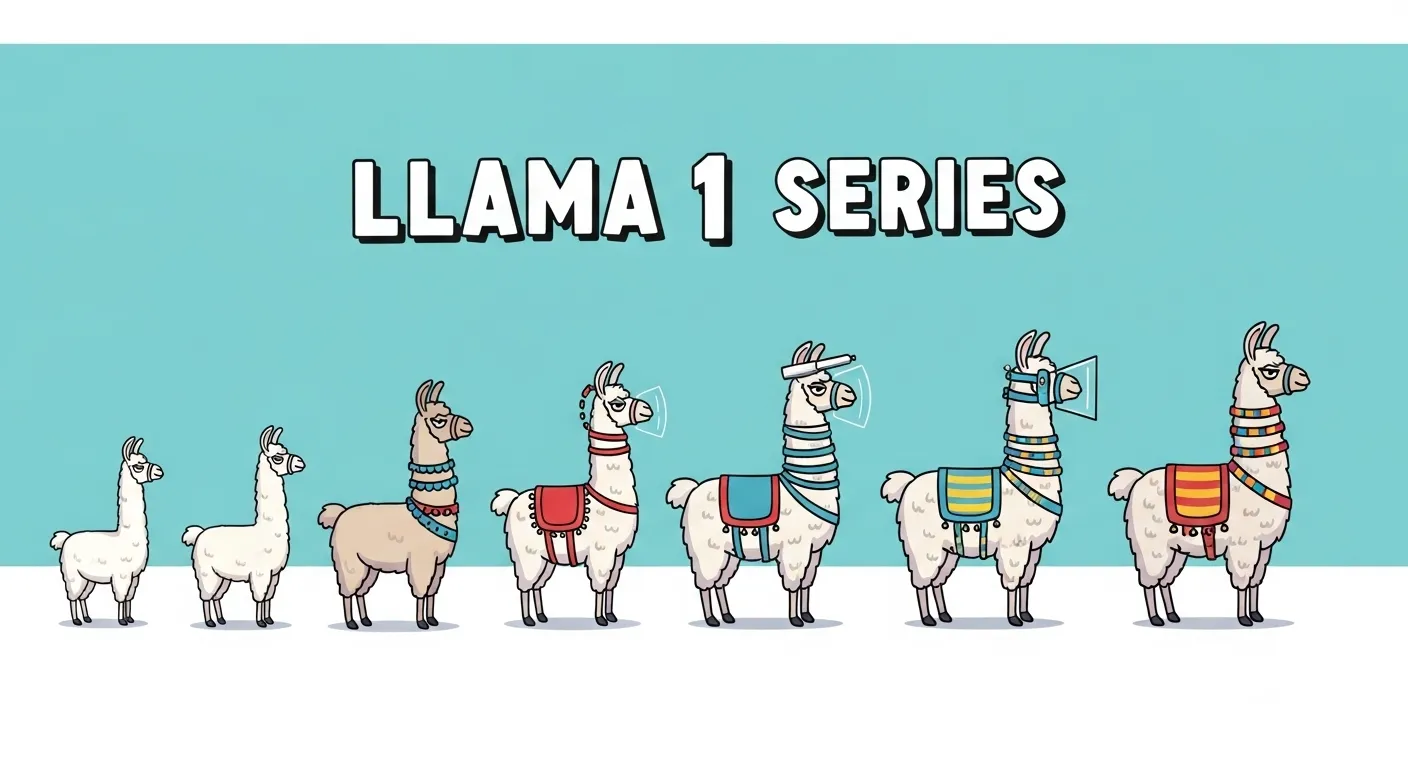
| Feature | Description |
| Open-Source | Released under a research license for academic and experimental purposes. |
| Model Sizes | 7B, 13B, 30B, and 65B parameters. |
| Training Data | Exclusively publicly accessible sources. |
| Architecture | Decoder-only Transformer architecture optimized for sequence modeling. |
| Performance | Capable of competing with larger models in multiple tasks. |
| Accessibility | Researchers can download, fine-tune, and experiment with model weights. |
The design philosophy behind LLaMA 1 was elegance over brute force: smaller, highly optimized models that could perform comparably to models like GPT‑3 in many benchmarks. In particular, the 13B parameter variant frequently outperformed expectations in tasks such as language understanding, summarization, and zero-shot reasoning, illustrating that architectural sophistication could outweigh sheer scale.
LLaMA 1 Architecture Explained
Understanding why LLaMA 1 performs efficiently requires a deep dive into its architectural innovations. Each component contributes to enhanced capabilities while maintaining computational efficiency.
Transformer Core
At its foundation, LLaMA 1 employs a decoder-only Transformer, a paradigm widely adopted in autoregressive LLMs.
Key Features:
- Autoregressive sequence modeling: Predicts the subsequent token given a sequence of preceding tokens.
- Self-attention mechanism: Captures dependencies between tokens at varying distances.
- Left-to-right processing: Ideal for text generation and sequential tasks.
In contexts, this architecture excels at:
- Text generation: Producing coherent and contextually relevant passages.
- Question answering: Reasoning over input sequences to extract accurate responses.
- Language comprehension: Understanding syntax, semantics, and token relationships
The Transformer core’s flexibility ensures that LLaMA 1 can generalize across diverse benchmarks despite its relatively smaller parameter counts.
SwiGLU Activation
Activation functions in neural networks determine how information flows and how non-linear patterns are learned. LLaMA 1 adopts SwiGLU, a variant of the GLU (Gated Linear Unit) family.
Advantages of SwiGLU in models:
- Efficiency: Requires fewer floating-point operations than traditional GeLU activations.
- Enhanced representational power: Captures complex token relationships effectively.
- Training stability: Reduces vanishing gradient issues, promoting robust learning.
Empirical studies indicate that SwiGLU accelerates convergence on tasks like language modeling, summarization, and multi-step reasoning.
Rotary Positional Embeddings (RoPE)
Positional encoding allows Transformers to distinguish token order. While Older LLMs rely on absolute embeddings, LLaMA 1 integrates RoPE.
RoPE benefits:
- Relative positioning: Encodes the distance between tokens, enhancing long-range dependency modeling.
- Improved generalization: Supports reasoning over long sequences without retraining.
- Flexibility: Adapts to sequences longer than the training context.
This approach is particularly useful for document understanding, summarization, and context-dependent language generation, where token relationships are critical.
RMSNorm
Normalization ensures stable training dynamics in deep networks. LLaMA 1 replaces conventional LayerNorm with RMSNorm.
RMSNorm characteristics:
- Computationally efficient: Reduces the number of arithmetic operations.
- Memory-friendly: Lower overhead on large model layers.
- Stable convergence: Maintains performance across varying tasks.
This subtle but impactful optimization ensures that LLaMA 1 remains both fast and scalable, a critical factor for researchers with limited hardware.
Training Data & Optimization
| Feature | Details |
| Token Count | ~1.4 trillion tokens. |
| Data Sources | Publicly available datasets: Wikipedia, Common Crawl, GitHub, Books. |
| Optimizer | Adam optimizer with learning rate decay. |
| Training Setup | Distributed GPU clusters optimized for efficiency. |
LLaMA 1 emphasizes transparent, reproducible training using open data — a major differentiator from GPT‑3, which leveraged proprietary and mixed data sources. This ensures research reproducibility, a critical aspect in academic experimentation.

LLaMA 1 vs GPT-3 Head-to-Head
Comparing LLaMA 1 to GPT‑3 highlights how architecture and optimization can rival raw scale.
| Feature | LLaMA 1 | GPT‑3 |
| Model Sizes | 7B–65B | 175B |
| Training Data | Public only | Private + mixed |
| License | Open research | Closed API |
| Activation | SwiGLU | GeLU |
| Positional Encoding | RoPE | Absolute |
| Performance | Competitive | Benchmark standard |
| Instruction Tuning | Not official | Few-shot API |
| Context Window | 2,048 tokens | 2,048 tokens |
| Custom Tuning | Yes | API-driven |
Key Takeaways:
- Scale vs Efficiency: Despite being smaller, LLaMA 1 performs competitively due to superior architectural design.
- Accessibility: Open-source license encourages experimentation, unlike GPT‑3’s closed API model.
- Compute Optimization: LLaMA 1 achieves strong results at lower computational cost.
Strengths of the LLaMA 1 Series
Open Access & Customization
Researchers can:
- Download pre-trained weights.
- Fine-tune for domain-specific tasks.
- Distill smaller models for edge deployments.
- Conduct experimental research on architecture innovations
Efficient Architecture
LLaMA 1 integrates:
- Lightweight normalization (RMSNorm)
- Efficient activation (SwiGLU)
- Relative positional embeddings (RoPE)
This Combination ensures maximum performance per FLOP, a metric critical in research and deployment.
Strong Baseline Performance
Even smaller models like 13B parameters perform robustly on:
- Text summarization
- Question answering
- Translation
- Code generation
Research Foundation
LLaMA 1 has become a research cornerstone, informing the design of:
- LLaMA 2 and 3
- Other open-source LLMs
- Efficient training methodologies
Its design decisions continue to influence state-of-the-art architecture strategies.
Limitations and Weaknesses
Despite its achievements, LLaMA 1 exhibits several limitations:
Limited Instruction Tuning
- Chat-style responses are less polished.
- Fine-tuning is often required for applications requiring instruction adherence.
Short Context Window
- Maximum 2,048 tokens limit multi-step reasoning and long-document processing.
Task Performance Variability
- Struggles with coding, logic, math, and structured outputs.
Security and Misuse Risks
- Open models can be used to generate unsafe or biased outputs.
- Developers must integrate safety layers during the deployment process.
Why LLaMA 1 Still Matters in 2026
- Historical Significance: Demonstrated that efficiency can compete with scale.
- Research Value: Provides insights into optimization, architecture, and public dataset training.
- Base for Successor Models: Informed LLaMA 2 and LLaMA 3 designs.
- Lessons in Efficiency: Emphasizes clever architectural choices over brute force scaling.
Pros & Cons
Pros:
Open-source, research-friendly
Efficient and scalable
Competitive performance
Influential design decisions
Cons:
Weak instruction following
Short context window
Limited performance on complex reasoning tasks
Requires safety and filtering layers
FAQs
A: It remains useful for research, benchmarking, and model exploration, but is outperformed by newer models like LLaMA 2/3 and GPT‑4.
A: Released under a research-only license prohibiting commercial use.
A: It competes effectively in many tasks, despite having smaller parameter counts, due to its optimized architecture and efficient training.
A: Its 2,048 token limit restricts performance on long documents or multi-step reasoning.
A: Ideal for learning, experimentation, and research on foundational LLM design.
Conclusion
The LLaMA 1 Series is more than an AI model; it is a landmark achievement demonstrating that strategically optimized, smaller LLMs can compete with much larger models. Its innovations in activation functions, normalization, positional embeddings, and efficient training have shaped the trajectory of open-source research.
Even in 2026, LLaMA 1 remains educationally and historically valuable, providing insights into how intelligent architecture choices can drive high performance, resource efficiency, and accessibility in large language models.
Researchers and developers continue to draw inspiration from LLaMA 1, Ensuring its legacy endures in contemporary AI development.