Introduction
The Llama 4 Series, developed by Meta AI, is one of the most talked-about open-source LLM families in 2025–2026. But here’s the burning question for AI Researchers and developers:
- Can a single AI model truly handle millions of tokens and maintain coherent reasoning?
- How does Llama 4 stack up against GPT-4o, Gemini 2.5 Pro, DeepSeek v3.1, and Qwen, which dominate the closed-source market?
- Is it ready for real-world tasks like coding, multilingual support, document analysis, and multimodal reasoning?
This guide dives deep into architecture, benchmarks, strengths, weaknesses, and practical use cases for the Llama 4 Series. By the end, you’ll know not just what the model can do—but what it cannot do, giving you a realistic picture of its value in 2026.
What Is the Llama 4 Series?
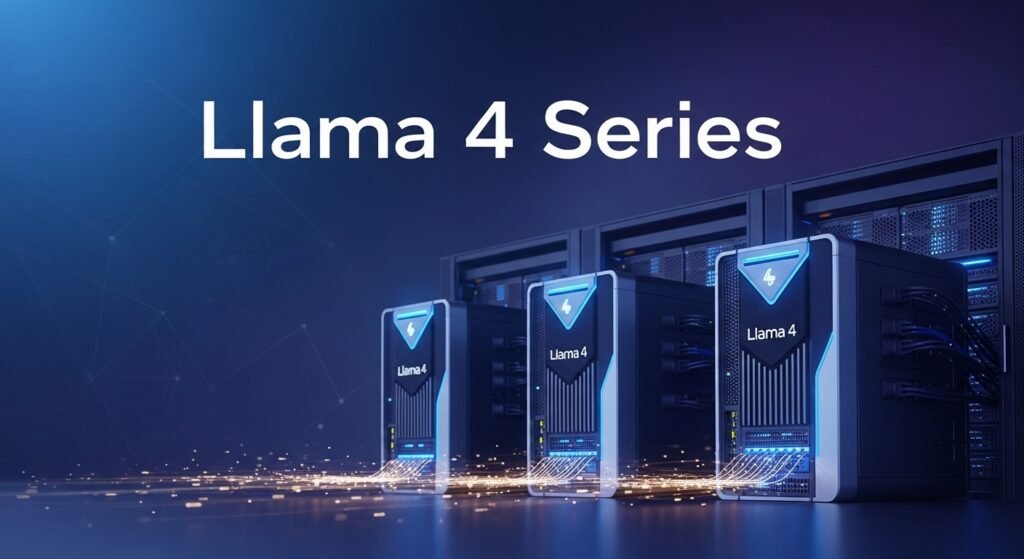
Meta’s fourth-generation open-weight LLMs are more than a simple upgrade—they represent a flexible, high-performance open-source ecosystem. Unlike previous iterations, Llama 4 introduces:
- Mixture-of-Experts (MoE) layers for adaptive task specialization
- Ultra-large context windows, theoretically supporting millions of tokens
- Multimodal intelligence, reasoning over text and images simultaneously
- Open-source accessibility, allowing developers, researchers, and enterprises to self-host and customize
Curiosity Boost: The MoE design lets Llama 4 “activate” only the experts needed for a task. In practice, this is like having 10 specialized AI models running in parallel—but only using the right ones at the right time.
Core Architectural Features
| Feature | Description | Why It Matters |
| Open-Source Weights | Public access to model parameters and Training code | Enables research, fine-tuning, and self-hosted deployment |
| Multimodal Functionality | Handles text + image inputs natively | Supports integrated reasoning over charts, images, and documents |
| Massive Context Windows | Millions of tokens per prompt | Enables long-document comprehension, multi-turn reasoning, and extended code analysis |
| Mixture-of-Experts (MoE) | Dynamically activates specialized “experts” | Increases efficiency without sacrificing expressivity |
| Multiple Model Sizes | Scout, Maverick, Behemoth | Supports edge devices, mid-tier workloads, and ultra-large experimental tasks |
Key Llama 4 Variants
Llama 4 Scout
- Lightweight, efficient, suitable for single-GPU or edge deployments
- Ideal for long-document indexing, NLP pipelines, and low-latency inference
Llama 4 Maverick
- Flagship mid-tier model balancing Performance, multimodal reasoning, and context size
- Suitable for enterprise assistants, multilingual chatbots, and hybrid analytics
- Benchmark highlight: Maverick can outperform GPT-4o on certain structured multimodal reasoning tasks
Behemoth
- Ultra-large experimental model for deep reasoning and massive context comprehension
- Full deployment is gradual due to resource and computational demands
- Target: pushing the frontier of AI reasoning and multimodal intelligence
Feature Breakdown – Capabilities
Multimodal Intelligence
Llama 4 can reason over text and images simultaneously. For instance, it can:
- Analyze charts and graphs in reports
- Answer complex document questions with visual data context
- Generate multimodal insights for enterprise dashboards
| Task | Llama 4 Maverick | GPT-4o | Gemini 2.0 Flash |
| MMMU (Image + Text) | 73.4% | 69.1% | 71.7% |
| ChartQA | ~90% | ~85.7% | ~88.3% |
| DocVQA | ~94.4% | ~92.8% | — |
Insight: Llama 4 sometimes beats closed-source models, making it a surprisingly strong open-source competitor.
Long-Context Handling
Llama 4 can theoretically manage millions of tokens in a single prompt, enabling:
- Multi-chapter book Comprehension
- Large codebase analysis
- Extended research workflows
Caveat: Token quantity doesn’t equal comprehension. Ultra-long context sequences require attention strategies, memory optimization, and task-specific tuning.
Long-Context Benchmark Insight (MTOB Evaluation):
- Accuracy may not scale linearly with token count
- Deep semantic understanding of long narratives can still challenge the architecture
Coding & Logical Reasoning
| Model | LiveCodeBench (%) |
| Llama 4 Maverick | 43.4 |
| GPT-4o | 32.3 |
| Gemini 2.0 Flash | 34.5 |
| DeepSeek v3.1 | 45.8–49.2 |
Observation: Maverick can outperform GPT-4o on general coding tasks, though DeepSeek remains strong for structured algorithmic reasoning.
Comparative Benchmarks – Llama 4 vs Rivals
| Category | Llama 4 Maverick | GPT-4o | Gemini 2.5 Pro / 2.0 Flash | DeepSeek v3.1 | Qwen 2.5 |
| Multimodal (MMMU) | 73.4 | 69.1 | 71.7 | — | — |
| ChartQA / DocVQA | ~90 / ~94.4 | ~85.7 / ~92.8 | ~88.3 / — | — | — |
| Coding (LiveCode) | 43.4 | 32.3 | 34.5 | 45.8–49.2 | — |
| Reasoning (MMLU Pro) | 80.5 | — | 77.6 | 81.2 | — |
| Multilingual MMLU | 84.6 | 81.5 | — | — | — |
| Long-Context (MTOB) | ~50.8 / 46.7 | Limited (128K) | ~48.4 / ~39.6 | Limited (128K) | — |
Takeaways:
- Strong multimodal reasoning & multilingual comprehension
- Coding consistency depends on the dataset
- Theoretical long-context is unmatched but needs optimization
Strengths of Llama 4 Series
- Open-Source Flexibility: Fine-tune, self-host, or adapt for domain-specific AI pipelines
- Cost-Effective Deployment: Ideal for high-frequency queries or enterprise data-sensitive tasks
- Superior Multimodal Reasoning: Integrated reasoning for charts, documents, and images
- Multilingual & Cross-Lingual Proficiency: Supports global applications without additional fine-tuning
Weaknesses and Limitations
- Ultra-long Context Challenges: Millions of tokens ≠ for perfect understanding
- Benchmark Transparency Issues: Meta uses Experimental tuning in submissions
- Mixed Coding Performance: Logic-heavy tasks may underperform
- Deployment Variability: Performance depends on hardware, fine-tuning, and the inference engine
Practical Use Case Recommendations
Ideal Scenarios:
- AI assistants with sensitive data
- Document understanding & OCR pipelines
- Multilingual conversational agents
- Cost-conscious AI deployments at scale
Less Suitable For:
- High-stakes decision-making systems
- Complex, unoptimized code generation
- Ultra-long narrative comprehension without fine-tuning
FAQs
A: But more tokens don’t automatically guarantee better reasoning. Task-specific tuning matters.
A: Self-hosting Llama 4 is cheaper at scale, though infrastructure costs vary.
A: Absolutely, fine-tuning improves benchmarks and real-world results.
A: Core weights and architecture are public, with some licensing conditions.
A: But check license terms for specific applications.
Conclusion
The Llama 4 Series is a game-changer in open-source AI, combining flexibility, cost efficiency, and multimodal intelligence. However:
- Benchmarks are setup-dependent
- Real-world performance may vary
- Long-context comprehension requires careful Management
Bottom line: For developers, researchers, and enterprises seeking customizable, scalable, multimodal AI, Llama 4 is a top choice. For ultra-consistent outputs, closed-source alternatives like GPT-4o, Gemini, or DeepSeek may still have an edge.