Introduction
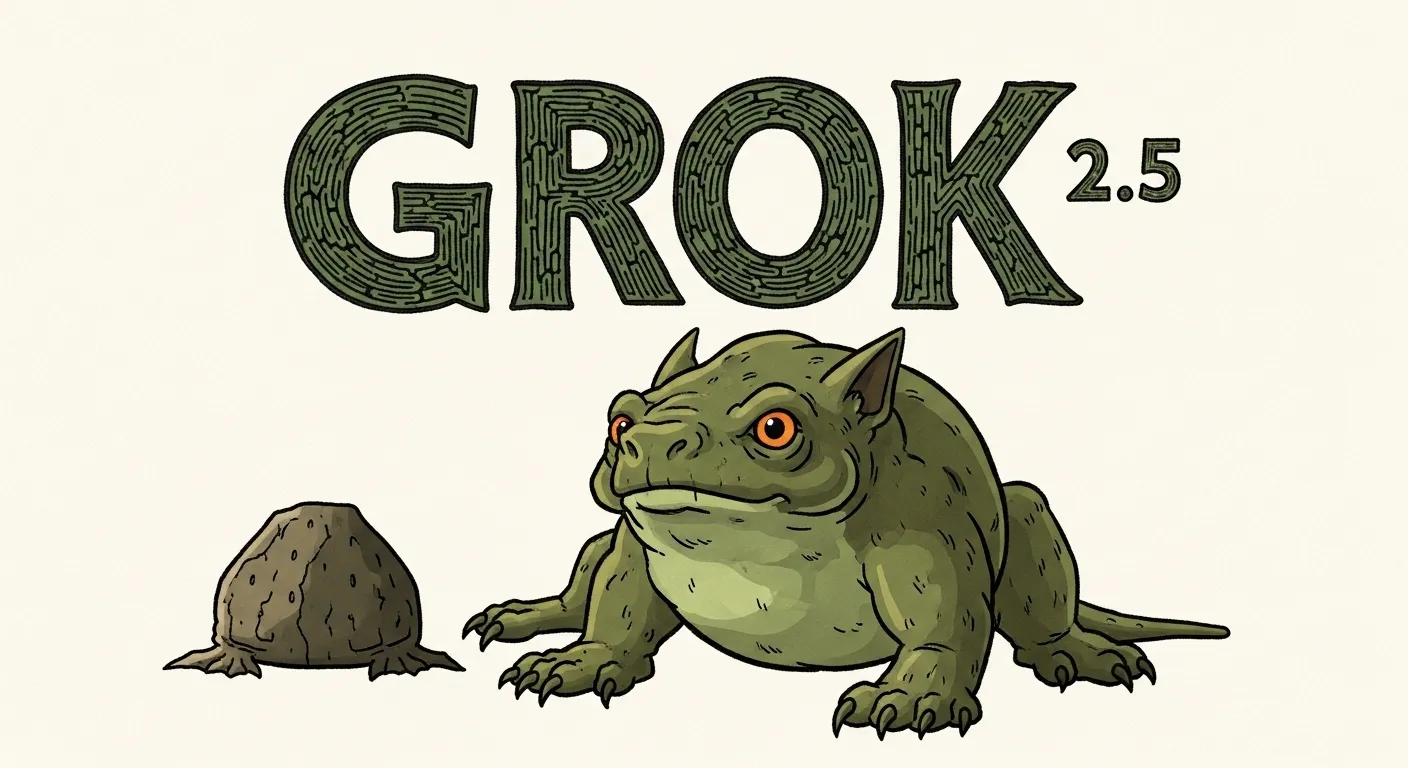
The realm of artificial intelligence and natural language processing is progressing at an unprecedented rate. Within this evolutionary surge, Grok-2.5 has emerged as one of the most influential open-source large language models of 2026. Engineered by xAI, Elon Musk’s AI enterprise, Grok‑2.5 is a sophisticated, adaptable, and experimental tool tailored for developers, computational linguists, researchers, and corporate enterprises alike.
Launched under a custom community license, Grok‑2.5 integrates Mixture-of-Experts technology, which dynamically activates only specific expert subnetworks during inference. This architecture balances computational efficiency with high-performance processing, optimizing resource usage while maintaining superior model capabilities. However, this autonomy comes with licensing constraints, ethical considerations, and deployment challenges, which all stakeholders must understand comprehensively.
In this extensive guide, you will discover every aspect of Grok‑2.5, including:
- In-depth architecture and functional features
- Benchmarks compared with GPT‑5, Claude, and Gemini
- Practical and multimodal applications
- Ethical, regulatory, and safety considerations
- Deployment, scaling, and hardware recommendations
What Is Grok-2.5?
Grok‑2.5 represents the next-generation generative model from xAI, engineered to handle textual, code-based, and multimodal inputs efficiently. Unlike its predecessors, Grok‑2.5 introduces a Mixture-of-Experts (MoE) paradigm, whereby only relevant experts are engaged during inference. This significantly reduces computational overhead while enhancing the model’s adaptability to a diverse array of tasks.
Key Technical Highlights:
- Publicly released under the Grok 2 Community License
- Parameter count: ~268–314 billion
- Extended contextual window for long-document comprehension
- Supports multimodal processing (text + images, limited video capabilities)
These features make Grok‑2.5 exceptionally versatile for a variety of applications:
- AI research and computational linguistics
- Software automation and code generation pipelines
- Enterprise-level data parsing and analysis
- Creative content generation and multimodal workflows
Grok‑2.5 Technical Architecture
Mixture-of-Experts (MoE) Paradigm
The Mixture-of-Experts architecture underpins Grok‑2.5, dynamically selecting a subset of experts tailored for each task. In contrast to traditional dense transformer models, MoE optimizes computational expenditure and enhances task-specific specialization.
Benefits of MoE in contexts:
- Reduced computational resource requirements for large-scale inference
- Specialized processing for distinct subdomains (e.g., code generation, summarization, logical reasoning)
- Scalability for multimodal applications
Model Comparison Table:
| Specification | Grok‑2.5 | GPT‑5 | Claude 4 | Gemini 1.5 |
| Parameters | 268–314B (MoE) | 300B | 280B | 260B |
| Architecture | Mixture-of-Experts | Dense Transformer | Dense Transformer | Dense + Memory |
| Context Length | ~16k tokens | 12k tokens | 14k tokens | 12k tokens |
| Multimodal Support | Text + Image | Text | Text | Text + Image |
| Open Source | ✅ Community License | ❌ Closed | ❌ Closed | ⚠ Partial |
Key Technical Innovations
- Dynamic Expert Activation: Allocates computational effort selectively, improving inference efficiency
- Extended Context Management: Enables long-document analysis without performance degradation
- Multimodal Integration: Supports text-image reasoning, enhancing creative and research tasks
- Optimized Local Deployment: FP8 quantization for GPU Efficiency and reduced memory footprint
Features That Distinguish Grok-2.5
Advanced Understanding & Reasoning
Grok‑2.5 demonstrates superior capabilities in:
- Logical problem-solving and deductive reasoning
- Automated code synthesis, debugging, and completion
- Summarization and semantic understanding of extended documents
Multimodal Processing Capabilities
Unlike many open-source LLMs, Grok‑2.5 supports:
- Image captioning and contextual understanding
- Basic video analysis (frame-level insights)
- Creative content generation using text + image prompts
Open Source Accessibility
- Full model weights available on Hugging Face
- Local execution for experimentation and research
- Community-driven innovation accelerates feature improvements and custom applications
Open-Source Release Explained
Advantages of Grok 2 Community License:
- Transparent research access: Enables reproducibility and algorithmic scrutiny
- Full visibility into model architecture and weight parameters
- Local experimentation without cloud dependency
Limitations / Considerations
- Commercial derivatives may require additional licensing
- Cannot train other AI models solely using Grok‑2.5 outputs
- Large-scale enterprise deployment may necessitate legal review
Grok‑2.5 Compared to Other Leading Models
| Feature | Grok‑2.5 | GPT‑5 | Claude 4 | Gemini 1.5 |
| Open Source | ✅ Community License | ❌ Closed | ❌ Closed | ⚠ Partial |
| Text Accuracy | High | Very High | High | High |
| Multimodal | ✅ Text + Image | ❌ | ❌ | ✅ Text + Image |
| Safety Constraints | ⚠ Medium | ✅ High | ✅ High | ⚠ Medium |
| Context Length | 16k | 12k | 14k | 12k |
| Ideal Use Case | Research, Custom AI Agents | Enterprise AI & Chatbots | Enterprise & SaaS | Creative AI & Research |
Key Takeaways:
- Grok‑2.5 excels in transparency, research freedom, and multimodal tasks
- Proprietary models like GPT‑5 provide robust safety, moderation, and enterprise readiness
- Grok‑2.5 is ideal for custom AI agent creation, advanced research, and coding assistance
Real-World Use Cases
Developer Tools & Automation
- Automate repetitive programming tasks
- Intelligent code review, bug detection, and optimization
- Parsing and summarizing documentation and logs
Enterprise Data Analysis
- Summarization of massive reports
- Extraction of structured data from PDFs and unstructured sources
- Generate actionable insights for business intelligence
Creative Workflows
- Marketing copy, content writing, and digital design Generation
- Multimodal prompts integrating images and text
- AI-assisted editorial pipelines for publications
Pro Tip: Use sandbox environments initially due to licensing restrictions and safety protocols.
Benchmarks & Performance Analysis
| Task | Grok‑2.5 | GPT‑5 | Claude 4 |
| Logical Reasoning | 85% | 92% | 90% |
| Code Generation | 88% | 94% | 90% |
| Long Document Comprehension | 82% | 89% | 85% |
| Multimodal Accuracy | 78% | 65% | 60% |
Observations:
- Reasoning and coding capabilities remain competitive
- MoE architecture enables long-context comprehension efficiently
- Multimodal performance surpasses other open-source models for research and creative tasks
Safety, Ethical Considerations & Risk Mitigation
Despite robust capabilities, Grok‑2.5 entails ethical and operational risks:
- Bias & Unsafe Output Generation: Potential for offensive or inappropriate content
- Moderation Challenges: Particularly for images, video, and multimodal outputs
- Regulatory Compliance: Licensing and ethical considerations must be reviewed
Pro Tip: Integrate content moderation, human-in-the-loop supervision, and sandbox deployment for safe adoption.
Deployment & Hardware Requirements
- Resource-intensive, particularly for local deployment
- Recommended setup: 8×40GB+ GPUs for optimal performance
- Optional FP8 quantization allows smaller hardware footprints
- Cloud deployment available via Hugging Face or Docker containers
Future Roadmap
- Grok‑3 expected in late 2026 with improved efficiency, multimodal reasoning, and safety protocols
- Community contributions continue to enhance Grok-2.5 usability
- Enterprise adoption is likely to grow in automation, research, and creative workflows
Pros & Cons
Pros:
- Open-source access via community license
- Efficient MoE architecture
- Strong reasoning, coding, and multimodal capabilities
- Handles long-context documents
- Ideal for research, custom AI agents, and development tools
Cons:
- Requires high-end hardware
- License restrictions for commercial derivatives
- Requires active safety and bias management
- Enterprise readiness lags behind GPT‑5 and Claude
FAQs
A: Under the community license, although commercial use is restricted.
A: With quantization, though 8×40GB GPUs are recommended for best performance.
A: Comparable in reasoning and coding; GPT‑5 excels in safety, moderation, and enterprise deployment.
A: It supports text + image tasks, while video capabilities are limited.
A: But with careful hardware planning, licensing evaluation, and safety oversight.
Conclusion
Grok‑2.5 represents a breakthrough in open-access leveraging Mixture-of-Experts architecture, long-context processing, and multimodal capabilities. It is particularly suited for:
- Research and computational linguistics
- Developer tools, code automation, and custom agent frameworks
- Experimental enterprise applications with careful licensing and safety planning
For full control and experimentation in Grok‑2.5 is one of the top choices in 2026. Enterprises, however, should Carefully consider hardware, licensing, and operational safety before scaling large deployments.