AI Meta Layoffs 2026 — A Deep Dive
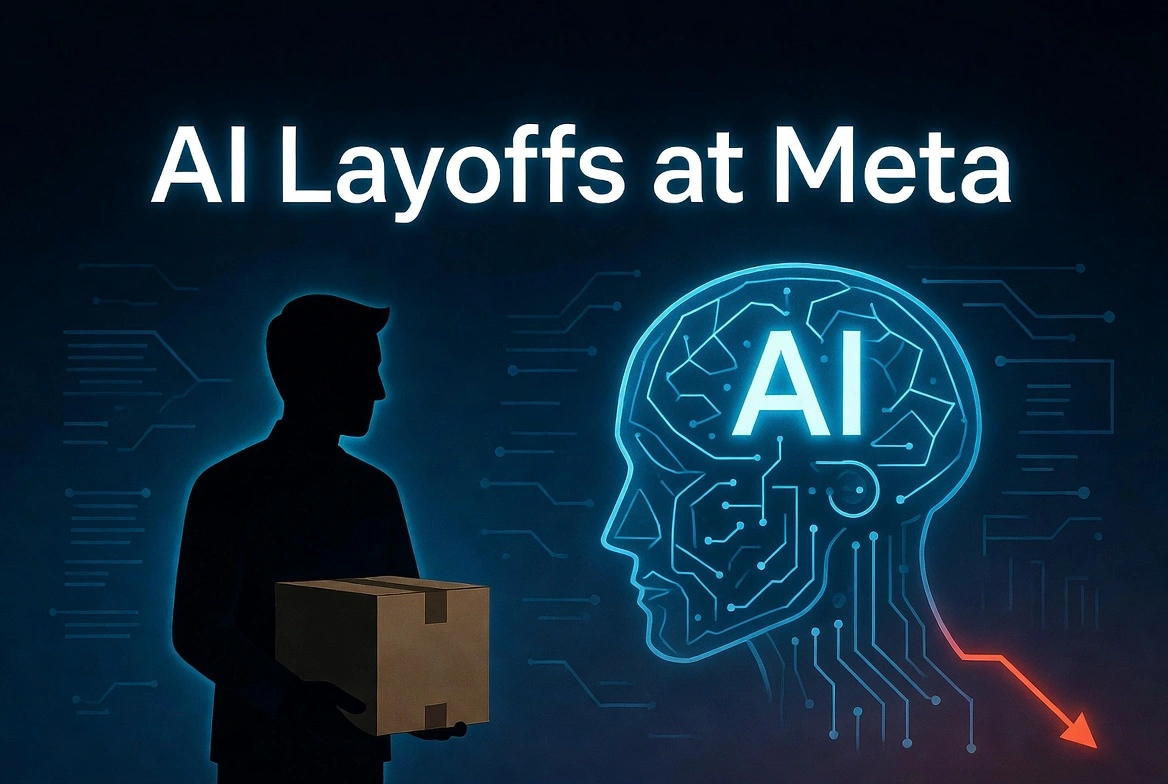
The Layoffs Of AI-focused employees, which happened in early 2026, in the company once known as Facebook and the parent of Instagram, have been one of the most controversial subjects in the global technology community. This is not a typical downsizing effort in Silicon Valley; AI meta layoffs are rather a longer-term shift like work, labor, and productivity as it is being redefined in the era of artificial intelligence.
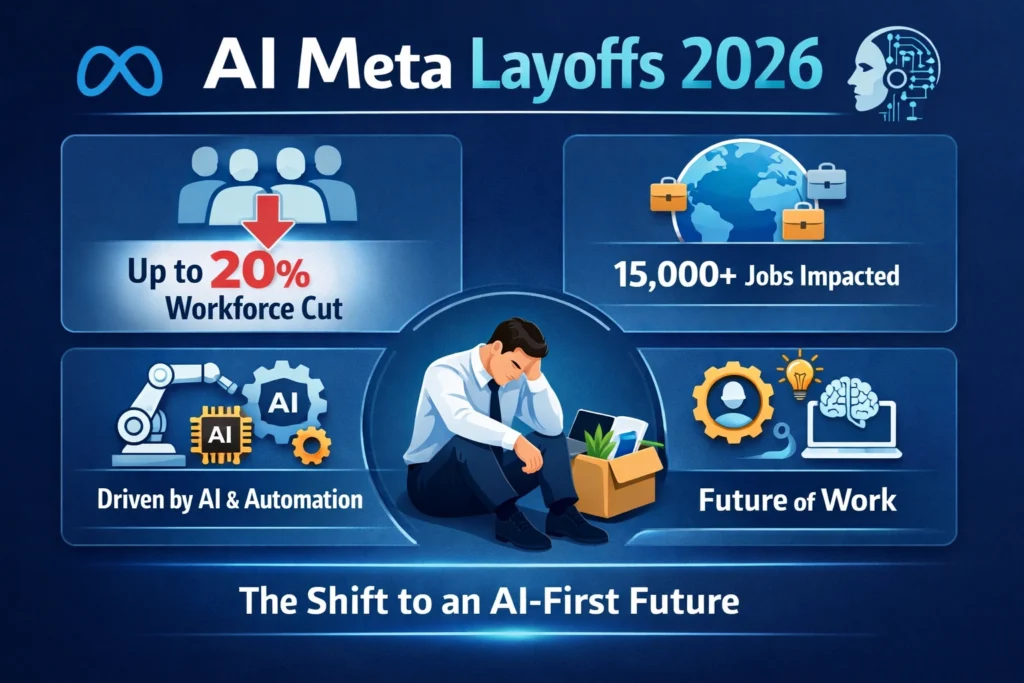
More recent reporting by Reuters reveals that Meta will undergo massive layoffs that could affect approximately 20 per cent of its employees as the company refocuses on artificial intelligence and automation.
Introduction — A Shift in What Layoffs Mean
In the past, job cuts at major tech companies were typically framed around economic downturns, lower revenue, or cost containment due to sluggish markets. But the narrative around Meta’s 2026 layoffs is fundamentally different.
Instead of being purely a response to financial pressure or weak sales, this round of ai meta layoffs is largely about structural transformation — where artificial intelligence and automation are being positioned not just as productivity tools, but as central pillars of the company’s future business model.
That means:
- Less emphasis on traditional hierarchical labor
- More focus on AI‑augmented processes
- A strategic pivot toward entirely new organizational structures
In simple terms: this isn’t just trimming staff — it’s reshaping how Meta thinks about work.
What Exactly Do “AI Meta Layoffs” Mean?
When we speak about AI Meta layoffs, we mean:
Meta is reducing human roles and reorganizing teams so that increasingly sophisticated AI systems take over tasks previously done by people — especially where tasks are repetitive, predictable, or rule‑based.
Instead of layoffs caused by weak performance or lack of demand, this round is centered on AI‑driven efficiency, where machines are gradually absorbing work humans used to do.
This isn’t simply “AI taking jobs.” It’s part of a broader restructure where:
✔ Routine tasks are automated
✔ Human labor is repurposed toward high‑value functions
✔ Lower‑skill roles decline
✔ Demand grows for AI‑centric skills
The Scale of the Layoffs
According to multiple credible reports, including Reuters:
| Detail | Estimate / Observed |
| Estimated Workforce Impact | Up to ~20 % reduction in staff |
| Approximate Jobs Potentially Affected | ~15,000‑16,000 workers |
| Company Focus | AI, automation infrastructure |
| Reason | Adjusting operations around AI, infrastructure costs |
| Reporting Status | Planning phase; date not finalized |
This would be the largest strategic workforce reduction at Meta since its highly publicized cuts in late 2022 and early 2023 — often referred to as its “Year of Efficiency,” when the company reduced roughly 21,000 jobs in total.
Unlike prior layoffs aimed mostly at cost relief, the AI 2026 layoffs are associated with long‑term investment and structural modernization.
What’s Driving Meta’s 2026 Layoffs?
Let’s break down the real reasons behind this significant shift.
1. Enormous AI Investment and Outsized Costs
Meta is committing hundreds of billions of dollars to build out artificial intelligence infrastructure — including massive data centers, supercomputing clusters, and advanced model development.
These projects are extraordinarily expensive, often requiring:
- High‑performance GPUs
- Vast amounts of power and cooling
- Specialized data center facilities
- Large teams of AI researchers and engineers
As these infrastructure bets grow, Meta’s executives appear increasingly inclined to offset part of these rising costs by reorganizing and reducing other internal expenses — including human labor.
This is not unique to Meta. Many other tech companies, like Amazon and Block, have also cited AI or automation as part of the rationale for workforce changes.
2. AI Replacing or Enhancing Human Work
Where once companies hired multiple employees to do repetitive or predictable work, AI tools are now capable of:
✔ Writing basic code
✔ Processing large datasets
✔ Moderating content at a massive scale
✔ Generating reports and insights
✔ Automating workflows and processes
In many scenarios, AI Systems can accomplish these tasks faster and at lower total cost than teams of humans. When this happens, companies like Meta begin to reprioritize the mix of roles, often moving toward hybrid structures where:
AI performs high‑volume tasks
Human workers focus on strategy, creativity, and complex problem-solving
This transition inevitably reduces the need for certain categories of workers.
3. Productivity and Efficiency Goals
Leadership at Meta has explicitly pointed toward productivity per worker as a key future metric — rather than sheer employee count.
The idea is simple:
A smaller workforce powered by sophisticated AI tools may produce more output at lower cost.
This mindset is influencing internal planning and resource allocation — and in turn, ai meta layoffs become part of unlocking that productivity.
The notion is not purely about cost-cutting either; it’s also about redesigning how work gets done.
4. A Strategic Pivot Toward an AI‑First Organization
Meta today has a markedly different mission compared to its early years, focused on social media platforms.
Instead, the company is positioning itself as:
✔ A leader in generative and foundational AI
✔ A builder of advanced automation systems
✔ A provider of next‑generation computing platforms
This repositioning necessitates changes in workforce composition, which inevitably impacts jobs and teams that were more central to Meta’s earlier business models.
A Broader Tech Trend — Not an Isolated Case
Meta isn’t alone.
Across the Technology Industry in 2026, several companies are evaluating workforce restructuring while citing AI investments as part of the rationale.
Examples include:
- Amazon is restructuring roles and cutting jobs
- Block making layoffs tied in part to AI capabilities
- Oracle and other firms are adjusting staffing in light of automation trends
This suggests a broader pattern in big tech: companies are increasingly balancing heavy AI spending with workforce-optimization strategies.
The movement is more than just Meta — it’s part of a technology ecosystem reshaping where and how people work.
Which Jobs Are Most At Risk?
While the specific impact will vary by company and team, generally, certain job types are more vulnerable to AI substitution:
High‑Risk Categories
- Customer support and call center roles
- Data entry and basic data processing
- Junior or repetitive technical jobs
- Conventional content moderation positions
- Basic analytics and reporting roles
These roles tend to be:
✔ Rule‑based
✔ Repetitive
✔ Predictable
Tasks that can be easily described in clear rules or trained on large datasets are much more susceptible to automation.
Why Are These Jobs Vulnerable?
AI systems excel at:
✔ Repeating patterns
✔ Following strict rules
✔ Scaling work without downtime
✔ Processing high volumes of data
Humans, in contrast, are stronger at:
✔ Creative thinking
✔ Complex strategy
✔ Emotional intelligence
✔ Handling ambiguity
When work consists of predictable, high‑volume tasks, AI tools are often more efficient, which reduces the need for human involvement.
The Future of Work After Meta’s Layoff Shift
The employment landscape is not disappearing — it’s evolving.
Here’s how:
1. Growth in High‑Value, AI‑Centric Roles
As companies automate repetitive work, they still need people who can:
✔ Build AI systems
✔ Manage and fine‑tune models
✔ Design complex automation flows
✔ Interpret and oversee AI outputs
Roles likely to grow include:
- AI engineers
- Machine learning specialists
- Prompt engineers
- Data scientists
- Automation architects
This indicates a move toward skill‑intensive roles with deeper technical requirements.
2. Reduction in Middle‑Skill Jobs
The workforce may experience what economists call a hollowing effect:
✔ Low‑skill jobs decline
✔ High‑skill technical roles grow
✔ Middle‑skill positions shrink
This shift can affect income distribution and career paths, making middle‑range roles scarcer relative to high‑ and low‑skill jobs.
3. Companies Expect More Output From Fewer Workers
Future organizations will likely:
✔ Be smaller
✔ Operate more with AI assistance
✔ Emphasize adaptive skills
This raises the value of technical competence, especially in areas tied to AI and automation.
Before vs After — How AI Transforms Organizational Behavior
| Aspect | Before AI | After AI Shift |
| Team Size | Large | Leaner |
| Productivity | Moderate | High |
| Operational Cost | High | Optimized |
| Innovation Speed | Slower | Faster |
| Decision Making | Human‑only | AI‑assisted |
This comparison captures the essence of why companies like Meta are reorganizing around AI.
A Strategic Insight Often Overlooked
Many narratives about corporate layoffs focus only on job losses. But the deeper story is that layoffs — in the context of AI — are also often about:
Creating scalable teams that integrate advanced technology to drive future growth.
In other words:
This isn’t just a “tech failure” or “cost crisis.” It’s an experiment in building a new operational model for technology companies in the AI era.
Hidden Risks of AI‑Driven Layoffs
AI is an enabling technology — but relying too heavily on it in organizational decisions comes with risks:
1. AI Isn’t Perfect
AI systems can make errors — and without human oversight, mistakes can propagate quickly.
Incorrect decisions or faulty outputs can:
✔ Harm reputation
✔ Damage customer trust
✔ Lead to financial loss
Thus, thoughtful human involvement remains critical.
2. Data Privacy and Ethical Challenges
AI Systems often require vast amounts of user data to operate. This raises:
✔ Privacy concerns
✔ Security challenges
✔ Ethical debates about consent and usage
Striking the right balance is essential to safeguard users.
3. Paradox of Over‑Dependence
Relying exclusively on machines can backfire:
✔ AI systems fail
✔ No human backup exists
✔ Bad outcomes get amplified
This underscores the need to pair automation with human judgment.
Evolution of Tech Layoff Trends
We can roughly trace layoff motivations over recent years:
| Year | Layoffs | Dominant Reason |
| 2022 | ~11,000+ | Cost cutting |
| 2023 | ~10,000+ | Efficiency push |
| 2026 | ~15,000+ | AI transformation |
This pattern shows not just layoffs, but a shift in underlying causes from short‑term financial fixes to long‑term structural transformation.
Pros & Cons of AI‑Driven Layoffs
Every major shift has both positive and negative implications.
Pros
- Increased overall efficiency
- Faster innovation cycles
- Lower operational expenses
- Better scalability
- Competitive advantage in AI development
Cons
- Significant job losses
- Short‑term economic uncertainty
- Widening skill gaps
- Ethical issues and privacy concerns
- Potential over‑dependence on automated systems
Key Takeaways
To summarize the major points:
- Meta is planning to potentially cut up to ~20 % of its workforce in 2026 as part of an AI‑focused restructuring.
- The primary driver is not traditional cost-cutting, but reallocating resources toward massive AI investments and productivity optimization.
- This reflects a broader industry shift toward automation and AI‑enabled operations.
- Traditional roles tied to repetitive or predictable tasks are more at risk.
- Meanwhile, demand grows for high‑skill professionals in AI, data, and engineering.
- The labor market isn’t disappearing — it’s transforming.
FAQs
A: Meta’s layoffs in 2026 are linked to its push toward an AI‑centric organizational model — reallocating human labor as its AI tools and infrastructure become more central to operations.
A: Estimates suggest up to ~15,000‑16,000 workers — roughly 20 % of the company’s global workforce.
A: AI isn’t replacing all jobs, but it is being used to automate many tasks once done by humans, changing how teams are structured.
A: Yes — similar restructurings at Amazon, Block, and other tech companies suggest AI‑linked workforce transformation is a bigger trend.
A: Roles involving creativity, advanced strategy, emotional intelligence, and deep technical expertise are least likely to be automated.
Conclusion
The AI‑driven Layoffs at Meta in 2026 mark a pivotal moment in the tech industry. These workforce reductions are not merely cost-cutting measures — they reflect a strategic shift toward an AI-first organizational model, where automation and intelligent systems reshape how work is done. While repetitive and rule-based jobs face the highest risk, new opportunities are emerging for workers skilled in AI, data science, and machine learning.This transformation signals a broader industry trend: companies that adapt to AI and automation will gain efficiency, innovation speed, and competitive advantage, while those that resist may fall behind. For employees, the future requires embracing new skills, staying adaptable, and focusing on roles that complement AI rather than compete with it.