Introduction
The evolution of large language models has Accelerated dramatically, and the transition from Claude 2 to Claude 2.1 represents a meaningful leap forward rather than a minor iteration. While many comparison articles attempt to explain the differences, most remain shallow, fragmented, or overly simplistic—failing to address what truly matters to developers, founders, and advanced users.
If you are:
- A developer evaluating AI APIs for integration
- A startup founder building scalable AI-powered products
- A technical decision-maker comparing model capabilities
- Or a power user seeking optimal performance
Then this comprehensive guide is designed specifically for you.
In this in-depth analysis, we will systematically explore:
- Feature-level distinctions
- API architecture and capabilities
- Practical, real-world applications
- Performance improvements and trade-offs
- A clear decision-making framework
By the end, you won’t just understand the differences—you’ll know exactly which model aligns with your needs.
What Is Claude 2 and Claude 2.1?
Both Claude 2 and Claude 2.1 are advanced large language models engineered for natural language comprehension, logical reasoning, coding assistance, and extended-context processing.
Claude 2
- Released: July 2023
- Context Window: 100K tokens
- Strengths: Reliable reasoning, solid coding support, general-purpose usage
- Limitations: Restricted scalability, weaker long-context retention
Established a strong foundation, particularly for conversational AI and moderate-length document processing.
- Released: November 2023
- Context Window: 200K tokens
- Strengths: Enhanced accuracy, expanded memory capacity, and tool integration
- Improvements: Reduced hallucination rate, advanced system prompts, improved API
Claude 2.1 is not merely an upgrade—it represents a structural enhancement aimed at enabling production-grade AI systems.
Claude 2 vs Claude 2.1: Feature Comparison
Core Differences Table
| Feature | Claude 2 | Claude 2.1 |
| Context Window | 100K tokens | 200K tokens |
| Hallucination Rate | Higher | Significantly lower (~2x reduction) |
| Tool Use | ❌ Not supported | ✅ Supported (beta) |
| System Prompts | Basic | Advanced control |
| API Integration | Limited | Enhanced |
| Efficiency | Moderate | Optimized |
Key Insight: Claude 2.1 effectively doubles memory capacity while simultaneously improving reliability and operational efficiency.
Key Feature Breakdown
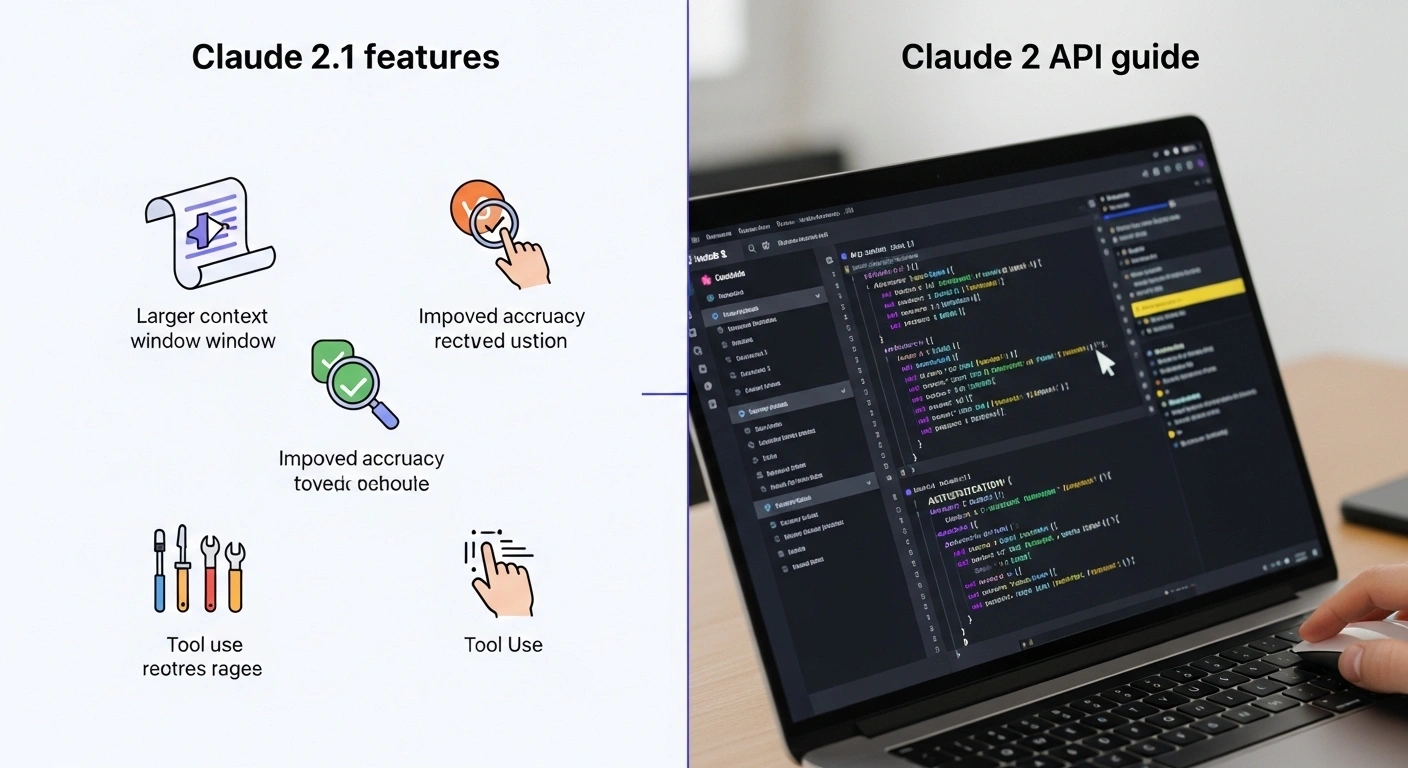
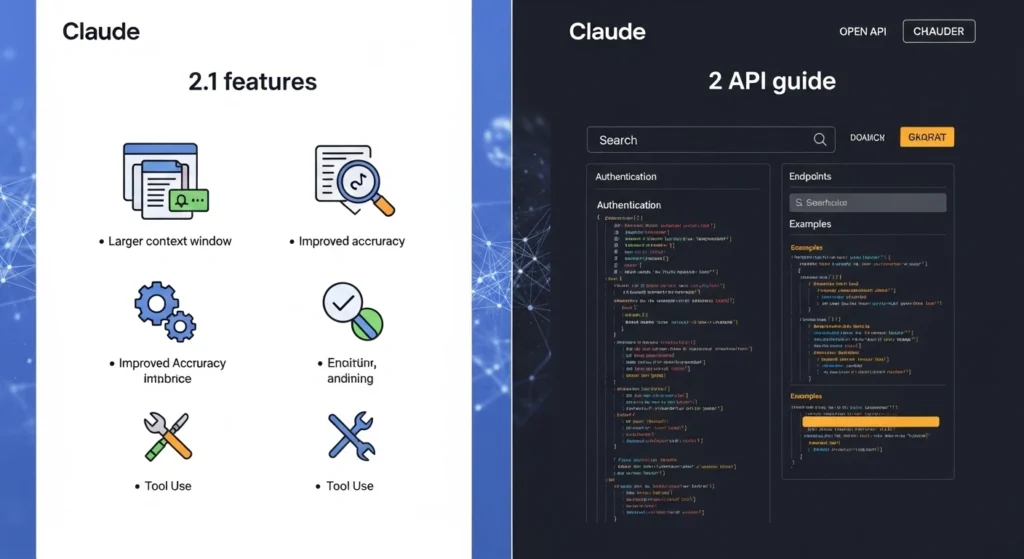
200K Context Window
Claude 2.1 introduces an expanded context window capable of processing extremely large inputs.
This means it can handle:
- Entire books
- Extensive codebases
- Financial statements
- Legal contracts
- Research datasets
Approximately 150,000+ words in a single interaction.
Why This Matters
This enhancement unlocks new possibilities:
- Legal AI platforms are analyzing full case files
- Academic research tools summarizing large papers
- Enterprise analytics systems process bulk data
In contrast, Claude 2 often struggles with truncation and loss of context when handling large inputs.
Reduced Hallucination Rate
One of the most critical improvements in Claude 2.1 is its reduced tendency to generate incorrect or fabricated information.
Claude 2.1 is:
- More cautious
- More transparent
- More likely to admit uncertainty
Practical Impact
- More trustworthy outputs
- Lower risk in professional environments
- Improved factual consistency
This is especially crucial in:
- Healthcare applications
- Financial analysis
- Legal documentation
Tool Use
Claude 2.1 introduces tool usage capabilities, allowing it to interact with external systems.
This includes:
- Function calling
- API requests
- Database queries
- Structured data retrieval
What This Enables
Instead of just generating text, the model can:
- Execute actions
- Retrieve real-time data
- Integrate with software systems
This transforms Claude from a passive responder into an active AI agent.
Advanced System Prompts
System prompts in Claude 2.1 allow developers to define behavior with greater precision.
Developers can now:
- Set tone and personality
- Control response format
- Enforce rules and constraints
- Guide reasoning processes
Why This Is Important
- Consistent outputs
- Better alignment with brand voice
- Improved reliability in production
Claude 2, by comparison, offers only limited control.
Claude API Guide
How Claude API Works
At its core, the Claude API follows a simple interaction pattern:
- Send input prompt
- Process via model
- Receive generated output
However, in Claude 2.1, this pipeline becomes significantly more sophisticated.
Claude 2 API vs Claude 2.1 API
| Capability | Claude 2 API | Claude 2.1 API |
| Context Handling | Moderate | Extensive |
| Tool Integration | ❌ None | ✅ Supported |
| Prompt Control | Basic | Advanced |
| Use Cases | Simple bots | Complex systems |
Example API Use Cases
Claude 2
- Chatbots
- Content writing
- Basic automation
- Lightweight applications
Claude 2.1
- AI copilots
- SaaS platforms
- Workflow automation
- Data-driven applications
- Multi-step reasoning systems
Example Workflow
A typical advanced workflow:
- User submits query
- Model interprets intent
- Selects the appropriate tool
- Executes API call
- Processes response
- Returns structured output
This multi-step orchestration is not possible with Claude 2.
Pricing Comparison
- Claude 2: Higher cost per token
- Claude 2.1: More efficient pricing structure
Key Insight
Even if raw pricing appears similar, Claude 2.1 delivers:
- Better output quality
- Fewer errors
- Reduced need for retries
Result: Lower effective cost
Performance & Benchmarks
Claude 2 already demonstrated strong reasoning capabilities, with benchmarks like MMLU reflecting solid performance.
Claude 2.1 improves upon this by offering:
- Better contextual understanding
- Higher factual accuracy
- Improved long-form coherence
Practical Differences
| Scenario | Claude 2 | Claude 2.1 |
| Short queries | Good | Excellent |
| Long documents | Limited | Exceptional |
| Accuracy | Moderate | High |
| Reliability | Inconsistent | Consistent |
Real-World Use Case Comparison
Research AI
- Claude 2 → Struggles with large documents
- Claude 2.1 → Processes full datasets efficiently
Coding Assistant
- Claude 2 → Capable but limited context
- Claude 2.1 → Better debugging, fewer mistakes
Enterprise AI
- Claude 2 → Not scalable
- Claude 2.1 → Production-ready
Which One Should You Choose?
Choose Claude 2 if:
- You need a simple solution
- You are working on small-scale projects
- You require basic chatbot functionality
- Budget constraints are strict
Choose Claude 2.1 if:
- You need advanced AI capabilities
- You process large volumes of data
- You are building scalable applications
- You require automation and tool integration
For most modern applications, Claude 2.1 is the superior choice.
Hidden Limitations
Claude 2.1 Downsides
- Slightly slower with massive inputs
- Increased implementation complexity
- Tool usage is still evolving
Claude 2 Downsides
- Limited scalability
- No tool integration
- Lower accuracy
Future Outlook
Claude 2.1 introduces foundational elements that define the future of AI:
- Tool integration
- Extended memory
- Controlled behavior
These capabilities are essential for:
- Autonomous AI agents
- Intelligent workflows
- Advanced decision systems
FAQs
A: Claude 2.1 offers improved accuracy, larger context handling, and enhanced API capabilities.
A: It supports function calling through tool usage (currently in beta).
A: Claude 2.1 is more cost-efficient in the long run due to better performance and fewer errors.
A: It can process up to 100K tokens, but struggles compared to Claude 2.1.
Conclusion
After a comprehensive breakdown of features, API capabilities, performance metrics, and real-world applications, the distinction between Claude 2 and Claude 2.1 becomes unmistakably clear.
Claude 2 was a strong and reliable model for its time. It delivered solid reasoning, dependable Conversational abilities, and sufficient performance for basic applications such as chatbots, content generation, and lightweight automation. For smaller projects or simple deployments, it still holds some relevance.
However, Claude 2.1 fundamentally redefines what a modern AI model should be.
With its expanded 200K-token context window, significantly lower hallucination rate, and powerful tool-integration capabilities, Claude 2.1 moves beyond static text generation into the realm of dynamic, intelligent systems. It enables developers to build applications that are not only responsive but also context-aware, action-oriented, and scalable.