Introduction
If you’re evaluating Claude 2.1 vs Claude 2 features, you’re already operating at a more strategic level than most AI users.
At a superficial glance, both models appear nearly identical. They originate from the same AI ecosystem, share comparable pricing structures, and deliver robust reasoning capabilities. However, when you examine them more critically, the distinctions become substantial—especially for developers, enterprises, analysts, and researchers working with complex workflows.
Claude 2.1 is not merely an incremental enhancement. It represents a significant evolution toward:
- Extended context intelligence
- Improved factual precision
- Enterprise-grade dependability
In 2026, this distinction is critical. Artificial intelligence is no longer just a productivity tool—it has become deeply embedded in operational systems, decision-making pipelines, and large-scale digital infrastructures.
Whether you are:
- Writing and optimizing code
- Interpreting large datasets
- Developing AI-powered applications
The model you select will directly influence your efficiency, accuracy, scalability, and overall output quality.
What You’ll Learn in This Guide
Detailed feature-by-feature breakdown
Real-world performance evaluation
Practical applications beyond theory
Overlooked limitations competitors ignore
Clear recommendations tailored to your needs
Claude 2 vs Claude 2.1 — Quick Comparison Table
| Feature | Claude 2 | Claude 2.1 |
| Release Date | July 2023 | November 2023 |
| Context Window | 100K tokens | 200K tokens |
| Output Length | ~4K tokens | ~4K tokens |
| Hallucination Rate | Moderate | Reduced |
| Long Document Handling | Degrades after ~70K | Stable up to ~200K |
| Pricing | Comparable | Comparable |
| Safety Alignment | Balanced | More refined |
| Enterprise Readiness | Moderate | High |
Key Insight: Claude 2.1 effectively doubles the context capacity while significantly improving reliability and consistency in real-world scenarios
What is Claude 2?
Overview
Claude 2 is a versatile AI language model engineered for general-purpose usage. It gained widespread adoption due to its introduction of a 100K token context window, which was considered groundbreaking at launch.
What Claude 2 Can Do
- Natural language comprehension
- Code generation and debugging
- Document summarization
- Conversational interaction
Key Strengths of Claude 2
Large Context (For Its Era)
Claude 2 pioneered long-context processing, enabling users to analyze extensive documents without excessive segmentation.
Strong Analytical Reasoning
It performs well in logical problem-solving, structured thinking, and programming-related tasks.
Flexible Output Generation
Compared to newer models, it allows more creative freedom and less restrictive responses.
Limitations of Claude 2
Context Degradation in Long Inputs
Performance begins to decline after approximately 70K tokens, leading to reduced coherence.
Higher Hallucination Frequency
It occasionally produces confident but inaccurate or fabricated responses.
Limited Enterprise Stability
Not fully optimized for large-scale, mission-critical workflows.
Best For:
- General-purpose tasks
- Medium-length content creation
- Creative writing and ideation
What is Claude 2.1?
Overview
Claude 2.1 is a substantial upgrade engineered for enhanced accuracy, scalability, and operational reliability in real-world environments.
Core Improvements
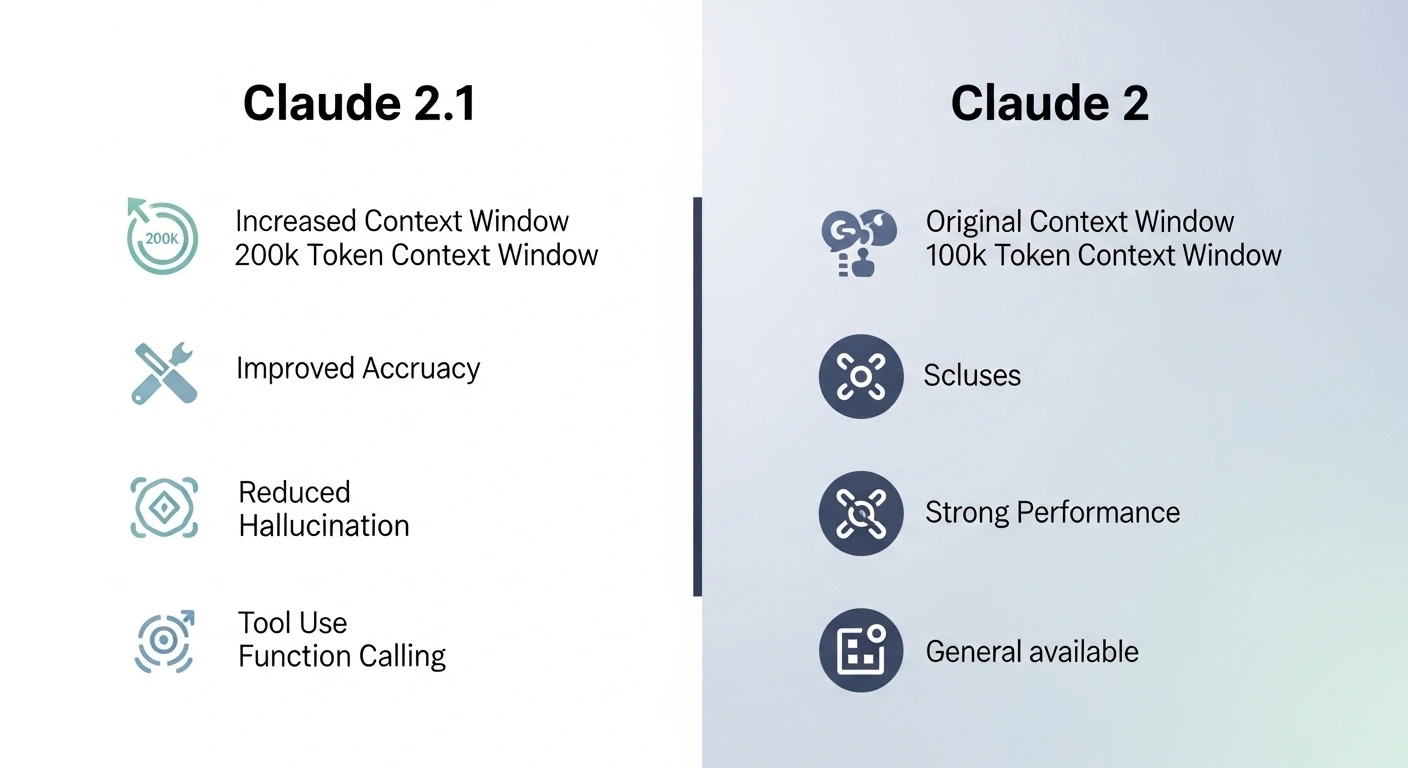
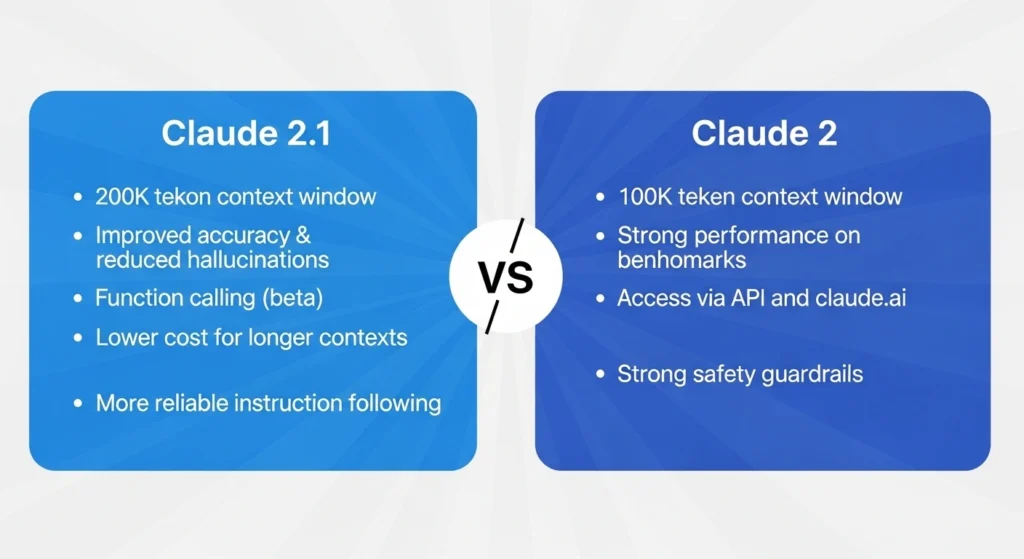
- 200K token context window
- Reduced hallucination rates
- Improved instruction adherence
- Enhanced safety alignment
What Makes Claude 2.1 Different
Claude 2.1 is purpose-built for:
- Enterprise-grade workflows
- Legal and financial analysis
- Large-scale AI deployments
Why It Matters
Claude 2.1 can process hundreds of pages within a single prompt.
This enables:
- No need to split documents
- Minimal context loss
- More coherent and holistic insights
Best For:
- Academic and industrial research
- Business intelligence workflows
- Large-scale data processing
Deep Feature Comparison
Context Window
Claude 2
- 100K tokens
Claude 2.1
- 200K tokens
Why This Matters (Critical Insight)
This is not merely a numerical upgrade—it fundamentally transforms how AI can be utilized.
With Claude 2.1, users can:
Analyze complete books
Process entire code repositories
Manage multi-document workflows seamlessly
Real-World Example
- Legal professionals reviewing contracts
- Researchers are synthesizing multiple academic papers
Key Insight:
Claude 2 begins to lose consistency beyond ~70K tokens, while Claude 2.1 maintains coherence across significantly larger contexts.
Accuracy & Hallucination Reduction
Claude 2 Challenges
- Generates incorrect but confident answers
- Weak citation reliability
Claude 2.1 Improvements
- Stronger grounding in input data
- Lower hallucination probability
- More dependable outputs
Why This Is Essential
These improvements are critical in domains such as:
- Financial reporting
- Legal documentation
- Medical analysis
Simple Reality:
Inaccurate AI outputs can lead to serious real-world consequences.
Claude 2.1 significantly mitigates this risk.
Long-Context Reasoning
Claude 2
- Struggles to retain the earlier context
- Limited cross-referencing ability
Claude 2.1
- Maintains context across extended inputs
- Connects ideas more effectively
Impact
Improved research workflows
More accurate summarization
Stronger analytical insights
2026 Perspective:
Modern AI applications rely on large-scale data processing, not short prompts.
Safety & Alignment Differences
Claude 2
- More flexible responses
- Less strict moderation
Claude 2.1
- Improved refusal handling
- Safer, more controlled outputs
- Enhanced alignment with policies
Trade-Off
Better for enterprise environments
Slightly reduced creative freedom
Reality Check:
Organizations prioritize safety, compliance, and reliability over unrestricted creativity.
Performance & Benchmarks
Claude 2
- MMLU score ~78.5
- Strong baseline performance
Claude 2.1
- Limited public benchmarks
- Superior real-world performance
Important Insight
Benchmarks fail to measure:
- Long-context reasoning
- Workflow efficiency
- Real-world usability
Conclusion:
Claude 2.1 outperforms Claude 2 in practical scenarios.
Pricing Comparison
Both models maintain similar pricing structures.
Cost Efficiency Insight
Claude 2.1 is more cost-efficient because:
Fewer prompts required
Reduced repetition
Higher accuracy per query
Result:
Improved productivity and lower operational costs.
Real-World Use Case Comparison
For Developers
| Use Case | Claude 2 | Claude 2.1 |
| Small scripts | Good | Excellent |
| Large codebases | Limited | Strong |
| Debugging | Good | Superior |
Claude 2.1 can analyze entire repositories without fragmentation.
For Researchers
| Use Case | Claude 2 | Claude 2.1 |
| Paper summaries | Good | Excellent |
| Multi-paper synthesis | Weak | Strong |
| Large datasets | Limited | Advanced |
Content Creators
| Task | Claude 2 | Claude 2.1 |
| Blog writing | Flexible | Precise |
| Creative writing | Better | Slightly restricted |
| Fact-based content | Good | Excellent |
For Businesses (2026 Focus)
Claude 2.1 is ideal for:
- Compliance auditing
- Financial modeling
- Enterprise documentation
Why Businesses Prefer Claude 2.1
Higher accuracy
Better scalability
Stronger safety controls
Pros and Cons
Claude 2 Pros
Flexible responses
Strong reasoning capabilities
Suitable for general applications
Claude 2 Cons
Limited context capacity
Higher hallucination rate
Weak long-document performance
Claude 2.1 Pros
200K token context window
Improved accuracy
Reduced hallucinations
Enterprise-grade reliability
Claude 2.1 Cons
More restrictive outputs
Limited benchmark transparency
How to Use These AI Models Effectively
Best Practices
Provide clear, structured instructions
Include complete context whenever possible
Break complex tasks into manageable steps
Always validate outputs
Pro Tip (Critical Insight)
With Claude 2.1:
Upload comprehensive datasets
Request cross-document insights
This maximizes its full potential.
Tips to Write Better AI Prompt
Good Prompt Example
“Summarize key financial risks from this report in structured bullet points with supporting examples.
Bad Prompt Example
“Explain this document.
Golden Rules
Be explicit and precise
Add constraints and structure
Provide examples
Avoid vague or ambiguous instructions
Better prompts lead to higher-quality outputs.
Hidden Limitations Competitors Ignore
Context Does Not Equal Perfect Memory
Even with 200K tokens, limitations still exist.
Accuracy Still Requires Validation
Claude 2.1 is more reliable—but not infallible.
Safety Can Restrict Creativity
Higher alignment often reduces creative flexibility.
Key Insight:
Effective AI usage requires a combination of automation and human oversight.
Which One Should You Choose?
Choose Claude 2.1 if you need:
Long-document processing
High accuracy outputs
Enterprise-grade workflows
Advanced research capabilities
Choose Claude 2 if you need:
Simpler tasks
Creative writing flexibility
Less restrictive outputs
Final Verdict
Is not just an upgrade—it represents a paradigm shift in AI capability.
Remains useful for lighter tasks, but it struggles in areas that are critical in 2026:
- Large-scale data processing
- Long-context reasoning
- Accuracy under complexity
Claude 2.1 clearly dominates in these domains.
Bottom Line
If you are serious about leveraging AI in 2026:
Claude 2.1 is the superior choice.
FAQs
A: Especially for long-context tasks, accuracy, and enterprise applications.
A: The 200K token context window is double that of Claude 2.
A: Both models have similar pricing.
A: Claude 2.1 performs better, especially with large codebases.
A: It significantly improves output accuracy.
Suggested Internal Linking Topics
- Best AI tools for developers (2026)
- Complete the Claude AI guide
- GPT vs Claude comparison
- AI tools for business workflows
- Advanced prompt engineering techniques
Conclusion
Selecting between Claude 2 and Claude 2.1 ultimately depends on your specific requirements.
If your tasks are Relatively simple, Claude 2 remains a viable option.
However, if your work involves:
- Large datasets
- Complex research workflows
- Enterprise-level applications
Claude 2.1 is the more intelligent and future-proof choice.