Introduction
In 2026, the artificial intelligence (AI) ecosystem, especially in natural language processing, is advancing at an unprecedented velocity. Developers, data scientists, and organizations are continuously seeking models that merge high computational efficiency, contextual intelligence, and operational affordability. Claude Haiku 4.5, the latest lightweight transformer-based model from Anthropic, has emerged as a strategic asset for organizations needing rapid, real-time AI insights without incurring the premium costs typical of larger LLMs like Sonnet 4.5 or Opus 4.5.
Whether your enterprise is developing AI-powered customer engagement systems, multi-agent orchestration frameworks, or context-aware coding assistants, Haiku 4.5 delivers near-frontier capabilities while optimizing for latency, scalability, and cost-efficiency. This exhaustive guide covers architectural insights, performance characteristics, token economics, multi-agent orchestration, use cases, and practical benchmarks of Claude Haiku 4.5, providing developers and businesses with all the insights required to make data-driven AI decisions.
What Is Claude Haiku 4.5?
Claude Haiku 4.5 is a lightweight, high-throughput model within the Claude 4.5 family, architected specifically for tasks requiring minimal latency, large context comprehension, and economical inference costs. Unlike larger, computation-intensive models, Haiku 4.5 excels in real-time response generation, making it ideal for applications where instantaneous decisions are critical.
Key Highlights:
- Extensive Context Understanding: 200,000-token context window for extended dialogue management or document-level comprehension.
- High Output Capacity: Generates responses up to ~64,000 tokens, suitable for exhaustive reasoning or multi-turn dialogue.
- AI Safety & Alignment: Certified ASL-2, ensuring outputs align with ethical standards.
- Multi-Agent Orchestration: Supports parallel agentic workflows for automation, scraping, or complex reasoning.
- Efficient Approximation: Delivers ~90% of Sonnet 4.5’s reasoning and coding capabilities at a significantly reduced cost.
Haiku 4.5 represents a fusion of speed, affordability, and near-frontier intelligence, making it one of the most versatile engines for enterprise-scale deployment in 2026.
Key Features of Claude Haiku 4.5
Computational Efficiency & Throughput
Claude Haiku 4.5 is optimized for high-performance pipelines, providing up to 2x the speed of Sonnet 4.5 while maintaining contextual fidelity. Its low-latency design is particularly effective for:
- Customer-facing AI chatbots requiring sub-second response generation
- Real-time code suggestion engines for development teams
- Automated multi-agent orchestration pipelines for enterprise workflows
Despite being computationally lightweight, Haiku 4.5 maintains robust language understanding, ensuring that speed does not Compromise semantic accuracy or reasoning depth.
Near-Frontier Performance
While engineered for efficiency, Haiku 4.5 retains ~90% of the logical reasoning, code synthesis, and text comprehension capabilities of Sonnet 4.5. Its architectural optimizations allow it to perform advanced tasks, such as:
- Context-aware code generation and debugging
- Automated content summarization and expansion
- Large-scale data extraction, sentiment, and entity recognition
This trade-off between size and capability makes Haiku 4.5 a perfect solution for high-volume real-time tasks without excessive computational expenditure.
Extended Token Handling
- Context Window: 200,000 tokens enables handling entire books, extensive transcripts, or multi-turn dialogue histories.
- Output Capacity: ~64,000 tokens, ideal for long-form content generation, technical reports, or combined agent workflows.
Large token handling is essential for document-level batch reasoning and multi-agent orchestration, where cumulative context matters for accuracy.
Enhanced Safety & Ethical Alignment
Claude Haiku 4.5 incorporates AI Safety Level 2 (ASL-2) mechanisms, including contextual bias detection, ethical output filtering, and alignment protocols. This makes the model production-ready for enterprise applications where responsible AI deployment is critical.
Multi-Agent Orchestration & Automation
Haiku 4.5 can coordinate multiple autonomous AI agents in parallel, which is invaluable for:
- Complex GUI automation and process orchestration
- Web scraping and data aggregation workflows
- Multi-step reasoning pipelines
This multi-agent orchestration capability reduces manual oversight, accelerates task execution, and simplifies scalable AI deployment, making it ideal for enterprise-grade infrastructures.
Pricing Breakdown
Claude Haiku 4.5 remains one of the most cost-effective solutions in 2026, offering high-throughput capabilities without premium pricing:
| Metric | Cost | Notes |
| Input Tokens | $1 / million tokens | Affordable for large-scale inference |
| Output Tokens | $5 / million tokens | Optimized for detailed generation |
| Prompt Caching | Up to 90% savings | Reuse repeated prompts to reduce costs |
| Batch Processing | ~50% discount | Reduces operational expenditure |
Comparison with Other Claude Models
| Model | Input Cost | Output Cost | Optimal Use Case |
| Haiku 4.5 | $1 | $5 | Real-time, coding, high-volume tasks |
| Sonnet 4.5 | $3 | $15 | Complex reasoning, multi-agent orchestration |
| Opus 4.5 | $5 | $25 | Advanced research, multi-modal simulations |
Haiku 4.5 strikes a balance between performance, token handling, and cost, making it attractive for startups and high-volume users.
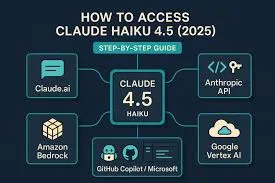
“Explore Claude Haiku 4.5 2026’s high-speed, cost-efficient model for real-time AI, multi-agent workflows, and extended token processing.”
Haiku 4.5 vs Other Claude Models
| Feature | Haiku 4.5 | Sonnet 4.5 | Opus 4.5 |
| Speed | Fastest | Balanced | Moderate |
| Context Window | 200k | 200k | 250k |
| Output Tokens | 64k | 128k | 200k |
| AI Safety | ASL-2 | ASL-2 | ASL-3 |
| Best Use Case | Real-time apps, coding | Complex reasoning, agent orchestration | Research, simulation, advanced workflows |
| Cost | Low | Mid-range | High |
This comparative analysis illustrates Haiku 4.5’s optimized Efficiency in cost, speed, and near-frontier performance.
Use Cases That Excel
Real-Time Customer Support Chatbots
Haiku 4.5 ensures fast, coherent, and contextually aligned responses for high-volume customer support operations, minimizing latency and operational costs.
AI-Powered Coding Assistants
- Delivers real-time coding suggestions and debugging insights
- Supports pair programming and collaborative prototyping
- Achieves ~90% of Sonnet 4.5’s coding capabilities
Multi-Agent Automation
- Orchestrates multiple workflow agents concurrently
- Reduces manual task execution
- Accelerates repetitive, rule-based, or procedural tasks
Scalable Operations
- Handles massive token inputs efficiently
- Supports batch processing and caching
- Enables enterprise-scale deployments without high cost
Pros & Cons
Pros:
- Ultra-fast inference with low operational cost
- Supports extensive context windows
- Robust multi-agent orchestration
- Near-frontier reasoning and coding capabilities
- Cost-efficient for high-volume or startup deployments
Cons:
- Slightly lower performance than Sonnet 4.5 for high-complexity reasoning
- Maximum output tokens lower than Opus 4.5
- Limited for advanced research or multi-modal AI tasks
Technical Specifications
| Specification | Details |
| Model Type | Lightweight Claude 4.5 family |
| Context Window | 200,000 tokens |
| Max Output | ~64,000 tokens |
| Input Cost | $1 / million tokens |
| Output Cost | $5 / million tokens |
| Safety Level | ASL-2 |
| Optimal Use | Real-time, coding, multi-agent orchestration |
| Deployment | API, Cloud-based |
Real-World Applications
E-commerce Chatbots
- Manages 10k+ concurrent queries seamlessly
- Reduces response latency, improving customer satisfaction
Developer Tooling
- Provides context-aware code completion
- Offers debugging and recommendation assistance
Multi-Agent Automation
- Executes batch workflows across multiple services
- Coordinates parallel agent execution for efficiency
FAQs
A: Haiku 4.5 emphasizes low-latency inference, cost efficiency, and multi-agent orchestration, whereas Sonnet 4.5 is optimized for complex reasoning, extensive output generation, and advanced tasks.
A: It achieves ~90% of Sonnet 4.5’s code synthesis and reasoning performance, suitable for AI-assisted development and debugging workflows.
A: Through prompt caching (reuse of repeated prompts) and batch processing, effectively lowering both input and output token expenditure.
A: It is ASL-2 certified, guaranteeing responsible, aligned, and safe outputs for enterprise deployments.
A: It can handle parallel execution of multiple or task-specific agents, reducing manual intervention and improving throughput.
A: E-commerce, software engineering, automation, customer service, and research operations benefit from its large context handling, speed, and cost efficiency.
Conclusion
Claude Haiku 4.5 delivers a harmonious balance of speed, performance, and operational affordability. Its extended token comprehension, multi-agent orchestration, and near-frontier reasoning make it ideal for developers, startups, and enterprises seeking scalable real-time capabilities.
For real-time AI interactions, intelligent coding assistance, or Automated workflows, Haiku 4.5 represents a strategic, cost-efficient solution in 2026.