Introduction
In 2026, artificial intelligence has completely changed the way software engineers, product teams, and Companies build systems. Large language models or LLMs are now a part of the process, making things much more productive. They are no longer just new and experimental. Are being used for important tasks, from suggesting code completions to creating application frameworks on their own. LLMs have become tools for getting things done.
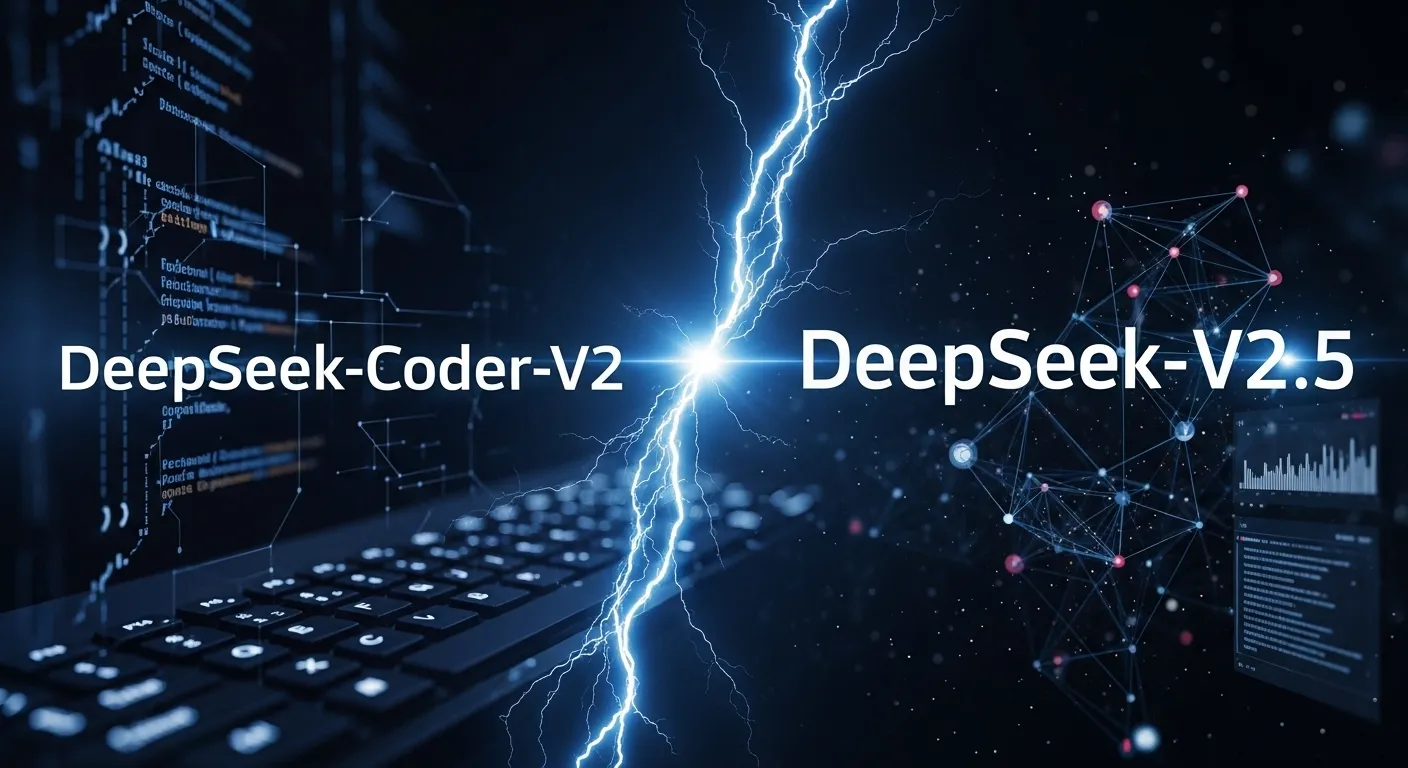
Among the most advanced open models available today are:
- DeepSeek-Coder-V2
- DeepSeek-V2.5
Yet they are architected with different optimization philosophies.
So the essential question becomes:
Should you deploy the specialized programming-centric engine (DeepSeek-Coder-V2)?
OR
The unified multi-domain intelligence system (DeepSeek-V2.5)?
This in-depth developer guide provides a comprehensive, technically grounded, informed comparison designed for engineers, AI architects, CTOs, and enterprise decision-makers.
We will break down:
- Architectural distinctions
- Training corpus composition
- Coding benchmarks (explained clearly)
- Context window behavior and token dynamics
- Real-world workflow simulations
- Deployment economics
- Strengths and limitations
- Use-case mapping
- Enterprise recommendations
- Future outlook (2026–2027)
By the conclusion, you will have a definitive understanding of which model aligns with your computational objectives and operational infrastructure.
Why DeepSeek-Coder-V2 vs DeepSeek-V2.5 Matters in 2026
The AI ecosystem in 2026 has bifurcated into two principal paradigms:
Specialized AI Architectures
These models are purpose-built for a singular domain and heavily optimized for peak performance within that domain.
Unified General-Purpose AI Systems
These architectures are trained to perform across heterogeneous tasks — coding, reasoning, summarization, dialogue, and analysis — within one consolidated framework.
This comparison perfectly encapsulates that tradeoff:
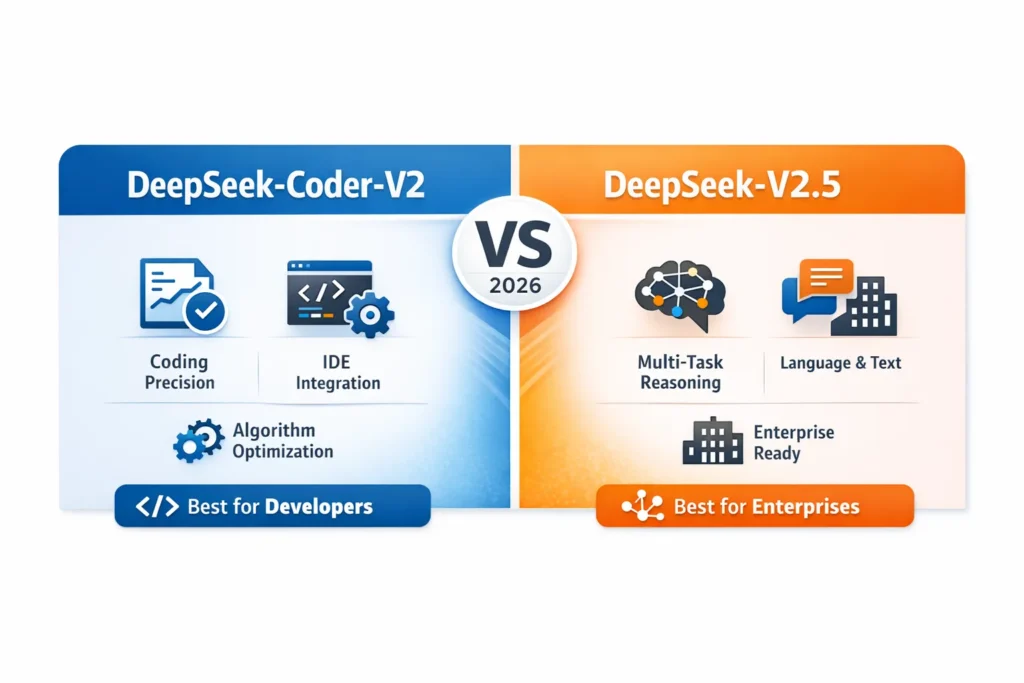
| Specialized (Coder-V2) | Unified (V2.5) |
| Maximum programming precision | Balanced cross-domain capability |
| Strong algorithmic optimization | Advanced reasoning & instruction alignment |
| IDE-level integration | Organization-wide deployment |
Selecting the wrong architecture can result in:
- Increased infrastructure expenditure
- Higher API orchestration complexity
- Engineering inefficiencies
- Reduced performance-to-cost ratio
Therefore, this guide moves beyond Superficial feature listings and dives into level distinctions.
What Is DeepSeek-Coder-V2?
DeepSeek-Coder-V2 is a domain-specialized large language model engineered primarily for software development and structured code generation.
It is designed to excel in:
- Code synthesis
- Auto-completion
- Debugging
- Refactoring
- Competitive programming
- Algorithmic reasoning
- Structured syntax modeling
Core Architectural Characteristics
DeepSeek-Coder-V2 exhibits:
- Code-first training distribution
- Syntax-aware token optimization
- Large context window
- Enhanced AST (Abstract Syntax Tree) representation learning
- Lower structural hallucination frequency
- Deterministic formatting consistency
It supports multiple languages, including:
- Python
- JavaScript
- TypeScript
- C++
- Go
- Rust
- Java
- SQL
In simplified terms:
If software engineering constitutes your primary workflow, this model was architected specifically for that function.
What Is DeepSeek-V2.5?
DeepSeek-V2.5 represents a unified multimodal reasoning architecture. Rather than concentrating solely on programming, it integrates diverse task domains within one model.
It combines:
- Conversational AI
- Instruction-following intelligence
- Logical reasoning
- Coding capability
- Text summarization
- Research interpretation
- Business documentation
Instead of being code-dense, it is linguistically and cognitively balanced.
Ideal for:
- Writing + coding hybrid workflows
- Business teams
- Research environments
- Multi-department organizations
- Cross-functional AI systems
In straightforward language:
This is an “all-in-one AI cognition engine.”
DeepSeek-Coder-V2 vs DeepSeek-V2.5: Quick Comparison Table
| Feature | DeepSeek-Coder-V2 | DeepSeek-V2.5 |
| Primary Objective | Programming-centric | Unified intelligence |
| Training Emphasis | Code-heavy corpora | Mixed code + language |
| Coding Benchmarks | Higher in pure code tasks | Slightly lower |
| Instruction Alignment | Moderate | Strong |
| General Reasoning | Limited | Advanced |
| Context Window | Very large | Large |
| Deployment Strategy | Separate coding endpoint | Unified endpoint |
| Best For | Developers & AI coding tools | Enterprises & multi-task teams |
Architecture & Training Differences
Training Data Distribution
DeepSeek-Coder-V2 Training Composition
The training corpus heavily emphasizes:
- Public open-source repositories
- Algorithm challenge datasets
- Structured programming samples
- Competitive coding problems
- Code-dense documentation
This dense syntactic exposure enables:
- Strong grammar adherence
- Structural integrity
- Improved edge-case handling
- Reduced probabilistic formatting Deviations
DeepSeek-V2.5 Training Composition
DeepSeek-V2.5 blends:
- Programming corpora
- Academic research papers
- Conversational dialogue datasets
- Instruction-tuned prompts
- Business and enterprise writing
This multi-distribution exposure enhances:
- Cross-domain contextual reasoning
- Natural language coherence
- Instruction compliance
- Adaptive tone generation
Optimization Philosophy
DeepSeek-Coder-V2 Is Optimized For:
- Syntax precision
- Compiler-friendly token sequences
- Deterministic output formatting
- Structural dependency tracking
- Error minimization in code blocks
DeepSeek-V2.5 Is Optimized For:
- Multi-task generalization
- Contextual comprehension
- Semantic reasoning
- Instruction-following alignment
- Explanation clarity
Simple Analogy
DeepSeek-Coder-V2 = Specialist surgeon performing high-precision operations.
DeepSeek-V2.5 = Experienced general physician handling diverse medical needs.
Real-World Coding Performance Breakdown
Benchmarks alone do not provide a complete representation of model efficacy. Real-world simulations reveal operational behavior.
Scenario 1: Large Codebase Refactoring
Example:
- 15,000+ lines
- Multi-module backend architecture
- Dependency mapping
- API restructuring
DeepSeek-Coder-V2 Performance
Maintains structural hierarchy
Preserves logical flow
Minimizes regression errors
Consistent formatting
Better cross-file reference handling
DeepSeek-V2.5 Performance
Strong architectural comprehension
Clear refactor explanation
Slightly less rigid structure preservation
Winner: DeepSeek-Coder-V2
Scenario 2: Full-Stack Application Generation
Prompt Example:
“Build a full-stack Next.js application with authentication and REST API routes.”
DeepSeek-V2.5 Advantages
Logical project breakdown
Step-by-step explanation
Setup guidance
Documentation clarity
Instruction adherence
DeepSeek-Coder-V2 Behavior
Produces syntactically clean code
Minimal architectural narrative
Less instructional scaffolding
Winner: DeepSeek-V2.5
Scenario 3: Competitive Programming & Algorithms
For:
- LeetCode-style challenges
- Time complexity optimization
- Space complexity reduction
- Edge-case robustness
DeepSeek-Coder-V2 demonstrates:
- Higher Pass@K probability
- More optimal algorithmic outputs
- Better constraint satisfaction
- Strong corner-case detection
Winner: DeepSeek-Coder-V2
Coding Benchmarks Explained
Many articles present raw metrics without explanation. Let’s interpret them.
Code Generation Accuracy
Measures whether generated code:
- Compiles successfully
- Executes correctly
- Produces expected output
DeepSeek-Coder-V2 typically exhibits marginally higher deterministic accuracy.
Pass@K Metric
Definition:
If a model generates K attempts, what is the probability that at least one attempt solves the problem correctly?
Higher Pass@K = Better exploratory solution diversity.
DeepSeek-Coder-V2 often outperforms in code-centric evaluations.
Instruction Compliance
Example constraints:
- “Use recursion only.”
- “Avoid external libraries.”
- “Do not modify function signature.”
DeepSeek-V2.5 demonstrates stronger adherence to such constraints.
Context Window Behavior & Token Efficiency
Context window capacity determines how much information the model can process simultaneously.
DeepSeek-Coder-V2:
- Optimized for long code sequences
- Handles multi-file inputs efficiently
- Maintains syntactic cohesion
DeepSeek-V2.5:
- Handles mixed text + code contexts
- Preserves conversational continuity
- Better narrative memory retention
In extended enterprise prompts combining policy, documentation, and code, V2.5 demonstrates more stable coherence.
Strengths & Weaknesses
DeepSeek-Coder-V2 – Advantages
- Superior code precision
- Strong algorithmic optimization
- IDE-ready output
- Reduced hallucinated syntax
- Efficient token utilization for code
DeepSeek-Coder-V2 – Limitations
- Less conversational fluency
- Minimal explanation depth
- Not optimized for academic summarization
- Requires well-structured prompts
DeepSeek-V2.5 – Advantages
- Balanced performance spectrum
- Advanced reasoning capability
- Strong explanation generation
- Unified deployment simplicity
- High instruction alignment
DeepSeek-V2.5 – Limitations
- Slightly lower extreme coding benchmarks
- Verbose output tendency
- Less hyper-specialized debugging capability
Pricing & Deployment Considerations
Both models are open-weight and commonly hosted via:
- Hugging Face
- Self-hosted GPU clusters
- Enterprise AI platforms
Cost variables include:
- GPU type (A100, H100 class)
- Throughput requirements
- Token consumption
- Fine-tuning overhead
- Self-host vs Managed API
Deployment Comparison Table
| Factor | Coder-V2 | V2.5 |
| GPU Demand | High | High |
| Infrastructure Complexity | Medium | Lower |
| Token Efficiency | High for code | Balanced |
| Enterprise Scalability | Dev-team centric | Organization-wide |
Use Case Recommendations
Choose DeepSeek-Coder-V2 If:
- You are building AI coding assistants
- You manage algorithm-heavy workflows
- You integrate into IDEs
- You operate coding SaaS products
- You maintain large repositories
Choose DeepSeek-V2.5 If:
- You want a unified AI infrastructure
- Your teams mix writing + coding
- You require strong reasoning
- You generate documentation frequently
- You prioritize simplified deployment
Enterprise Perspective
Enterprise environments prioritize:
- Stability
- Scalability
- Compliance
- Cost-efficiency
- Maintainability
If maintaining separate AI stacks increases architectural fragmentation, DeepSeek-V2.5 simplifies system topology.
However, companies building developer tools gain competitive differentiation from DeepSeek-Coder-V2’s specialization.
Future Outlook
The trajectory suggests:
- Unified models improving programming depth
- Specialized coding models enhancing reasoning
- Hybrid ensemble architectures are emerging
Nevertheless, specialization continues to outperform in deeply technical domains.
FAQs
A: Not universally. V2.5 is more versatile. Coder-V2 is stronger in pure programming tasks.
A: If coding is your main workflow, DeepSeek-Coder-V2 is usually better.
A: Slightly in benchmark-heavy scenarios, but for most real-world projects, the difference is small.
A: With proper GPU infrastructure and optimization, both scale effectively.
A: Fine-tuning depends on your deployment stack and available compute.
Conclusion
When comparing DeepSeek-Coder-V2 vs DeepSeek-V2.5, the decision ultimately depends on workload specialization vs unified intelligence strategy.
Both models from DeepSeek are powerful, scalable, and enterprise-capable — but they are optimized for different objectives.
If Your Priority Is Maximum Coding Precision
Choose DeepSeek-Coder-V2 if:
- Your primary workload is software development
- You build AI coding assistants or IDE integrations
- You work with complex algorithms or competitive programming
- You manage large, multi-file repositories
- You require strict syntax integrity and lower structural hallucination
DeepSeek-Coder-V2 remains superior in:
- Pure code generation accuracy
- Pass@K performance in programming benchmarks
- Edge-case handling
- Deterministic Formatting
For developer-centric teams, it delivers measurable productivity gains and cleaner outputs.