Introduction
Artificial Intelligence is expanding at an Unprecedented pace—arguably faster than any technological transformation in modern history. From intelligent chatbots and predictive automation to enterprise-level data systems, AI is redefining how individuals operate, businesses scale, and investors allocate capital.
Among the emerging names gaining massive traction in this ecosystem is DeepSeek.
If you’ve recently searched for “how to invest in DeepSeek,” you’re certainly not alone. Thousands of investors across Europe, Asia, and global markets are actively exploring opportunities to gain exposure to this rapidly evolving AI company.
However, here’s the reality that many websites either obscure or fail to clarify effectively:
You cannot invest in DeepSeek directly in 2026.
There is no publicly traded stock, no ticker symbol, and no direct retail access available at this time.
But here’s the critical insight most beginner guides miss:
The absence of direct access does NOT mean the opportunity is gone.
In fact, experienced investors often generate returns by positioning themselves around emerging trends rather than chasing unavailable assets.
In this comprehensive 2026 investment guide, you will discover:
- Whether DeepSeek is likely to launch an IPO
- Strategic methods to invest indirectly in DeepSeek-related growth
- The most promising AI stocks and ETFs to evaluate
- Hidden risks that inexperienced investors frequently overlook
- A step-by-step framework to build a resilient AI-focused portfolio
By the end of this guide, you’ll have a clear, actionable roadmap to capitalize on the AI revolution—even without owning DeepSeek equity.
What Is DeepSeek?
DeepSeek is a China-based artificial intelligence enterprise specializing in the development of advanced and cost-efficient AI models, particularly within the domain of Large Language Models (LLMs).
These models are designed to rival some of the most sophisticated AI systems globally, while maintaining a strong emphasis on efficiency and scalability.
Key Highlights
- Primary Focus: Large Language Models (LLMs)
- Core Advantage: Cost optimization in AI training
- Strategic Goal: Disrupt traditional AI pricing models
- Ownership Structure: Privately held
Unlike many AI startups that rely heavily on venture capital, DeepSeek is reportedly backed by a quantitative hedge fund, giving it a distinct operational and financial structure.
This differentiates it significantly from organizations such as OpenAI or Google DeepMind, which follow alternative funding and governance models.
Why DeepSeek Matters in 2026
DeepSeek is not merely another entrant in the AI race—it represents a structural shift in how artificial intelligence is engineered, deployed, and monetized.
Key Reasons
Lower-Cost AI Infrastructure
Most AI firms allocate billions of dollars toward training large-scale models. DeepSeek, however, prioritizes computational efficiency, algorithmic optimization, and resource management.
Outcome: AI becomes more affordable, scalable, and accessible to a broader market.
Intensifying Global Competition
DeepSeek is emerging as a formidable competitor to major AI players in the United States and Europe.
This intensifies innovation cycles and drives technological advancement across the industry.
Democratization of AI
By lowering costs, DeepSeek contributes to the widespread adoption of AI tools across startups, SMEs, and large enterprises.
This Democratization could redefine productivity, innovation, and economic growth on a global scale.
Can You Invest in DeepSeek Stock?
Short Answer: NO
As of 2026, you cannot invest in DeepSeek stock.
Here’s Why
- No stock exchange listing
- No publicly available ticker symbol
- No access for retail investors
- Fully privately owned entity
Quick Overview Table
| Factor | Status |
| Publicly traded | ❌ No |
| Stock symbol | ❌ None |
| IPO announced | ❌ No |
| Retail investment | ❌ Not available |
Bottom line: Any platform claiming to offer “DeepSeek shares” is highly likely to be fraudulent or misleading.
Will DeepSeek Have an IPO?
IPO Probability: Medium
Currently, there is no official announcement regarding a DeepSeek IPO. However, several indicators suggest that a public listing may occur in the future.
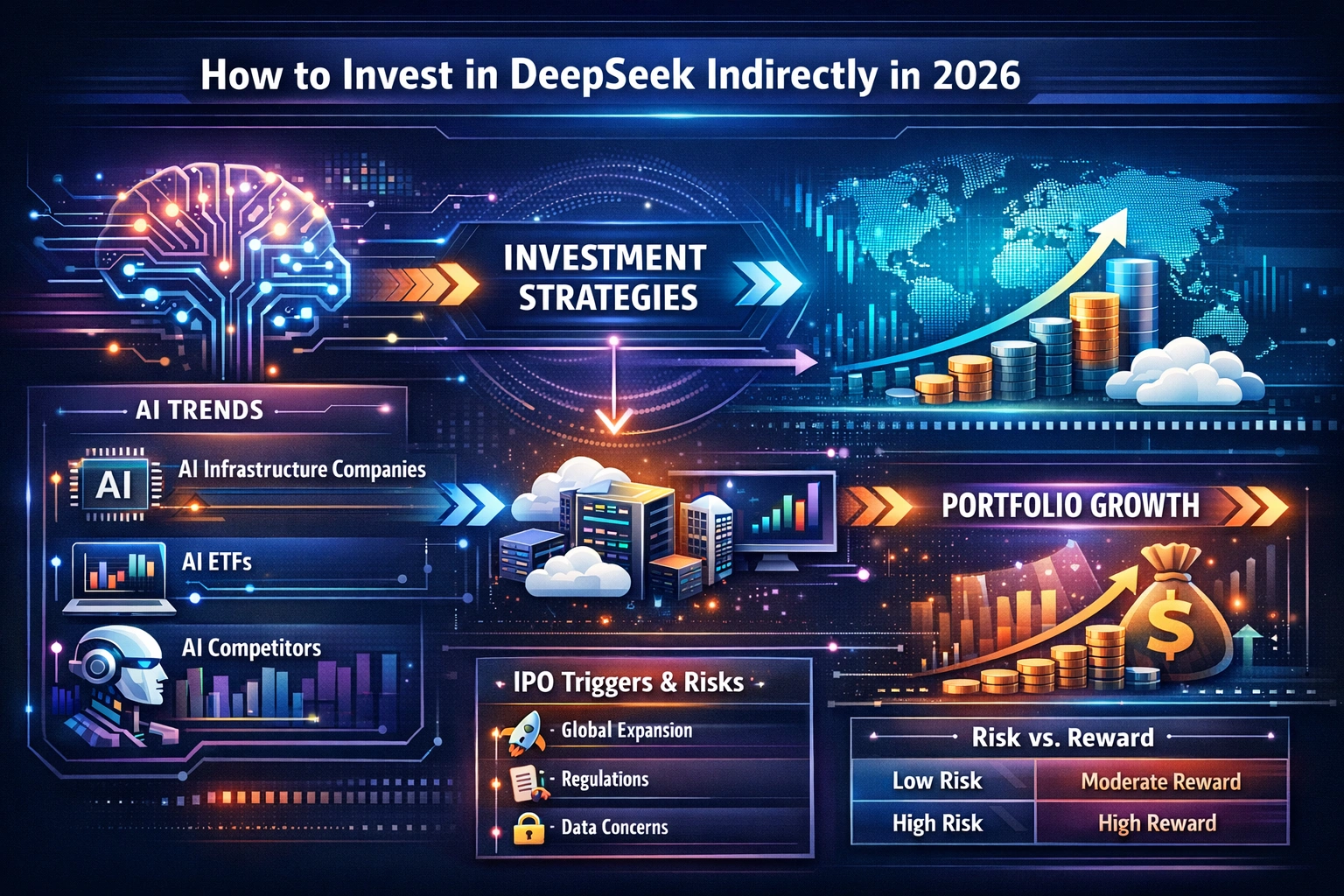
Potential IPO Catalysts
- Expansion into international markets
- Increasing competition within the AI sector
- Requirement for large-scale capital infusion
- Monetization of AI products and services
Risks That Could Delay an IPO
- Regulatory oversight in China
- Data transparency and governance concerns
- Geopolitical tensions between major economies
- Strategic preference to remain private
Expert Insight: Most analysts anticipate that DeepSeek may go public later in the decade rather than in the immediate future.
How to Invest in DeepSeek
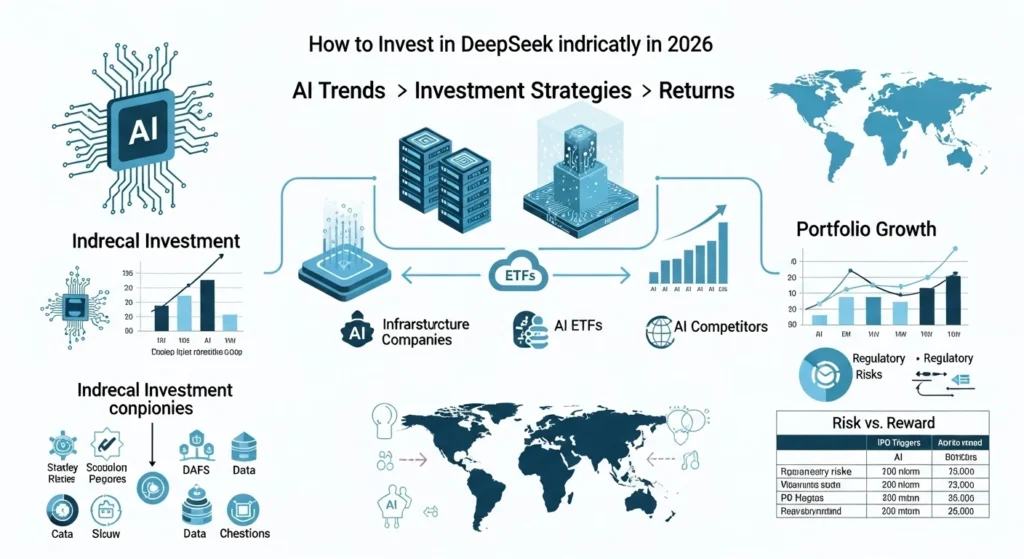
Since direct ownership is not feasible, intelligent investors leverage indirect exposure strategies.
Invest in AI Infrastructure Companies
DeepSeek relies heavily on computational hardware and cloud-based systems.
Key Investment Segments
- AI semiconductors
- Cloud computing platforms
- Data center infrastructure
Examples
- NVIDIA (AI chip manufacturing leader)
- Microsoft (cloud ecosystem and AI integration)
- AMD (advanced processing technologies)
These companies benefit regardless of which AI firm dominates the market.
Invest in AI ETFs
Exchange-Traded Funds (ETFs) provide diversified exposure to the broader AI industry.
Advantages
- Reduced risk through diversification
- Simplified investment process
- Suitable for beginner investors
ETF Categories
- Robotics and AI-focused ETFs
- Technology sector ETFs
- Innovation-driven funds
Ideal for long-term capital appreciation with lower volatility.
Invest in AI Competitors
DeepSeek operates within a competitive ecosystem of global AI innovators.
Investing in competing firms allows you to benefit from overall industry expansion.
Key Segments
- Generative AI platforms
- Enterprise AI solutions
- Cloud-based AI services
Monitor Pre-IPO Opportunities
Sophisticated investors may explore early-stage opportunities through:
- Private equity funds
- Secondary share marketplaces
- Institutional investment platforms
Important: These options typically require significant capital and are not suitable for beginners.
AI Investment Strategy Table
| Strategy | Risk Level | Accessibility | Potential Return |
| AI Stocks | Medium | Easy | High |
| AI ETFs | Low | Very Easy | Moderate |
| Competitors | Medium | Easy | High |
| Pre-IPO | High | Limited | Very High |
Risks You MUST Understand
Neglecting risk assessment is one of the most common mistakes in investing.
Regulatory Risk
- Government intervention
- Data protection laws
- Sudden policy shifts
Transparency Limitations
Private companies often do not disclose:
- Financial statements
- Operational performance metrics
- Investor communications
AI Bubble Risk
The AI sector is experiencing significant hype.
- Overvaluation concerns
- Market corrections
- Speculative investment behavior
Scams & Fraudulent Schemes
Common traps include:
- Fake “DeepSeek tokens.”
- Misleading IPO announcements
- Unregulated investment platforms
Always verify credibility before committing capital.
Step-by-Step: How to Invest in AI Instead
Even without direct access to DeepSeek, you can still build a robust AI investment strategy.
Open a Brokerage Account
Select reputable platforms:
- UK: FCA-regulated brokers
- EU: MiFID II compliant institutions
Conduct Thorough Research
Focus on:
- Semiconductor firms
- Cloud infrastructure providers
- AI-focused ETFs
Diversify Your Portfolio
Avoid concentrating capital in a single asset.
Adopt a Long-Term Perspective
AI represents a multi-decade growth trend, not a short-term opportunity.
Monitor Industry Developments
Stay informed about:
- Technological breakthroughs
- IPO announcements
- Regulatory changes
Pro Strategy: Build a “DeepSeek-Themed Portfolio.”
You can simulate exposure to DeepSeek by constructing a thematic portfolio.
Suggested Allocation
| Sector | Allocation |
| AI Chips | 40% |
| Cloud Providers | 30% |
| AI Software | 20% |
| Startups | 10% |
This approach balances growth potential with risk management.
Europe-Specific Investment Insights
For European investors:
- Utilize UCITS-compliant ETFs
- Consider currency exposure (EUR/USD)
- Monitor EU AI regulations
Why ETFs Are Preferred
- Tax efficiency
- Built-in diversification
- Lower volatility
How to Apply These Strategies
A simplified approach:
- Begin with ETFs
- Gradually add individual stocks
- Rebalance portfolio periodically
- Stay updated on market trends
Tips to Build Your AI Investment Strategy
- Prioritize fundamentals over hype
- Avoid unrealistic “get rich quick” expectations
- Maintain a long-term horizon (5–10 years)
- Rely on credible data sources
- Diversify across global markets
Pros & Cons
Advantages
- Exposure to the AI industry growth
- Multiple investment pathways
- Risk reduction through diversification
- Strong long-term potential
Disadvantages
- No direct ownership
- Market volatility
- Regulatory uncertainties
- Limited insider information
FAQs
A: DeepSeek is a private company and not listed on any stock exchange.
A: There is no stock symbol because the company is not publicly traded.
A: Only institutional investors may have access. Retail investors usually cannot.
A: There is no official IPO date as of 2026.
A: The best way is to invest indirectly through AI stocks, ETFs, and infrastructure companies.
Conclusion
DeepSeek stands out as one of the most compelling AI companies in today’s rapidly evolving Technological landscape.
However, the fundamental reality remains:
You cannot invest in DeepSeek directly in 2026.
But strategic investors do not wait for perfect conditions—they adapt and position themselves intelligently.
By allocating capital toward:
- AI infrastructure companies
- Diversified ETFs
- Competing AI firms
You can still benefit from the same macro trends driving DeepSeek’s growth.