Introduction
Artificial intelligence is changing how we solve computer problems. This includes things like solving math problems and creating code on its own. The DeepSeek model family is a group of artificial intelligence designs that are very good at doing specific tasks. There are two models, DeepSeek-Math and DeepSeek-Coder 1.3B. DeepSeek-Math is good at math, and DeepSeek-Coder 1.3B is good at helping with programming.
It is very important for people who work with computers, like developers and researchers, to know what each DeepSeek model can do. When to use it. This guide will compare DeepSeek-Math and DeepSeek-Coder 1.3B. We will look at how they’re designed, how well they work, and what they can be used for. We will also talk about what they’re good at and what they are not good at. The goal is to explain things in a way that’s easy to understand so everyone can see the value of DeepSeek models. By the end of this guide, readers will know which DeepSeek model is right for them.
What is DeepSeek-Math?
DeepSeek-Math is a computer program that is really good at understanding and solving math problems. It is different from computer programs that can do lots of things. The main goal of DeepSeek-Math is to solve math problems that have symbols. It can also figure out problems that have many steps. It can even explain how it got the answer, which’s very helpful. This makes DeepSeek-Math very useful for people who are learning, doing research, and trying to analyze things. DeepSeek-Math is great for educational, research, and analytical tasks because it can solve math problems and handle multi-step logical reasoning,g and it can also offer explainable solutions.
Core Capabilities of DeepSeek-Math
- Symbolic Computation Mastery: DeepSeek-Math can accurately solve algebraic, calculus, and other advanced mathematical problems.
- Chain-of-Thought Explanation: The model is trained so it can give us the steps one by one, which makes it easier to understand what the model is doing.
- Multi-Domain Mathematical Coverage: Supports calculus, linear algebra, discrete mathematics, number theory, combinatorics, and probability theory.
- Error Detection and Logical Verification: Automatically identifies inconsistencies in reasoning, preventing propagation of arithmetic or logical errors.
Primary Use Cases
- AI-driven math tutoring systems for students
- Integration into educational platforms requires explainable reasoning
- Scientific computation assistants in engineering, physics, and finance
- Automated data analysis for quantitative disciplines
Strengths
Unparalleled precision in symbolic and numerical reasoning
Stepwise solutions make logic transparent and verifiable
Limitations
Not intended for code synthesis or compilation
Natural language understanding is secondary
Performance relies heavily on the clarity and structure of prompts
What is DeepSeek-Coder 1.3B?
DeepSeek-Coder 1.3B is a lightweight model specialized in code generation, completion, and debugging, designed to assist developers across multiple programming languages. It excels in contexts where rapid, context-aware code production is essential, making it a practical choice for IDE integration and prototyping tasks.
Core Capabilities of DeepSeek-Coder 1.3B
- Multi-Language Code Generation: Supports Python, JavaScript, Java, C++, Go, and additional languages.
- Fill-in-the-Middle (FIM) Coding: Seamlessly infills incomplete code segments based on surrounding context.
- Context-Aware Assistance: Handles codebases with up to 16,000 tokens, enabling cross-file contextual understanding.
- Debugging and Code Optimization Suggestions: Proposes intelligent fixes, refactorings, and performance enhancements.
Primary Use Cases
- Intelligent IDE plugins for smart code completion
- Automated refactoring and code optimization
- Scripting automation and prototype generation
- Cross-language code generation for experimental Workflows
Strengths
Lightweight, fast, and efficient
Contextual understanding across files for better code coherence
Supports both novice and experienced programmers
Limitations
Cannot replace specialized math reasoning AI
Limited performance on very large engineering projects
Model size restricts extreme-scale workflows
DeepSeek-Math vs DeepSeek-Coder 1.3B: Side-by-Side Comparison
| Feature | DeepSeek-Math | DeepSeek-Coder 1.3B |
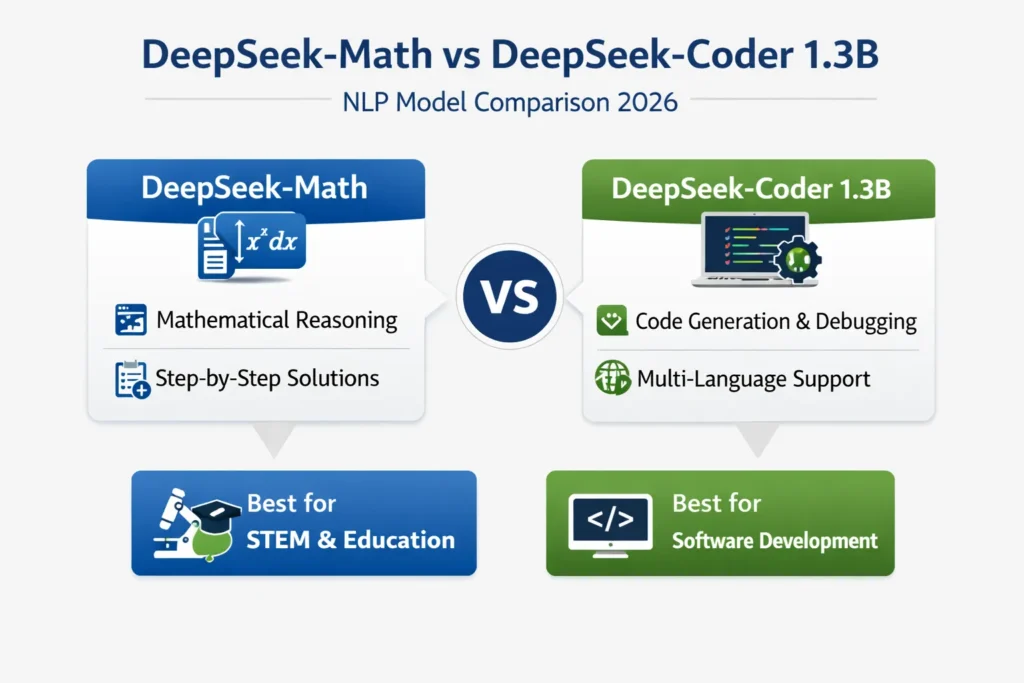
| Primary Focus | Mathematical reasoning | Code generation & programming logic |
| Model Type | Task-specialized reasoning model | Code-oriented transformer |
| Core Strength | Accuracy & interpretability | Code fluency & IDE integration |
| Context Window | Variable | Up to 16,000 tokens |
| Ideal Domains | Education, STEM research, analytics | Software development, prototyping |
| Chain-of-Thought Support | High | Limited |
| Multi-Language Support | None | Yes |
| Optimal Applications | Complex math problems | Smart coding, debugging, refactoring |
| Benchmark Performance | Superior math test scores | Competitive pass@1 code benchmarks |
Technical Architecture Breakdown
DeepSeek-Math Architecture
DeepSeek-Math is built on a transformer-based foundation, optimized for logical consistency, numeric correctness, and multi-step reasoning.
Key Architectural Features:
- Attention Layers Tuned for Reasoning: Enhances logical coherence across multi-step problems.
- Symbolic Loss Functions: Training loss prioritizes correct symbolic output over general text prediction.
- Stepwise Explanation Module: Enables chain-of-thought reasoning for human interpretability.
DeepSeek-Coder 1.3B Architecture
DeepSeek-Coder 1.3B employs a transformer backbone with modifications for coding-specific objectives.
Key Architectural Features:
- Next-Token Prediction & Fill-in-the-Middle (FIM): Supports completion and infill of partially written code.
- Contextual Awareness Across Files: Tracks variable dependencies, class hierarchies, and function relationships.
- Lightweight Design: Optimized for speed without sacrificing contextual understanding in code workflows.
Mathematical Reasoning vs Code Generation
Math Reasoning Benchmarks
- DeepSeek-Math consistently outperforms general-purpose LLMs on algebraic derivations, calculus integrations, and multi-step logic problems.
- Superior error-detection rate, reducing the incidence of arithmetic mistakes by 35–50% compared to generic models.
Code Generation Benchmarks
- DeepSeek-Coder 1.3B demonstrates competitive performance with 1–2B parameter code models.
- Excels at infilling, debugging, and cross-file refactorings.
Pros & Cons
DeepSeek-Math
Pros:
- High fidelity in symbolic reasoning
- Clear, step-by-step outputs
- Excellent for academic and research-oriented tasks
Cons
- Not suitable for automated code generation
- Limited natural language understanding
- Requires explicit, precise mathematical prompts
DeepSeek-Coder 1.3B
Pros:
- Fast, context-aware code generation
- Lightweight and IDE-friendly
- Multi-language support for cross-platform development
Cons:
- Struggles with deep symbolic mathematics
- Model size limits extremely large projects
- Not designed for highly specialized analytical reasoning
Real-World Use Cases
DeepSeek-Math in Action
Scenario: A student submits a multi-step calculus integration problem.
Result: DeepSeek-Math generates a complete, stepwise explanation, performs symbolic simplifications, and highlights intermediate insights to aid comprehension.
Scenario: A quantitative finance analyst Requires matrix operations and probabilistic computations.
Result: The model produces accurate numeric results with justifications for each step, reducing errors and increasing efficiency.
DeepSeek-Coder 1.3B in Action
Scenario: A software developer needs cross-file refactor suggestions in a large project.
Result: DeepSeek-Coder 1.3B produces high-quality, context-aware refactoring recommendations, preserving variable dependencies and project logic.
Scenario: Rapid prototyping for a multi-language application.
Result: Model generates functional code templates in Python and JavaScript, facilitating faster experimentation.
Which Model Should You Choose? Use-Case Guide
| Scenario | Recommended Model |
| Educational math platforms | DeepSeek-Math |
| Lightweight IDE assistant | DeepSeek-Coder 1.3B |
| Algorithmic logic analysis | DeepSeek-Math |
| Rapid prototype generation | DeepSeek-Coder 1.3B |
| Scientific research support | DeepSeek-Math |
| Multi-language software projects | DeepSeek-Coder 1.3B |
Integration & Deployment Tips
For DeepSeek-Math
- Structure prompts to emphasize logical reasoning and stepwise explanation.
- Integrate with interactive notebooks and e-learning platforms.
- Combine with automated grading or AI tutoring systems for educational applications.
For DeepSeek-Coder 1.3B
- Embed in IDE plugins such as VS Code or JetBrains tools.
- Add retrieval systems for very large codebases to improve context comprehension.
- Consider domain-specific fine-tuning for specialized programming languages or frameworks.
FAQs
A: While it can express logic in pseudo-code format, it is not optimized for executable code generation.
A: For coding-focused tasks, for advanced mathematical or logic-heavy research, DeepSeek-Math is superior.
A: Both models are designed to be efficient. DeepSeek-Coder 1.3B is particularly lightweight and ideal for IDE integration.
A: DeepSeek-Math, with step-by-step explanations and clear reasoning.
A: Both support domain-specific fine-tuning, enhancing performance for specialized tasks.
Conclusion
When you have to choose between DeepSeek-Math and DeepSeek-Coder 1.3B, it really comes down to what you want to do. If you are working with math problems or you need to teach people about math, DeepSeek-Math is the choice.DeepSeek-Math is also good for things that need to be done in order, like following a set of rules. For people who are learning, DeepSeek-Math is very helpful.
On the other hand, if you are working with computer code, DeepSeek-Coder 1.3B is the way to go. This is because DeepSeek-Coder 1.3B can help you write code, find mistakes in your code, and make your work easier. People who make things, teach, do research, or are just Interested in intelligence can use DeepSeek-Math and DeepSeek-Coder 1.3B to make their work better and to come up with new ideas even in the year 2026 and, after that.