Introduction
Artificial intelligence is advancing at an unprecedented pace. By 2026, the question Developers ask has evolved beyond a simple “Which AI is best?” It’s now:
Which AI model is most suitable for my precise workflow and task-specific requirements?
Among the most discussed open-source models currently available, two DeepSeek offerings dominate conversations:
- DeepSeek-R1
- DeepSeek-Coder
Both architectures are potent, both are open-weight, and both allow fine-grained customization. However, they are purpose-built for distinctly divergent tasks.
This comprehensive pillar guide, exceeding 3500 words, provides an in-depth, focused comparison across:
- Architectural distinctions
- Benchmark results and task performance
- Programming capabilities
- Logical and algorithmic reasoning
- Security, hallucination potential, and limitations
- Licensing, deployment, and operational cost
- Use-case scenarios and workflow integration
- Developer decision frameworks
By the end, you’ll have a clear understanding of whether DeepSeek-R1 or DeepSeek-Coder aligns with your project requirements in 2026.
Why the DeepSeek-R1 vs DeepSeek-Coder Comparison Matters
Open-source LLMs have transitioned from experimental tools to production-ready systems. engines are now integral to multiple operational layers, including:
- IDE plugins and coding copilots
- Automated enterprise workflows
- SaaS-based solutions
- Research-oriented reasoning systems
- DevOps pipelines and monitoring solutions
Organizations increasingly prefer open models over fully proprietary APIs because they provide:
- Localized deployment and on-prem solutions
- Custom fine-tuning to domain-specific corpora
- Transparent behavior and reproducible outputs
- Infrastructure-level configurability
The key distinction lies in their specialization:
| Model | Core Orientation |
| DeepSeek-R1 | Reasoning-centric, analytical engine |
| DeepSeek-Coder | Code-centric, productivity-focused engine |
Selecting the wrong model can lead to:
- Suboptimal inference speed
- Reduced task accuracy
- Increased hallucination probability
- Developer inefficiencies and frustration
Let’s delve into each model’s specific traits.
What Is DeepSeek-R1?
DeepSeek-R1 is a reasoning-optimized large language model (LLM) designed for structured cognition and high-fidelity analytical outputs. Unlike conventional generative models that focus on token-level prediction, DeepSeek-R1 emphasizes hierarchical reasoning, chain-of-thought analysis, and multi-step logical deductions.
Its core competencies include:
- Advanced logical problem-solving
- Stepwise algorithmic reasoning
- Complex system debugging
- Multi-stage analytical workflows
In parlance, DeepSeek-R1 can be considered a cognitive LLM that prioritizes rationality and structural coherence over raw token generation. It’s often described as a “thinking-first” neural system.
Core Capabilities of DeepSeek-R1
DeepSeek-R1 excels in domains that require structured reasoning:
- Analytical mathematics and proofs
- Algorithm dissection and explanation
- Hierarchical problem decomposition
- Deep debugging of complex systems
- Multi-step decision-making pipelines
- Structured analytical support for research workflows
In knowledge representation terms, it’s optimized for symbolic reasoning within a probabilistic language model, making it highly suitable for knowledge-intensive applications.
How DeepSeek-R1 Works
Typical LLMs generate text by estimating the most probable next token given a context window. DeepSeek-R1 extends this with reinforcement learning from reasoning feedback (RLRF) to:
- Decompose complex problems into logically sequenced subtasks
- Evaluate consistency across sequential outputs
- Optimize solution paths with structured reasoning
Applications include:
- Academic and scientific research
- Financial quantitative modeling
- Engineering system validation
- Architecture and algorithm design
- Technical decision support
Trade-offs: Due to its reasoning depth, DeepSeek-R1 may produce longer outputs and have slightly reduced inference speed, but the quality of structured reasoning often outweighs latency concerns for researchers and analysts.
What Is DeepSeek-Coder?
DeepSeek-Coder is the programming-specialist LLM, engineered for developer productivity. Its training corpus emphasizes:
- Public GitHub repositories
- Open-source software documentation
- Technical tutorials and code Examples
- Framework-specific code patterns
DeepSeek-Coder functions as an AI coding assistant, generating syntax-correct and context-aware code efficiently.
Core Capabilities of DeepSeek-Coder
Optimized for software engineering workflows, DeepSeek-Coder supports:
- Multi-language code synthesis
- IDE autocompletion
- Refactoring recommendations
- Snippet scaffolding
- Unit test automation
Supported languages include Python, JavaScript, TypeScript, Java, C++, and Go, among others.
It integrates seamlessly with environments such as:
- Visual Studio Code
- JetBrains IDEs
- Enterprise-specific IDE solutions
How DeepSeek-Coder Works
Instead of reasoning depth, DeepSeek-Coder emphasizes:
- Syntax and semantic pattern recognition
- Rapid token-efficient generation
- Context-aware framework compliance
- Real-time inference for IDE integration
It’s engineered for practical code generation, focusing on developer acceleration and productivity optimization.
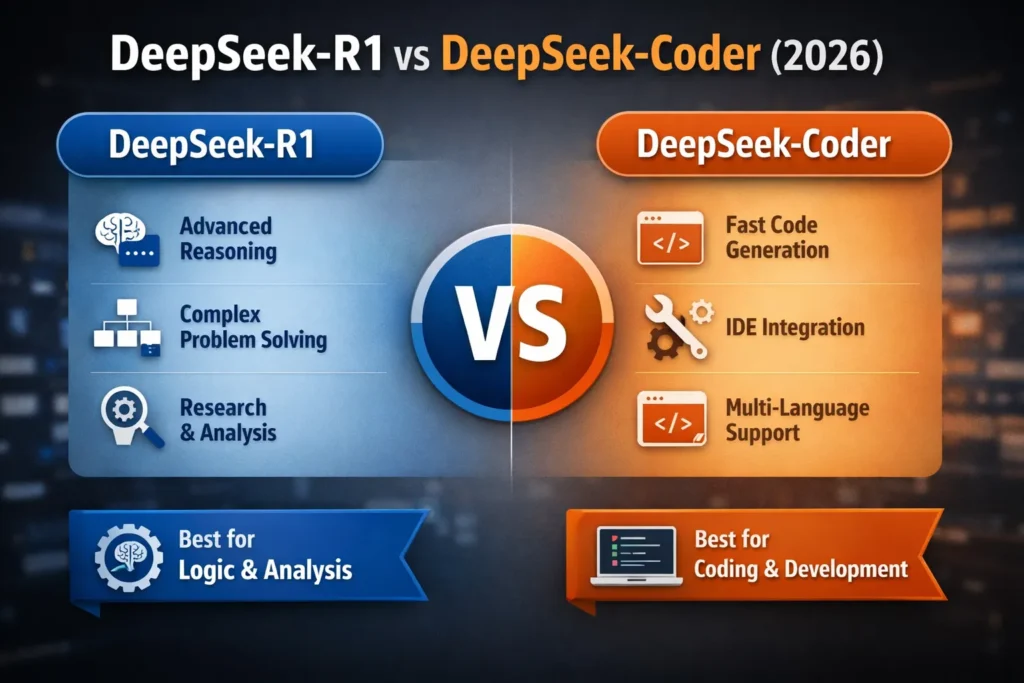
DeepSeek-R1 vs DeepSeek-Coder Side-by-Side Comparison
| Feature | DeepSeek-R1 | DeepSeek-Coder |
| Primary Focus | Logical reasoning, structured cognition | Code synthesis, programming productivity |
| Best For | Algorithm analysis, multi-step debugging, and research tasks | Fast code completion, snippet generation, and IDE integration |
| Training Emphasis | Reinforcement learning optimized for reasoning | Code-heavy corpus with pattern extraction |
| Output Style | Stepwise explanatory chains | Direct, executable code |
| Speed | Moderate | High |
| Context Window | Long reasoning chains | ~16K+ tokens coding context |
| Strength | Deep problem decomposition | Rapid snippet and boilerplate generation |
| Weakness | Slower inference, verbose outputs | Limited multi-step reasoning |
| Ideal Users | Researchers, analysts, logic engineers | Software developers, engineers, and IDE power users |
| Licensing | Open-source | Open-source |
Benchmark Performance Analysis (Coding vs Reasoning)
Coding Benchmarks
DeepSeek-Coder demonstrates:
- High success rates in multi-language code completion tasks
- Efficient scaffolding of complex frameworks
- Strong performance in competitive programming prompts
- Pattern recognition for API and library use
DeepSeek-R1 performs well in explanatory coding:
- Algorithm walkthroughs
- Recursive and stack-based logic elucidation
- Multi-step problem decomposition
From a standpoint, Coder is optimized for operational token prediction within structured code Sequences, whereas R1 is optimized for reasoning-rich token chains.
Logic & Reasoning Benchmarks
For tasks demanding formal reasoning:
- Multi-step deduction
- Mathematical derivation
- Logic proof generation
- Algorithmic decision chains
DeepSeek-R1 significantly surpasses DeepSeek-Coder, making it the choice for research labs, fintech modeling, and data-intensive reasoning.
Practical Example Real Developer Scenario
Scenario: Debugging a Complex Recursive Function
- DeepSeek-Coder: Generates corrected syntax quickly, outputs executable code, and saves time in IDEs.
- DeepSeek-R1: Provides a detailed analysis of recursion depth, stack behavior, and logic flaws, suggesting algorithmic optimizations and design improvements.
This illustrates the distinction between speed-oriented generation versus reasoning-centric chain-of-thought modeling.
Real-World Use Cases
When to Use DeepSeek-R1
Opt for DeepSeek-R1 when tasks involve:
- Advanced mathematical derivations
- Risk simulation and modeling
- Complex debugging scenarios
- System architecture analysis
- Academic or research-intensive problem solving
Example: A fintech startup constructing quantitative risk models may utilize DeepSeek-R1 to validate calculation logic, simulate decision pathways, and ensure reasoning consistency.
When to Use DeepSeek-Coder
Opt for DeepSeek-Coder when tasks involve:
- Rapid generation of code snippets
- API scaffold generation
- Framework-specific boilerplate
- Frontend component creation
- Automated unit test generation
Example: A SaaS developer building a dashboard could employ DeepSeek-Coder to generate React components, construct CRUD APIs, automate repetitive tasks, and refactor legacy code efficiently.
Security, Hallucinations & Limitations
Open-source LLMs are not inherently risk-free.
DeepSeek-R1 Limitations
- Potentially over-explanatory outputs
- Moderate response latency
- Possible insecure suggestions if prompted inadequately
- Requires validation for production-critical systems
DeepSeek-Coder Limitations
- Occasionally hallucinates APIs or framework functions
- May generate Logically flawed but syntactically correct code
- Suboptimal for deep multi-step reasoning tasks
Security Best Practices
Both models benefit from:
- Sandboxed deployment
- Human-in-the-loop validation
- Static and dynamic code scanning
- Access control and auditing
Never auto-deploy AI-generated code without thorough review.
Cost, Licensing & Infrastructure
Both DeepSeek-R1 and DeepSeek-Coder are:
- Open-source
- Customizable for domain-specific fine-tuning
- Deployable locally or in cloud environments
Compared to proprietary APIs, open-source LLMs offer lower long-term operational costs, full control, and transparent behavior.
Factors influencing real-world cost include:
- GPU infrastructure and memory requirements
- Cloud hosting or on-prem deployments
- Scaling and high-throughput workloads
- Fine-tuning for domain-specific tasks
Pros & Cons
DeepSeek-R1
Pros:
- Superior logical reasoning and analytical ability
- Detailed debugging insights
- Transparent and interpretable outputs
- Suitable for research-focused applications
Cons:
- Slower inference speed
- Verbose outputs
- Not optimized for IDE efficiency
DeepSeek-Coder
Pros:
- Rapid code generation
- Multi-language and framework support
- Strong integration with IDEs
- Maximizes developer productivity
Cons:
- Limited reasoning depth
- Potential API hallucinations
- Requires careful output Validation
Decision Matrix: Which One Should You Choose?
Key evaluation questions:
Do you need deep reasoning or rapid code generation?
Are you debugging logic-intensive systems?
Is speed more critical than explanation depth?
Will this model run as an IDE-integrated assistant?
Quick Decision Guide:
- Choose DeepSeek-R1 → If your primary need is structured reasoning and multi-step logic analysis.
- Choose DeepSeek-Coder → If your focus is on developer productivity and fast coding workflows.
Many organizations employ both in tandem to maximize output efficiency.
Future Roadmap & Trends
DeepSeek’s evolving architecture includes:
- Distilled lightweight variants for smaller-scale deployments
- Larger context windows for extended reasoning or coding tasks
- Enhanced safety alignment and hallucination mitigation
- Hybrid models combining reasoning depth with coding efficiency
Future engines may integrate R1’s reasoning strength with Coder’s speed, potentially eliminating the gap between reasoning and code-specialized LLMs.
FAQs
A: It depends on task requirements. R1 excels in reasoning-heavy workflows, while Coder is optimized for programming productivity.
A: for many scenarios. Enterprise-grade security validation is still essential.
A: DeepSeek-R1 is generally more effective for logic-intensive debugging.
A: Both are open-weight and fully customizable.
A: Absolutely. Organizations can fine-tune both for domain-specific tasks or coding/analytical workflows.
Conclusion
Choosing between DeepSeek-R1 and DeepSeek-Coder ultimately comes down to your workflow priorities and task-specific needs. Both models are open-source, powerful, and customizable, but they are purpose-built for distinct problem domains:
- DeepSeek-R1 is a reasoning-first model, excelling in multi-step logic, algorithmic reasoning, and structured analytical tasks. Its strength lies in deep problem-solving, stepwise explanations, and reliability in reasoning-intensive workflows, making it ideal for researchers, analysts, and fintech or engineering applications where accuracy and logical consistency are paramount.
- DeepSeek-Coder is a coding-first model, designed to accelerate developer productivity through rapid, syntax-correct code generation, IDE integration, and multi-language support. Its Advantages include speed, practical coding efficiency, and framework familiarity, making it perfect for developers building SaaS platforms, web apps, APIs, or automating repetitive code tasks.