Introduction
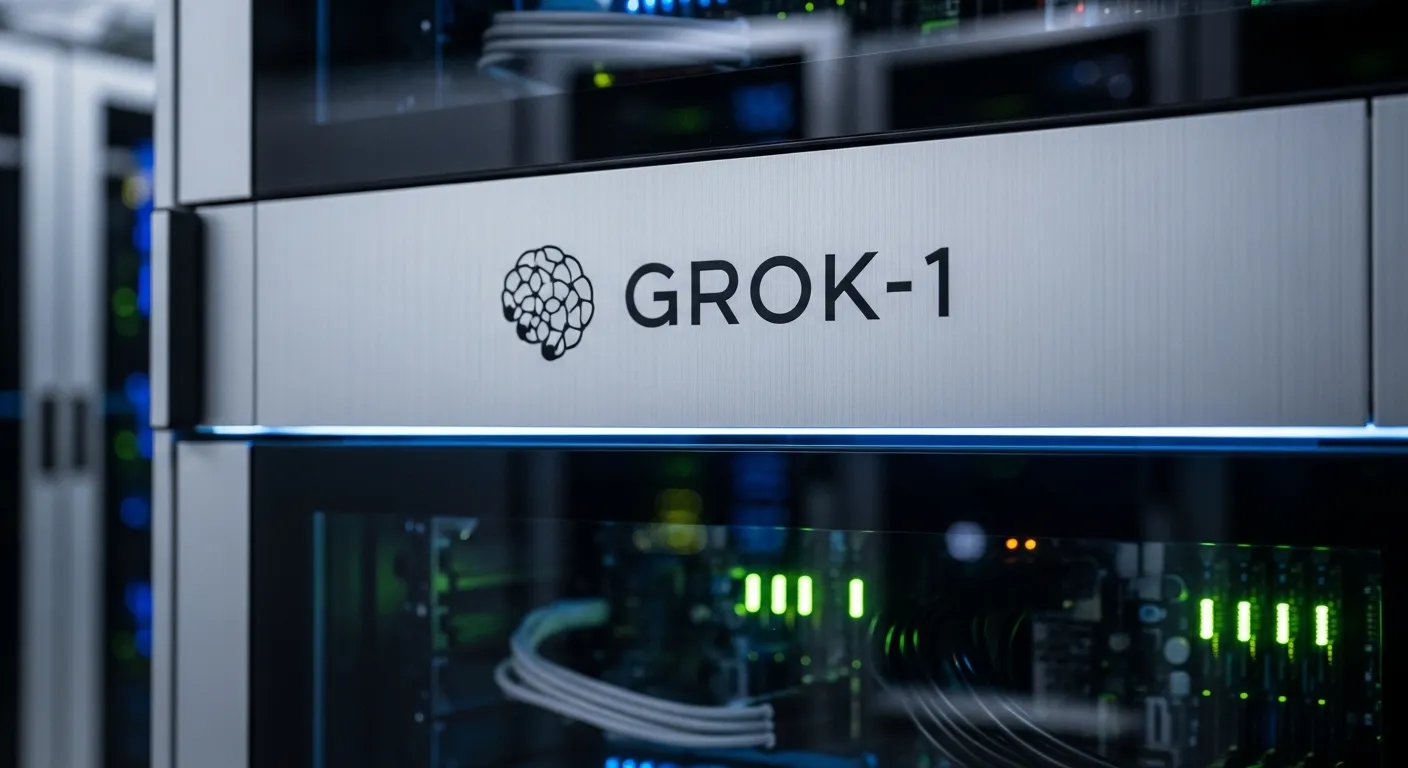
The landscape of open-source large language models (LLMs) has dramatically evolved in recent years, with Grok‑1 emerging as one of the most compelling innovations in 2026. Developed by xAI, the AI venture co-founded by Elon Musk, Grok-1 is an open-source Mixture-of-Experts (MoE) LLM that incorporates a staggering 314 billion parameters. Unlike conventional dense models, which deploy all parameters for every token, Grok‑1 activates a subset of its parameters per token, resulting in computational efficiency without sacrificing performance.
This guide is designed to provide a comprehensive analysis of Grok‑1 — from its historical origins, architecture, and technical specifications to real-world applications, benchmarks, limitations, and comparisons with other leading LLMs such as GPT‑4 and LLaMA. For researchers, developers, and AI enthusiasts looking to harness a powerful open-source alternative, this resource will serve as a cornerstone reference.
What Is Grok‑1?
Grok‑1 represents a paradigm shift in open-source LLMs. Unlike proprietary models such as GPT‑4, Grok‑1 is freely available under the Apache 2.0 license, enabling developers, researchers, and startups to fully explore, fine-tune, and deploy the model without licensing restrictions.
At its core, Grok‑1 utilizes a Mixture-of-Experts (MoE) architecture, which allows it to selectively activate a fraction of its 314 billion parameters per token. This strategy ensures scalable efficiency, enabling high-capacity reasoning while reducing memory and compute overheads.
Key Highlights:
- Open-source: Available under Apache 2.0 license; free for research, experimentation, and commercial use.
- Parameters: 314 billion, with ~25% activated per token.
- MoE Design: Each layer contains multiple “experts,” with only a subset active at a time, balancing performance and efficiency.
- Ideal Users: Researchers, AI developers, startups, and academic labs seeking a high-capacity, accessible model.
In natural language processing terms, Grok‑1 is a transformer-based autoregressive model, optimized for both sequence modeling and knowledge extraction. Its dynamic expert selection mechanism reduces redundant computation while maintaining high expressivity in representations.
History & Origins of Grok
The term “Grok” originates from Robert A. Heinlein’s 1961 science-fiction novel, Stranger in a Strange Land, signifying deep, intuitive understanding. The Grok series embodies this philosophy by enabling machines to “grok” or comprehend contextually and semantically textual input efficiently.
Timeline:
- Late 2023: Grok‑1 conceptualized as xAI’s first large open MoE LLM.
- March 2024: Official release of base weights under Apache 2.0 license.
- 2024–2025: Iterative versions like Grok‑1.5, Grok‑2, Grok‑3, and Grok‑4 added enhancements, including long-context processing, multimodality, and improved reasoning.
The design ethos focused on providing high-scale models accessible to the public, in contrast to proprietary systems like GPT‑4 that are closed-source and subscription-based.
Architecture Explained: MoE & Efficiency
The Mixture-of-Experts (MoE) architecture is a sophisticated transformer variant that optimizes computation. Unlike dense transformers, where all parameters contribute to every token, MoE activates only a subset of experts relevant to the input token.
How MoE Works in Grok‑1:
- Each layer contains 8 experts.
- 2 experts are active per token (~25% of parameters).
- Dynamic routing assigns tokens to the most relevant experts.
Think of MoE as a team of specialists: instead of deploying the entire workforce, only the most suitable Experts handle each task, increasing computational efficiency and reducing memory usage.
Benefits:
- Faster inference: Reduces FLOPs while maintaining expressive power.
- Lower memory footprint: Scales parameter count without proportionally increasing hardware demands.
- Training efficiency: Researchers can explore ultra-large models without dense compute overhead.
From a natural language perspective, this architecture allows selective attention to semantic nuances while handling longer sequences via rotary positional embeddings, which are superior to static embeddings for sequence modeling and long-context understanding.
Technical Specifications
| Feature | Specification |
| Parameters | 314 Billion |
| Architecture | Mixture-of-Experts (MoE) |
| Experts Active/Token | 2 of 8 (~25%) |
| Layers | 64 |
| Attention Heads | 48 query + 8 key/value |
| Embedding Size | 6,144 |
| Vocabulary Size | 131,072 tokens |
| Context Window | 8,192 tokens |
| Positional Encoding | Rotary embeddings |
| Training Stack | JAX + Rust |
| License | Apache 2.0 |
The rotary embeddings enhance sequential understanding, while MoE layers enable ultra-large parameter models to run efficiently. In terms, this allows long-context language modeling, complex reasoning, and semantic representation at scale.
Performance & Benchmarks
Although Grok‑1 does not surpass commercial giants like GPT‑4 in absolute reasoning or natural language generation, it demonstrates competitive performance among open-source models:
- MMLU (General Knowledge): ~73% accuracy
- HumanEval (Coding): ~63%
- Mathematical Reasoning: High-school level proficiency
- Comparison: Outperforms open models like LLaMA 2 70B in reasoning and code evaluation tasks
Why This Matters:
Grok‑1 is positioned as a high-efficiency open LLM, bridging the gap between smaller open models and proprietary supermodels. It demonstrates that MoE and high parameter count can yield significant performance improvements without exorbitant compute cost.
Use Cases & Real-World Applications
The open-source and MoE nature of Grok‑1 enables deployment across a spectrum of tasks:
Natural Language Applications:
- Text generation & paraphrasing
- Summarization & abstraction
- Conversational agents (after fine-tuning)
- Question answering systems
Developer & Research Applications:
- Fine-tuning for custom domain-specific models
- Academic research experiments
- Creating derivative AI systems
Productivity & Tools:
- Virtual assistants
- Data analytics and insights generation
- AI-assisted coding and writing tools
The flexibility of an open 314B parameter model allows startups and labs to explore advanced tasks without reliance on costly API subscriptions.
Limitations & Known Issues
Despite its strengths, Grok‑1 has some limitations:
- Not fine-tuned for conversational AI: Requires additional training.
- High hardware requirements: Optimal deployment needs 300GB+ GPU memory.
- Susceptible to hallucinations: Like all LLMs, unverified outputs are possible.
- Sparse documentation: Base weights released, but extensive tuning guidelines are limited.
Understanding these limitations is critical before production deployment, particularly in high-stakes domains.
Grok-1 vs Other LLMs
| Model | arameters | Strengths | Weaknesses |
| Grok‑1 | 314B | Open-source, efficient MoE | Needs hardware, base model not chat-ready |
| GPT‑3.5 | 175B | Versatile, widely adopted | Dense, less computationally efficient |
| LLaMA 2 | Up to 70B | Lightweight, open-source | Lower reasoning and coding capacity |
| GPT‑4 | Proprietary | Top-tier reasoning and generation | Closed-source, subscription-only |
Takeaway: Grok‑1 stands out for open access, massive scale, and MoE efficiency, even if it doesn’t surpass proprietary models in raw reasoning or Generalization.
How to Access & Use Grok-1
Grok‑1 is freely accessible.
Step-by-Step:
- Visit the official GitHub repository: xAI Grok‑1
- Clone the model weights and codebase
- Set up a JAX + Rust environment
- Run locally or across multi-GPU systems
- Fine-tune for specific or research applications
Tip: Base weights require fine-tuning to optimize for chat, domain-specific generation, or coding tasks.
Future Outlook
The Grok family is continuously evolving:
- Grok‑1.5: Enhanced context window and multimodal support
- Grok‑2 / 3 / 4.x: Advanced reasoning capabilities, available via xAI API or cloud services
Long-Term Trends:
- Semantic search and knowledge extraction assistants
- Domain-specialized AI tools for healthcare, finance, and research
- Open-source-driven AI exploration for academic labs and startups
Grok‑1 lays the foundation for scalable, efficient, open AI accessible to the global community.
Pros & Cons
Pros
Open-source Apache 2.0 license
Efficient MoE architecture
Large parameter count for research exploration
High adaptability for fine-tuning
Cons
Heavy computational requirements
Base model not fine-tuned for conversational tasks
Risk of hallucinations in outputs
FAQs
A: Grok‑1 is more efficient and open-source, with higher reasoning and code performance in some benchmarks, but GPT‑3.5 is easier for general-purpose deployment.
A: Not effectively, its 314B parameters require multi-GPU setups or distributed compute clusters.
A: Text generation, summarization, coding assistance, and research experimentation (after fine-tuning).
A: The Apache 2.0 license allows commercial and academic use.
A: Grok‑1 leverages MoE for computational efficiency and has a vast 314B parameter base, whereas LLaMA 2 is smaller, denser, and less scalable.
Conclusion
Grok-1 is one of the most significant contributions to open-source AI in 2026, offering a 314B-parameter MoE architecture that combines efficiency, flexibility, and scale. While it does not yet surpass proprietary models like GPT -4 in absolute reasoning, its accessibility and extensibility make it a cornerstone for research, startups, and AI-driven innovation.
Its Mixture-of-Experts design enables modeling at an unprecedented scale with reduced hardware demands, making it an ideal choice for academia, startups, and developer-driven AI projects. Grok‑1 represents the future of open-source intelligence, bridging the gap between powerful proprietary models and globally Accessible AI tools.