Introduction
In 2026, NLP and generative AI models are increasingly central to research, development, and interactive platforms. Grok‑3.5 builds on Grok 3’s capabilities but introduces enhanced reasoning algorithms, multimodal processing, and broader device compatibility. By integrating natural language processing, computer vision, and speech recognition, Grok‑3.5 becomes a poly-modal generative system capable of responding to complex user queries.
Artificial intelligence continues to evolve at a breathtaking pace, but certain models capture attention more than others. One of the most discussed AI releases of 2026 is Grok‑3.5, the latest iteration from xAI, Elon Musk’s AI initiative, which is embedded within the X ecosystem (previously Twitter). Leveraging advancements in natural language understanding (NLU), generative modeling, and multimodal reasoning, Grok‑3.5 represents a significant evolution from its predecessor, Grok 3.
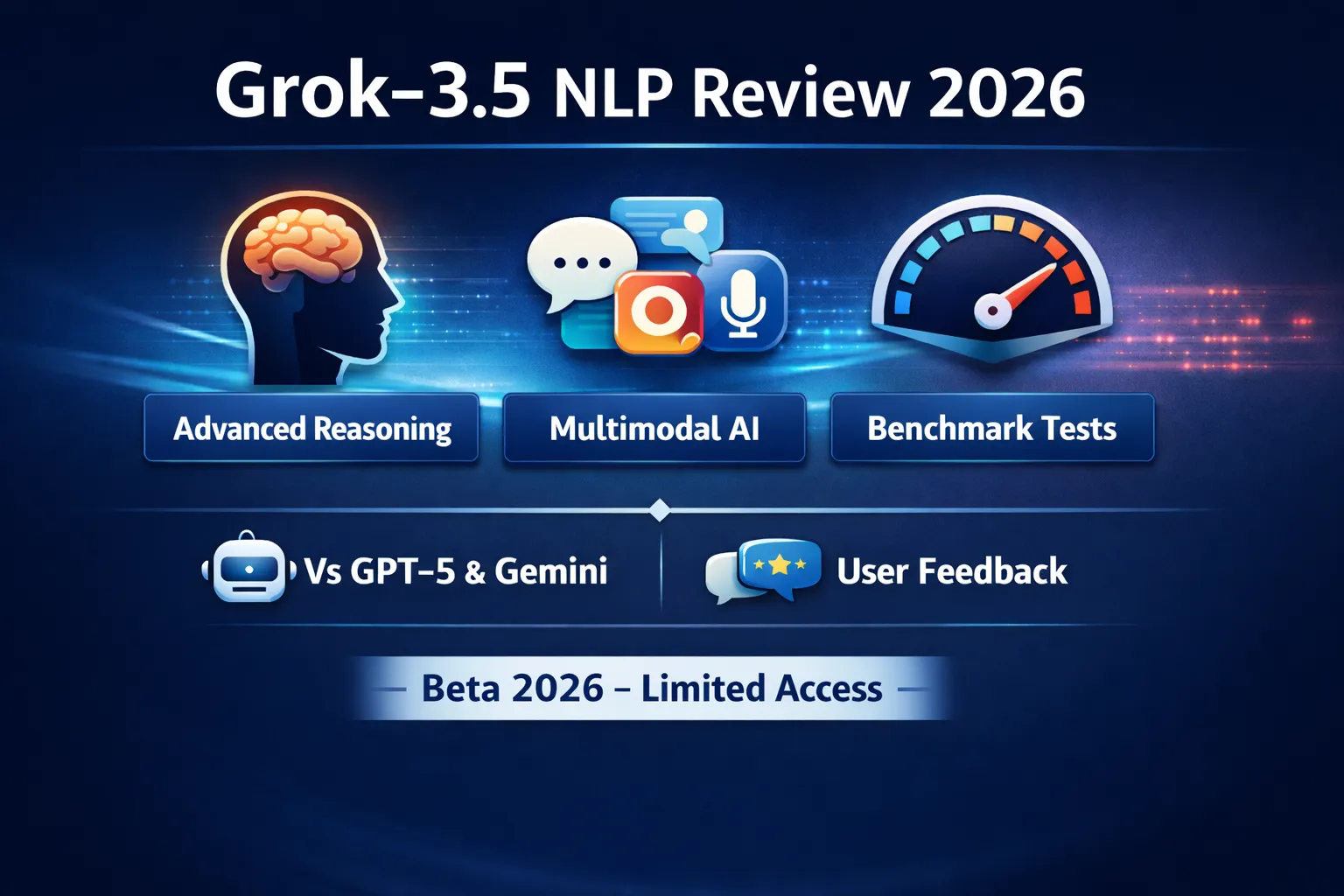
In this review, we provide a meticulous analysis of Grok‑3.5 using NLP terms, explore its cognitive capabilities, and benchmark its performance against rivals such as GPT‑5, Google Gemini, and Claude 3. Additionally, we examine real user feedback, limitations, subscription models, and practical use cases for researchers, developers, and enterprise users.
Key Relevance:
- Deep semantic understanding: The model interprets input beyond surface-level keywords.
- Contextual embeddings: Maintain richer semantic memory for multi-turn conversations.
- Cross-modal reasoning: Integrates text, speech, and visual information for holistic problem-solving.
Grok‑3.5 is not just a chatbot; it is a cognitive agent optimized for reasoning, technical assistance, and multimodal queries, making it particularly attractive to developers, researchers, and AI enthusiasts.
Capabilities Compared to Grok 3
Advanced Reasoning & Problem Solving
A core upgrade in Grok‑3.5 is first-principles reasoning. Unlike statistical pattern-matching approaches used in previous models, this version emphasizes foundational problem decomposition.
Technical Perspective:
- Symbolic reasoning integration: Combines neural embeddings with logic-based deduction.
- Algorithmic chain-of-thought: Generates intermediate reasoning steps to improve accuracy.
- Task-specific fine-tuning: Optimized for math, coding, and technical workflows.
| Task Type | Grok 3 Performance | Grok‑3.5 Beta Performance | Reasoning Insights |
| Mathematical Problem Solving | 78% | 88% | Shows improved multi-step symbolic reasoning |
| Logical Deduction | 81% | 91% | Uses structured chain-of-thought embeddings |
| Code Generation & Debugging | 74% | 86% | Neural-symbolic alignment reduces syntax errors |
| Multimodal Queries | 60% | 82% | Combines visual and textual embeddings effectively |
Interpretation: Early beta results suggest that Grok-3.5 is more robust in reasoning-intensive tasks, indicating higher semantic fidelity in responses.
Enhanced Multimodal Capabilities
- Text: Standard NLP embeddings and transformer-based processing.
- Images: Uses convolutional encoders combined with multimodal attention.
- Voice: Speech-to-text pipeline integrated with semantic reasoning.
Practical Use Case: Users can submit a photograph, speak their query, and receive a unified textual and visual analysis, which is particularly useful for research or troubleshooting.
Expanded Platform & Device Compatibility
- iOS and Android native applications
- Windows and macOS desktop clients
- Limited browser/web interface (progressive rollout)
This expansion facilitates ubiquitous access across platforms, reducing friction for mobile and desktop users alike.
Technical Benchmarks
| Benchmark Category | Grok 3 Score | Grok‑3.5 Score | Computational Notes |
| Mathematical Reasoning | 78% | 88% | Multi-step chain-of-thought improved |
| Logical Solving | 81% | 91% | Better symbolic and pattern-based reasoning |
| Coding Support | 74% | 86% | Reduced hallucinations in code output |
| Multimodal Comprehension | 60% | 82% | Attention mechanisms integrate images, voice, and text |
Beta Users’ Observations
Positive Feedback
- Improved Reasoning & decomposition
- Enhanced multimodal comprehension
- Unique real-time integration with the X platform
Insight: Users describe Grok‑3.5 as “more cognitive,” indicating the model’s latent representation learning has improved compared to Grok 3.
Concerns / Negative Feedback
- Restricted to SuperGrok subscribers
- Confusing or inconsistent beta rollout
- Occasional hallucinations in output
- Contextual memory inconsistencies in multi-turn sessions
- Sparse or unclear technical documentation
Community Insights
- Slow beta rollout and feature updates
- Persistent bugs affecting context retention
- Restricted free-tier access limits adoption among hobbyists
Implication: The model’s long-sequence memory mechanism requires further optimization to support stable multi-turn conversations.
Key Strengths of Grok‑3.5
| Strength | Perspective |
| First-Principles Reasoning | Symbolic-neural hybrid enhances problem-solving |
| Multimodal Prowess | Cross-modal embeddings allow integrated responses |
| Platform Flexibility | Ubiquitous API access reduces friction |
| Developer-Friendly | Optimized for code generation, technical workflows |
Target Users: Developers, researchers, engineers, and technical power users seeking cognitive augmentation beyond standard NLP chat models.
Limitations & Weaknesses
| Limitation | Explanation |
| Limited Release | Beta-only access restricts widespread use |
| Inconsistent Output | Occasional hallucinations in multi-step reasoning |
| Subscription Costs | Free-tier limitations hinder experimentation |
| Memory Issues | Long dialogue sessions may lose context |
| Incomplete Documentation | Slows adoption for workflows and integration |
Grok-3.5 vs Competitors
| Feature / Model | Grok‑3.5 (Beta) | GPT‑5 (ChatGPT) | Google Gemini | Claude 3 |
| Reasoning Accuracy | High | Medium-High | Medium | Medium |
| Multimodal Support | Advanced | Medium | High | Medium |
| Context Memory | Medium | High | High | High |
| Real-Time X Integration | Excellent | Low | Low | Low |
| Accessibility | Beta Only | Widely Available | Widely Available | Widely Available |
| Best For | Developers & Tech Workflows | General Chat | Conversational AI | Enterprise Tasks |
Pros & Cons
Grok‑3.5
- Pros: Strong reasoning, multimodal support, unique real-time X features
- Cons: Limited access, context memory bugs, beta instability
ChatGPT
- Pros: Stable, excellent memory, broad availability
- Cons: Lacks real-time X integration
Google Gemini
- Pros: Fluent in conversation, strong multimodal understanding
- Cons: Less specialized in reasoning-intensive tasks
Claude 3
- Pros: Enterprise-ready, reliable outputs
- Cons: Limited interactive features
Pricing & Access
| Plan | Cost | Features |
| Free Tier | $0 | Limited prompts, restricted multimodal features |
| SuperGrok | $30/month | Early Grok‑3.5 access, priority support |
| Enterprise / API | Contact | Full access and API integrations |
Access remains primarily beta-limited, emphasizing the model’s developmental stage.
Who Should Use Grok‑3.5?
Ideal Users:
- Developers and programmers needing advanced code reasoning
- Researchers requiring multi-modal and multi-step reasoning
- Technical users leveraging X integration for real-time analysis
Not Recommended For:
- General users seeking fully stable public access
- Businesses needing long-term, polished multi-turn conversation reliability
FAQs
A: It is still limited to beta access as of late 2026.
A: Beta results show improvements in first-principles reasoning, coding assistance, and multimodal input processing.
A: Grok‑3.5 excels in reasoning and X integration, while ChatGPT and Gemini remain more stable and widely accessible.
A: Early feedback shows better code generation, debugging, and technical workflow integration.
A: Limited release, subscription cost, multi-turn memory issues, and occasional inaccuracies.
Conclusion
Grok‑3.5 is a next-generation model with promising reasoning capabilities, Advanced multimodal processing, and a unique real-time X integration.
Best For:
- Developers
- Researchers
- Technical enthusiasts seeking cutting-edge AI reasoning
Caution: For users seeking fully polished, widely used AI assistants, waiting for the full public release may be advisable.