Introduction
Artificial intelligence (AI) is advancing at an Unprecedented rate. In 2026, AI models are evolving so rapidly that developers, enterprises, and tech enthusiasts are inundated with choices. One of the most prominent AI ecosystems today is Grok, an AI model family engineered by xAI.
Despite the buzz, many professionals are confused: which model should they select? The Grok lineup currently includes:
- Grok-4 Fast
- Grok Code Fast
- Grok-4.1 Fast
On the surface, these models appear similar. Yet, under the hood, their architectures, token handling, performance, and ideal use cases differ significantly. Choosing the wrong model could result in wasted compute resources, slower outputs, suboptimal code quality, or inaccurate AI responses.
Whether you are:
- A developer creating AI applications
- A startup founder evaluating infrastructure
- An enterprise decision-maker exploring AI automation
- An AI researcher exploring multimodal capabilities
… It is critical to understand the differences between these Grok models before adoption. This guide aims to provide an exhaustive comparison of contextual comprehension, reasoning ability, coding efficiency, latency, hallucination rate, cost-effectiveness, and enterprise readiness, all explained in plain English with centric terminology.
By the end, you will clearly know which Grok model fits your unique 2026 workflow requirements.
What Is Grok? An Focused Overview
Grok is a family of generative AI models created by xAI to rival industry leaders such as:
- ChatGPT
- Gemini
- Claude
Unlike standard chatbots or limited engines, Grok emphasizes deep reasoning, extended context comprehension, multimodal inputs, and enterprise-grade capabilities. Key features include:
- Massive context windows: Up to 2 million tokens, allowing for processing of large text corpora, legal contracts, research papers, and multi-file codebases.
- Enhanced reasoning architectures: Supports logical inference, multi-step deduction, and complex problem-solving.
- Tool calling & API integration: Connects seamlessly with enterprise systems and software environments.
- Real-time knowledge retrieval: Integrates live datasets for dynamic responses.
- Multimodal support: Capable of processing both text and image inputs, enabling richer AI interactions.
The Fast variants—including Grok-4 Fast, Grok Code Fast, and Grok-4.1 Fast—are optimized specifically for:
- Lower inference latency
- Accelerated computational throughput
- Reduced operational costs
- Scalability for real-time production AI workflows
These optimizations make Grok Fast models ideal for both developers building AI applications and enterprises deploying high-volume solutions.
Understanding the Three Grok Models Clearly
Before diving into benchmarks, it is crucial to define each model with specific terminology and practical real-world use cases.
Grok-4 Fast
Overview: Grok-4 Fast is a balanced engine optimized for general-purpose AI deployment. It emphasizes speed without sacrificing reasoning quality, offering a hybrid between fast inference and contextual depth.
Capabilities:
- High-speed response generation: Reduced token processing latency.
- Balanced reasoning: Can switch between shallow, fast replies and deep multi-step reasoning.
- Multimodal integration: Supports both textual and visual inputs.
Best Suited For:
- AI conversational agents
- Customer support AI
- General enterprise AI workflows with medium complexity
Grok Code Fast
Overview: Grok Code Fast is a programming-optimized tool designed specifically for software engineering workflows. Unlike general-purpose models, it excels in:
- Code generation
- Syntax accuracy
- Debugging and refactoring
- IDE and script integration
Technical Note: Its context window (~256K tokens) is smaller than Grok-4 or Grok-4.1. Fast but highly efficient for programming tasks.
Best Suited For:
- Developers and coders
- Rapid prototyping
- DevOps automation and CI/CD scripts
- API and backend service generation
Grok-4.1 Fast
Overview: Grok-4.1 Fast represents the next evolution of Grok models, integrating enhanced reasoning, expanded context handling, and enterprise robustness.
Key Improvements Over Grok-4 Fast:
- Full 2 million token context window
- ~65% reduction in hallucinations
- Stronger reasoning consistency
- Advanced enterprise-grade tool integration
- Enhanced long-document processing
Best Suited For:
- Large-scale enterprise automation
- Legal and financial document analysis
- Academic research and multi-source summarization
- Complex AI system Architectures
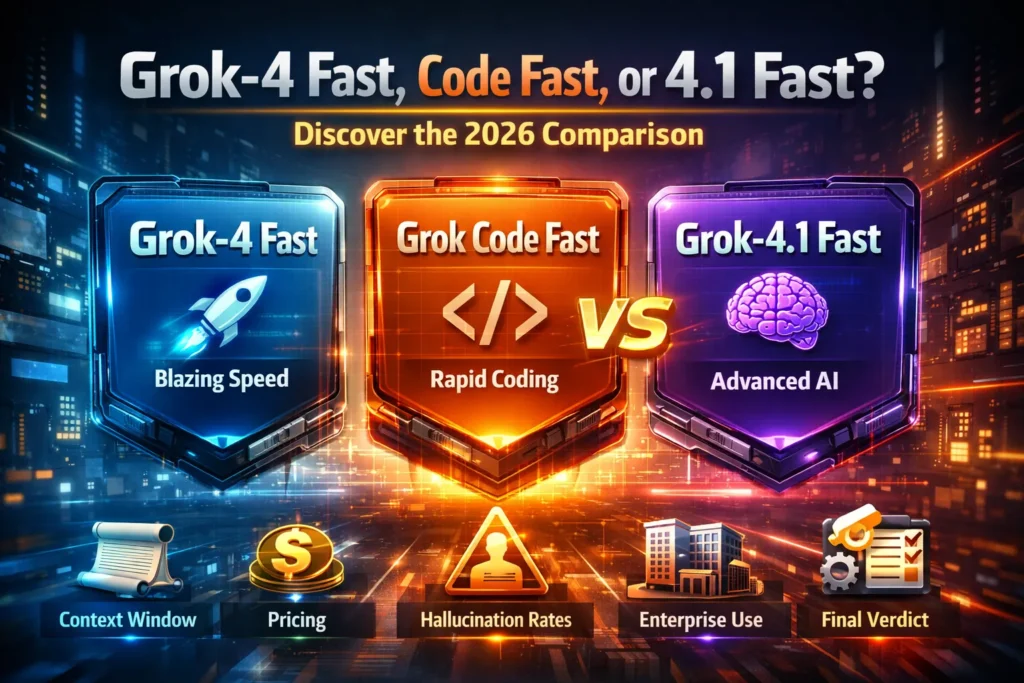
Head-to-Head Comparison: Grok-4 Fast vs Grok Code Fast vs Grok-4.1 Fast
| Feature | Grok-4 Fast | Grok Code Fast | Grok-4.1 Fast |
| Release Timeline | 2025 | 2025 | Late 2025 |
| Context Window | Up to 2M tokens | ~256K tokens | 2M tokens |
| Coding Optimization | Moderate | Excellent | Excellent |
| Image Support | Yes | No | Yes |
| Hallucination Rate | Moderate | Low in code | ~65% lower vs older models |
| Tool Calling | Yes | Limited | Advanced |
| Enterprise Readiness | Medium | Medium | High |
| Best For | Balanced speed & reasoning | Fast code generation | Enterprise & long context tasks |
| Cost Efficiency | High | Very High | Moderate–High |
Performance Deep Dive: Centric Insights
Context Window: Why 2M Tokens Matter
In a larger context window enables the model to:
- Maintain semantic coherence across long documents
- Track entities, references, and relationships in extended text
- Analyze large datasets without context truncation
Real-World Example:
- Legal analysis: Parsing 500-page contracts
- Software engineering: Refactoring 300K-line codebases
- Research workflows: Summarizing multi-source scientific papers
Inference: For any multi-file, long-context task, Grok-4.1 Fast outperforms other models. However, for smaller coding projects, Grok Code Fast remains more cost-efficient.
Speed Comparison
Inference Latency Benchmarks:
- Grok Code Fast: Fastest for programming tasks due to a token-optimized pipeline.
- Grok-4 Fast: Optimized for conversational flow and multi-turn interactions.
- Grok-4.1 Fast: Slightly slower due to deep reasoning and multi-modal embeddings.
Scenario Examples:
- Live AI chatbots & customer support: Grok-4 Fast
- Python scripts, Java backend APIs, React components: Grok Code Fast
- Enterprise-scale document processing & research workflows: Grok-4.1 Fast
Hallucination Rate & Reliability
Hallucination: When an AI generates factually incorrect or contextually irrelevant text.
- Dangerous in legal, financial, healthcare, and compliance settings
- Grok-4.1 Fast reduces hallucinations ~65% compared to Grok-4 Fast
- Critical for enterprises requiring accuracy over speed
Coding Benchmarks & Developer Performance
Key metrics for Coding include:
- Syntax correctness
- Error detection and correction
- Code explanation clarity
- Multi-file reasoning for large projects
Best Use Cases:
- Rapid coding → Grok Code Fast
- Large codebase refactoring → Grok-4.1 Fast
- Balanced coding + reasoning → Grok-4 Fast
Enterprise Deployment
Enterprises require:
- Stable, accurate outputs
- Low hallucination
- Tool & API integration
- Long-context memory
Winner: Grok-4.1 Fast
It is ideal for:
- Corporate process automation
- Legal & financial documentation
- Research institutions
- Government documentation systems
AI Chatbots & Customer Support
For conversational systems:
- Low latency
- Good dialogue flow
- Cost-efficient scalability
Winner: Grok-4 Fast
Provides a balanced tradeoff between speed, reasoning, and cost, especially in multimodal chat systems.
Research & Academic Workflows
For research analysts, PhD students, and policy experts:
- Multi-source document synthesis
- Long-document comprehension
- Complex reasoning tasks
Winner: Grok-4.1 Fast
Handles long PDFs, large corpora, and extended reasoning chains effectively.
Pricing & Cost Efficiency
Relative Costs:
- Lowest: Grok Code Fast → optimized for smaller coding workloads
- Moderate: Grok-4 Fast → balanced general-purpose
- Highest: Grok-4.1 Fast → enterprise-scale
Inference: Pay more for Enterprise accuracy and extended token context, or save on developer-centric coding tasks.
Pros & Cons
Grok-4 Fast
Pros:
- Balanced reasoning and speed
- Supports 2M token context
- Multimodal support
Cons:
- Slightly higher hallucination than Grok-4.1
- Not optimized exclusively for coding
Grok Code Fast
Pros:
- Extremely fast code generation
- High cost efficiency
- Developer-centric
Cons:
- Smaller context window (~256K tokens)
- No image/multimodal support
- Not enterprise-grade
Grok-4.1 Fast
Pros:
- Full 2M token context
- Lowest hallucination rate
- Strong enterprise integrations
Cons:
- Higher compute cost
- Slightly slower inference than Code Fast
Decision Matrix: Which Should You Choose?
| Scenario | Best Model |
| Startup building an AI chatbot | Grok-4 Fast |
| Developer writing daily scripts | Grok Code Fast |
| Enterprise automation | Grok-4.1 Fast |
| Research analysis | Grok-4.1 Fast |
| Cost-sensitive coding | Grok Code Fast |
| Multimodal AI application | Grok-4 Fast |
Quick Summary
- Speed priority → Grok Code Fast
- Balanced reasoning → Grok-4 Fast
- Accuracy + scale → Grok-4.1 Fast
FAQs
A: Grok-4.1 Fast excels in reasoning stability, enterprise readiness, and hallucination reduction, although it comes at a slightly higher computational cost.
A: Grok Code Fast is designed for programming tasks, delivering the fastest inference for syntax-accurate outputs.
A: Grok-4 Fast is multimodal, capable of processing text and images, unlike Grok Code Fast.
A: It allows the model to maintain a coherent understanding across extremely long documents, multi-file codebases, or research papers, without losing memory continuity.
Conclusion
Selecting the ideal Grok model boils down to your specific requirements, workflow complexity, and budget. Each variant offers distinct advantages depending on context, scale, and task type:
Grok Code Fast is the ultimate choice for developers and software engineers who prioritize speed, cost-efficiency, and coding accuracy. Its smaller context window (~256K tokens) is perfectly suited for scripting, IDE integration, and rapid prototyping workflows. If your main focus is programming-focused, this model delivers the best return on compute Investment.
Grok-4 Fast strikes a balance between speed and reasoning, making it ideal for conversational AI, multimodal applications, and enterprise chatbots. Its support for up to 2M token contexts and image inputs makes it highly versatile, bridging the gap between general AI applications and specialized coding tasks.