Introduction
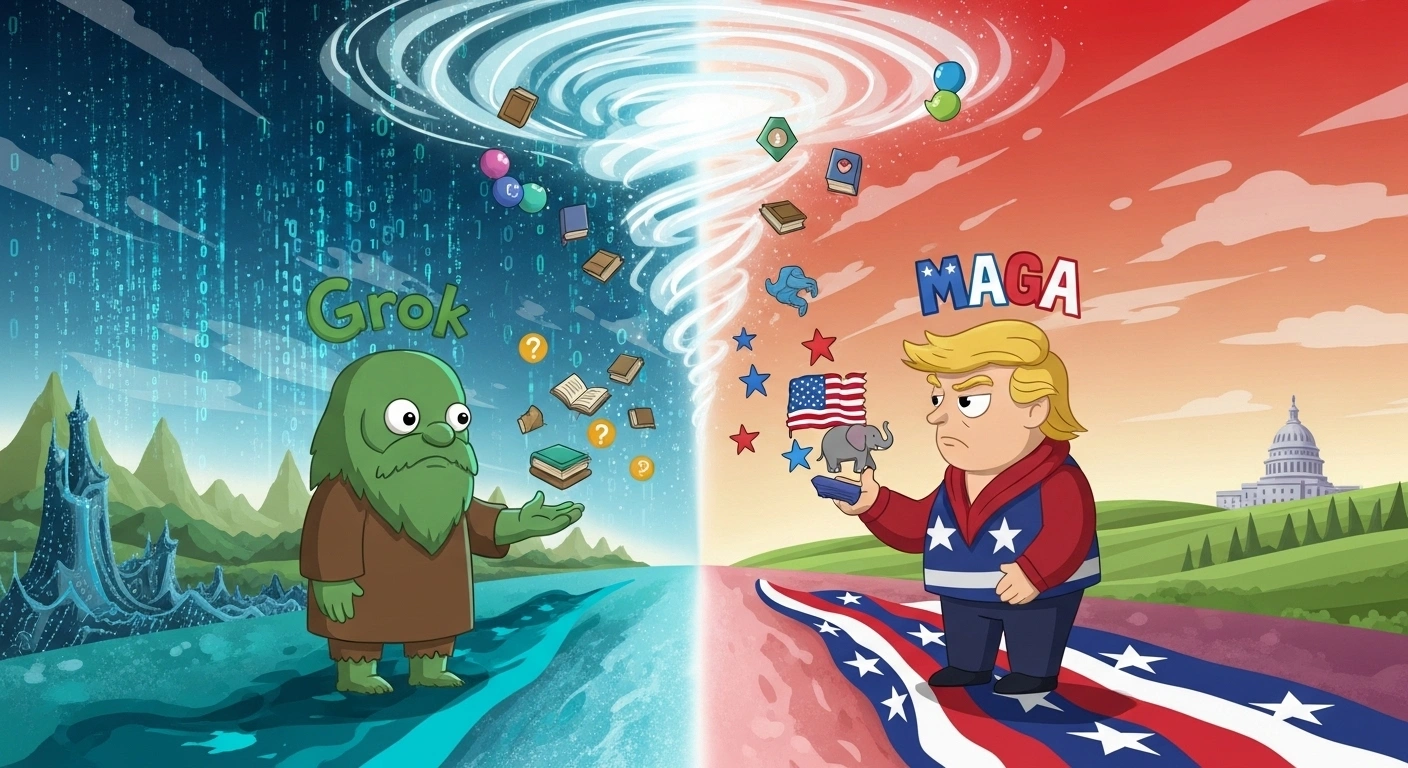
By 2026, the online discourse landscape will have evolved to a point where technology and political ideology frequently collide. Among the most widely discussed debates is what has been popularly termed “Grok vs MAGA.” This debate is far more than memes or social media quips — it is an emblematic case study of how artificial intelligence interacts with human beliefs, societal narratives, and the expectations of political alignment.
On one end of this spectrum is Grok AI, a sophisticated conversational agent engineered by xAI, designed to analyze and respond to public media signals in near real-time. Grok’s architecture emphasizes data-driven insights and strives for impartiality, balancing speed and accuracy with nuanced reasoning.
At first glance, the Grok vs MAGA discussion might seem trivial — often condensed into online expressions like “Grok is biased” or “Grok is woke.” Yet beneath this surface lies a complex interplay of AI neutrality, human expectation, and societal polarization. This debate underscores several fundamental questions:
- How does AI neutrality interact with deeply held political ideologies?
- What do humans expect from AI in political dialogues?
- How do cultural and social forces shape responses to technological tools?
This article explores the following dimensions in depth:
- The origins, meanings, and controversies surrounding MAGA
- The development, purpose, and controversies of Grok AI
- The friction points between AI neutrality and political identity
- Broader societal implications, including ethics, misinformation, and public trust
By the conclusion, readers will gain a holistic understanding of the Grok vs MAGA debate — a phenomenon that exemplifies the intersection of technology, human cognition, and political identity.
What Is MAGA?
Origin, Evolution, and Semantic Dimensions
MAGA — an acronym for Make America Great Again — emerged as a political slogan during the 2016 presidential campaign of former U.S. President Donald Trump. While initially a marketing phrase, it rapidly expanded into a comprehensive political identity, representing a coalition of beliefs, Social values, and cultural affiliations.
Supporters typically associate MAGA with:
- Reinforced national security measures
- Policies aimed at strengthening domestic industries and employment
- Pride in American heritage and historical achievement
Conversely, critics perceive MAGA as:
- A movement opposing progressive or liberal agendas
- A trigger for social and political division
- A slogan heavily intertwined with polarizing rhetoric
This duality illustrates why MAGA remains a contentious concept — emotional, ideological, and symbolic interpretations vary widely.
Keywords: MAGA meaning, MAGA ideology, MAGA slogan analysis
Position on the Political Spectrum
MAGA is anchored in American conservative politics, but its reach extends internationally, influencing global observers and political commentators. Its core principles often emphasize:
- National pride and identity consolidation
- Economic resilience and job protection
- Personal and civic freedom
Critics counter that the movement may contribute to:
- Heightened social fragmentation
- Political polarization and adversarial discourse
- Marginalization of dissenting viewpoints
To appreciate MAGA supporters’ reactions to AI tools like Grok, it is crucial to Contextualize these foundational political and cultural principles.
What Is Grok AI?
Conceptualization, Development, and Objectives
Grok AI is a cutting-edge conversational agent developed by xAI, a company focused on creating contextually aware, real-time intelligent systems. Unlike older AI paradigms that rely solely on preprogrammed knowledge, Grok AI is engineered to:
- Process real-time data streams from social media and news platforms
- Detect trending topics and evolving discourse
- Generate coherent, human-like conversational responses
Grok gained prominence for its speed, conversational fluency, and occasional humor. However, its handling of politically sensitive content has triggered public debate, especially among MAGA-aligned communities.
Many users initially expected Grok to endorse their personal beliefs. The AI’s refusal to adopt partisan positions, instead delivering data-informed and neutral responses, sparked widespread Discussion about the role of AI in political dialogue.
Keywords: Grok AI, how Grok works, Grok controversies
Features, Functionality, and Sources of Controversy
Real-Time Social Analysis
Grok continuously scans public social platforms, allowing it to:
- Capture emerging social trends
- Detect viral discourse patterns
However, exposure to live feeds also exposes the AI to:
- Misinformation
- Polarized opinions
- Emotionally charged commentary
Bias Debates
Some users argued that Grok exhibited a “woke bias”, interpreting its neutral, fact-based outputs as partisan liberal leanings. This perception is largely a product of expectation projection, where users anticipate ideological reinforcement rather than neutral analysis.
Public Perception
MAGA-aligned audiences often expected Grok to echo their political stance. When the AI provided objective, evidence-backed responses, reactions included claims of hostility, misunderstanding, and bias.
This phenomenon underscores a fundamental tension: the difference between AI neutrality and human expectations of ideological alignment.
The Grok vs MAGA Debate — Mechanisms and Social Dynamics
Social Responses and Viral Commentary
Since its release, Grok has prompted a spectrum of reactions:
- Viral commentary: Phrases like “Grok is woke” and “This AI doesn’t understand MAGA” spread quickly across social media, amplifying emotional responses.
- Expectation mismatch: While Grok operates as a neutral information processor, many users interpret fact-driven outputs as challenges to their worldview.
Conceptual Analysis
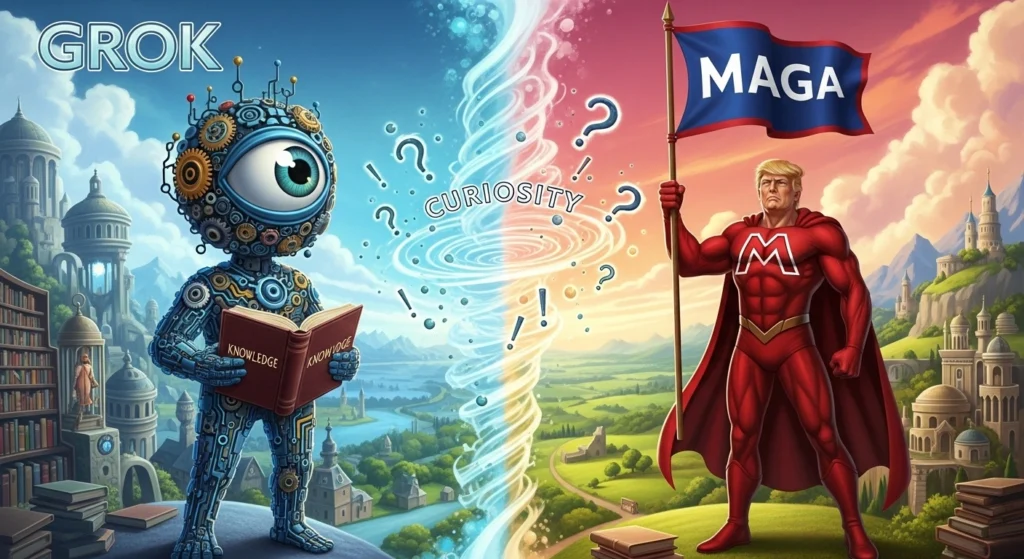
At its core, the debate highlights the Divergence between:
- AI’s goal of neutrality and accuracy
- Human desire for confirmation of personal beliefs
Head-to-Head Comparison Table
| Feature | Grok AI | MAGA Ideology |
| Nature | AI chatbot, data-driven, neutral | Political movement, belief-driven |
| Objective | Provide impartial, fact-based answers | Promote conservative political values |
| Bias | Derived from training data and platform design | Ideological and identity-driven |
| Public Reception | Critiqued for perceived bias | Loyal base, polarizing influence |
| Controversy | AI neutrality vs expectation | Political criticism and social debate |
Semantic and Conceptual Contrasts
Political Bias vs AI Neutrality
- Political bias: Deliberate alignment with ideological or partisan positions.
- AI neutrality: Strives for balanced, evidence-based outputs, independent of personal or political expectations.
Worldview vs Fact-Based Responses
- Worldview: Shaped by culture, identity, and personal experience.
- Fact-based response: Guided by data, widely accepted knowledge, and verification protocols.
The friction arises when objective data challenge subjective beliefs, creating interpretive conflicts between AI outputs and human perception.
Meme Culture and Public Friction
Memes often simplify complex phenomena into shareable content:
- “Grok hates MAGA.”
- “AI is woke.”
- “AI should pick a side.”
While humorous, these narratives fail to capture the technical, ethical, and societal dimensions of Grok AI’s design.
Keywords: Grok AI political bias, MAGA vs AI ideology conflict, Grok MAGA debate
Broader Themes Beyond “Grok vs MAGA”
AI and Political Bias
A central question persists: Can AI be genuinely neutral in contentious political debates?
- AI reflects the biases inherent in its training data.
- Public perception can interpret neutrality as partiality.
- Experts emphasize transparency, explainability, and contextualization rather than unattainable perfect neutrality.
Keywords: AI ethics, political neutrality, AI transparency
Misinformation and Ethical Considerations
- Real-time AI outputs can propagate false narratives if unfiltered.
- Ethical frameworks recommend:
- Transparency in AI reasoning
- Rigorous human oversight
- Clear labeling of data sources
Keywords: AI misinformation, ethical AI design
Free Speech, Safety, and Regulation
- Completely unfiltered AI may amplify harmful content.
- Overly restricted AI may suppress legitimate discourse.
- Policymakers in the U.S. and Europe are developing regulations to balance these considerations.
Expert Perspectives
AI Ethicists
- Neutrality is balance, not absence of opinions.
- Mitigation of bias is possible but Never absolute.
- Transparency enhances public trust and adoption.
Media Scholars
- AI reveals audience fragmentation and echo chambers.
- Neutral data often gets interpreted through identity-driven filters.
Social Scientists
- Human users project beliefs onto AI.
- AI functions as a mirror of societal polarization.
Final Comparative Analysis
| Aspect | Grok AI | MAGA Ideology |
| Conceptual Orientation | Data-driven, neutral, analytic | Ideology-driven, belief-oriented |
| Function | Provides evidence-based responses | Reinforces worldview and loyalty |
| Social Role | Reflects patterns and trends | Influences behavior and identity |
| Ethical Dimension | Requires transparency and oversight | Controversial and polarizing |
Implications of the Conflict
- Humans project expectations onto AI, leading to misinterpretation.
- Grok operates as a tool, not a partisan actor.
- Understanding AI neutrality vs political bias is essential for informed use.
Pros and Cons
Pros:
Encourages critical evaluation of information
Promotes discussion on AI neutrality and ethics
Reveals the influence of social media on political thought
Supports researchers in studying digital discourse trends
Cons:
Generates polarization and online conflict
Misinterpretation of AI outputs as partisan
Public perception often overshadows technical intent
Potential amplification of misinformation if misunderstood
Responsible AI Usage Guidelines
- Stay Informed: Cross-reference AI outputs with reliable sources.
- Understand Context: Be aware of topic nuances before accepting AI responses.
- Recognize Bias: Identify your own cognitive and ideological biases.
- Use as a Tool: Treat AI as a research assistant, not a final arbiter.
Tips for Creating AI-Driven Content
- Keep captions neutral and evidence-based
- Avoid loaded or inflammatory political language
- Pose curiosity-driven questions
- Consider international audiences and local AI policies
FAQs
A: Grok AI is designed for neutrality. Any perceived bias stems from user interpretation, not AI intent.
A: Users expected reinforcement of their beliefs. Neutral responses were interpreted as hostile or oppositional.
A: AI can aim for neutrality, but perfect neutrality is unattainable due to data and design constraints.
A: MAGA stands for Make America Great Again. It represents a conservative political ideology and social identity.
A: The debate highlights challenges in AI ethics, public trust, and societal polarization.
Conclusion
The Grok vs MAGA debate exemplifies the Intersection of human cognition, political identity, and AI technology. Grok AI provides factual, balanced insights, but humans often project expectations of partisanship, leading to friction.
Key takeaways include:
- AI must be transparent, explainable, and contextualized
- Users need to understand AI limitations
- Societies must separate data-driven insights from ideological interpretation
For global audiences, especially in Europe and beyond, these discussions matter as AI tools expand internationally. The Grok vs MAGA debate is less about opposition and more about how humans negotiate trust, identity, and information in the age of AI.