Introduction
Meta’s Llama ecosystem has transformed the artificial intelligence landscape at remarkable speed. When Llama 3 launched, it quickly became one of the most widely adopted open-weight transformer families for developers, researchers, startups, and enterprises. It delivered strong reasoning, coding, and instruction-following capabilities while remaining practical for deployment.
Then Meta introduced Llama 4 Scout, and the Conversation shifted dramatically.
Suddenly, the community was discussing:
- A 10-million token context window
- A Mixture-of-Experts (MoE) architecture
- Enhanced ultra-long sequence reasoning
- Enterprise-grade scalability and throughput optimization
On paper, it appears to be a monumental leap forward.
But here’s the real, practical question:
Is Llama 4 Scout genuinely superior to the Llama 3 series in real-world production systems?
Benchmarks appear impressive. Marketing claims are bold. But experienced engineers and AI architects care about something else entirely:
- Output consistency
- Infrastructure expenditure
- Deployment friction
- Fine-tuning robustness
- Long-term maintainability
- Latency under load
- Cost per inference
In this comprehensive 2026 deep-dive, we examine:
- Architectural philosophy (MoE vs dense transformers)
- Benchmark interpretation with context
- Context window reality vs promotional hype
- GPU requirements and hosting costs
- Deployment trade-offs
- Stability and inference predictability
- Practical use cases
- Honest strengths and weaknesses
- Common misconceptions
- Expert-level decision framework
If you’re evaluating Llama 4 Scout vs Llama 3.3 70B or other Llama 3 variants, this guide will help you make a strategic, evidence-based decision.
Why This Comparison Matters in 2026
The shift from Llama 3 to Llama 4 Scout is not incremental — it represents a fundamentally different design philosophy.
We are not discussing a minor parameter increase. We are examining:
- A different computational paradigm
- A radically expanded context window
- New scaling mechanics
- Altered memory utilization patterns
- Distinct cost structures
- Divergent performance trade-offs
This comparison is especially critical for:
- AI startups operating under budget constraints
- Enterprise ML teams deploying at scale
- Independent developers self-hosting models
- Researchers experimenting with long-context reasoning
- SaaS founders optimizing inference margins
- Infrastructure engineers are balancing throughput and cost
Choosing the wrong model can result in:
- Escalating cloud invoices
- Degraded latency
- Inconsistent outputs
- Operational instability
- Debugging complexity
- Infrastructure bottlenecks
Modern AI engineering is not about adopting the largest model available.
It is about selecting the model aligned with your workload characteristics.
Overview: What Are Llama 4 Scout & Llama 3 Models?
Llama 3 Series Overview
The Llama 3 family introduced high-performance dense transformer architectures across multiple arameter scales:
- 8B
- 70B
- 3.3 70B optimized refinement
Core Attributes of Llama 3
- Context window: approximately 128K tokens
- Dense transformer backbone
- Strong reasoning benchmarks
- Reliable coding capability
- Easier deployment configuration
- Stable inference behavior
- Mature tooling ecosystem
Llama 3 quickly became favored for:
- Coding copilots
- Retrieval-Augmented Generation (RAG) systems
- Fine-tuning workflows
- On-premise deployment
- AI SaaS backends
- Conversational agents
Its popularity emerged from a balanced blend of:
Performance + Stability + Accessibility + Cost-efficiency
Llama 4 Scout Overview
Llama 4 Scout represents a more experimental and ambitious direction.
Major innovations include:
- Mixture-of-Experts (MoE) transformer design
- Up to 10 million token context capacity
- Improved long-sequence reasoning
- Enhanced scaling efficiency
Scout was engineered for:
- Massive document ingestion
- Enterprise knowledge repositories
- Legal and research archives
- Multi-document synthesis
- Long-memory AI workflows
- Advanced research copilots
However, architectural sophistication introduces operational complexity.
Architecture Differences: MoE vs Dense Models
Understanding architecture is essential because it determines:
- Compute utilization
- Inference stability
- Fine-tuning flexibility
- Debugging complexity
- Latency patterns
- Hardware requirements
- Memory allocation
Llama 3: Dense Transformer Architecture
Dense transformer models activate all parameters for every token processed.
Advantages of Dense Models
- Predictable computation pathways
- Deterministic inference behavior
- Stable output generation
- Simplified fine-tuning
- Easier diagnostics
- Reduced routing variance
Dense architectures are conceptually straightforward. Every forward pass engages the full parameter space.
Disadvantages
- Higher compute per token
- Less scaling efficiency at extreme sizes
- Larger energy footprint
However, simplicity often translates into production reliability.
Llama 4 Scout: Mixture-of-Experts (MoE)
MoE models activate only a subset of parameters for each token.
Instead of utilizing the entire network, tokens are dynamically routed to specialized “experts.”
Advantages of MoE
- Improved parameter efficiency
- Scalable architecture
- Reduced active compute per token
- Potentially higher performance-to-compute ratio
Disadvantages
- Complex routing mechanisms
- Increased debugging difficulty
- Potential output variability
- Infrastructure sophistication
- Expert load imbalance issues
While MoE can outperform dense models in controlled benchmarks, real-world coding and reasoning tasks sometimes reveal variability.
Architecture directly impacts:
- Inference latency
- Throughput consistency
- GPU allocation
- Fine-tuning complexity
- Deployment architecture
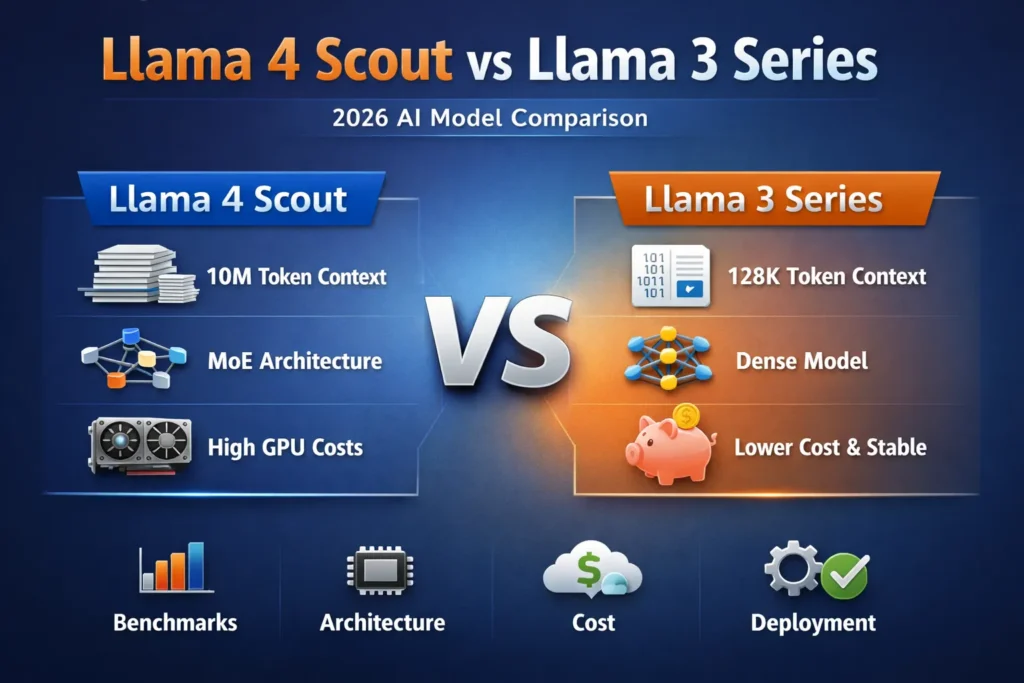
Head-to-Head Benchmark Comparison
Benchmarks are useful indicators, but they must be interpreted cautiously.
Below is a contextualized comparison:
| Metric | Llama 4 Scout | Llama 3.3 70B |
| Context Window | 10M tokens | 128K tokens |
| Architecture | MoE | Dense |
| Long-Context Reasoning | Exceptional | Moderate |
| Coding Stability | Mixed reports | Consistent |
| Hardware Demand | Extremely high | Manageable |
| Fine-Tuning Simplicity | Complex | Easier |
| Deployment Complexity | High | Moderate |
| Ecosystem Maturity | Emerging | Mature |
Real-World Performance vs Benchmarks
Common benchmark suites include:
- MMLU
- GSM8K
- HumanEval
- ARC
- TruthfulQA
These evaluations measure structured reasoning under controlled conditions.
However, benchmarks rarely capture:
- Production latency under concurrent load
- Memory scaling costs
- Infrastructure bottlenecks
- Real-user prompt variability
- Long-tail error patterns
- Stability across extended sessions
Where Llama 4 Scout Excels
- Ultra-long document synthesis
- Enterprise archival systems
- Academic research workflows
- Massive codebase analysis
- Knowledge graph construction
Where Llama 3 Maintains Advantage
- Coding assistants
- Stable SaaS backends
- Cost-sensitive deployments
- Local hosting environments
- Small-team infrastructure setups
In practice, many developers prioritize:
Consistency > Benchmark dominance
Context Window Reality Check: What 10 Million Tokens Actually Means
The 10M token context window is the most promoted feature of Scout.
10 million tokens approximate:
- Thousands of pages of legal text
- Entire software repositories
- Extensive academic archives
- Multi-year communication logs
Impressive but expensive.
Practical Limitations
Extremely long context introduces:
- Substantial VRAM consumption
- Increased inference latency
- Higher cost per request
- Complex optimization requirements
- Larger attention computation overhead
Most real-world applications require:
- 8K–32K tokens
- Occasional RAG augmentation
- Structured memory compression
For many startups, 128K tokens is already more than sufficient.
Ultra-long context is powerful but specialized.
Hardware & Deployment Costs
This is where many articles lack depth.
Long-context MoE models dramatically increase memory and Compute demands.
GPU Requirements Comparison
| Deployment Factor | Llama 4 Scout | Llama 3.3 70B |
| Recommended GPUs | Multi-node cluster | Fewer GPUs |
| VRAM Needs | Extremely high | Manageable |
| Cloud Cost | Significant | Moderate |
| Local Hosting | Impractical for most | Feasible |
Critical Insight
If self-hosting:
Llama 3 is considerably easier to deploy and maintain.
Scout may require:
- Enterprise GPU clusters
- Advanced distributed training systems
- Optimized memory partitioning
- Sophisticated load balancing
Longer context means:
More tokens processed →
Greater compute demand →
Higher inference expenditure
For startups, marginal benchmark gains rarely justify the exponential costs of infrastructure.
Cost Per Million Tokens
While provider pricing varies, conceptually:
- Larger context windows increase per-request computation
- MoE routing introduces overhead
- Long-memory attention amplifies cost
In AI SaaS economics:
Lower inference cost = higher profit margin
Best Use Cases for Each Model
Choose Llama 4 Scout If:
- You process multi-million token archives
- You manage enterprise-scale document systems
- You operate high-performance GPU clusters
- Long-context reasoning is essential
- You build AI research platforms
Choose Llama 3 If:
- You develop coding assistants
- You require stable outputs
- You fine-tune models frequently
- You deploy locally
- You operate under cost constraints
- You prioritize predictable inference
For most startups, Llama 3 remains the pragmatic choice.
Pros & Cons
Pros
- Massive context capacity
- Strong long-sequence reasoning
- Scalable MoE efficiency
- Enterprise-oriented
Cons
- Expensive infrastructure
- Complex deployment
- Routing variability
- Overkill for typical applications
Llama 3 Series Pros
- Stable inference
- Strong coding consistency
- Easier fine-tuning
- Lower hardware barrier
- Mature ecosystem
Llama 3 Series Cons
- Smaller context window
- Less extreme scaling capacity
- Limited ultra-long memory
Step-by-Step Decision Framework
Define Context Requirements
Under 128K → Llama 3
Multi-million tokens → Scout
Assess Infrastructure
Limited GPU budget → Llama 3
Enterprise cluster → Scout
Evaluate Stability Needs
Mission-critical reliability → Llama 3
Research experimentation → Scout
Analyze Budget Constraints
Cost-sensitive → Llama 3
Enterprise-funded → Scout
Common Myths & Misconceptions
Llama 4 Scout Always Outperforms Llama 3
Performance depends on workload characteristics.
Bigger Context Means Better AI
Unused context adds cost, not intelligence.
Benchmarks Tell the Full Story
Real-world stability matters more.
FAQs
A: Not always. Many developers report that Llama 3 provides more consistent coding output.
A: Main differences are architecture (MoE vs dense), context window (10M vs 128K), and hardware requirements.
A: Only if you process extremely large documents or enterprise-scale archives.
A: It generally requires fewer resources and lower inference cost.
A: Most startups benefit more from Llama 3 due to stability and cost efficiency.
Conclusion
In 2026, Llama 4 Scout vs Llama 3 Series is more than a routine upgrade — it reflects a strategic evolution in model design. Llama 4 Scout introduces a Mixture-of-Experts (MoE) approach focused on scalability, efficiency, and handling ultra-long contexts, making it appealing for large-scale AI deployments and advanced workloads.
On the other hand, the Llama 3 Series continues to offer dependable, dense architecture, simpler deployment, and predictable performance across standard enterprise and development environments. It remains a strong choice for teams Prioritizing stability and easier infrastructure management.