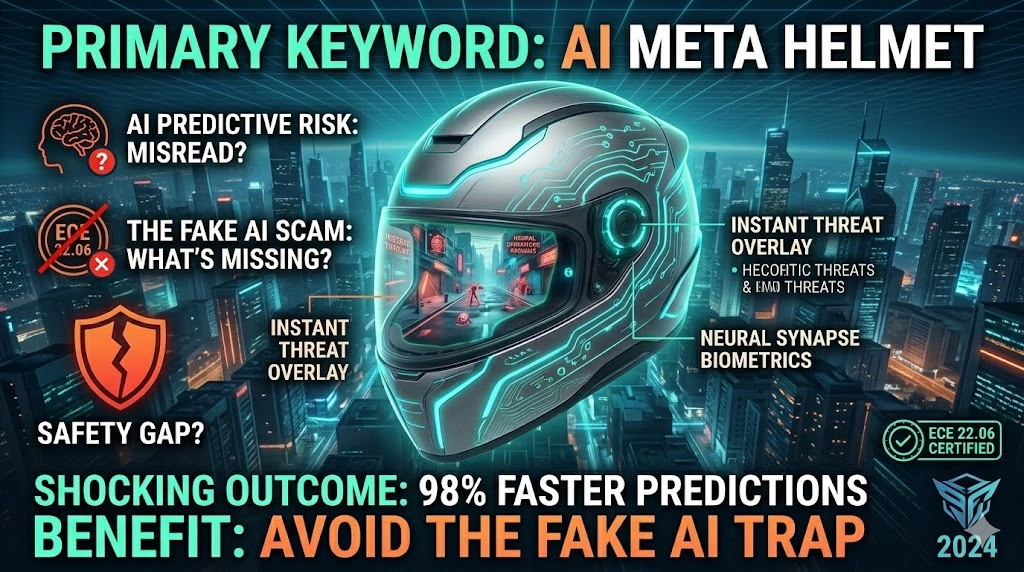
AI Meta Helmet — Real Tech or Viral Scam? The Truth Revealed
AI Meta Helmet is mostly viral hype, not a fully real consumer product. In this guide, you will discover what is genuinely available, what is exaggerated, and how to spot unsafe fake helmets before a dangerous mistake online in Europe. The phrase AI Meta Helmet has become a magnet for attention. It sounds futuristic, dramatic, and almost impossible to ignore. It combines the two most powerful buzzwords in modern tech marketing: AI and Meta. Put them together with the word helmet, and you instantly get a product name that feels advanced, premium, and next-generation.
That is exactly why the term spreads so quickly across short-form video platforms, marketplace listings, and flashy ad creatives. The name itself creates expectation before the product even appears. It suggests intelligence, automation, augmented reality, smart sensing, and a new era of riding safety. For many people, that is enough to trigger curiosity and even impulse buying.
What is an AI Meta Helmet? (Why Everyone Is Confused)
But in practical terms, the reality is far more grounded. In the consumer market, what is usually sold under these futuristic labels is not true cinematic-grade AI, but a mixture of marketing language, ordinary electronics, and selective feature names. Today’s real-world smart helmets generally focus on connectivity, communication, lighting, cameras, navigation assistance, and crash-related alerts rather than full predictive intelligence. Commercial examples from established brands show Bluetooth connectivity, GPS support, voice control, cameras, rear-view systems, active brake lights, and crash detection features, which are useful, but they are not the same thing as the sci-fi promise made by viral ads.
For riders in Europe, this topic is not just about hype. It is about safety, compliance, and making sure that a helmet actually protects your head instead of putting you at greater risk. In Europe, UN Regulation No. 22 covers protective helmets for drivers and passengers of mopeds and motorcycles, and the 22.06 series is the current updated version that manufacturers and buyers need to understand.
By the end of this guide, the reader should understand the difference between marketing fantasy and real-world helmet technology, the warning signs of misleading products, the practical smart-helmet features that exist today, and the standards that matter most when shopping in Europe. That makes the article useful not only for search engines, but for real riders who want clarity before they spend money.
What Is the AI Meta Helmet?
The term AI Meta Helmet is not a formal engineering category. It is a viral label, a conceptual phrase, and a branding shortcut that tries to compress several technologies into one attention-grabbing name. The expression usually implies a helmet that combines artificial intelligence, augmented reality, intelligent sensors, wireless connectivity, and hands-free assistance.
On paper, that sounds impressive. In a marketing video, it sounds even better. A helmet that can “see” the road, warn you about danger, guide your navigation, and act like a personal assistant appears to offer the future of riding in one compact package. The language is emotional and aspirational, which is exactly why it works so well in ads.
The problem begins when the marketing story is treated like a technical specification. The presence of a few LEDs, a Bluetooth module, or a camera does not magically transform a helmet into a truly intelligent protective system. Real smart helmets on the market focus on specific, limited functions: communication, visibility, navigation support, or incident alerts. Consumer products from companies such as CrossHelmet, Cardo, and LIVALL show features like heads-up displays, rear-view cameras, sound control, Bluetooth intercom, crash detection, smart lighting, and GPS/navigation support. Those features are valuable, but they are still feature-based tools, not autonomous predictive systems.
That distinction matters because language shapes expectation. When a product is sold as “AI,” buyers often assume it can interpret traffic, understand context, and prevent collisions with the sophistication of a human expert. In reality, the consumer market is still much closer to a connected helmet than to a fully intelligent riding companion.
So when people ask why the term is everywhere, the answer is simple: it is a perfect storm of trend-chasing language, visual spectacle, and consumer curiosity. It sounds like progress, even when the underlying product is ordinary.
Common Features Advertised Online
Most viral listings for the AI Meta Helmet recycle the same feature claims again and again. The wording changes, but the message is similar: the helmet is supposed to be smarter, safer, and more responsive than traditional gear.
Typical claims include voice control, GPS navigation projected into the rider’s field of view, rear-view visibility, crash alerts, automatic hazard recognition, and smart notification systems. In some cases, sellers also add phrases like “AR visor,” “real-time threat analysis,” or “collision prediction,” which are powerful words because they suggest live, machine-driven intelligence.
The issue is not that smart helmet features do not exist. They do exist. The issue is that the promise often outruns the product. Real consumer smart helmets currently emphasize communication and convenience. CrossHelmet, for example, publicly lists a head-up display, sound control, rear-view camera, touch panel, safety light, and connectivity. LIVALL describes smart motorcycle helmets as integrating Bluetooth connectivity, GPS navigation, voice control, and even built-in cameras. Cardo’s helmet and accessory ecosystem highlights crash detection, helmet-health monitoring, active brake lighting, and communication functions.
That gives us the most important lesson in this whole topic: a feature list is not the same thing as a truly intelligent system. A camera is a camera. Bluetooth is Bluetooth. A heads-up display is a display. Add them together, and you may create a very useful helmet, but not necessarily an AI-driven safety platform.
This is why readers should treat the online wording carefully. The more extravagant the promise, the more important it becomes to ask for proof, certification, and independent testing.
Why the Keyword “AI Meta Helmet” Went Viral
This phrase became popular for three main reasons, and all three are rooted in modern digital behavior.
First, the word AI is a performance word. It grabs attention instantly. It signals intelligence, automation, speed, and sophistication. Even when the actual technology is basic, the label creates a premium impression.
Second, the word Meta adds a futuristic layer. It suggests immersion, virtual experience, next-gen interfaces, and a product that belongs in the coming era rather than the present one. In marketing psychology, that kind of language is very effective because it makes ordinary objects feel visionary.
Third, social media rewards spectacle. A 12-second clip can make a simple helmet look revolutionary if the lighting, music, captions, and camera angle are carefully designed. When the audience sees a glowing visor, a dramatic voice-over, and a futuristic shell, the product seems more advanced than it may actually be.
That combination creates a powerful loop. The stronger the visual effect, the more people share it. The more people share it, the more the term spreads. The more the term spreads, the more legitimate it appears. Viral repetition becomes a substitute for verification.
The result is not just popularity. It is confusion. Buyers start searching for a product that sounds real because everyone else is talking about it, even if the underlying item is just a repackaged smart helmet, a basic helmet with decorative lighting, or a low-cost shell dressed up with tech language.
Is the AI Meta Helmet Real or Fake?
This is the central question, and it deserves a direct answer.
The viral version is usually Misleading. Many of the online examples attached to this name rely on exaggerated advertising, vague specifications, and unrealistic feature claims. Some listings use futuristic words to describe simple electronics. Others show visual effects that do not prove advanced functionality at all. In that sense, the “AI Meta Helmet” label often behaves more like a branding illusion than a trustworthy technical category.
That does not mean every helmet marketed with smart features is fraudulent. It does mean that the consumer should separate three different things: branding, functionality, and safety.
A product can look futuristic and still be basic. It can include electronics and still not be intelligent. It can be called “smart” and still be only partially useful. Real commercial smart helmets today tend to offer communication, visibility, and convenience features rather than the deep, predictive, context-aware AI promised by viral content. CrossHelmet’s public feature set, for example, centers on HUD, rear-view camera, sound control, touch panel, safety light, and connectivity. LIVALL and Cardo similarly emphasize Bluetooth, GPS, cameras, crash detection, lighting, and monitoring tools.
So the accurate answer is this: the phrase is real as a search term and marketing trend, but it is usually not a reliable description of a fully functioning consumer product.
The Viral Version: Why It Feels Real
The viral version feels convincing because it borrows the appearance of innovation.
It uses glossy images, reflective shells, glowing panels, digital overlays, and language that sounds technical enough to satisfy a quick scroll. It also benefits from a modern trust shortcut: many people assume that if a product looks advanced, it must have advanced engineering behind it.
This is where the psychological trap Begins. Visual design can create perceived credibility. A helmet with an angular shell, integrated lights, a visor display, and a polished promotional video can look like a premium safety device, even if its internal technology is modest. That makes it easy for viewers to confuse aesthetic sophistication with functional intelligence.
The broader consumer smart-helmet market proves that there is a genuine foundation for this style of product. Today’s real offerings can include communication systems, GPS support, voice control, rear-view cameras, crash detection, smart lighting, and helmet-health monitoring. Those are real features with real utility. They are also the reason the viral narrative works so well: it starts from a kernel of truth and then stretches that truth into something far bigger.
The result is a product category that feels more advanced than it often is. That is why the reader must look beyond the glow, the branding, and the emotional language.
The Real Version: What Exists in the Market Today
The real version is much more practical, much more limited, and much easier to explain.
What exists today is the smart helmet category. These helmets are designed to improve convenience, communication, and visibility. Some models emphasize speaker systems and intercom connectivity. Others offer rear cameras or HUD-style displays. Some include fall detection, emergency alerts, active brake lights, or helmet-integrity monitoring. The strongest commercial examples make safety and awareness feel more integrated, but even then, the technology is still bound by what current hardware and software can reliably deliver.
That matters because people often confuse “smart” with “AI.” They are not the same. A helmet can be smart without being predictive. It can be connected without being autonomous. It can be helpful without being revolutionary.
For European riders, the practical question is not whether a helmet sounds futuristic. The question is whether it is certified, comfortable, durable, and actually useful on the road. Under UN Regulation No. 22, the helmet is a protective device, not a gadget first and a safety product second. The technology should support that purpose, not distract from it.
How Real AI Helmets Actually Work
To understand what a true AI helmet would require, it helps to break the concept into its core layers.
The first layer is computer vision. That means cameras or visual sensors collect information from the environment. In an ideal system, the helmet would identify lanes, vehicles, pedestrians, obstacles, weather conditions, and potentially dangerous movement. The machine would not merely record the world; it would interpret it.
The second layer is AI processing. That is the decision engine. In theory, models could classify objects, detect risk patterns, estimate trajectories, and prioritize warnings. This requires not just software, but enough computing power to make those decisions quickly and accurately while the rider is moving.
The third layer is augmented reality. This is where visual data is projected into the rider’s field of view. Instead of looking down at a phone, the rider would see navigation cues, alerts, and system status inside the visor space.
The fourth layer is sensor fusion. Real systems would combine GPS, gyroscopes, accelerometers, and possibly other sensors to understand speed, tilt, movement, and impact. That helps the system distinguish normal riding behavior from emergencies.
Is the AI Meta Helmet Real or Fake? (Biggest Buyer Risk)
The fifth layer is ergonomic safety Integration. This is the part most people forget. Even if the technology works, it still has to live inside a helmet that protects the head, fits properly, manages airflow, and does not create dangerous distractions. A beautiful display is useless if it blocks attention or weakens the protective structure.
This is where the gap between idea and reality becomes obvious. A true AI helmet is not simply a helmet with electronics glued into it. It is a tightly engineered system that must balance safety, latency, optics, battery life, durability, and legal compliance. That is a major engineering burden, which is why the consumer market has not yet reached the fully realized version that viral ads imply.
Why Fake AI Helmets Are Dangerous
The danger is not only that buyers waste money. The deeper problem is that misleading helmet marketing can affect rider behavior.
A fake or poorly made helmet may provide the illusion of intelligence while failing at the actual job of protecting the head. That is a serious issue because a helmet is not a decorative accessory. It is personal protective equipment, and any weakness in its shell, foam, strap, or fit can matter in a crash.
The second danger is distraction. A product that claims to be “AI-powered” may encourage the rider to trust alerts, signals, or screens too much. If the system is unreliable, delayed, or poorly calibrated, it can create hesitation at the wrong moment. In riding, hesitation is expensive.
The third danger is compliance confusion. In Europe, helmets must meet the relevant motorcycle helmet regulations. UN Regulation No. 22 applies to protective helmets for mopeds and motorcycles, and the 22.06 series is the current updated framework that buyers should recognize. If a product is sold with vague claims but no proper certification evidence, it should be treated with extreme caution.
The fourth danger is modification risk. The UNECE has also discussed how communication accessories interact with helmet approval, which underlines a simple truth: attachments and integrated electronics can affect compliance, depending on design and verification. That is one more reason to avoid blind trust in accessory-heavy marketing.
In short, the problem is not just misinformation. The problem is that misinformation about a helmet can become a safety issue in the real world.
What to Watch for Before Buying
A serious buyer should not ask, “Does it look cool?” The better questions are, “Is it certified? Is it honest? Is it useful? Is it safe?”
A trustworthy product should clearly explain what it does and what it does not do. It should list its actual hardware and software features without hiding behind vague phrases. It should show proper safety certification. It should describe battery life, fit, ventilation, and intended use in plain language. It should not promise miracle-level intelligence at bargain-bin pricing.
In Europe, the safety standard is especially important. A helmet is part of the rider’s physical protection system, and the technical details matter. Certification is not a decorative stamp. It is a verification process that should be visible, understandable, and traceable.
There is also a common-sense rule: if the product page spends more time selling fantasy than explaining engineering, the buyer should slow down. Authentic gear does not need theatrical overstatement to prove value. It needs evidence.
Can You Buy a Real AI Meta Helmet in 2026?
The accurate answer is more nuanced than a simple yes or no.
If by real AI Meta Helmet you mean the fully futuristic, all-in-one, predictive, augmented-reality helmet from viral videos, then the consumer market is not there yet. What exists today are connected helmets, smart helmets, and modular safety systems that solve specific problems well, but do not deliver the complete science-fiction promise.
If by real you mean practical smart features, then yes, those exist. Riders can buy helmets and helmet ecosystems with Bluetooth communication, rear-view cameras, head-up displays, voice control, smart lighting, crash detection, active brake lights, and helmet-health monitoring. CrossHelmet publicly lists a head-up display and rear-view camera. LIVALL describes Bluetooth connectivity, GPS navigation, voice control, and built-in cameras. Cardo’s helmet system highlights crash detection and real-time helmet monitoring.
That distinction should be central to any honest article. The consumer does not need hype; the consumer needs precision.
What You Can Buy Instead
The best alternative is not “fake AI.” It is a good, certified smart helmet or a certified regular helmet paired with reliable accessories.
A modern rider can build a very capable setup using a certified helmet, a quality communication system, and a navigation app on a phone or integrated display. This creates a practical balance of safety and convenience without falling into exaggerated claims.
Current commercial smart-helmet examples show the direction of the market. Some prioritize communication and group riding. Others emphasize cameras, lights, or fall alerts. Others work on helmet-integrity monitoring and ergonomics. These are legitimate innovations, and they are more credible than an anonymous store page promising miracle-level AI at a suspiciously low price.
For many buyers, that is enough. The goal is not to own the most futuristic object in the garage. The goal is to ride more safely, more comfortably, and with fewer distractions.
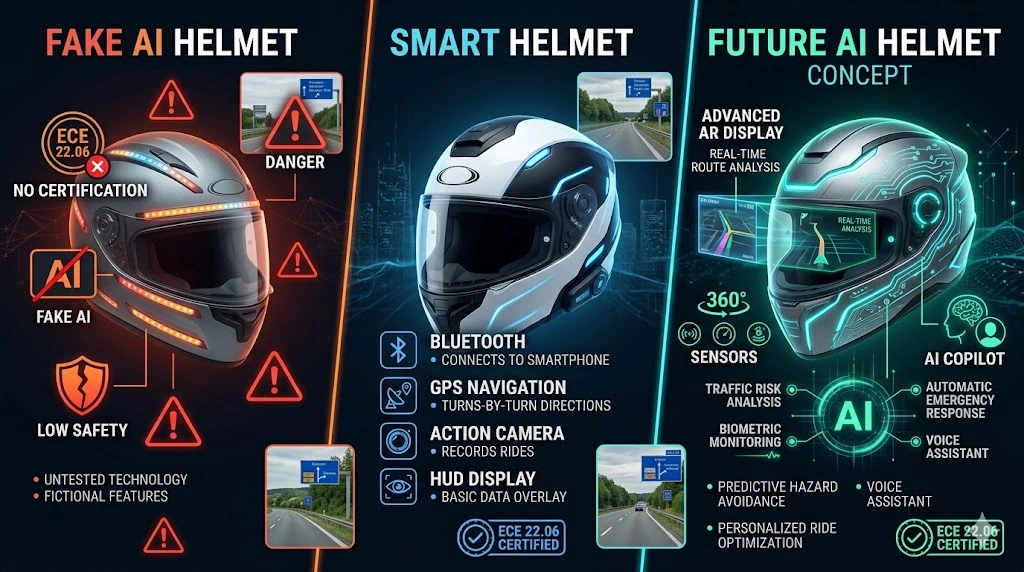
AI Meta Helmet vs Smart Helmets vs Advanced Concept Helmets
The cleanest way to understand the market is to separate it into three categories.
The first category is the viral AI Meta Helmet. This is mostly a marketing concept. It sells the idea of intelligence, immersion, and next-level danger detection, but the claims are often vague or unsupported.
The second category is the smart helmet. This is the real consumer category. It includes useful features like Bluetooth connectivity, GPS assistance, voice control, cameras, rear-view visibility, crash detection, lighting, and health or integrity monitoring. These products are tangible and commercially available.
The third category is the advanced concept helmet. This is where future-facing research, prototypes, or high-end experimental systems may live. These systems are more ambitious, but they are not the same as mass-market equipment for ordinary riders. They may exist as prototypes, concept demonstrations, or specialized platforms, but they are not the everyday answer for a consumer shopper.
This three-part split helps readers avoid confusion. It also helps search engines understand the article’s intent, because the topic is not just “helmet.” It is authenticity, capability, and safety.
Pros & Cons of the AI Meta Helmet Concept
The concept has genuine appeal. It captures people’s imagination because it sits at the intersection of safety, convenience, and technological ambition. In theory, a helmet that gives intelligent warnings, visual guidance, and hands-free assistance could improve road awareness and reduce friction during rides.
It also has a strong cultural advantage: it feels modern. Readers and viewers naturally gravitate toward products that seem to represent the future. That makes the concept powerful in branding, social media, and product storytelling.
But the downside is serious. The current consumer market is still full of exaggeration. Many products are promoted with inflated language, unclear technical details, and weak proof. That creates risk for buyers who assume they are getting advanced protection when they are really getting a basic shell with cosmetic electronics.
The other downside is practical: real-world riding conditions are harsh. Battery life, heat, glare, latency, calibration, fit, rain, vibration, and maintenance all matter. A concept can be brilliant in a video and frustrating on a road.
So the concept has upside, but the present-day execution is uneven. That is the honest position.
How to Use Smart Helmet Technology Today (Step-by-Step Guide)
Start with the helmet itself. Choose a model that is properly certified for your market and intended use. In Europe, that means paying attention to the relevant motorcycle helmet standard and not treating the helmet as if it were just another gadget. UN Regulation No. 22 is the framework riders should take seriously.
Next, separate safety from convenience. Safety comes from the shell, fit, retention system, comfort, and certification. Convenience comes from electronics. Do not let the electronics distract you from the helmet’s core function.
Then decide which smart functions genuinely help your riding. For some riders, that means Bluetooth communication. For others, it may be a rear-view camera, a HUD, or a fall alert. Real consumer smart helmets and helmet systems already cover many of these needs, including Bluetooth intercom, cameras, active lighting, and crash-related notifications.
Finally, keep the setup simple. The safer the system, the easier it is to operate under stress. A helmet should reduce cognitive load, not add to it.
Tips to Choose Safe Smart Helmets in Europe
The first rule is certification. A proper motorcycle helmet should clearly show the standards it meets, and the buyer should be able to verify that information rather than guessing.
The second rule is brand transparency. A real manufacturer tells you what the product does, how it is tested, and what limitations it has. A shady seller hides behind adjectives.
The third rule is proportion. If the product is priced suspiciously low while claiming elite-level AI, caution is wise. Deep engineering costs money. Testing costs money. Compliance costs money. That means a miracle product at a tiny price often signals compromise somewhere.
The fourth rule is functional honesty. You should know whether the product offers Bluetooth, navigation support, HUD features, cameras, crash detection, or anything else. Current smart helmets commonly advertise exactly those features, which makes them credible references for what the market can actually support today.
The fifth rule is comfort. A helmet can be technologically interesting and still be miserable to wear. If the fit is wrong or the ventilation is poor, the rider pays for it on every journey.
Europe Relevance: Why This Topic Matters More Here
Europe is a serious market for this conversation because safety expectations are high and helmet compliance is not optional.
Motorcycle and moped riders need protective helmets that comply with applicable regulatory requirements. UN Regulation No. 22 is the international reference point, and the 22.06 series reflects the modernized standard that matters in current discussions of helmet safety. That is why European buyers should pay attention not only to marketing, but to homologation and product legitimacy.
This is also why misleading tech claims are a bigger issue in Europe than they may appear at first. A flashy product can create the illusion of advanced protection, yet the rider still depends on the helmet’s actual structure and verified performance. Europe’s regulatory mindset makes this especially important: the product has to prove itself.
So for European readers, the message is simple. Do not let futuristic branding outrun the legal and safety reality. The helmet has to work first. Everything else comes second.
Future of AI Helmets (2026–2030 Predictions)
The future is promising, but it should be discussed with realism.
There is clear momentum toward better sensors, better displays, better connectivity, better crash awareness, and smarter rider assistance. That direction is already visible in current consumer products, which increasingly combine communication, visibility, and incident-related features. CrossHelmet emphasizes HUD and camera support. LIVALL highlights connected smart features. Cardo’s BEYOND helmet introduces monitoring and crash detection.
The next stage will likely improve integration. That means cleaner displays, lighter batteries, better ergonomics, more reliable alerts, and more useful rider assistance without overwhelming the user.
But the road to full AI is still long. True predictive hazard perception needs stable hardware, trustworthy algorithms, low-latency processing, and strong safety validation. Those requirements are not trivial. They take time, engineering discipline, and real-world testing.
So the future may be impressive, but the timeline should not be exaggerated. The smartest position is optimism with restraint.
Common Mistakes People Make
One common mistake is believing a viral clip without checking the product details. Social content is designed to persuade quickly, not to teach carefully.
Another mistake is ignoring certification. A helmet is not a fashion item. The protective structure matters more than the promotional language.
A third mistake is assuming that “AI,” “Meta,” or “Smart” automatically means safe. Those words are branding tools, not proof.
A fourth mistake is buying based on appearance alone. Some of the most visually dramatic products are the least reliable.
A fifth mistake is mixing up convenience with protection. Bluetooth and cameras may improve the ride experience, but they do not replace proper impact protection, fit, or certification. The currently available smart-helmet market makes this distinction very clear.
FAQs
The viral version is usually more marketing than reality. Real smart helmet features do exist, but the consumer market today is mainly built around Bluetooth, cameras, HUDs, navigation support, lighting, and crash-related functions rather than the fully predictive AI experience suggested by flashy ads.
You can buy smart helmets and certified helmets with electronic features in Europe, but the fully futuristic “AI Meta Helmet” described in viral content is not the same as the products actually sold by established brands. In Europe, the helmet must still align with the relevant motorcycle helmet safety framework, including UN Regulation No. 22 / 22.06 references.
Yes, if the features are genuinely useful to your riding style. Smart helmets can improve connectivity, navigation convenience, visibility, and incident awareness. Current commercial examples show features like Bluetooth, GPS support, cameras, crash detection, and helmet monitoring, which can be helpful when used responsibly.
The closest thing today is a well-designed smart helmet system with communication, camera, display, lighting, and emergency-related features. These helmets are practical, connected, and increasingly advanced, but they are still not the same as a full predictive AI helmet.
Yes. A misleading helmet can create a false sense of security, distract the rider, and obscure whether the product actually meets safety expectations. In Europe, helmet compliance matters, and buyers should treat unverified claims with caution.
Conclusion: The Reality Behind the AI Meta Helmet
The AI Meta Helmet is a perfect example of how a powerful phrase can race ahead of the product behind it. It combines futuristic wording, visual drama, and consumer curiosity into one irresistible search term.
What is real today is more modest, but still useful. Smart helmets can offer Bluetooth communication, GPS support, cameras, HUD elements, crash detection, active lights, and helmet-health monitoring. These features are already appearing in the market, and they matter to riders.
What is mostly fake or exaggerated is the claim that viral helmets already deliver full AI-powered predictive intelligence in a safe, consumer-ready form.
For Europe, the decision should always start with safety and compliance. The helmet must protect first, comply first, and prove itself first. The futuristic part is interesting, but the road demands something more important: trust.