Meta AI Explained (2026) — What Nobody Tells You First
Meta AI Explained is Meta’s AI assistant for chat, content, search, and productivity across apps like WhatsApp, Instagram, and Facebook. If the features, pros, or limits feel confusing, this guide breaks everything down clearly. You’ll learn real use cases, hidden benefits, and surprising drawbacks most users discover too late in 2026.
Meta AI has moved from being a convenient in-app assistant to a much broader AI experience across Meta’s ecosystem. In 2026, the product is no longer just about quick chat replies. It now sits at the intersection of conversational AI, multimodal generation, social content workflows, and real-time information retrieval across Meta’s apps and devices. Meta’s official updates also show a steady expansion in Europe, including a rollout across 41 European countries and 21 overseas territories, plus broader real-time content and partner news integrations in 2026.
What Is Meta AI & Why Is Everyone Talking About It?
For Europe-based users, this matters because the AI landscape is not just about capability anymore; it is also about accessibility, compliance, language coverage, and where the assistant lives inside everyday digital behavior. The European Union’s AI policy framework is actively shaping how AI is deployed, governed, and trusted, with the AI Act and the Apply AI Strategy pushing trustworthy adoption across sectors and SMEs. That makes Meta AI especially relevant as a consumer-facing, social-first AI layer that must operate inside a highly regulated market.
What is Meta AI?
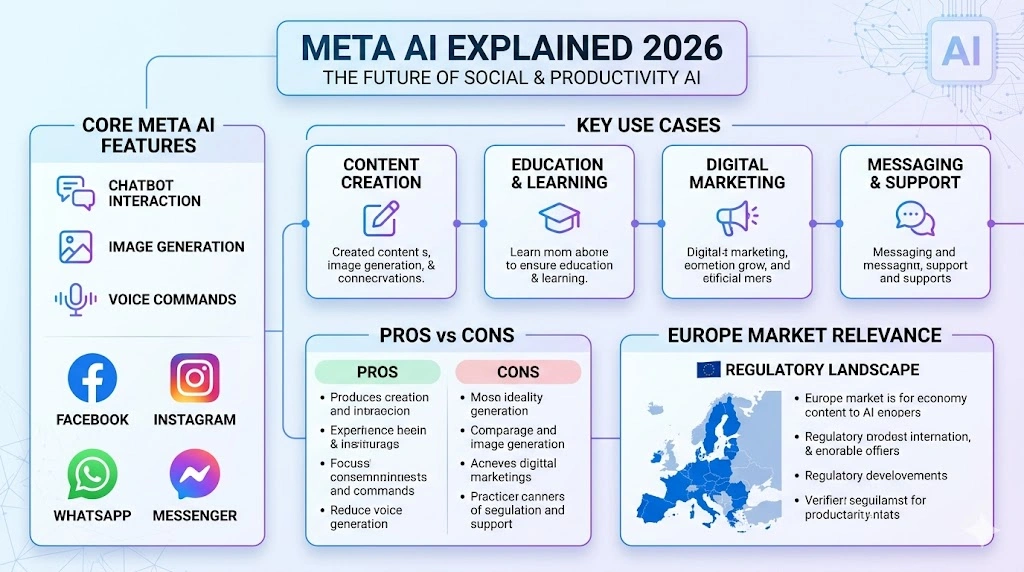
Meta AI is Meta’s built-in artificial intelligence assistant that appears across its apps and products, rather than living only as a separate standalone tool. Meta has described it as an assistant you can use across Facebook, Instagram, WhatsApp, and Messenger, and more recently as part of a wider app and web experience that lets people chat, discover content, and interact with creative tools.
In practical NLP terms, Meta AI is best understood as a context-aware, multimodal assistant embedded inside a social graph. That means it is designed to recognize intent quickly, answer short queries, support conversation flow, and generate content in formats that fit social media behavior, such as captions, replies, images, edits, and short videos. That interpretation follows from Meta’s own product direction around chat, voice, image generation, AI Studio, video editing, and news-aware responses.
The key purpose of Meta AI
Meta AI is designed to reduce friction. Instead of asking users to leave the app, open another tab, or switch to a separate workflow, Meta places the assistant where people already spend time: messaging, feeds, search bars, and media-sharing surfaces. That design makes it ideal for rapid, lightweight tasks such as brainstorming, summarizing, replying, or generating visual ideas.
How Meta AI Works
Meta AI is powered by Meta’s model stack and research pipeline, which includes the Llama family and newer model iterations. Meta has repeatedly tied Meta AI to Llama-based advances, and in April 2026, it said Muse Spark powers a smarter and faster Meta AI assistant, with rollout to WhatsApp, Instagram, Facebook, Messenger, and AI glasses planned in the coming weeks.
From a systems perspective, the assistant works as a conversational interface over several capabilities: text generation, web-connected information access, image generation, voice interaction, content discovery, and, in some markets, more advanced media editing features. Meta’s own newsroom has said Meta AI can draw from broader real-time content sources, including global news and entertainment, and that the assistant can generate results across content from friends, followers, and the web.
The core NLP flow is straightforward: the user expresses intent, the system parses context, the assistant selects a response path, and output is delivered inside the same app or surface. What makes Meta AI distinct is not just model intelligence but distribution. The assistant is woven into social behavior, so it can respond in a feed, a DM, a camera workflow, a story editor, or a web interface without forcing a context switch.
Key Features of Meta AI
1. Deep integration across Meta apps
One of Meta AI’s strongest advantages is distribution. Meta has positioned the assistant across Facebook, Instagram, WhatsApp, Messenger, the Meta AI app, and the web, so users can move between conversations, content, and media without breaking flow. In 2025, Meta said the app and web would support continuity, and in 2026, it continued to expand the assistant’s surface area across products and devices.
2. Voice interaction
Meta added voice capabilities that let people talk to Meta AI on Messenger, Facebook, WhatsApp, and Instagram DM, with spoken replies as well. This matters for usability because it lowers interaction cost and makes the assistant easier to use during multitasking, mobile browsing, and hands-free moments.
3. Photo understanding and image-based assistance
Meta AI can analyze images, answer questions about them, and help edit them in conversational form. Meta has said users can share a photo and ask what it is, how to do something with it, or how to modify it. It also supports photo touch-ups inside WhatsApp and other image-based creative flows. In NLP and multimodal terms, that is a classic step from text-only dialogue to vision-language interaction.
4. Image generation and creative visuals
Meta AI can generate images and help users create visual concepts quickly. Meta’s product updates show continued improvements in image generation, and its own learning pages say the assistant can generate both AI images and short AI videos. That makes Meta AI useful for concept art, social graphics, ad ideas, mood boards, and lightweight creative experimentation.
5. AI Studio and customizable assistants
Meta AI Studio gives people a way to create and discover AI characters, including creator-style assistants. Meta says AI Studio lets users build AIs for entertainment, productivity, support, and new experiences. This shifts Meta AI from a single assistant into a platform for persona-driven, task-specific interactions.
6. Video creation and editing
Meta has added more video-focused AI tools, including video editing in the Meta AI app, the Meta.AI website, and the Edits app. In 2025, it said users could transform short clips using more than 50 editing prompts, and in 2025, it also introduced Vibes as a feed for creating and remixing short-form AI videos. In 2026, the product direction continued toward more media-rich creation.
7. Real-time content and news access
Meta AI’s 2026 newsroom update says the assistant now offers a broader range of real-time content, including global news, entertainment, and lifestyle stories, with links to partner publishers such as News Corp, Le Figaro, Prisa, and Süddeutsche Zeitung. That makes the assistant more useful for topical discovery and current-event browsing.
8. Improved personalization and memory direction
Meta’s March and April 2025 updates show a clear roadmap toward more personalized and context-rich AI experiences, including memory and personalization in the US and broader creative tools in more markets. This is a strong signal that Meta is moving from generic prompt-answering into relationship-aware assistance.
Use Cases of Meta AI
1. Social media content creation
Meta AI is especially strong for content that lives inside social ecosystems. It can help write captions, post ideas, quick comments, short promotional blurbs, and reel hooks. That makes it highly practical for creators who need fast output rather than long-form editorial depth.
2. Education and learning support
Students can use Meta AI for simple explanations, quick summaries, and concept clarification. Meta has explicitly framed the assistant as useful for learning, studying, and answering questions, which aligns well with lightweight educational support and short-form comprehension tasks.
3. Small business marketing
For small businesses, Meta AI is practical for ad copy, product descriptions, response suggestions, and idea generation. Since Meta’s own ecosystem is already central to many small-business marketing funnels, the assistant can fit naturally into the daily workflow of a founder or social media manager.
4. Messaging assistance
Meta AI is useful in chats because it can suggest replies, clarify tone, and help people respond faster. The fact that voice, image sharing, and photo understanding are built into the conversation flow makes it more versatile than a simple text box assistant.
5. Creative brainstorming
Meta AI is good at ideation. It can generate visual themes, campaign angles, story concepts, and short prompts that creators can then refine. In practical workflow terms, this makes it a high-speed brainstorming layer rather than a final production engine.
6. Media edits and quick transformations
Meta’s recent updates show that people can use Meta AI for photo and video transformation, including background changes, style shifts, and short-form video edits. This is valuable for creators who need fast, polished output without professional editing software.
Meta AI vs ChatGPT-style AI Tools
So Meta AI and ChatGPT-style tools overlap, but they are optimized for different kinds of user intent. Meta AI is built for ambient, social, in-app assistance. ChatGPT, by contrast, is designed as a more general-purpose AI chatbot and now offers voice, web search, tasks, deep research, custom GPTs, apps, and more advanced work modes.
In functional terms, Meta AI is better aligned with quick social outputs, image and video touch-ups, casual question answering, and interaction inside Meta products. ChatGPT-style tools are generally better suited to multi-step reasoning, deeper writing tasks, coding workflows, connected apps, and project-style knowledge work. That is an inference based on the official product directions of both ecosystems.
A useful way to think about it is this: Meta AI is the embedded social assistant, while ChatGPT is the flexible general-purpose work assistant. Meta AI helps you stay inside the platform you are already using; ChatGPT is built to be a broader external workspace.
Performance Analysis of Meta AI
Speed
Meta AI is fast because it is embedded directly into high-frequency products such as Messenger, WhatsApp, Instagram, and Facebook. The assistant is designed for immediate interaction rather than a separate, slower research workflow.
Accuracy
For short, everyday questions, Meta AI appears well-suited to quick retrieval and conversational support. For deeper analysis, however, Meta itself has kept expanding the assistant’s content sources and model stack, which suggests that real-time relevance and balance are ongoing product goals rather than fully solved problems. That makes “good for daily questions, less ideal for complex reasoning” a reasonable inference.
Creativity
Meta AI is increasingly creative in image, video, and social content use cases. Its strength is not long-form literary depth; it is rapid generation, remixing, and content variation for social formats. That is why it feels strong for captions, visuals, and media prompts, but less specialized than dedicated writing or research tools.
Pricing and Accessibility
Meta has described Meta AI as free and already available across its apps in multiple markets, with continued expansion over time. In 2026, the bigger variable is not only price but feature availability by region, app version, and market rollout.
For many users, the accessibility advantage is the real value. There is no major onboarding friction, no separate subscription just to try the assistant, and no need to learn a completely new interface if you already use Meta products daily.
Meta AI in Europe
Europe is one of the most important regions for Meta AI because the market combines high social media usage, strong creator economies, multilingual needs, and a fast-evolving regulatory environment. Meta’s March 2025 rollout covered 41 European countries and 21 overseas territories, beginning with intelligent chat in six European languages. By 2026, Meta was also adding more international content and media-related experiences.
The regulatory side matters just as much as the product side. The EU AI Act is the bloc’s first comprehensive legal framework for AI and is explicitly designed to foster trustworthy AI in Europe. The European AI Office was also established as the EU’s center of AI expertise to support the development, deployment, and governance of trustworthy AI. For a consumer assistant like Meta AI, that means Europe is not just a growth market; it is a policy-sensitive one.
Meta has also said it wants to train models in the EU using interactions with AI at Meta and public content shared by adults on Meta products, while giving EU-based people the ability to object. That is an important privacy-and-governance signal for publishers, creators, and businesses operating in Europe.
The Apply AI Strategy further shows that Europe wants AI adoption to strengthen competitiveness, support SMEs, and promote a trustworthy, human-centric approach. For content creators and marketers, this means Meta AI’s role in Europe should be viewed not just as a convenience tool but as part of a broader AI adoption curve across the region.
Pros and Cons of Meta AI
Pros
Meta AI is easy to access, fast, social-native, and useful for short content and conversational support. Its strongest advantage is that it appears inside apps people already use every day, and Meta keeps broadening it with voice, photo understanding, video tools, and real-time content access.
It is also a strong fit for beginners. Because it feels embedded and familiar, the learning curve is lower than for many standalone AI tools. That makes it useful for students, casual users, creators, and small businesses that want immediate value without technical complexity.
Cons
Meta AI still has limits in deep reasoning, advanced research, high-end coding, and long-form SEO writing. Meta’s own product direction shows it is improving rapidly. But much of its strength is still in quick, contextual. Social-first interactions rather than specialist professional workflows.
Another limitation is ecosystem dependence. Since Meta AI is deeply tied to Meta’s apps and product choices, users who want a tool that is more open-ended, more workflow-neutral, or more customizable may prefer a general-purpose assistant instead. That is an inference based on how the products are positioned.
How to Use Meta AI
Using Meta AI is simple. Open one of Meta’s apps, access the chat or assistant surface, and ask a question or request a task. On the web or in the Meta AI app, users can continue conversations and move between voice, text, and creative actions more fluidly. Meta’s product updates show that this cross-surface continuity is an intentional part of the experience.
A good practical pattern is to use Meta AI for the first draft, then refine the output yourself. This is especially effective for captions, post ideas, image prompts, and short explanations. In NLP terms, Meta AI works best when the task is specific, short-horizon, and highly contextual.
Best Prompt Tips for Meta AI
The strongest Meta AI prompts are short, concrete, and goal-oriented. Since the assistant is optimized for quick conversational output, clear intent usually performs better than a vague, overloaded request. For example, “Write a short Instagram caption for a beach photo in a fun tone” is better than “Create a full marketing strategy for my post.” This is a practical prompt-engineering inference grounded in Meta’s social-content focus.
You also get better results when you specify format, tone, audience, and length. That is standard NLP prompting practice, but it is especially relevant for Meta AI because the assistant is designed to respond inside fast-moving social and messaging contexts.
Future of Meta AI
The product trajectory suggests that Meta AI is moving toward a more multimodal assistant that can handle text, voice, photos, video, content discovery, and contextual actions across Meta’s ecosystem. The company’s 2025 and 2026 updates around Vibes, video editing, AI Studio, support automation, and Muse Spark point to a future where the assistant becomes more creative, more practical, and more integrated.
For Europe, the long-term story is likely to be shaped by language expansion, regulatory compliance, and trust. If Meta keeps improving real-time content, multilingual quality, and region-aware behavior while staying aligned with EU rules, Meta AI could become a major mainstream assistant for everyday users and small businesses. That is an inference, but it is strongly supported by Meta’s own Europe rollout and the EU’s policy direction.
FAQs
Meta AI is used for social media assistance, content creation, answer generation, image and video tasks, and everyday conversation inside Meta’s apps and web surfaces. Meta has explicitly described it as helpful for getting things done, learning, creating, and connecting across Facebook, Instagram, WhatsApp, and Messenger.
Meta has described Meta AI as free and available in its apps, although the exact feature set can vary by region and rollout stage. In 2026, some capabilities are expanding gradually across markets, so availability is not identical everywhere.
No. Meta AI is excellent for social-first, quick, in-app tasks, but ChatGPT-style tools are more suitable for advanced writing, deeper reasoning, coding, research, and broader workflow use. OpenAI’s current ChatGPT positioning includes voice, web search, apps, agentic task support, and advanced reasoning-oriented features.
Yes. Meta said it began rolling out Meta AI across 41 European countries and 21 overseas territories in March 2025, starting with intelligent chat in six European languages. Meta also continued expanding features for Europe in 2025 and 2026.
Meta AI can help with short marketing copy, captions, and idea generation, but it is not the strongest choice for deep SEO writing, topical authority articles, or long-form editorial work. Its product strengths are social integration, rapid interaction, and media-oriented creativity.
Conclusion
Meta AI in 2026 is a social-first, multimodal assistant built for speed, accessibility, and everyday usefulness. Its strongest value lies in the places people already spend time: chats, feeds, stories, media tools, and app-native workflows. Meta’s own updates show consistent momentum across Europe, broader content access, voice interaction, image understanding, AI Studio, and video editing.
For Europe-based creators, students, and small businesses, the best way to think about Meta AI is as a fast first-pass assistant. It is useful for ideation, lightweight content, and instant help, while more advanced AI platforms remain better suited for deep research, coding, and long-form professional production. That balance is likely to define how Meta AI is used through 2026 and beyond.