Introduction
In the rapidly evolving ecosystem of large language models (LLMs), the year 2026 represents a critical inflection point where artificial intelligence systems are no longer evaluated purely on their generative fluency, but rather on semantic efficiency, contextual depth, computational optimization, and domain-specific intelligence.
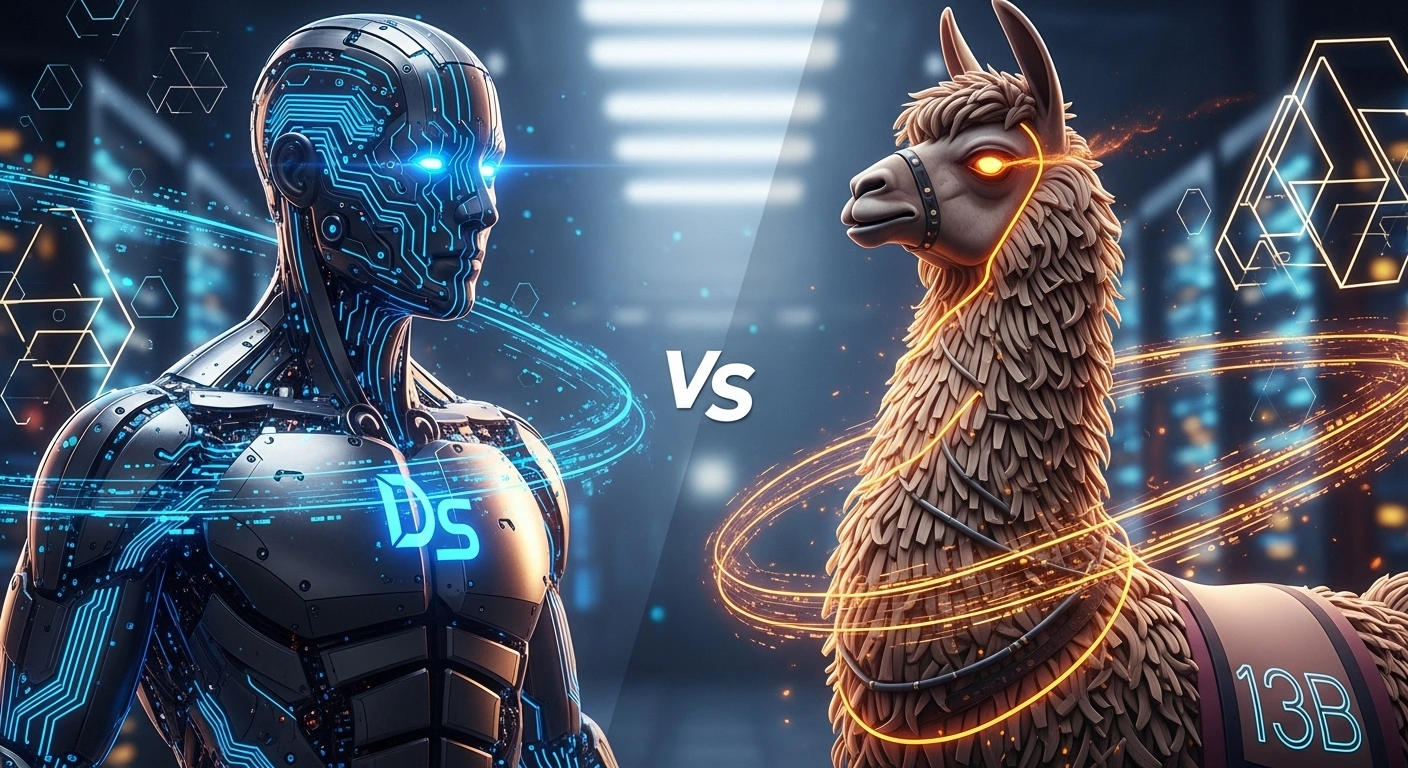
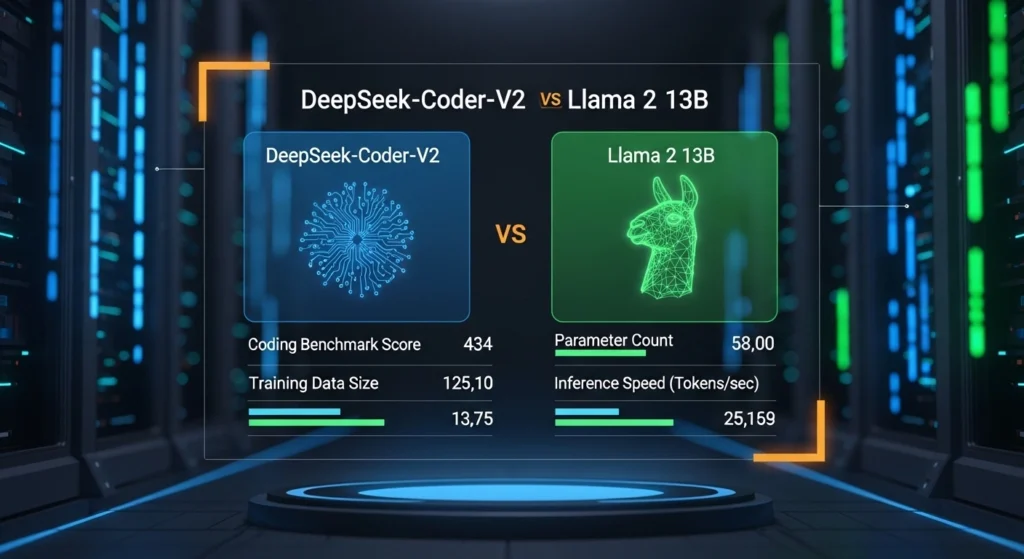
Within this paradigm shift, the comparison between DeepSeek-Coder-V2 and Llama 2 13B becomes particularly significant for developers, data scientists, and AI engineers aiming to build production-level applications.
Modern software engineering workflows now depend heavily on transformer-based neural architectures, and selecting the right model directly influences:
- Code synthesis accuracy
- Token-level inference efficiency
- Contextual memory retention
- API cost scaling
- Multi-file reasoning capability
- Repository-level comprehension
While Llama 2 13B is widely recognized as a foundational dense transformer model with broad natural language capabilities, DeepSeek-Coder-V2 introduces a more advanced paradigm based on Mixture-of-Experts (MoE) architecture, optimized specifically for programming-centric tasks and large-scale code intelligence.
For European AI startups, SaaS companies, and independent developers, this decision is not merely technical—it is strategic. It determines infrastructure cost, latency performance, and long-term scalability of AI-powered systems.
This article delivers a deep semantic analysis, benchmarking interpretation, architectural decomposition, and real-world applicability comparison to help you choose the optimal model for modern AI development pipelines.
What is DeepSeek-Coder-V2?
DeepSeek-Coder-V2 is a specialized code intelligence transformer model designed to maximize performance in programming-related natural language processing tasks. Unlike general-purpose LLMs, it is engineered with task-specific inductive bias toward code semantics, syntax modeling, and structural reasoning across programming languages.
Core Characteristics
- Supports 300+ programming and scripting languages
- Utilizes a 128K token extended contextual embedding window
- Built on a Mixture-of-Experts sparse activation architecture
- Optimized for:
- Code generation (syntactic + semantic correctness)
- Automated debugging pipelines
- Multi-file dependency resolution
- Repository-scale reasoning
- Context-aware refactoring suggestions
Significance
DeepSeek-Coder-V2 leverages contextual token sparsity and expert routing mechanisms, enabling the model to activate only relevant neural sub-networks per task. This reduces computational overhead while maintaining high representational fidelity in code generation tasks.
This makes it particularly effective for:
- Large-scale software repositories
- Microservice architecture understanding
- Multi-language interoperability systems
- DevOps automation pipelines
What is Llama 2 13B?
Llama 2 13B is a dense transformer-based foundational language model developed for general-purpose natural language understanding and generation tasks. It belongs to the second generation of Meta’s open-source LLM ecosystem.
Core Characteristics
- Contains 13 billion dense parameters
- Fixed ~4K token context window
- Fully activated neural network per inference cycle
- Trained on large-scale multilingual corpora
- Strong generalization across NLP tasks
Functional Strengths
Llama 2 13B performs exceptionally well in:
- Conversational AI systems
- Content generation pipelines
- Lightweight local inference environments
- Research prototyping
- Instruction-following NLP tasks
Limitation in Coding Domain
Despite its versatility, Llama 2 13B lacks:
- Deep code-specific optimization layers
- Extended contextual memory for large repositories
- Advanced debugging reasoning chains
- Fine-grained syntax-aware generation modules
Architecture Comparison: MoE vs Dense Transformers
Understanding architectural design is crucial for evaluating model efficiency and computational behavior.
DeepSeek-Coder-V2
DeepSeek-Coder-V2 is built on a sparse activation neural architecture, where only a subset of expert networks is activated during inference.
Implications:
- Reduces redundant token processing
- Improves inference efficiency
- Enhances scalability across distributed systems
- Optimizes memory bandwidth utilization
Key Advantage:
Instead of processing all parameters Simultaneously, it selectively routes input tokens through specialized expert modules.
Llama 2 13B
Llama 2 operates on a fully dense activation architecture, meaning every parameter contributes to every inference step.
Implications:
- Higher computational cost per token
- Stable but less scalable performance
- Predictable but rigid inference patterns
Architecture Comparison Table
| Feature | DeepSeek-Coder-V2 | Llama 2 13B |
| Model Type | MoE Sparse Transformer | Dense Transformer |
| Compute Efficiency | High | Medium |
| Scalability | Excellent | Limited |
| Token Efficiency | Optimized | Uniform |
| Coding Specialization | Advanced | General |
Verdict: DeepSeek-Coder-V2 demonstrates superior architectural efficiency for code-centric workloads.
Coding Benchmarks & NLP Performance Evaluation
Benchmarking provides empirical validation of model capability in structured reasoning tasks.
DeepSeek-Coder-V2 Performance Profile
DeepSeek demonstrates strong performance across:
- HumanEval (code synthesis accuracy)
- MBPP (basic programming problem solving)
- GSM8K (logical reasoning chains)
Interpretation:
The model excels in:
- Code token prediction probability distribution
- Syntax-semantic alignment
- Multi-step logical decomposition
Llama 2 13B Performance Profile
Llama 2 13B, while strong in general NLP tasks, exhibits:
- Lower performance in algorithmic reasoning tasks
- Reduced accuracy in multi-step code generation
- Limited debugging inference depth
Benchmark Summary Table
| Benchmark | DeepSeek-Coder-V2 | Llama 2 13B |
| HumanEval | High accuracy | Low-medium |
| MBPP | Strong | Moderate |
| Code Reasoning | Advanced | Basic |
| Debugging | Excellent | Weak |
Conclusion: DeepSeek-Coder-V2 is architecturally superior in coding benchmarks.
Context Window & Long-Form Memory Analysis
How much semantic information a model can retain.
Context Comparison
| Model | Context Length |
| DeepSeek-Coder-V2 | 128K tokens |
| Llama 2 13B | ~4K tokens |
Implications
DeepSeek enables:
- Full repository ingestion
- Multi-file dependency mapping
- Long-context reasoning chains
- Persistent memory simulation
Llama 2 is restricted to short-form interactions and limited document scope.
Cost Efficiency & Economic Scalability
DeepSeek-Coder-V2
- Designed for low-cost inference scaling
- Optimized token-to-performance ratio
- Suitable for SaaS APIs and enterprise workloads
Llama 2 13B
- Free open-source deployment
- High infrastructure cost at scale
- GPU-intensive runtime behavior
Cost Comparison Table
| Factor | DeepSeek | Llama 2 |
| API Cost | Low | N/A |
| Scaling Cost | Efficient | High |
| Infrastructure | Optimized | Heavy |
Economic Verdict: DeepSeek is more cost-efficient for production environments.
Latency & Inference Speed Analysis
DeepSeek-Coder-V2
- Sparse activation reduces computational overhead
- Faster token generation per second
- Optimized caching strategies
Llama 2 13B
- Full parameter activation increases latency
- Slower throughput under heavy workloads
DeepSeek achieves superior latency optimization and throughput scalability.
Real-World Developer Applications
DeepSeek-Coder-V2 Ideal Use Cases:
- AI-powered coding assistants
- SaaS backend automation
- DevOps orchestration systems
- Multi-file code analysis engines
Llama 2 13B Ideal Use Cases:
- Offline AI applications
- Lightweight chatbots
- Research prototyping
- Privacy-sensitive deployments
Europe-Focused AI Deployment Context
In regions like:
- Germany
- France
- United Kingdom
- Netherlands
- Switzerland
Developers must consider:
- GDPR compliance
- Data sovereignty
- Local inference vs cloud API usage
Insight:
- DeepSeek → best for scalable enterprise AI systems
- Llama 2 → preferred for local, privacy-first deployments
Pros & Cons
DeepSeek-Coder-V2
Advantages:
- High semantic coding accuracy
- Large contextual memory window
- Efficient inference pipeline
- Production-grade scalability
Disadvantages:
- Requires API-based integration
- More complex system architecture
Llama 2 13B
Advantages:
- Easy local deployment
- Open-source flexibility
- Strong general NLP performance
Disadvantages:
- Weak coding specialization
- Limited context window
- Higher scaling inefficiency
Implementation & Usage Workflow
DeepSeek Integration Flow
- API access configuration
- Prompt structuring (code-oriented NLP input)
- Response parsing
- Integration into CI/CD pipelines
Llama 2 Deployment Flow
- Model download
- Local environment setup
- Runtime optimization (GPU/CPU tuning)
- Custom fine-tuning if required
FAQs
A: It significantly outperforms Llama 2 in coding benchmarks and real-world development tasks.
A: Typically, no—it’s optimized for API usage, unlike Llama 2.
A: DeepSeek is cheaper at scale, while Llama 2 is free but costly in infrastructure.
A: DeepSeek-Coder-V2 is among the top choices for coding-focused workflows.
A: Especially for local, offline, or lightweight applications.
Conclusion
The evolution of AI coding models reflects a broader transition in machine learning—from generalized transformer Architectures toward task-specialized, efficiency-optimized neural systems.
DeepSeek-Coder-V2 represents this next generation, offering:
- Advanced semantic reasoning
- High-dimensional context processing
- Economical inference scaling
- Developer-centric optimization
Meanwhile, Llama 2 13B continues to serve as a foundational open-source model for general NLP experimentation and lightweight applications.
Ultimately, your selection should align with system design priorities:
- Performance + scalability → DeepSeek-Coder-V2
- Simplicity + local control → Llama 2 13B
In the 2026 AI ecosystem, the competitive edge belongs to models that merge contextual intelligence with computational efficiency—and DeepSeek leads this transformation.