Introduction
Selecting the ideal AI coding model in 2026 is no longer about identifying a single “best” solution—it’s about aligning the model with your workflow, financial constraints, technical environment, and performance expectations.
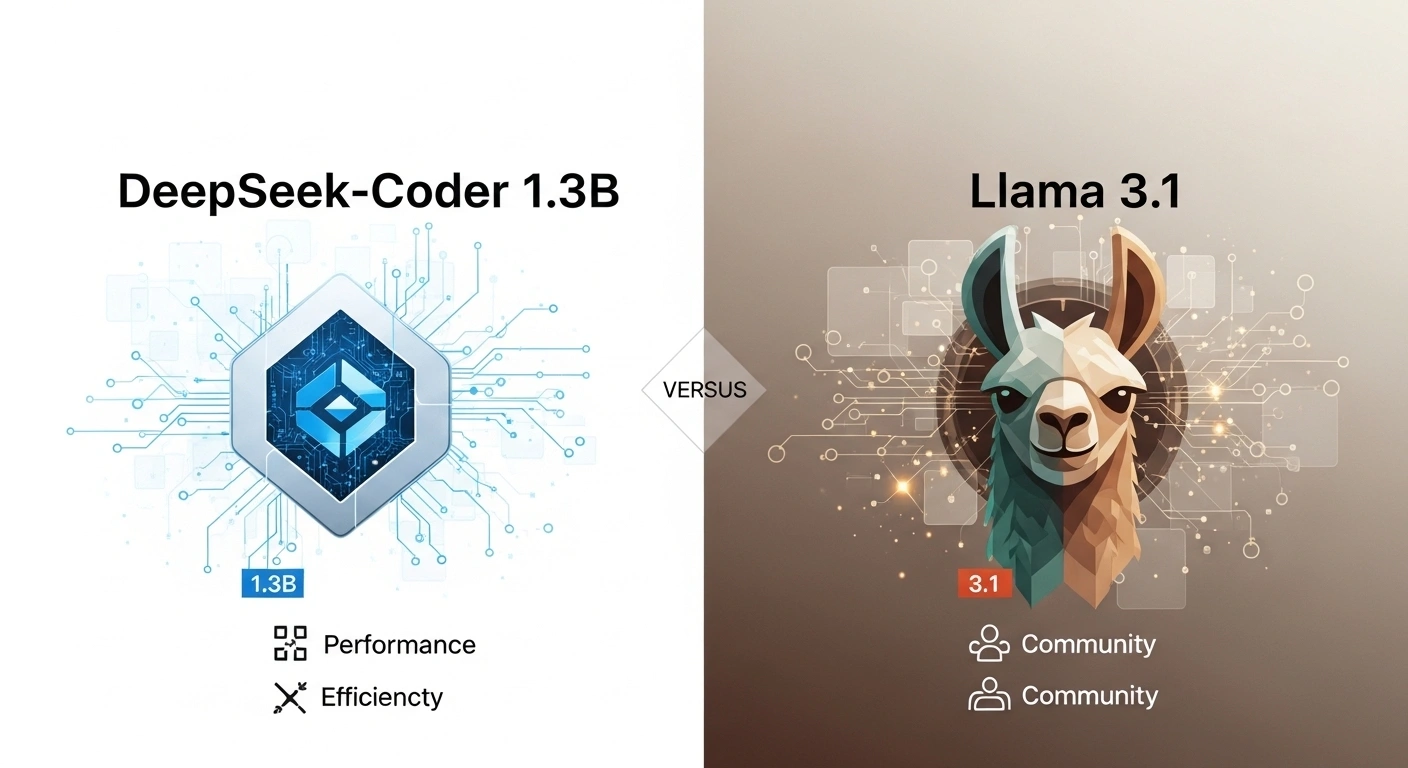
This is exactly where the comparison between DeepSeek-Coder 1.3B vs Llama 3.1 becomes both fascinating and strategically important.
On one side, you have a compact, efficient, and highly optimized coding-focused model that can operate locally—even on modest hardware configurations. On the other side, you’re dealing with a large-scale, enterprise-grade artificial intelligence system designed for advanced reasoning, extensive context handling, and sophisticated software engineering workflows.
One emphasizes speed, affordability, and accessibility
The other prioritizes power, intelligence, and scalability
Whether you’re an independent developer, a startup founder building an MVP, or part of a large engineering organization, this in-depth comparison will guide you toward the most suitable choice based on real-world applicability rather than theoretical benchmarks.
What Is DeepSeek-Coder 1.3B?
Unlike general-purpose AI systems, it is fine-tuned exclusively on code-related datasets, enabling it to deliver efficient and relevant outputs for software development workflows.
Core Characteristics
- Trained on massive-scale code corpora (~2 trillion tokens)
- Designed for:
- Code completion
- Debugging assistance
- Refactoring suggestions
- Syntax correction
- Optimized for low-latency inference
- Compatible with local execution environments
Why Developers Prefer It
Extremely fast response times
Compatible with standard laptops and desktops
Minimal operational cost (near-zero when self-hosted)
Open-source adaptability and flexibility
Practical Scenario
Imagine a freelance developer working remotely. With DeepSeek-Coder, they can:
- Build web applications
- Identify and fix bugs quickly
- Generate boilerplate code
- Avoid recurring API expenses
This fundamentally transforms productivity for solo developers and small teams.
What Is Llama 3.1?
Llama 3.1 represents a next-generation, general-purpose large language model designed for Advanced computational reasoning and enterprise-level AI applications.
Unlike DeepSeek, it is not limited to coding—it functions as a multi-domain intelligence system.
Model Variants
- 8B parameters (lightweight version)
- 70B parameters (balanced performance)
- 405B parameters (high-end, ultra-capable model)
Key Capabilities
- Deep logical reasoning
- Multi-file and repository-level understanding
- Long-context processing
- AI agent orchestration
- Cross-domain knowledge integration
Ideal Use Cases
- Enterprise-grade software systems
- SaaS platforms with AI integration
- Research and development environments
- Complex automation workflows
It’s not just a coding assistant—it’s a complete AI infrastructure component.
DeepSeek-Coder 1.3B vs Llama 3.1: Quick Comparison
| Feature | DeepSeek-Coder 1.3B | Llama 3.1 |
| Model Type | Specialized coding model | General-purpose AI |
| Parameters | 1.3B | 8B – 405B |
| Hardware Needs | Low-end CPU/GPU | High-performance GPUs |
| Speed | Very high | Moderate to lower |
| Cost | Extremely low | Significantly higher |
| Accuracy | Strong (coding-focused) | Very high overall |
| Context Handling | Limited | Advanced |
| Best Use | Local dev, lightweight tasks | Enterprise & complex systems |
Benchmark Comparison
Many comparison articles focus excessively on raw metrics without contextual interpretation.
Here’s a more realistic breakdown:
Llama 3.1
- Achieves approximately 85–90% on HumanEval
- Strong general reasoning ability
- Better suited for complex algorithmic challenges
DeepSeek-Coder
- Optimized specifically for:
- Code generation workflows
- Debugging efficiency
- Slightly lower benchmark scores, but higher real-world efficiency
Key Insight
- Llama = more intelligent and versatile
- DeepSeek = more efficient and practical
For many developers, efficiency outweighs theoretical superiority.
Pricing Comparison
| Model | Cost per 1M Tokens |
| DeepSeek-Coder | ~$0.42 |
| Llama 3.1 | ~$15–$19 |
This represents up to 98% cost reduction.
Implications
- Startups significantly reduce operational expenses
- Independent developers can work at negligible cost
- Scaling AI-powered applications becomes financially viable
This is why DeepSeek dominates search results for affordable AI coding tools.
Hardware Requirements
DeepSeek-Coder 1.3B
Compatible with:
- Standard CPUs
- Systems with ~8GB RAM
- Entry-level GPUs
Llama 3.1
Requires:
- High-VRAM GPUs (24GB–80GB+)
- Dedicated cloud infrastructure
- Advanced deployment pipelines
Summary
- DeepSeek = widely accessible
- Llama = resource-intensive investment
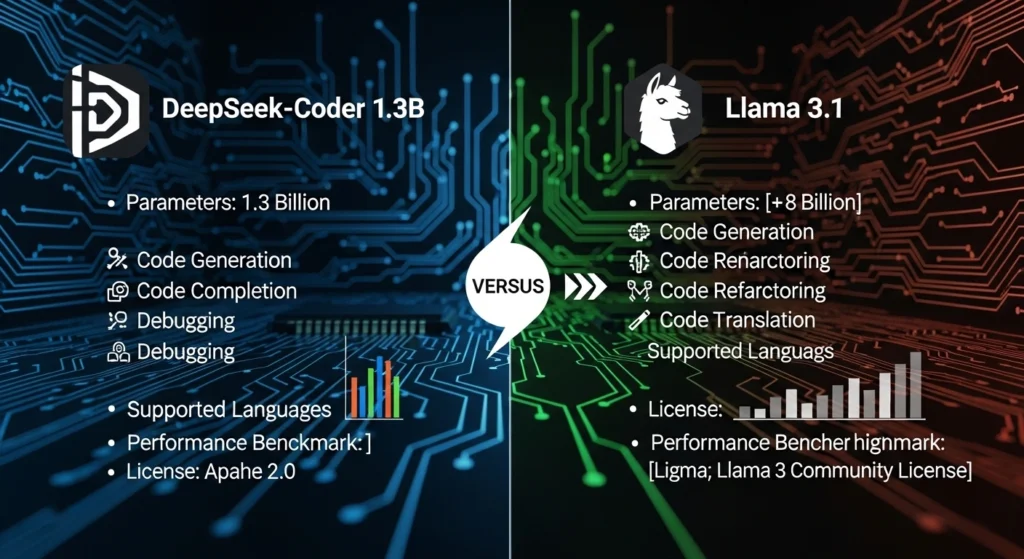
Real Developer Performance
DeepSeek Excels When:
- Rapid code completion is required
- Working in local development environments
- Budget constraints are significant
- Lightweight IDE integrations are preferred
Llama Excels When:
- Managing large-scale codebases
- Performing architectural planning
- Building AI-driven applications
- Requiring deep contextual reasoning
Use Case Breakdown
Best for Beginners
DeepSeek-Coder 1.3B
- Easy to configure
- No expensive infrastructure
- Immediate productivity gains
Best for Startups
DeepSeek-Coder
- Cost-efficient scaling
- Ideal for MVP development
- Rapid iteration cycles
Best for Enterprises
Llama 3.1
- Handles complex systems
- Supports advanced AI workflows
- Enterprise-grade reliability
Best for Research
Llama 3.1
- Superior analytical capabilities
- Multi-domain problem solving
Pros & Cons
DeepSeek-Coder 1.3B
Advantages:
- Extremely affordable
- Local deployment capability
- Fast execution
- Beginner-friendly
Limitations:
- Restricted reasoning depth
- Smaller context window
- Less suitable for large-scale systems
Llama 3.1
Advantages:
- High accuracy and intelligence
- Advanced reasoning capabilities
- Handles complex software ecosystems
- Multi-functional AI system
Limitations:
- High cost
- Demands powerful hardware
- Slower inference speed
Specialized vs General AI
This is the most overlooked distinction in competitor content.
DeepSeek-Coder
Specialist model
Designed exclusively for programming
Llama 3.1
Generalist model
Handles diverse domains
Fundamental Truth
- Specialized models = focused, efficient, optimized
- General models = powerful, flexible, but resource-heavy
Understanding this distinction is crucial for decision-making.
How to Use These AI Tools
Using DeepSeek-Coder
- Install locally via repositories
- Integrate with development environments like VS Code
- Use for:
- Autocomplete
- Debugging
- Refactoring
Using Llama 3.1
- Access through APIs or cloud services
- Integrate into applications
- Use for:
- AI agents
- SaaS platforms
- Complex automation workflows
Content Optimization Tips
If you’re creating AI-related content:
- Focus on problem-solving rather than features
- Use clear, benefit-driven language
- Highlight:
- Speed
- Cost efficiency
- Real-world applications
Practical clarity consistently outperforms hype-driven messaging.
Market Relevance
In regions with strict regulations and cost sensitivity:
- Local deployment enhances data privacy compliance
- Affordable models enable wider adoption
Meanwhile, large organizations prioritize:
- Scalability
- Performance
- Advanced AI capabilities
FAQs
A: DeepSeek is better for fast, affordable coding tasks, while Llama 3.1 excels in complex logic and large-scale development.
A: It’s specifically designed to run on CPUs and low-end systems, making it ideal for personal use.
A: Because it uses significantly larger models and requires powerful infrastructure, it increases compute costs.
A: Especially for small to medium projects, debugging, and rapid prototyping.
A: Startups should choose DeepSeek for cost efficiency unless they need advanced AI capabilities.
Conclusion
DeepSeek-Coder 1.3B and Llama 3.1 are not direct competitors—they are designed with Fundamentally different objectives.
DeepSeek is ideal for:
- Speed
- Cost efficiency
- Local development
Llama 3.1 is suited for:
- Advanced reasoning
- Enterprise-grade systems
- Complex applications
In 2026, the most effective developers are not selecting the most powerful model—they are selecting the most appropriate tool for their specific requirements.