Introduction
The artificial intelligence Ecosystem in 2026 has evolved far beyond simple chatbot utilities. Modern AI systems are now deeply integrated into software engineering pipelines, autonomous agent architectures, SaaS infrastructures, DevOps automation, and enterprise-level decision-making systems.
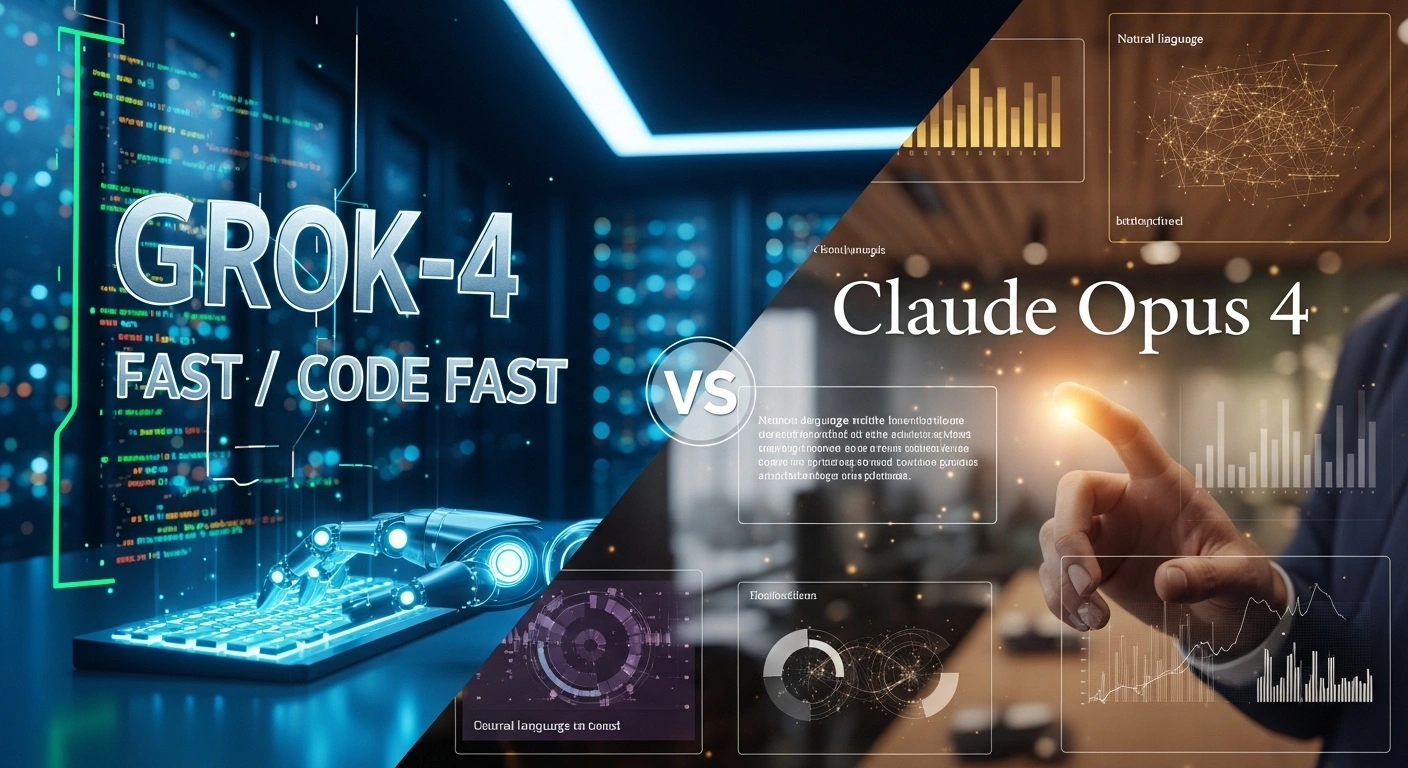
In this rapidly shifting landscape, two dominant paradigms have emerged:
- Grok-4 Fast / Code Fast → engineered for ultra-fast inference, scalable throughput, and experimental AI-driven workflows
- Claude Opus 4 → designed for structured reasoning, enterprise reliability, and deeply coherent long-form intelligence
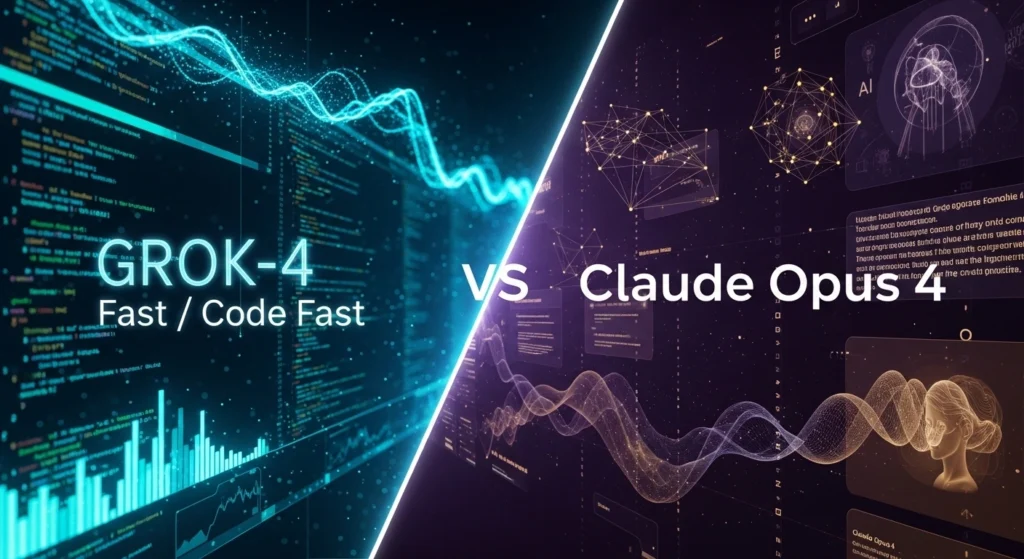
At first glance, both systems appear to serve similar purposes: code generation, reasoning assistance, debugging, and automation. However, their underlying architecture philosophy is fundamentally different.
Grok prioritizes velocity, iteration speed, and distributed agent execution, while Claude emphasizes precision, logical consistency, and production-grade reliability.
This decides between them not a matter of “which is better overall,” but rather which intelligence model aligns with your engineering objective.
In this comprehensive guide, we analyze:
- Coding intelligence performance
- Real-world developer workflows
- AI agent architecture behavior
- Cost efficiency at scale
- Benchmark reasoning comparisons
- Production system reliability
By the end, you will understand exactly which model suits your technical ecosystem in 2026.
Understanding the AI Model Ecosystem
Before diving into comparisons, it is essential to understand how each model family is structured within the broader AI intelligence stack.
Grok 4 Ecosystem
The Grok family is engineered around a high-throughput intelligence framework, optimized for rapid inference cycles and large-scale API-driven systems.
Core Variants:
- Grok 4 (Flagship Model)
→ General-purpose high-performance reasoning engine - Grok 4 Fast
→ Reduced latency version optimized for real-time applications - Grok Code Fast
→ Developer-centric coding model focused on programming automation
Core Design Philosophy:
- Ultra-low response latency
- High-volume API throughput
- Agentic task execution
- Parallel reasoning pipelines
- Cost-efficient scaling for startups
Ideal environment: SaaS platforms, automation engines, AI agents, rapid prototyping systems
Claude Opus 4
Claude Opus 4 represents the upper tier of structured AI reasoning systems, prioritizing safety, interpretability, and enterprise reliability.
Core Design Philosophy:
- Deep multi-step reasoning chains
- High factual consistency
- Structured code generation
- Long-context comprehension
- Predictable output behavior
Ideal environment: enterprise software, regulated industries, mission-critical systems, large-scale codebases
Benchmark Comparison
| Category | Grok 4 Fast / Code Fast | Claude Opus 4 |
| Logical reasoning depth | High speed, adaptive | More consistent and precise |
| Software engineering tasks | Strong iterative coding | Highly structured outputs |
| Debugging capability | Flexible, experimental | Conservative but accurate |
| Long-context understanding | Extremely large context support | Strong but more controlled |
| Output stability | Medium variability | Very high stability |
| Creative solution generation | Highly experimental | Safe and constrained |
Interpretation of Benchmark Behavior
- Grok excels in rapid ideation and fast computation cycles
- Claude dominates in stability, correctness, and enterprise-grade predictability
This makes them complementary rather than purely competitive.
Real Developer Workflow Analysis
Most competitor articles fail because they ignore actual engineering usage patterns. Below is a real-world breakdown.
SaaS Product Development Lifecycle
Grok 4 Fast / Code Fast
- Rapid backend scaffolding
- Fast API endpoint generation
- Quick iteration loops
- MVP development acceleration
- Experimental feature testing
Claude Opus 4
- Clean system architecture design
- Strong modular coding patterns
- Reliable production-ready logic
- Reduced bug frequency in deployment
Verdict:
- MVP → Grok wins
- Production SaaS → Claude wins
AI Agent Systems
Grok Strengths:
- High-speed tool invocation
- Multi-agent coordination
- Fast decision loops
- Real-time adaptive behavior
Claude Strengths:
- Structured planning chains
- Long-horizon reasoning
- Stable agent orchestration
- Predictable execution flow
Verdict:
- Experimental agents → Grok
- Enterprise-grade agents → Claude
Large Codebase & Multi-Repository Development
Grok:
- Fast refactoring capabilities
- High iteration flexibility
- Occasional formatting inconsistency
Claude:
- Strong architectural discipline
- Consistent coding standards
- Better dependency management
Verdict:
Claude is suitable for production-scale repositories.
Cost Efficiency & Scaling Economics
One of the most decisive factors in AI adoption is cost per computational output unit at scale.
Grok 4 Fast / Code Fast
- Lower token cost structure
- Optimized for mass API requests
- Highly efficient for startups
- Ideal for large-scale automation systems
Claude Opus 4
- Premium-tier pricing model
- Higher per-request cost
- Justified in enterprise environments
Cost Efficiency Comparison
| Metric | Grok 4 Fast | Claude Opus 4 |
| Token cost | Low | High |
| Scaling efficiency | Excellent | Moderate |
| Startup ROI | Very high | Medium |
| Enterprise ROI | High | Very high (stability-driven) |
Weakness Analysis
Grok 4 Limitations
- Over-optimization in some reasoning tasks
- Inconsistent instruction adherence in edge cases
- Less deterministic output behavior
Claude Opus 4 Limitations
- Higher operational cost
- Slower response latency
- Less experimental flexibility
Pros & Cons
Grok 4 Fast / Code Fast
Advantages:
- Extremely fast execution cycles
- Low-cost scalability
- Strong automation capability
- Ideal for experimentation
Disadvantages:
- Inconsistent output stability
- Variable reasoning depth
- Not ideal for strict production systems
Claude Opus 4
Advantages:
- High reasoning accuracy
- Strong coding discipline
- Enterprise adoption readiness
- Stable long-context processing
Disadvantages:
- Higher cost
- Slower inference speed
- Less creative flexibility
Global Developer Adoption Trends
Across major tech hubs such as:
- London
- Berlin
- Amsterdam
- Paris
- San Francisco
A hybrid AI strategy is becoming dominant:
- Grok 4 Fast → used for rapid prototyping and automation pipelines
- Claude Opus 4 → used for enterprise-grade deployment systems
This dual-stack architecture is now standard in fintech, SaaS platforms, and AI-native startups.
Best Practice AI Engineering Stack
Recommended Workflow:
Use Grok 4 Fast for:
- Idea generation
- Debugging cycles
- Automation scripting
- Rapid experimentation
Use Claude Opus 4 for:
- Final production code
- System architecture design
- Security-sensitive logic
- Enterprise deployment systems
Optimization Strategies for AI Coding
- Always define strict constraints in prompts
- Break large systems into modular components
- Use iterative refinement loops
- Combine Grok speed with Claude precision
FAQs
A: Claude Opus 4 is better for production-grade coding due to its structural consistency and reliability. Grok 4 Fast excels in rapid prototyping and fast experimentation workflows.
A: Grok 4 Fast is significantly more cost-effective, especially for large-scale API usage and high-frequency automation systems.
A: Not entirely. Grok is optimized for speed and experimentation, while Claude is optimized for enterprise-level reliability and structured reasoning.
A: Grok performs better for fast, dynamic agent loops, while Claude performs better for structured, long-term autonomous systems.
A: Grok focuses on speed, scalability, and experimentation, whereas Claude focuses on accuracy, reasoning depth, and production stability.
Conclusion
The comparison between Grok-4 Fast / Code Fast and Claude Opus 4 is not about superiority—it is about architectural alignment with your engineering needs.
- If your priority is speed, iteration, and scalable experimentation, Grok is the optimal choice.
- If your focus is enterprise stability, structured reasoning, and production reliability, Claude is unmatched.
In 2026, the most effective developers are not choosing one over the other—they are building hybrid AI ecosystems that combine both intelligence paradigms for maximum efficiency, scalability, and performance.