Introduction
In 2026, choosing the right AI API is no longer just a Technical decision—it directly impacts product Performance, cost structure, and scalability for modern SaaS businesses.
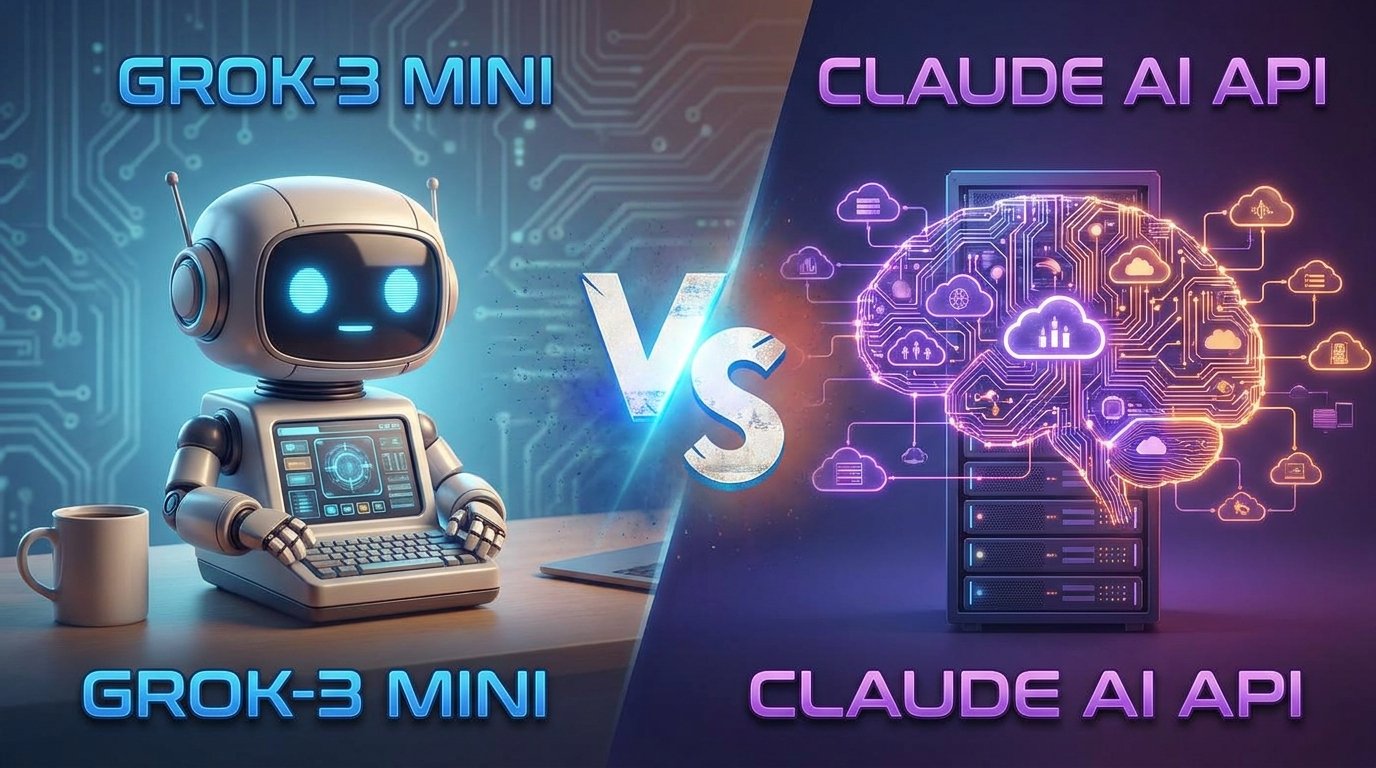
Two major players dominating this space are Grok-3 Mini by xAI and Claude AI API by Anthropic.
While both APIs are powerful, they serve fundamentally different purposes. Grok-3 Mini is designed for high-speed, low-cost, large-scale AI workloads, whereas Claude API focuses on deep reasoning, coding accuracy, and enterprise-grade reliability.
This guide provides a complete 2026 breakdown, including pricing, performance, real-world use cases, developer insights, and strategic recommendations so you can confidently choose the right API for your project.
Overview: Grok-3 Mini vs Claude AI API
Grok-3 Mini
Grok-3 Mini is built for efficiency and scale. It is optimized for developers who need massive API throughput without breaking the budget.
Key characteristics:
- Extremely fast response time
- Low-cost token usage
- Designed for high-volume applications
- Good general reasoning capabilities
Claude AI API
Claude API is built for intelligence-heavy tasks where accuracy and reasoning matter more than cost.
Key characteristics:
- Strong coding performance
- Advanced reasoning abilities
- Stable and structured outputs
- Preferred in enterprise systems
Pricing Breakdown
Pricing is one of the biggest deciding factors when choosing between Grok-3 Mini and Claude API.
Grok-3 Mini Pricing Advantage
Grok-3 Mini is widely considered one of the most cost-efficient AI APIs in the market.
Typical cost structure (industry estimates):
- Input tokens: very low cost per 1M tokens
- Output tokens: optimized for affordability
Ideal for:
- High-volume chatbots
- Content generation systems
- Real-time automation tools
- Data enrichment pipelines
The key advantage: You can scale to millions of requests without exponential cost growth.
Claude API Pricing Structure
Claude API is positioned as a premium intelligence model.
- Higher cost per 1M tokens
- Premium pricing for advanced reasoning models
- Enterprise-focused billing structure
You are paying for:
- Higher reasoning accuracy
- Reduced hallucination rates
- Better long-context understanding
Pricing Comparison Table
| Feature | Grok-3 Mini | Claude API |
| Input Cost | Very Low | Medium-High |
| Output Cost | Low | High |
| Scalability | Excellent | Moderate |
| Enterprise Cost Efficiency | High | Medium |
| Best For | High-volume apps | Complex reasoning apps |
Performance Comparison
Coding Ability
- Claude API → Industry-leading
- Grok-3 Mini → Good but inconsistent
Claude clearly outperforms Grok in:
- Debugging complex systems
- Multi-file code understanding
- Refactoring large applications
Reasoning Ability
- Claude → Structured, logical reasoning
- Grok → Fast but sometimes inconsistent
Claude is more reliable in:
- Legal reasoning
- Financial analysis
- Technical documentation
Speed & Latency
- Grok-3 Mini → ⚡ Ultra-fast responses
- Claude API → Moderate but stable responses
Real-World Developer Use Cases
When to Use Grok-3 Mini
Grok is ideal for startups and scaling systems:
- AI chatbots with millions of users
- Content automation platforms
- Social media reply generators
- Lightweight SaaS tools
- Real-time applications
When to Use the Claude API
Claude is ideal for high-precision systems:
- Developer tools (code assistants)
- Legal document analysis
- Financial modeling systems
- Research assistants
- Enterprise AI workflows
If your priority is accuracy + reasoning, Claude dominates.
Hidden Developer Insights
Most comparison articles ignore real production behavior. Here’s what developers actually observe:
Grok-3 Mini Strengths
- Extremely cost-efficient at scale
- Works well for “good enough” outputs
- Handles high traffic without major slowdowns
Claude API Strengths
- Lower error rates in production environments
- Better handling of long-context prompts
- More stable, structured responses
Head-to-Head Comparison Table
| Category | Winner |
| Pricing | Grok-3 Mini |
| Speed | Grok-3 Mini |
| Coding Ability | Claude API |
| Reasoning | Claude API |
| Scalability | Grok-3 Mini |
| Enterprise Reliability | Claude API |
| Long Context Handling | Claude API |
| Real-Time Apps | Grok-3 Mini |
Pros & Cons
Grok-3 Mini Pros
- Very low cost
- Extremely fast responses
- Great for scaling startups
- Efficient for bulk tasks
Cons
- Less reliable reasoning
- Inconsistent coding performance
- Not ideal for critical systems
Claude API Pros
- Best-in-class reasoning
- Excellent coding accuracy
- Strong enterprise trust
- Stable long-context handling
Cons
- Higher cost
- Slower responses compared to Grok
- Less suitable for high-volume, cheap tasks
People Also Ask
A: Grok-3 Mini is significantly cheaper and designed for high-volume usage, making it ideal for startups and scalable apps.
A: Claude API performs better in coding tasks due to its strong reasoning and structured output capabilities.
A: Yes, many developers use a hybrid approach—Grok for speed and Claude for accuracy.
A: It depends: Grok for low-cost scaling, Claude for high-quality intelligence features.
A: Yes, if your application requires accuracy, reliability, and enterprise-level performance.
Conclusion
The comparison between Grok-3 Mini and Claude AI API is not about which is universally better—it is about matching the right tool to the right use case.
Grok-3 Mini, developed by xAI, excels in speed, affordability, and high-volume scalability. On the other hand, the Claude API from Anthropic dominates in reasoning, coding accuracy, and enterprise reliability.
For most modern developers in 2026, the smartest approach is not choosing one over the other—but combining both strategically to build cost-efficient yet highly intelligent AI systems.