Introduction
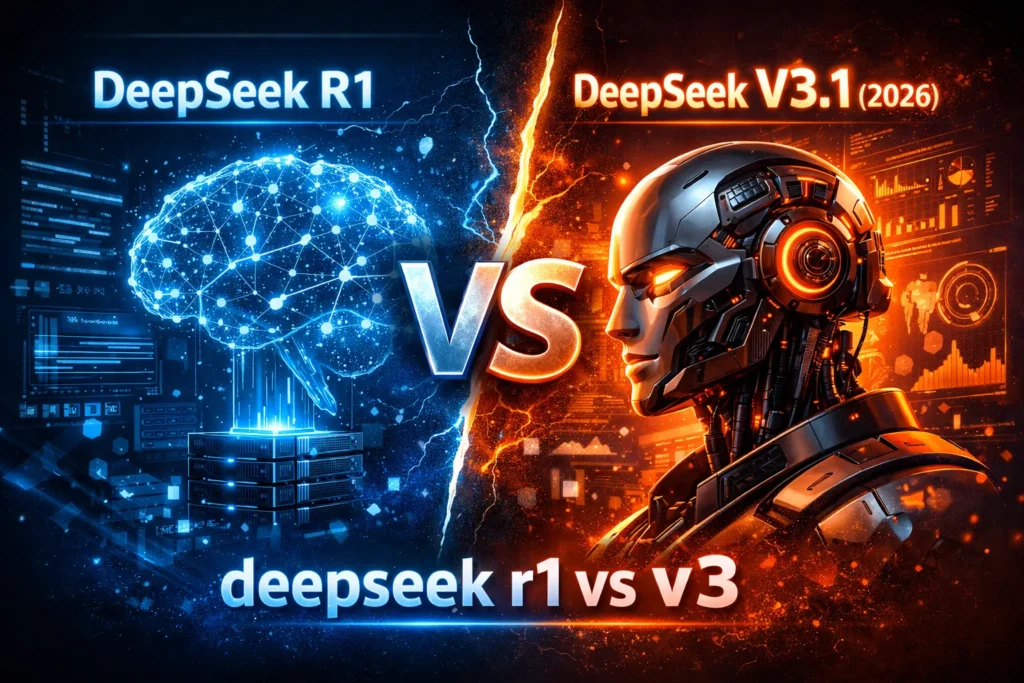
Artificial intelligence continues to reshape industries faster than ever before. In 2026, choosing the right AI model is Essential for Developers, enterprises, and researchers who want robust outcomes without compromise. Two of the most discussed models in the current AI landscape are DeepSeek R1 and DeepSeek V3.1.
In this extensive, NLP‑focused guide, we break down everything from architectural design and training mechanisms to benchmarks, pricing, API integration, real‑world deployment, and future roadmaps. By the end, you’ll have a nuanced understanding of which model is most suitable for your specific objectives.
What Are DeepSeek R1 & DeepSeek V3.1?
DeepSeek R1
DeepSeek R1 is a reasoning‑centric neural model engineered to excel at multi‑stage logical inference, complex analytical problem solving, and hierarchically structured output generation. It is designed for environments where precision, transparency, and interpretability of multi‑step reasoning are critical — such as academic research, technical workflows, and high‑assurance decision systems.
Distinct Capabilities:
- Highly reliable logical deduction
- Multi‑stage chain‑of‑thought reasoning
- Formal proof and analytical synthesis
- Structured output for advanced engineering tasks
Core Strength Overview:
Unlike generalist language models that emphasize conversational fluency, R1 is engineered around reasoning continuity — meaning it maintains coherent reasoning chains over multiple steps, which is especially important in math, complex programming, and scientific workflows.
DeepSeek V3.1
DeepSeek V3.1, on the other hand, is a generalist, high‑throughput NLP model aimed at delivering fast, fluent, and cost‑efficient natural language generation and understanding. Its architecture leverages Mixture‑of‑Experts (MoE) — allowing the system to activate only relevant subnetworks (“experts”) for each request, optimizing performance and reducing computational overhead.
Prominent Strengths:
- Efficient multilingual understanding
- Fast response times with low latency
- Strong conversational fluency
- Creative text generation and summarization
Design Philosophy:
Where R1 emphasizes depth — digging into the logic and structured reasoning of a prompt — V3.1 emphasizes breadth, enabling efficient scaling across high‑volume conversational and content generation tasks.
Architecture & Training Explained
To truly differentiate these models, it’s crucial to examine their internal schematics, training paradigms, and operational trade‑offs.
DeepSeek R1 Architecture
At its core, DeepSeek R1 is built upon a reasoning‑first backbone that extends a foundational DeepSeek architecture with specialized reinforcement training focused on logic and multi‑step inference.
- Chain‑of‑Thought Reinforcement Learning: Training includes targeted reinforcement signals to encourage the model to generate internally consistent stepwise outputs rather than treating each token generation independently.
- Structured Reasoning Optimization: R1 employs annotation‑rich datasets with verified reasoning paths, enabling it to traverse correlation chains methodically.
- Higher Compute for Deeper Reasoning: Because complex inference requires additional internal computation and Intermediate state tracking, inference latency tends to be higher than generalist alternatives.
Key Takeaway:
If your task requires robust inferential depth — such as solving advanced mathematical proofs, program synthesis, or logical deduction — DeepSeek R1 is purpose‑built to exceed expectations.
DeepSeek V3.1 Architecture
DeepSeek V3.1’s architecture revolves around a Mixture‑of‑Experts (MoE) framework, in which multiple subnetworks (experts) specialize in different functional or domain‑specific capabilities.
- Dynamic Expert Activation: Only a subset of experts are triggered per request, conserving resources and optimizing runtime performance.
- Lightweight Inference Paths: This architectural choice significantly reduces redundant computation, leading to faster throughput and lower energy costs.
- Optimized for Language Fluency: The training corpus prioritizes diverse linguistic data to ensure fluent text generation, conversational understanding, and semantic flexibility.
Trade‑offs:
While V3.1 remains capable of general reasoning, its architectural design prioritizes efficiency and linguistic adaptability over deep hierarchical logic.
Key Insight:
DeepSeek V3.1 is ideal for high‑volume natural language tasks, chatbots, multilingual processing, summarization, and non‑mission‑critical reasoning.
Side‑by‑Side Feature Comparison: R1 vs V3.1
The table below contrasts key aspects of each model to provide a quick yet detailed snapshot:
| Feature | DeepSeek R1 | DeepSeek V3.1 |
| Reasoning Strength | ⭐⭐⭐⭐⭐ | ⭐⭐⭐ |
| Real‑Time Response Speed | ⭐⭐ | ⭐⭐⭐⭐ |
| Cost Efficiency | Lower | Higher |
| Best for Logic & Coding | Yes | Good |
| Best for Conversation | Limited | Excellent |
| Architectural Paradigm | Chain‑of‑Thought Reinforcement | Mixture‑of‑Experts |
| Training Emphasis | Deep Reasoning | Natural Language Fluency |
| Inference Latency | Higher | Low |
| Multi‑Language Support | Strong | Excellent |
| Creativity in Text Generation | Moderate | High |
Analysis of Feature Differentiation
- Reasoning: R1’s reasoning scores are higher due to its explicit training on chained logic.
- Speed: V3.1’s optimized routing and lightweight pathing enable significantly faster responses.
- Cost: The complexity of R1 computation means higher per‑token costs, whereas V3.1 is built for cost‑effective scale.
- Conversational Ability: V3.1 outperforms R1 in natural, engaging dialogue and creative generation tasks.
- Application Breadth: V3.1 shines across diverse domains — like Customer support, summarization workflows, and content pipelines — whereas R1 is tailored for high‑assurance technical applications.
Benchmark & Performance Analysis
To assess performance, it helps to evaluate how these models fare across benchmark suites, real‑world evaluations, and domain‑specific tests.
Math & Logical Reasoning Benchmarks
| Benchmark Type | DeepSeek R1 Performance | DeepSeek V3.1 Performance |
| Multi‑Step Logic Tests | ~92% Accuracy | ~70% Accuracy |
| Algebraic Reasoning | Top quartile | Moderate |
| Advanced Code Logic | Excellent | Moderate |
| Symbolic Reasoning | High | Lower |
DeepSeek R1 Observations:
- Outperforms V3.1 substantially on complex, multi‑layered reasoning tasks.
- Capable of maintaining logical coherence across multiple inference stages.
DeepSeek V3.1 Observations:
- Performs strongly in general reasoning and moderate logical tests, but shows a performance gap in structured reasoning.
Speed & Efficiency Benchmarks
On standardized throughput and latency tests:
- DeepSeek V3.1 achieves 5×–10× faster response times for standard NLP prompts.
- R1 trades speed for depth and consistency of output, making it slower but more reliable for complex inference.
This difference is mainly due to MoE optimization in V3.1 versus compute‑intensive reasoning pathways in R1.
Coding Performance
| Task Type | DeepSeek R1 | DeepSeek V3.1 |
| Python Complex Scripts | Excellent | Adequate |
| JavaScript Logic Workflows | Excellent | Moderate |
| C++ Multi‑Stage Logic | Excellent | Some errors possible |
| Simple Code Autocomplete | Very Good | Excellent |
This shows that:
- For full project scripting, multi‑stage debugging, or logic‑intensive code generation, R1 is the go‑to model.
- For auto‑completion or basic script generation, V3.1 is fast and cost‑effective.
Pricing & API Costs
Here’s an indicative pricing table showing how DeepSeek models Compare in token cost:
| Model | Token Cost (Input) | Token Cost (Output) | Notes |
| DeepSeek R1 | $0.004 | $0.008 | Higher compute cost |
| DeepSeek V3.1 | $0.001 | $0.002 | Cost‑efficient, fast inference |
Pricing Summary
- R1 Costs 2×–6× More per token due to the depth of computation required for logical and structured reasoning.
- V3.1 Is Far More Economical, which makes it suitable for high‑volume conversational agents, content generation, or bulk NLP workflows.
Best Use Cases
Use Cases Where R1 Excels
| Use Case | Why R1 Works Best |
| Complex Code Development | Deep reasoning needed |
| Multi‑Step Logical Problem Solving | Maintains internal logic chains |
| Research & Scientific Modelling | Accurate inferential chains |
| Formal Mathematical Proofs | High precision and correctness |
Use Cases Where V3.1 Excels
| Use Case | Why V3.1 Works Best |
| Chatbots & Customer Support | Fast fluency and engagement |
| Content Writing & Generation | Creative, coherent outputs |
| Multilingual NLP Tasks | Language adaptability |
| High‑Volume Query Handling | Low cost, high throughput |
Limitations & Risks
DeepSeek R1’s Limitations
- Slower response times due to computational depth.
- Higher cost per token compared to generalist models.
- In some domains, especially creative language generation, R1 may be less fluid.
DeepSeek V3.1’s Limitations
- Less precise on highly structured multi‑step reasoning.
- May require external verification for mission‑critical outcomes.
- Potential for incorrect logic chains when faced with deeply Hierarchical problems.
Future Outlook
DeepSeek’s roadmap hints at hybrid models that combine the logical integrity of R1 with V3.1’s computational efficiency. This includes:
- Hybrid Reasoning‑Efficient Models
- Adaptive Expert Activation Based on Prompt Complexity
- Improved Cost Structures
- Cross‑domain Transferability Enhancements
The future models aim for both deep inferential capability and scalable performance across diverse deployment environments.
Pros & Cons
DeepSeek R1
Pros:
- Exceptional reasoning and structured logic.
- Accurate multi‑step code generation.
- Performs best for mathematical and structured tasks
Cons:
- Higher costs and slower speeds.
- Less conversationally fluent.
DeepSeek V3.1
Pros:
- Fast, efficient inference.
- Cost‑effective per token.
- Excellent for natural language and conversational tasks.
Cons:
- Reasoning depth is limited compared to R1.
- May require verification in complex analytical tasks.
FAQs
A: DeepSeek R1 is superior for advanced coding and logic manipulation, while DeepSeek V3.1 is adequate for simpler scripting and code completion.
A: V3.1’s per‑token pricing is significantly lower, making it more economical for high‑volume use cases.
A: Not efficiently — R1 is slower and less tuned for conversational fluency compared to V3.1.
A: Evaluate multi‑step reasoning accuracy, throughput speed, latency, language adaptability, and token cost relative to your use case.
A: Future releases are expected to combine reasoning capabilities with high‑efficiency performance for broader suitability.
Conclusion
Choosing between DeepSeek R1 and DeepSeek V3.1 ultimately comes down to your project’s primary requirements — speed versus depth, cost versus reasoning fidelity, and conversational fluency versus structured problem-solving.
DeepSeek R1 is the model of choice for high‑precision, multi-step reasoning, complex coding projects, formal mathematical problem solving, and research environments where accuracy and logical consistency cannot be Compromised. Its reinforcement learning with chain-of-thought optimization ensures that outputs are internally coherent, making it invaluable for structured, technical, or analytical applications. The trade-offs are higher per-token costs and slower inference speeds, but for tasks requiring rigorous reasoning, these are acceptable compromises.