Introduction
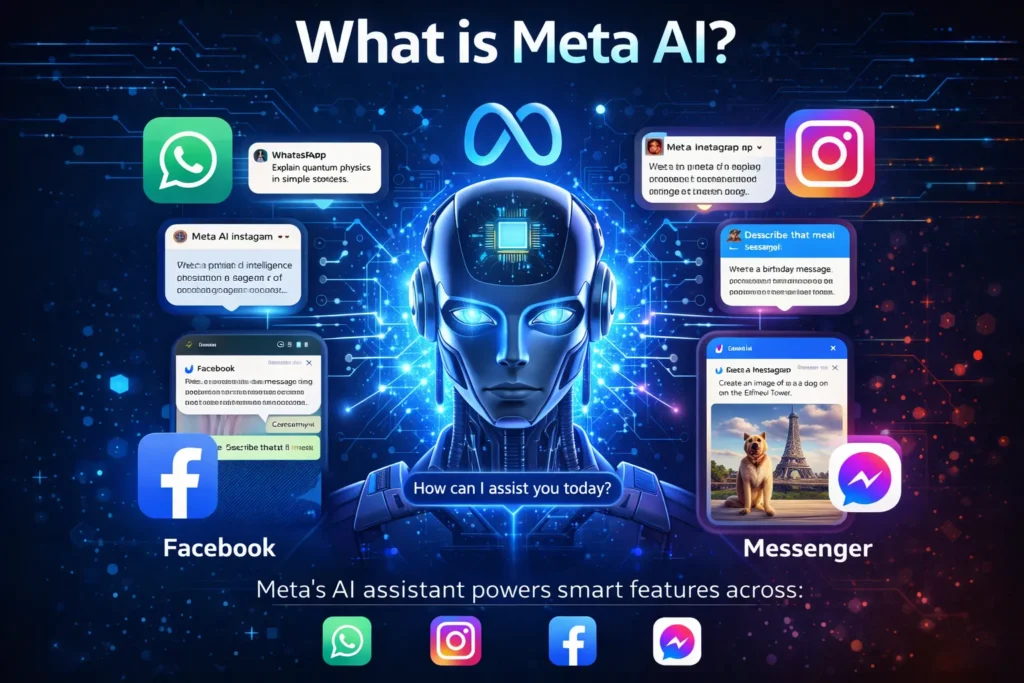
Meta AI is no longer merely a conversational assistant — in 2026, it has Transformed into a comprehensive artificial intelligence ecosystem embedded within platforms you interact with daily, such as WhatsApp, Instagram, Messenger, and Facebook. Leveraging advanced natural language processing (NLP), deep learning, and generative AI techniques enhances digital communication, boosts productivity, and supports creative workflows with unprecedented efficiency.
From generating context-aware text responses to aiding in content creation, and from summarizing intricate documents to translating languages with near-human accuracy, Meta AI is increasingly recognized as one of the most versatile AI platforms worldwide.
This extensive guide explores what it is, its technological foundations, applications across industries, comparison with competitors like ChatGPT, Google Gemini, and Claude, its advantages, limitations, and anticipated future trajectories.
Artificial intelligence paradigm created by Meta Platforms to deliver contextually intelligent, adaptive, and responsive interactions within its suite of applications. It’s more than just a chatbot; it represents a convergence of NLP, machine learning, and multimodal generative AI designed to make digital communication seamless.
Core Components of Meta AI
Meta AI encompasses:
- Conversational AI agents capable of natural dialogue
- Generative AI systems are producing text, social media content, and suggestions
- Advanced NLP models that analyze and synthesize information
- Research-driven AI from Meta’s AI Research Lab (FAIR)
- Multilingual support enabling global accessibility
Unlike single-task AI tools, Meta AI integrates language understanding, reasoning, and creativity, making it a versatile assistant across multiple domains.
Historical Evolution of Meta AI
Understanding Meta AI requires a Historical perspective on its progression and the innovations that shaped it.
| Year | Milestone |
| 2013 | Launch of FAIR (Facebook AI Research), focusing on NLP and computer vision breakthroughs |
| 2016–2019 | Development of advanced deep learning models and large-scale NLP architectures |
| 2020–2023 | Introduction of preliminary AI-powered conversational agents |
| 2024 | Rollout of Meta AI Assistant integrated inside WhatsApp, Instagram, and Messenger |
| 2025 | Expansion of AI features globally, including multilingual support |
| 2026 | Full cross-platform AI ecosystem with real-time integration across Meta apps |
The Role of FAIR
FAIR (now Meta AI Research Lab) spearheaded the development of large language models (LLMs) such as LLaMA, open-source machine learning frameworks, and AI research publications. FAIR has been instrumental in combining academic rigor with practical applications, enabling Meta AI to scale effectively while maintaining state-of-the-art NLP capabilities.
Meta AI vs Meta Research Lab
A crucial distinction exists between the user-facing Meta AI assistant and the research-driven FAIR Lab.
| Aspect | Meta AI Assistant | Meta AI (FAIR Lab) |
| Purpose | Deliver real-time AI services to users | Advance AI research, model development, and ML frameworks |
| Output | Conversational responses, text, and content suggestions | AI models, technical papers, open-source tools |
| Accessibility | Public | Academic & developer-centric |
| Example | Chat assistance in WhatsApp | LLaMA model release |
Thus, Meta AI represents both an applied product and a research ecosystem, bridging practical utility with scientific innovation.
How Meta AI Works & Technology Stack Explained
Meta AI leverages a multi-layered technological architecture underpinned by natural language processing, deep learning, and generative models.
Natural Language Processing
The cornerstone of Meta AI, enabling it to:
- Comprehend user inputs semantically and syntactically
- Generate contextually coherent responses
- Translate multiple languages fluently
- Summarize content intelligently
- Detect sentiment and intent for adaptive responses
Advanced NLP pipelines allow Meta AI to maintain conversational context, handle multi-turn dialogues, and provide responses aligned with user expectations.
Large Language Models (LLMs)
Meta AI employs transformer-based LLMs such as LLaMA to process billions of tokens of textual data. These models:
- Generate human-like text
- Provide predictive completion and paraphrasing
- Understand nuances, idioms, and domain-specific knowledge
- Enable multi-lingual and multimodal outputs
Generative AI Capabilities
Generative AI powers:
- Text synthesis for messages, captions, and documents
- Suggestive visual content (e.g., storyboards, thumbnails)
- Creative ideation and brainstorming support
Integration Layer
Meta AI’s integration layer ensures seamless interaction across apps:
- WhatsApp: automated replies, translations, and chat suggestions
- Instagram: caption recommendations, story prompts
- Messenger & Facebook: conversational assistance and content generation
- Web/Standalone App: central access to all AI features
This integration is pivotal, offering a cohesive AI experience across devices.
Key Features & Capabilities
Meta AI blends language intelligence, generative creativity, and productivity tools.
Textual & Conversational Functionality
Meta AI excels in:
- Answering queries in real time
- Conducting fluid conversations with adaptive tone
- Drafting and refining messages, emails, or posts
- Translating across multiple languages
- Summarizing lengthy articles or documents efficiently
Example:
“Rewrite my WhatsApp message to sound more professional.”
will rephrase it instantly, maintaining nuance and tone.
Media & Creative Utilities
While Meta AI’s visual generation is not yet fully comparable to dedicated image generators, it supports:
- Text-to-visual prompts for social media
- Creative suggestions for content and graphics
- Basic image modifications
This makes it a useful tool for marketers, influencers, and creators.
Cross-Platform Integration
| Platform | Functionality |
| Auto replies, translation, text suggestions | |
| Captions, post ideas, story prompts | |
| Messenger | Conversational assistance |
| Content generation & AI-driven suggestions | |
| Standalone | Centralized access for multi-app management |
Integration across platforms ensures consistent and accessible AI assistance.
Real-World Use Cases
Productivity Enhancement
Meta AI accelerates workflow efficiency:
- Summarizing articles or reports
- Drafting emails and messaging
- Planning tasks and schedules
- Answering research questions quickly
Example:
“Summarize this research paper in five bullet points.”
Meta AI generates concise, readable summaries in seconds.
Creative Endeavors
Meta AI fosters creativity and content ideation:
- Story and article writing
- Marketing and advertising copy
- Brainstorming new social campaigns
- Generating caption ideas for Instagram or Facebook
Customer Support Automation
Businesses leverage Meta AI for:
- Automatic response to customer Inquiries
- Handling routine support questions
- Booking or service assistance
This reduces human workload while improving response time and satisfaction.
Daily Assistance
Can support personal needs, including:
- Real-time translation
- Travel planning and tips
- Learning new topics or skills
- Food recipes and lifestyle recommendations
It functions as a digital personal assistant embedded within your favorite apps.
Meta AI vs Competitors
| Feature | Meta AI | ChatGPT | Google Gemini | Claude |
| Platform integration | WhatsApp, Instagram, Facebook | ❌ | ❌ | ❌ |
| Standalone chatbot | ✔️ | ✔️ | ✔️ | ✔️ |
| Image generation | Limited | Some | Advanced | Some |
| Open-source ecosystem | ✔️ (LLaMA) | Limited | Limited | Limited |
| Multilingual support | ✔️ | ✔️ | ✔️ | ✔️ |
| Real-world integration | Deep | Web/API | Web/API | Web/API |
Why choose Meta AI?
- Seamless app integration
- Strong multilingual and multimodal support
- Open-source model availability
Why choose competitors?
- ChatGPT: superior in text-only dialogue
- Google Gemini: better image generation
- Claude: enhanced safety for long-form content
Limitations, Challenges & Controversies
Despite its capabilities, faces several issues:
Privacy Concerns
- Handling of user data
- Data retention policies
- Compliance with regional privacy regulations like GDPR
Performance Gaps
- Occasional lower accuracy than GPT-4
- Variability in creative outputs
- Complexity in multi-step reasoning
Regulatory Hurdles
- Legal restrictions in some countries
- Pre-launch requirements for AI services
Ethical Considerations
- Mitigating misinformation
- Addressing bias in outputs
- Ensuring fairness and accountability
Future of Trends & Forecasts
VR/AR Integration
- Meta Quest VR and Ray-Ban Smart Glasses may host AI assistants
- Hands-free contextual assistance in immersive environments
Personalized Experiences
- Tailored AI responses based on user behavior and preferences
- Adaptive suggestions reflecting personal style and patterns
Enhanced Multimodal Capabilities
- Combining text, image, audio, and video in a unified interface
Global Expansion
- Wider language support
- Availability in new regions
- Localized AI experiences
Expected to achieve worldwide, multilingual accessibility by 2027.
FAQs
A: Meta AI is available at no cost for users, though some advanced tools may eventually feature premium tiers.
A: Accessible across numerous countries and languages, with ongoing expansions.
A: APIs and tools allow businesses to automate support, generate content, and improve user engagement.
A: Meta AI is deeply integrated with apps for practical use, while ChatGPT excels in standalone text conversations.
A: Some versions support text-to-image generation for social media and creative projects.
Conclusion
Meta AI in 2026 represents a fully integrated AI ecosystem, blending powerful NLP capabilities, generative creativity, and research-backed foundations.
Its strengths include:
- Advanced language Understanding and summarization
- Deep integration across widely-used platforms
- Open-source LLMs for developers
- Practical, everyday usability
From messaging to content creation, productivity to customer support, Meta AI is transforming how humans interact with technology, setting the stage for a more intelligent, integrated digital future.