Introduction
Artificial Intelligence in 2026 has Progressed far beyond simple query answering—it now powers automation pipelines, constructs applications, optimizes enterprise operations, and drives intelligent ecosystems. Modern AI systems are no longer passive tools; they function as active collaborators capable of decision-making, reasoning, and execution.
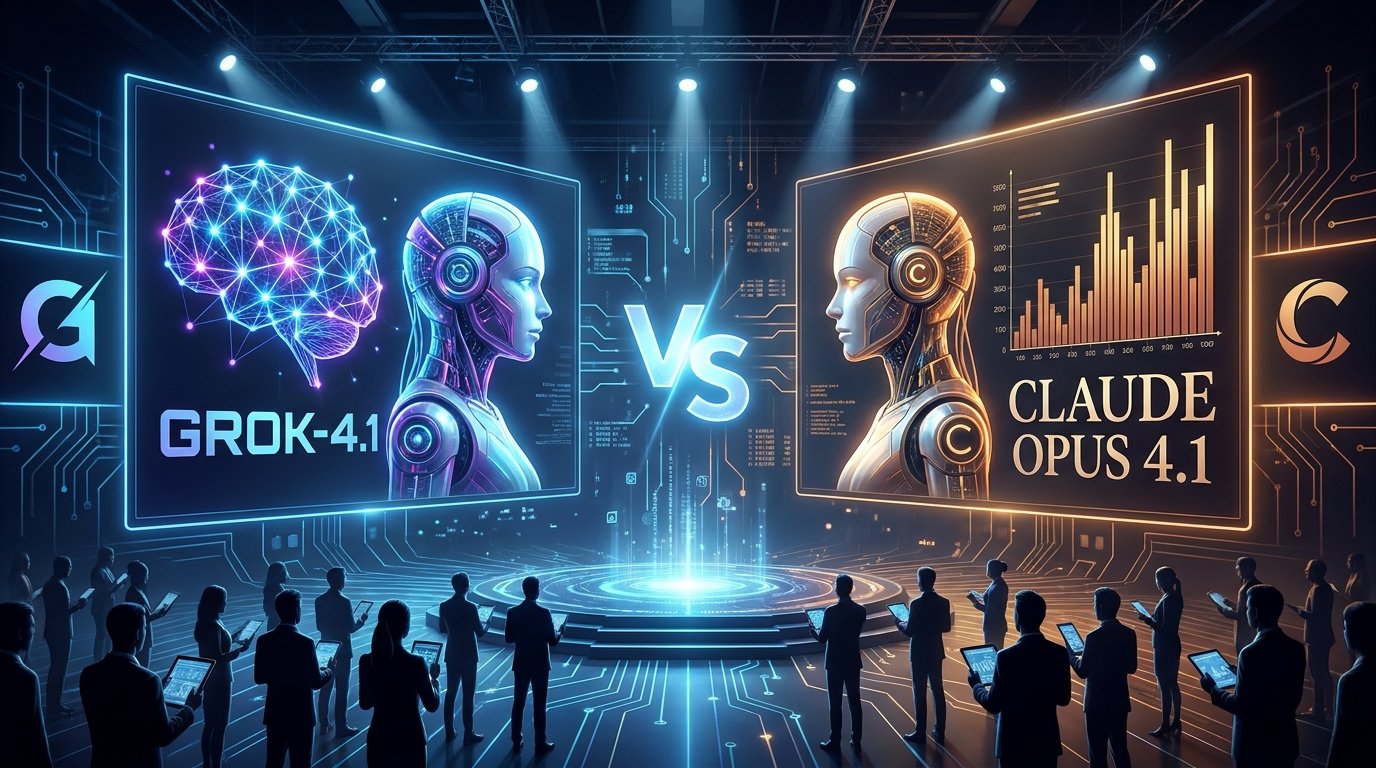
At the forefront of this technological evolution are two highly sophisticated AI models: Grok-4.1 and Claude Opus 4.1. Both represent cutting-edge innovation, yet they embody fundamentally distinct design philosophies and operational paradigms.
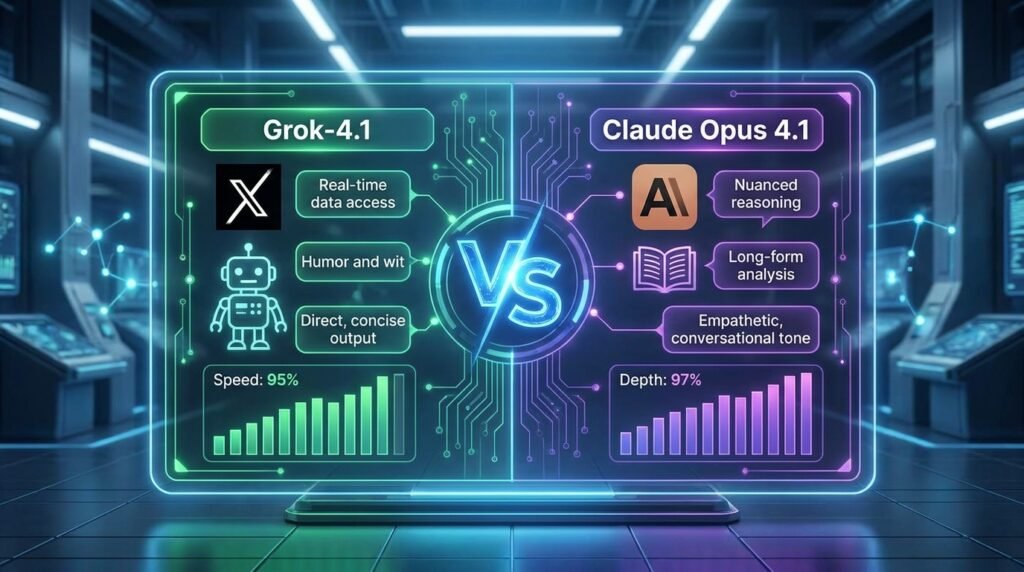
Grok-4.1 emphasizes real-time responsiveness, adaptability, and creative cognition, making it ideal for dynamic environments. In contrast, Claude Opus 4.1 prioritizes structured reasoning, precision engineering, and dependable output generation, positioning itself as a robust solution for technical and enterprise-grade workflows.
Selecting the wrong model can result in inefficiencies, increased operational expenditure, suboptimal outputs, and delayed development cycles—particularly for startups and enterprises operating in highly competitive markets such as Europe and the United States, where AI adoption is accelerating at scale.
This comprehensive, deeply researched guide explores every critical dimension: architecture, benchmarks, coding efficiency, reasoning depth, pricing structures, real-world implementations, and expert-level recommendations. By the end, you will clearly understand which AI system aligns with your objectives—or whether a hybrid strategy delivers superior results.
What is Grok-4.1?
Grok-4.1 is a next-generation conversational intelligence system engineered for dynamic interaction, contextual awareness, and real-time data processing. It is designed to function as an adaptive AI capable of integrating external tools, APIs, and live information streams.
Core Capabilities
- Real-time web integration and live data synchronization
- Multimodal processing (text, voice, image inputs)
- High emotional intelligence and tone adaptability
- Tool-native execution for automation workflows
Key Strengths
- Rapid response generation
- Iterative refinement capability
- Creative storytelling and narrative construction
- Context-aware adaptability
Ideal for: content creators, startups, marketers, product teams, and AI-driven applications
What is Claude Opus 4.1?
Claude Opus 4.1 is an advanced reasoning-centric AI system optimized for precision, structured analysis, and high-performance coding tasks. It is designed to deliver consistent, reliable, and logically coherent outputs across complex domains.
Core Capabilities
- Advanced programming and debugging
- Deep logical reasoning and stepwise analysis
- Structured and formatted outputs
- Enterprise-grade reliability and compliance
Key Strengths
- Exceptional debugging accuracy
- Reduced hallucination frequency
- Long-context comprehension
- Controlled and safe output generation
Ideal for: developers, enterprises, engineers, and technical operations
Architecture Comparison
Understanding architectural design is essential to interpreting performance, scalability, and reliability.
Claude Opus 4.1 Architecture
Claude employs a hybrid reasoning framework, combining fast-response mechanisms with deeper analytical processing layers.
Core Features
- Dual-mode reasoning (fast + deep cognition)
- Constitutional AI safety framework
- Controlled tool utilization
Impact
- Predictable and stable outputs
- High computational accuracy
- Enterprise-ready dependability
Grok-4.1 Architecture
Grok-4.1 is built on large-scale reinforcement learning systems with a strong emphasis on adaptability and tool integration.
Core Features
- Reinforcement learning optimization
- Tool-native architecture (web, APIs, execution engines)
- Agent-like autonomous behavior
Impact
- Flexible decision-making
- Real-time responsiveness
- Higher creativity with reduced predictability
Benchmark Comparison
| Benchmark | Claude Opus 4.1 | Grok-4.1 |
| MMLU (Knowledge) | ~86% | ~86.6% |
| SWE-bench (Coding) | ~74.5% | Slightly lower |
| Context Window | 100K tokens | 256K tokens |
| Multimodal Ability | Moderate | Advanced |
What These Benchmarks Actually Mean
Knowledge
Both models demonstrate nearly identical performance in general knowledge Comprehension, indicating comparable intellectual capacity.
Coding
Claude Opus 4.1 exhibits stronger reliability in software engineering tasks, particularly in debugging and production-grade code generation.
Context Window
Grok-4.1 supports significantly larger context lengths, allowing it to process extensive documents, conversations, and datasets.
Multimodal Capability
Grok excels in handling images, real-time inputs, and multimodal workflows, making it more versatile in dynamic scenarios.
Real-world takeaway:
- Claude = precision-driven tasks
- Grok = flexible and adaptive workflows
Coding Performance
Claude Opus 4.1 for Coding
Claude is widely regarded as one of the most powerful AI systems for software development.
Advantages
- High SWE-bench performance (~74.5%)
- Superior debugging capabilities
- Minimal hallucination rates
- Strong architectural understanding
Best Use Cases
- Backend infrastructure
- APIs and microservices
- Production-level systems
- Enterprise software
Grok-4.1 for Coding
Grok focuses on speed, ideation, and rapid iteration rather than strict precision.
Advantages
- Fast code generation
- Effective for brainstorming solutions
- Strong prototyping capabilities
Limitations
- Lower reliability in complex systems
- Increased logical inconsistencies
Reasoning & Intelligence
Claude Opus 4.1
- Step-by-step logical deduction
- Structured analytical thinking
- Ideal for mathematical and technical reasoning
Grok-4.1
- Intuitive reasoning approach
- Context-aware insights
- Human-like conversational intelligence
Creativity & Emotional Intelligence
Grok-4.1
- Advanced storytelling ability
- Tone modulation and humor
- Emotional awareness
Claude Opus 4.1
- Formal communication style
- Structured responses
- Limited expressive variation
Speed & Real-Time Capabilities
Grok-4.1
- Real-time browsing capabilities
- Faster output generation
- Live data integration
Claude Opus 4.1
- Controlled processing speed
- No native browsing
- Slight latency in responses
Use Case Comparison
| Use Case | Best Model |
| Developers | Claude Opus 4.1 |
| AI Agents | Claude Opus 4.1 |
| Startups | Grok-4.1 |
| Content Creation | Grok-4.1 |
| Enterprise Solutions | Claude Opus 4.1 |
Pricing & Cost Efficiency
Claude Opus 4.1 follows a premium pricing structure, targeting enterprise clients that require high reliability and compliance.
Grok-4.1 offers a more cost-effective and scalable pricing model, making it accessible for startups and growing businesses.
Pros & Cons
Grok-4.1 Pros
- Real-time intelligence
- Multimodal capabilities
- Cost efficiency
- Creative flexibility
Cons
- Less predictable outputs
- Weaker in complex coding
- Higher hallucination risk
Claude Opus 4.1 Pros
- Industry-leading coding performance
- High reliability
- Strong reasoning capabilities
- Enterprise-grade architecture
Cons
- Expensive pricing
- Limited creativity
- Slower response time
How to Use These AI Tools Effectively
Step-by-Step Workflow
- Use Grok-4.1 for ideation and brainstorming
- Validate logic using Claude Opus 4.1
- Develop and refine code with Claude
- Utilize Grok for content and UI/UX design
- Deploy a hybrid workflow strategy
Expert-Level Prompt Engineering Tips
- Provide precise instructions
- Use structured formats (steps, bullet points)
- Include examples for clarity
- Define tone, style, and output format
- Iterate and optimize prompts continuously
European Market Relevance
Across Europe—including the UK, Germany, France, and the Netherlands—AI adoption trends reveal distinct preferences:
- Startups prioritize Grok for agility and cost-effectiveness
- Enterprises prefer Claude for compliance and accuracy
- Hybrid workflows are becoming industry standards
GDPR-regulated industries often favor Claude due to its structured and safer outputs.
FAQs
A: Claude Opus 4.1 is better due to higher accuracy, better debugging, and lower hallucination rates.
A: Especially for rapid prototyping and brainstorming, but not ideal for complex production systems.
A: Grok-4.1 is generally more cost-efficient, making it ideal for startups.
A: And it’s highly recommended for maximum productivity and performance.
A: Grok-4.1 is better due to its creativity and emotional intelligence.
Conclusion
Choosing between Grok-4.1 and Claude Opus 4.1 is not about declaring a universal winner—it is about aligning the tool with your specific requirements.
If your priority is precision, reliability, and advanced coding performance, Claude Opus 4.1 stands out as the superior choice. It excels in structured environments, making it indispensable for developers, engineers, and enterprise applications.
Conversely, if your focus is speed, adaptability, and creative intelligence, Grok-4.1 emerges as a powerful and versatile solution—ideal for startups, marketers, and content-driven workflows.
However, the most effective strategy in 2026 is not choosing one over the other—it is leveraging both. By combining Grok’s creative ideation with Claude’s executional precision, organizations can unlock a powerful AI-driven workflow that maximizes efficiency, scalability, and output quality.