Introduction
If you have ever received a photo, video, meme, or link with “SFW” written beside it, you may have wondered what those three letters mean.
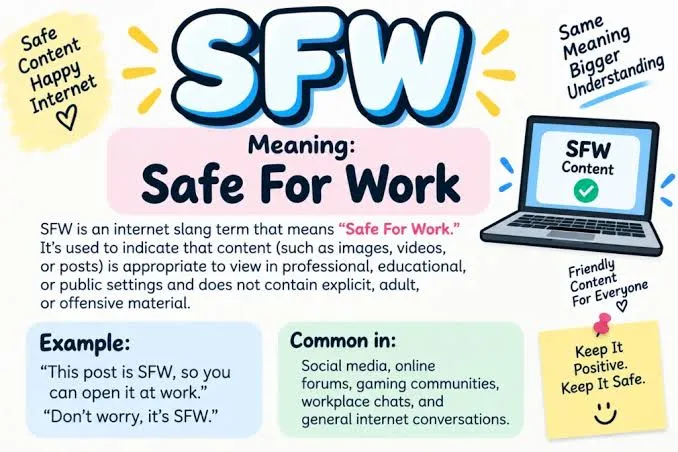
The SFW meaning in text is “Safe For Work.” People use this internet abbreviation to indicate that content is Generally Appropriate to view in a workplace, public setting, group chat, or around other people.
For example, if someone says, “Don’t worry, this video is SFW,” they are usually telling you that the video should not contain obviously explicit, graphic, or inappropriate material.
SFW is commonly used with images, videos, links, memes, jokes, posts, and other online content. Its familiar opposite is NSFW, meaning “Not Safe For Work.”
However, SFW does not mean “safe for absolutely everyone.” It is an informal, context-based label, so what one person or community considers SFW may not be considered appropriate in every environment.
Quick Answer: What Does SFW Mean in Text?
SFW means “Safe For Work.”
In texting and online conversations, it is used to tell someone that a piece of content is generally appropriate to open or view in a workplace or public environment.
Example:
“I found a funny video. It’s SFW, so you can watch it at work.”
In simple words, SFW is a quick way of saying that content is suitable for the intended public or professional setting.
Quick Meaning Summary
| Term | Meaning | Common Use |
| SFW | Safe For Work | Content suitable for workplace/public viewing |
| NSFW | Not Safe For Work | Content that may be inappropriate for work/public viewing |
| PG | Parental Guidance | Content-rating terminology |
| Family-friendly | Suitable for a broad family audience | General audience suitability |
| CW | Content Warning | Warning about potentially sensitive material |
| TW | Trigger Warning | Warning about potentially distressing material |
The important distinction is that SFW is mainly about viewing context, while terms such as PG and family-friendly can relate to different types of audience or rating standards.
What Does SFW Stand For?
SFW stands for “Safe For Work.”
The abbreviation breaks down like this:
- S = Safe
- F = For
- W = Work
So:
SFW = Safe For Work
It is an internet initialism commonly used as a label before or alongside digital content.
You might see it written as:
- SFW
- sfw
- SFW content
- SFW version
- SFW link
- SFW image
Capitalization normally does not change the meaning.
SFW Meaning in Text Messages
In text messages, SFW is usually used to give the recipient a quick warning or reassurance before they open something.
For example:
“Here’s the meme — SFW btw.”
This means the sender believes the meme is appropriate to view around other people.
Another common example is:
“Is this SFW?”
This means:
“Is this safe or appropriate to view here?”
You may see SFW in:
- One-to-one texts
- Group chats
- Workplace chats
- Discord messages
- Reddit discussions
- Social media comments
- Emails
- Online forums
- Messaging apps
The purpose is simple: give the reader useful context before they view the content.
SFW Meaning in Chat and Internet Slang
SFW is a form of internet slang, although its meaning is fairly straightforward.
When people use SFW in casual conversations, they are generally describing content as:
- Clean
- Non-explicit
- Suitable for public viewing
- Appropriate for the intended workplace environment
- Free from obviously graphic material
- Unlikely to create an awkward situation when viewed around others
For example:
“I’ll send you the SFW version.”
The sender is saying that they have selected or created a version that avoids material that could be inappropriate in a public or professional environment.
SFW can also be used humorously:
“That was surprisingly SFW.”
In that situation, the speaker may be saying that something was much more innocent or tame than expected.
The exact tone depends on the conversation.
What Does SFW Mean on Social Media?
On social media, SFW generally works as a content label.
Someone may use it to tell followers or other users that an image, video, post, meme, artwork, or link is appropriate for public viewing.
You may encounter SFW in discussions involving:
- Discord
- TikTok
- X
- Online forums
- Messaging communities
For example:
“This is the SFW version.”
This usually means the content has been kept appropriate for the intended audience or environment.
Keep in mind that SFW is not a universal content-rating system. Different communities and people can have different standards.
SFW Meaning on Reddit
On Reddit, SFW usually means “Safe For Work.”
Users may attach the label to posts, images, artwork, memes, links, or other content to indicate that it is generally appropriate to view in a workplace or public setting.
For example:
“Is this post SFW?”
A reply such as:
“Yes, it’s just a normal photography post.”
means that the responder considers the post appropriate for that setting.
However, Reddit communities can have their own rules and standards. Something considered acceptable in one subreddit may not fit the rules of another.
So, when viewing or posting content on Reddit, community rules still matter even when something is labeled SFW.
SFW Meaning on Discord
On Discord, SFW can describe content that is appropriate for a particular server, channel, or community.
For example:
“Please keep this channel SFW.”
This means users are being asked to avoid content that violates the channel’s rules concerning explicit, graphic, or otherwise inappropriate material.
A Discord server might have separate channels with different rules. Therefore, SFW does not automatically mean exactly the same thing in every server.
Always check the community’s guidelines when they are available.
SFW Meaning on Instagram and TikTok
On Instagram and TikTok, people may use SFW informally to describe content that is suitable for public viewing.
For example:
“This version is SFW.”
The speaker may be distinguishing a clean version from another version that contains more mature or inappropriate material.
SFW may appear in:
- Captions
- Comments
- Direct messages
- Content descriptions
- Discussions about images or videos
The meaning remains essentially the same:
Safe For Work.
Examples of SFW in Text Messages
Here are some natural examples showing how people use SFW in everyday digital communication.
Example 1: Sharing a Meme
Alex: “I found a hilarious meme.”
Sam: “Send it.”
Alex: “Sure, it’s SFW 😂”
Here, Alex is reassuring Sam that the meme should be suitable to share around other people.
Example 2: Sharing a Video
“This video is SFW, so you can watch it during your break.”
The sender is indicating that the video should not contain obviously inappropriate material.
Example 3: Asking Before Opening
“Is that link SFW?”
This means:
“Is that link safe or appropriate to open here?”
Example 4: Sharing Two Versions
“I made an SFW version for the public post.”
This suggests that the public version has been adjusted to remove content that might not be suitable for the intended environment.
Example 5: Discord
“Please keep the general channel SFW.”
Here, SFW is being used as a community guideline, rather than simply a label attached to one piece of content.
How to Use SFW Correctly
You can use SFW when you want to quickly tell someone that content is appropriate for a particular environment.
Common examples include:
“This is SFW.”
“Is this SFW?”
“Here’s the SFW version.”
“Don’t worry, it’s SFW.”
“Please keep the channel SFW.”
“I need an SFW image for the presentation.”
The abbreviation works particularly well when the people involved already understand common internet terminology.
For a highly formal business communication, however, writing “safe for work” or “appropriate for work” may be clearer.
How to Reply When Someone Says “SFW”
If someone tells you that something is SFW, there is no special response you need to give.
You can simply reply:
- “Okay, thanks!”
- “Got it.”
- “Perfect.”
- “Thanks for letting me know.”
- “Great, I’ll check it out.”
- “Good to know.”
If someone asks:
“Is this SFW?”
You could answer:
- “Yes, it’s SFW.”
- “Yes, it should be fine.”
- “No, I’d wait until you’re somewhere private.”
- “Mostly, but there is some strong language.”
The appropriate response depends on the actual content and the environment.
SFW vs. NSFW: What Is the Difference?
The easiest way to understand SFW is to compare it with NSFW.
| Term | Full Form | General Meaning |
| SFW | Safe For Work | Content generally considered appropriate for workplace/public viewing |
| NSFW | Not Safe For Work | Content that may be inappropriate for workplace/public viewing |
The two terms function as opposite labels.
For example:
“This meme is SFW.”
This tells the reader that the sender considers the meme suitable for the relevant public or professional setting.
On the other hand:
“That link is NSFW.”
Warns that the content may not be suitable to view around coworkers, classmates, family members, or other people.
NSFW can be used for content involving sexual material, nudity, graphic violence, profanity, or other potentially inappropriate subject matter.
SFW vs. PG vs. Family-Friendly
SFW, PG, and family-friendly are related ideas, but they are not identical.
means content is generally appropriate for viewing in a workplace or public environment.
PG is associated with a content-rating system and indicates that parental guidance may be appropriate depending on the content and audience.
Family-Friendly
Family-friendly generally suggests that content is suitable for a broad family audience, potentially including children.
Therefore, something can be SFW without necessarily being designed for children.
For example, an adult-oriented business discussion might be appropriate to view at work but not Necessarily be intended for young children.
The key distinction is:
SFW focuses on context, not a universal age rating.
Is SFW the Same as Family-Friendly?
No, not exactly.
There can be considerable overlap, but the terms serve different purposes.
SFW primarily asks:
“Would this generally be appropriate to view in a workplace or public setting?”
Family-friendly generally asks:
“Is this suitable for a broad family audience?”
Something can therefore be SFW while still containing mature themes or subjects that are not intended for children.
Does SFW Mean “Safe for Everyone”?
No.
This is one of the most important things to remember.
SFW means “Safe For Work,” not “Safe For Everyone.”
A piece of content labeled SFW may still contain:
- Mature topics
- Mild profanity
- Controversial subjects
- Adult discussions
- Humor that some people dislike
- Material that may not fit a particular workplace’s rules
Different workplaces, schools, families, and online communities have different standards.
So an SFW label should be understood as a general indication, not a guarantee for every person or situation.
Is SFW a Formal Content Rating?
Usually, no.
SFW is generally an informal internet label, rather than a universal standardized content-rating system.
That means different websites, communities, workplaces, and individuals may interpret SFW somewhat differently.
For example, one workplace may consider mild profanity acceptable, while another may not.
Therefore:
SFW = general context-based label
rather than:
SFW = universal guarantee of suitability
What Content Is Usually Considered SFW?
There is no single universal checklist for every workplace or online community.
Generally, content described as SFW may include:
- Nature photography
- Travel photos
- Educational articles
- Cooking videos
- Ordinary memes
- Pet videos
- Professional presentations
- General news
- Non-explicit artwork
- Everyday humor
- Ordinary workplace discussions
But context still matters.
A joke that is acceptable among close friends might not be appropriate in a conservative workplace.
That is why it is better to think of SFW as “generally appropriate for the intended professional/public environment” rather than “perfectly acceptable to everyone.”
Is SFW Rude or Offensive?
No. SFW itself is normally a neutral abbreviation.
People generally use it to help others understand what type of content they are about to see.
For example:
“Don’t worry, this is SFW.”
is usually simply a reassurance.
The abbreviation can sometimes be used jokingly or sarcastically, but the term itself is not inherently rude or offensive.
Can You Use SFW in Professional Communication?
Yes, but context matters.
If coworkers regularly use internet abbreviations, SFW may be perfectly understandable.
For example:
“The attachment is SFW.”
However, if you are writing a formal email to a client, manager, customer, or person who may not know internet slang, a clearer phrase may be better:
“The attachment is appropriate for workplace viewing.”
or:
“The attachment contains no explicit or graphic material.”
In formal communication, clarity is often more important than saving a few characters.
Does Lowercase “sfw” Mean Something Different?
Usually, no.
SFW and sfw generally have the same meaning:
Safe For Work
For example:
“This link is SFW.”
and:
“This link is sfw”
normally communicate the same idea.
Capitalization usually depends on the writer’s personal style.
Can SFW Have Other Meanings?
Yes. Like many abbreviations, SFW can have different meanings in specialized contexts.
For example, reference sources list meanings outside ordinary internet slang. The correct expansion depends on where you encountered the abbreviation.
However, if you see SFW in a text message, social media post, meme, chat, Reddit discussion, or online community, the intended meaning is usually:
Safe For Work.
Context is the best way to determine whether a specialized meaning is intended.
SFW Meaning in One Simple Sentence
If you only need the quick answer:
SFW means “Safe For Work,” an internet abbreviation used to indicate that content is generally appropriate to view in a workplace or public setting.
Related Internet Terms You Should Know
Understanding SFW becomes easier when you know a few related terms.
NSFW
NSFW means “Not Safe For Work.”
It warns that content may be Inappropriate to view in a workplace or public environment.
CW
CW commonly means “Content Warning.”
It alerts readers that content may involve a sensitive subject.
TW
TW commonly means “Trigger Warning.”
It is used to alert people about potentially distressing material.
18+
18+ generally indicates that content is intended for adults.
Unlike SFW, this is primarily an age-related designation rather than a workplace-context label.
SFW vs. Work-Safe
| Expression | Style | Example |
| SFW | Internet shorthand | “Is this link SFW?” |
| Safe for work | Direct and clear | “This article is safe for work.” |
| Work-safe | Casual/descriptive | “Here’s a work-safe version.” |
| Appropriate for work | More formal | “This material is appropriate for work.” |
If you are chatting with friends or coworkers who understand internet slang, SFW is concise and natural.
For formal communication, spelling out the phrase may be clearer.
Why Do People Use SFW Instead of “Safe For Work”?
The biggest reason is brevity.
Writing:
“This link is safe for work.”
takes considerably more space than:
“This link is SFW.”
Online communication often favors short, recognizable expressions.
SFW also works as a quick visual label. For example:
SFW: Funny office meme
immediately tells the reader how the sender expects the content to be viewed.
This is particularly useful when someone is sharing a link, image, video, or other media without much explanation.
Is SFW Used in Dating Apps?
SFW can appear in dating-app conversations as well, particularly when users are discussing photos, links, jokes, or other media.
For example:
“I have an SFW photo and another private one.”
In this context, SFW still means Safe For Work.
The exact meaning of the content being described depends on the conversation, but the abbreviation itself generally retains the same basic meaning.
Does SFW Mean the Content Is About Work?
No.
This is a common Misunderstanding.
SFW does not mean:
“This content is related to work.”
It means:
“This content is safe for work.”
A funny cat video, travel photo, cooking tutorial, educational article, or harmless meme can all be SFW even though none of them are about someone’s job.
Is SFW the Opposite of NSFW?
Yes, in ordinary internet usage.
- SFW = Safe For Work
- NSFW = Not Safe For Work
SFW signals that content is generally suitable for the relevant workplace or public setting.
NSFW warns that it may not be.
The two terms are commonly used together as simple content labels.
Common Misunderstandings About SFW
1. SFW does not mean “for work only.”
SFW content can be viewed anywhere. The label simply indicates that it is generally appropriate for workplace/public viewing.
2. SFW does not mean “for children.”
Something can be SFW without being specifically designed for children.
3. SFW is not a universal rating.
Different people and communities can have different standards.
4. SFW does not mean “boring.”
The term describes suitability, not whether content is entertaining or interesting.
5. SFW does not mean work-related.
The content can be completely unrelated to work.
6. SFW is not automatically a guarantee.
The label is an informal indication, so context and personal standards still matter.
People Also Ask
In internet slang, SFW is a content label used to describe material that is generally appropriate for workplace or public viewing.
SFW stands for Safe For Work.
The opposite is NSFW, meaning “Not Safe For Work.”
An SFW version is a version of content that has been created or selected to avoid material that could be inappropriate for workplace or public viewing.
The label itself is commonly used to describe content intended to be appropriate for workplace viewing. However, individual workplace standards can vary.
Conclusion
The SFW meaning in text is “Safe For Work.”
It is a common internet Abbreviation used to indicate that a photo, video, link, meme, message, joke, or other piece of content is generally appropriate to view in a workplace, public setting, or around other people.
You may encounter SFW in text messages, Reddit posts, Discord channels, social media, emails, forums, and online communities.
Its most familiar opposite is NSFW, meaning “Not Safe For Work.”
The most important point is that SFW does not mean “safe for everyone.” It is an informal, context-dependent label rather than a universal content-rating system. Different workplaces, communities, and individuals can have different standards.