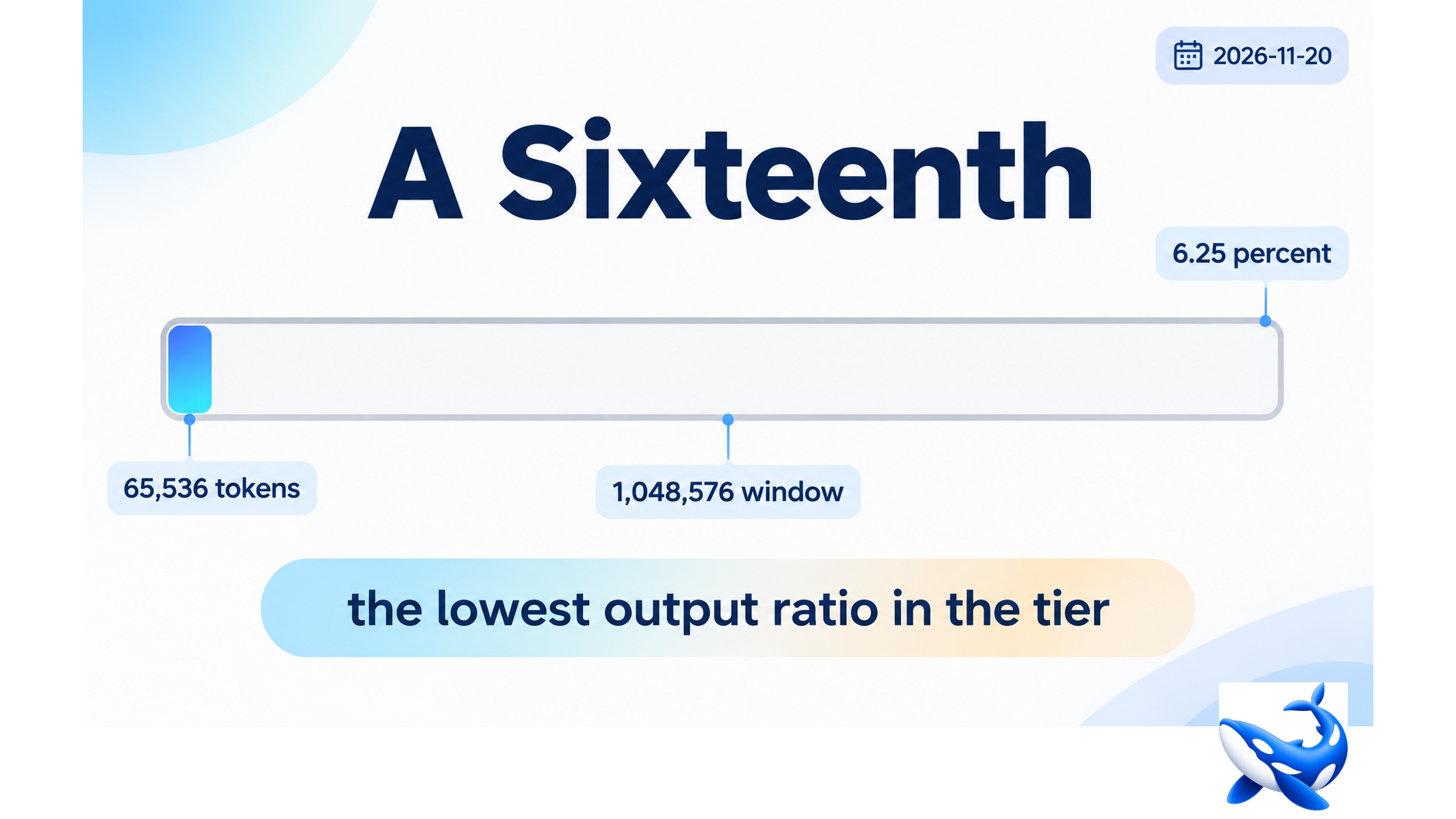
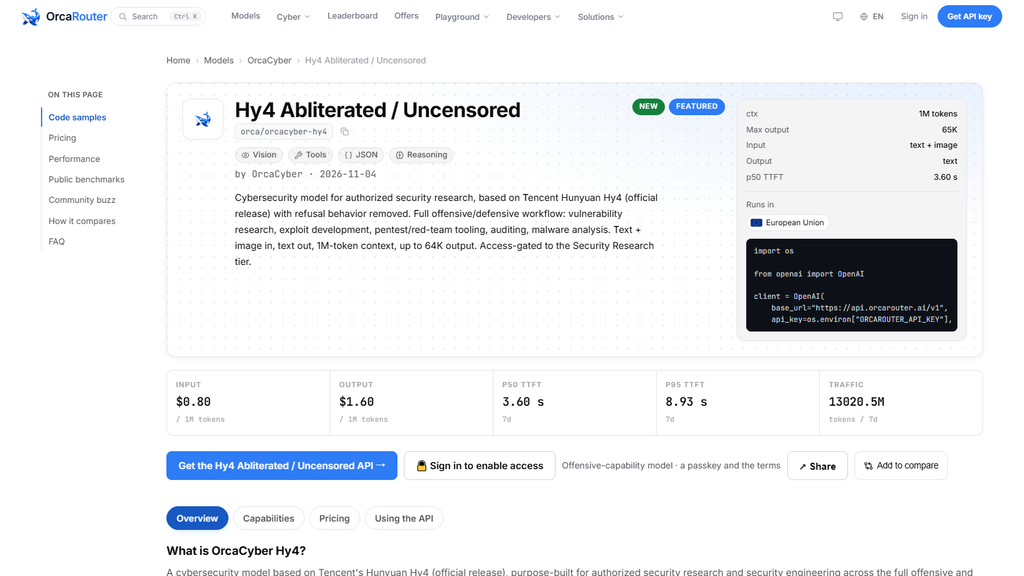
Six and a quarter percent is the smallest share of its own window that any card in this tier will answer with, and this card and its Flash sibling both sit there. OrcaRouter publishes the two fields. They are on OrcaCyber Hy4 context: a 1,048,576-token context against a 65,536-token maximum output.
The ceiling table
| card | context | max output | ratio |
| K3.1 Pro | 1,048,576 | 943,718 | 90.0 % |
| MiniMax M3.1 Flash | 262,144 | 131,072 | 50.0 % |
| Qwen3.8 Flash Next | 262,144 | 131,072 | 50.0 % |
| Flash 1.0 | 1,048,576 | 393,216 | 37.5 % |
| GLM 5.3 | 1,000,000 | 128,000 | 12.8 % |
| Zero 1.0 | 1,000,000 | 128,000 | 12.8 % |
| Zero 1.5 | 1,000,000 | 128,000 | 12.8 % |
| GLM 5.3 Flash | 1,048,576 | 131,072 | 12.5 % |
| MiMo V2.6 Flash | 1,048,576 | 131,072 | 12.5 % |
| Ultra 1.0 | 1,048,576 | 131,072 | 12.5 % |
| Hy4 | 1,048,576 | 65,536 | 6.25 % |
| Hy4 Flash | 1,048,576 | 65,536 | 6.25 % |
The card reads sixteen times more than it will write. That is the most extreme read-heavy shape in the tier, and it is a deliberate design choice shared with one sibling rather than an outlier.
Sixteen times is not a number that arrives by accident. A card built for summarisation, classification, extraction or triage — read the artifact, return a finding — needs exactly this ratio. A card built to rewrite or translate needs 1:1.
Which is to say the ratio describes the intended task, and a buyer whose task is not that shape will meet the ceiling immediately.
What 65,536 tokens is not enough for
Sixty-five thousand tokens is roughly 50,000 words. That is a long document and a short patch series.
| task | typical output | fits in 65,536? |
| classification verdict | under 500 tokens | yes |
| vulnerability write-up | 2,000 – 5,000 | yes |
| full function-level patch | 1,000 – 10,000 | yes |
| repository-wide patch series | 50,000 – 200,000 | sometimes not |
| annotated disassembly | 100,000 + | no |
| full-file rewrite of a large module | 20,000 – 80,000 | sometimes not |
Four rows fit and two sometimes do not. The two that sometimes do not are the ones a security team is most likely to want in one pass, because splitting a patch series or a rewrite across calls means reconciling eight outputs against each other.
Against the 128,000-token cards, this ceiling is half. Against K3.1 Pro it is a fourteenth. So the card sits at the bottom of the tier’s lengthening ladder, and a pipeline with any of the last three task shapes will outgrow it.
The mitigation is chunking with a merge step, which is a real engineering cost — and on a card this cheap, the token cost of the extra calls is not the expensive part, the reconciliation logic is.
The cost of a full-window pass
| component | quantity | rate | cost |
| input | 1,048,576 | $0.80 / M | $0.8389 |
| output | 65,536 | $1.60 / M | $0.1049 |
| full job | $0.9438 | ||
| warm input | 1,048,576 | $0.15 / M | $0.1573 |
| full job, warm | $0.2622 |
Under a dollar for a million-token read and a 65,536-token answer is the card’s strongest published argument.
Compare a full job on the ceiling-matching alternative. A task that needs a 100,000-token answer cannot run here at all; on a 131,072-token card it costs about $1.01 cold for the same million-token read. So the extra ceiling is nearly free in token terms — it is the *availability* of the larger answer, not its price, that separates the cards.
That reframes the ceiling as a capability question rather than a cost one. Where a 65,536-token answer is enough, this card is 7% cheaper than a 131,072-token sibling on the same job. Where it is not enough, the cheaper card cannot be used at any price.
Failure arithmetic on a read-heavy card
An error rate of 0.10% is the second-lowest in the tier, and it produces $1,031 of failure per billion tokens — third-cheapest, behind Hy4 Flash’s $215 and ahead of Flash 1.0’s $1,684.
| card | err % | blend | fail $/billion |
| Hy4 Flash | 0.17 % | $0.1228 | $215 |
| Hy4 | 0.10 % | $1.0000 | $1,031 |
| Flash 1.0 | 0.17 % | $1.0000 | $1,684 |
| MiniMax M3.1 Flash | 0.18 % | $1.0000 | $1,794 |
| Zero 1.5 | 0.09 % | $4.1250 | $3,517 |
| Zero 1.0 | 0.09 % | $4.1250 | $3,790 |
| K3.1 Pro | 0.19 % | $2.7500 | $5,180 |
The failed-token count is 13.2 million a week, which is eighth in absolute terms and larger than four cards’ total traffic.
On a card where the input is sixteen times the output, a retry is almost entirely an input re-read. That makes prefix caching the dominant lever on retries: a cold re-read of the full window costs $0.84 and a warm one $0.16, a five-sixths reduction.
So the same caching arithmetic that matters on the expensive cards matters here for a different reason. On Ultra 1.0 it saves $4.46 per retry and turns a $524 bill into $79. Here it saves $0.68 and turns an $84 retry bill into $16 — proportionally similar, arithmetically smaller. The proportion is set by the cache rate, and both cards charge well under a fifth of their input price for a cached read.
Sixteen to one, and what that asks of a prompt
A read-heavy ratio puts the burden on how a prompt is built, because everything the model is told counts as input.
| component | typical tokens | share of a 1 M read |
| the artefact under review | 800,000 | 76 % |
| system prompt and tool definitions | 4,000 | 0.4 % |
| retrieved context and prior findings | 150,000 | 14 % |
| output format instructions | 1,000 | 0.1 % |
| remaining room | 93,576 | 8.9 % |
The overhead is trivial against a million tokens and the artefact dominates everything. That is the good case: a card that reads sixteen times what it writes is at its best when the input is one large object and the answer is a verdict about it.
The bad case is a conversation. A multi-turn agent accumulates history, and each turn re-sends it. Fifty turns of a 20,000-token exchange is a million tokens of input for a few thousand tokens of output — technically inside the ratio and operationally wasteful.
So the ratio is a guide to task shape rather than a limit to respect. A single large read with a short answer is the design point; an accumulating dialogue is the case where the card’s ceiling and its window pull in opposite directions.
One more field belongs beside the ratio. This card’s published input modalities are text and image, with no video and no audio, and its parameter surface is eleven — the narrowest group in the tier alongside GLM 5.3 and K3.1 Pro. So the read-heavy design is paired with a narrow API, which together describe a card built to be pointed at one large artefact and asked one question about it.
OrcaCyber Hy4 pairs a 1,048,576-token window with a 65,536-token ceiling — 6.25%, the lowest read-to-write ratio in the tier, shared only with its Flash sibling. A full-window pass costs $0.94 cold and $0.26 warm.
The card reads sixteen times more than it writes, which is exactly the shape of triage, extraction and summarisation work and the wrong shape for patch series or large rewrites. Its 0.10% error rate gives $1,031 of failure per billion tokens, and because the input dominates, a warm prefix cuts a retry’s input cost by five sixths.
Sourcing note: the window, ceiling, price rows, cache rate, throughput, error rate, input modalities and token volume are read from the OrcaCyber Hy4 and Hy4 Flash model APIs and card pages on orcarouter.ai on 2026-11-20, with traffic and error rates being OrcaRouter production telemetry for the seven days to that date. The ratios, full-window costs, task-fit judgements and failure arithmetic are our own; task output sizes are illustrative ranges rather than measurements. OrcaCyber Hy4 is published as an abliterated model. No competitor product is named or compared. Checked 2026-11-20.