Introduction
Open-weight AI is no longer competing only on benchmark charts. In 2026, the conversation shifted toward something more practical: Which model actually delivers better results in production?
That is why DeepSeek-V3.1 VS Llama 4 Scout became one of the most important comparisons for developers, startups, AI agencies, SaaS founders, and enterprise teams.
At first glance, both models look impressive.
DeepSeek-V3.1 focuses on stronger reasoning, improved tool use, and agent workflows.
Llama 4 Scout pushes aggressively toward ultra-long context and multimodal experiences.
But specifications alone rarely tell the full story.
A 10-million-token context does not automatically mean better outputs. More parameters do not guarantee stronger coding. Lower pricing does not always reduce operating costs.
This guide goes deeper than typical benchmark articles.
You will learn:
- Which model performs better for coding
- Which scales more efficiently
- Which costs less in production
- Which fits startups vs enterprise teams
- Which delivers the best real-world value
By the end, you should know exactly which model to deploy.
DeepSeek-V3.1 at a Glance
DeepSeek-V3.1 is positioned as an evolution of DeepSeek’s open-weight strategy focused on reasoning, tool execution, and practical AI workflows.
One notable innovation is hybrid inference.
Users can shift between:
- Think mode (more deliberate reasoning)
- Non-Think mode (faster responses)
This allows a single deployment architecture to support multiple use cases.
Core Highlights
- Mixture-of-Experts (MoE)
- Open weights
- Strong coding orientation
- Function calling support
- Long-context capability
- Optimized for agent workflows
Ideal Users
- AI startups
- Coding assistants
- Internal copilots
- Agent builders
- Automation platforms
Llama 4 Scout at a Glance
Llama 4 Scout belongs to Meta’s broader Llama 4 ecosystem.
Its biggest differentiator is context capacity.
Instead of focusing only on reasoning depth, Scout targets workflows where enormous amounts of information must remain available inside one session.
Meta also positions Scout for multimodal and enterprise deployment.
Core Highlights
- MoE architecture
- Image understanding
- Very large context capacity
- Efficient active parameter usage
- Commercial deployment support
Ideal Users
- Enterprises
- Long-document workflows
- Multimodal systems
- Research environments
- Customer support automation
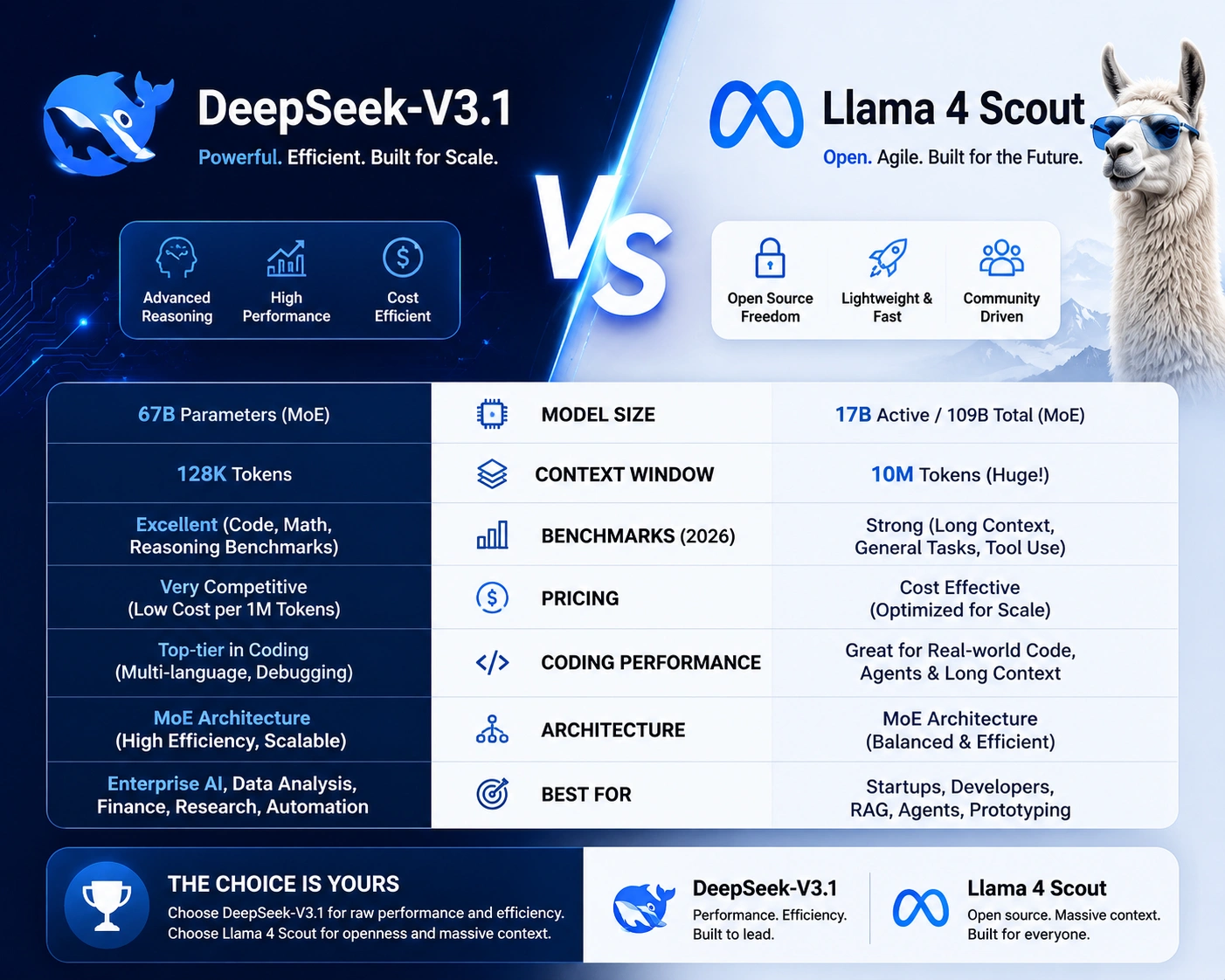
DeepSeek-V3.1 VS Llama 4 Scout: Quick Comparison Table
| Feature | DeepSeek-V3.1 | Llama 4 Scout |
| Release | 2025 | 2025 |
| Architecture | MoE | MoE |
| Context Window | ~128K–164K | Up to ~10M |
| Active Parameters | ~37B | ~17B |
| Image Input | No | Yes |
| Tool Calling | Strong | Supported |
| Open Weights | Yes | Yes |
| Commercial Usage | Yes | Yes |
| Coding Orientation | Strong | Moderate |
| Long Context | Excellent | Exceptional |
Architecture Breakdown: Why These Models Feel Different
Many articles stop at parameter counts.
That misses the real story.
What Is MoE?
Mixture-of-Experts activates only part of the model during inference.
That means:
- Lower computing cost
- Faster responses
- Better scaling economics
Think of it like hiring specialists instead of asking every employee to attend every meeting.
DeepSeek Approach
DeepSeek uses a larger active compute.
Benefits:
- Better reasoning
- Stronger code generation
- More accurate multi-step tasks
Trade-off:
- Higher operational cost.
Llama 4 Scout Approach
Scout prioritizes efficiency.
Benefits:
- Lower active compute
- Massive memory capacity
- Better economics at scale
Trade-off:
- Less specialized reasoning.
Benchmark Battle: What The Numbers Actually Mean
Benchmarks are often misunderstood.
Coding Performance
DeepSeek typically feels stronger when tasks involve:
- Refactoring
- Architecture reasoning
- Multi-step generation
- Tool execution
Example:
Uploading backend files and requesting a migration plan.
DeepSeek generally produces cleaner dependency awareness.
Winner: DeepSeek-V3.1
Reasoning
Benchmarks like GPQA reward difficult reasoning.
In practical testing:
DeepSeek usually performs more consistently.
Winner: DeepSeek-V3.1
Long Context
Llama dominates.
Large repositories, books, contracts, and support archives benefit from huge context windows.
Winner: Llama 4 Scout
Speed
Scout often offers better throughput economics.
Winner: Llama 4 Scout
Pricing Comparison: Which Model Costs Less?
Pricing varies by provider.
The better question is:
How much work can each dollar buy?
| Scenario | DeepSeek-V3.1 | Llama 4 Scout |
| 1M Input Tokens | Moderate | Lower |
| 1M Output Tokens | Higher | Lower |
| Prototype | Affordable | Very Affordable |
| Enterprise Scale | Moderate | Excellent |
SaaS Cost Simulation
Startup chatbot:
100K users
Average usage:
5K tokens/day
Monthly spend:
DeepSeek → Higher capability cost
Llama → Better cost efficiency
Enterprise conclusion:
Scout often reduces infrastructure expenses.
Context Window Explained
Context size creates hype.
Reality is more nuanced.
Large context improves:
- Document analysis
- Code repositories
- Long conversations
But a larger context can introduce:
- Retrieval noise
- Context dilution
- Increased latency
Practical Thresholds
0–50K:
Daily assistant tasks
50K–150K:
Engineering workflows
150K+:
Enterprise knowledge
Millions:
Research and archive processing
Context is useful only if retrieval quality remains high.
Developer Experience Comparison
API Integration
DeepSeek:
- Tool-first design
- Agent workflows
- Function calling
Llama:
- Broad ecosystem
- Easier experimentation
Local Deployment
DeepSeek:
Higher hardware expectations.
Llama:
More flexible deployment options.
Debugging
DeepSeek:
More Predictable reasoning.
Llama:
Simpler iteration loops.
Winner overall:
Depends on deployment goals.
DeepSeek-V3.1 VS Llama 4 Scout for Coding
Developers care less about benchmarks and more about outcomes.
Refactoring
Winner:
DeepSeek
Multi-File Understanding
Winner:
Llama (large context)
Bug Fixing
Winner:
DeepSeek
Repository Navigation
Winner:
Llama
Final Coding Verdict
Choose DeepSeek if:
- You build agents
- You automate development
- You value reasoning
Choose Scout if:
- You handle giant repositories
- You need retrieval at scale
Pros & Cons
DeepSeek-V3.1
Pros
Better reasoning
Strong coding
Tool calling
Excellent agents
Cons
Smaller context
Higher compute cost
Llama 4 Scout
Pros
Massive context
Image support
Cost efficiency
Cons
Weaker coding focus
Context quality depends on retrieval
How To Use These AI Tools
Define Workflow
Coding?
Documents?
Automation?
Estimate Token Cost
Calculate monthly traffic.
Test Small
Do not migrate immediately.
Measure Outcomes
Track:
- latency
- cost
- user satisfaction
Tips To Write Your Own AI Tool Comparisons
- Focus on use cases
- Explain benchmarks
- Include operating cost
- Show decision trees
- Avoid benchmark screenshots
Europe Perspective: What Teams Usually Prioritize
European AI buyers increasingly prioritize:
- deployment flexibility
- predictable operating costs
- data governance
- multilingual support
Startups often prefer cheaper inference.
Enterprises prioritize reliability.
Which Model Should You Choose?
Choose DeepSeek-V3.1 If:
- Coding matters
- You build agents
- You automate workflows
- Reasoning quality matters
Choose Llama 4 Scout If:
- Context matters most
- You process large datasets
- Cost efficiency matters
- You need multimodal input
Future Outlook: Who Wins 2026?
The market is moving toward specialization.
DeepSeek appears stronger for reasoning.
Llama appears stronger for scale.
The likely future:
- smaller active compute
- larger memory
- cheaper inference
- more agent capabilities
No single model wins every category.
People Also Ask
A: For reasoning and coding, often yes. For massive context workloads, Scout can be more practical.
A: Usually, lower token pricing is available through many providers.
A: DeepSeek generally performs better for engineering workflows.
A: Llama 4 Scout supports image inputs.
A: Cost-sensitive startups often begin with Llama. Product teams needing stronger logic may prefer DeepSeek.
Conclusion
The biggest mistake in AI model selection is assuming benchmarks equal business value. DeepSeek-V3.1 and Llama 4 Scout represent two different philosophies. DeepSeek focuses on intelligence density, reasoning, and tool execution. Llama focuses on context scale, efficiency, and broader Deployment economics.
If your product depends on coding quality and intelligent workflows, DeepSeek is difficult to ignore. If your goal is lower cost and long-context processing, Llama 4 Scout becomes extremely attractive. Bookmark this comparison and explore more AI model breakdowns on Ultraaiguide.com.