Introduction
If someone sends you “tsk” or “tsk tsk” in a message, you might wonder whether it is an abbreviation, slang term, or even a typo.
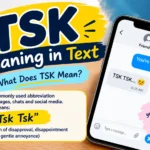
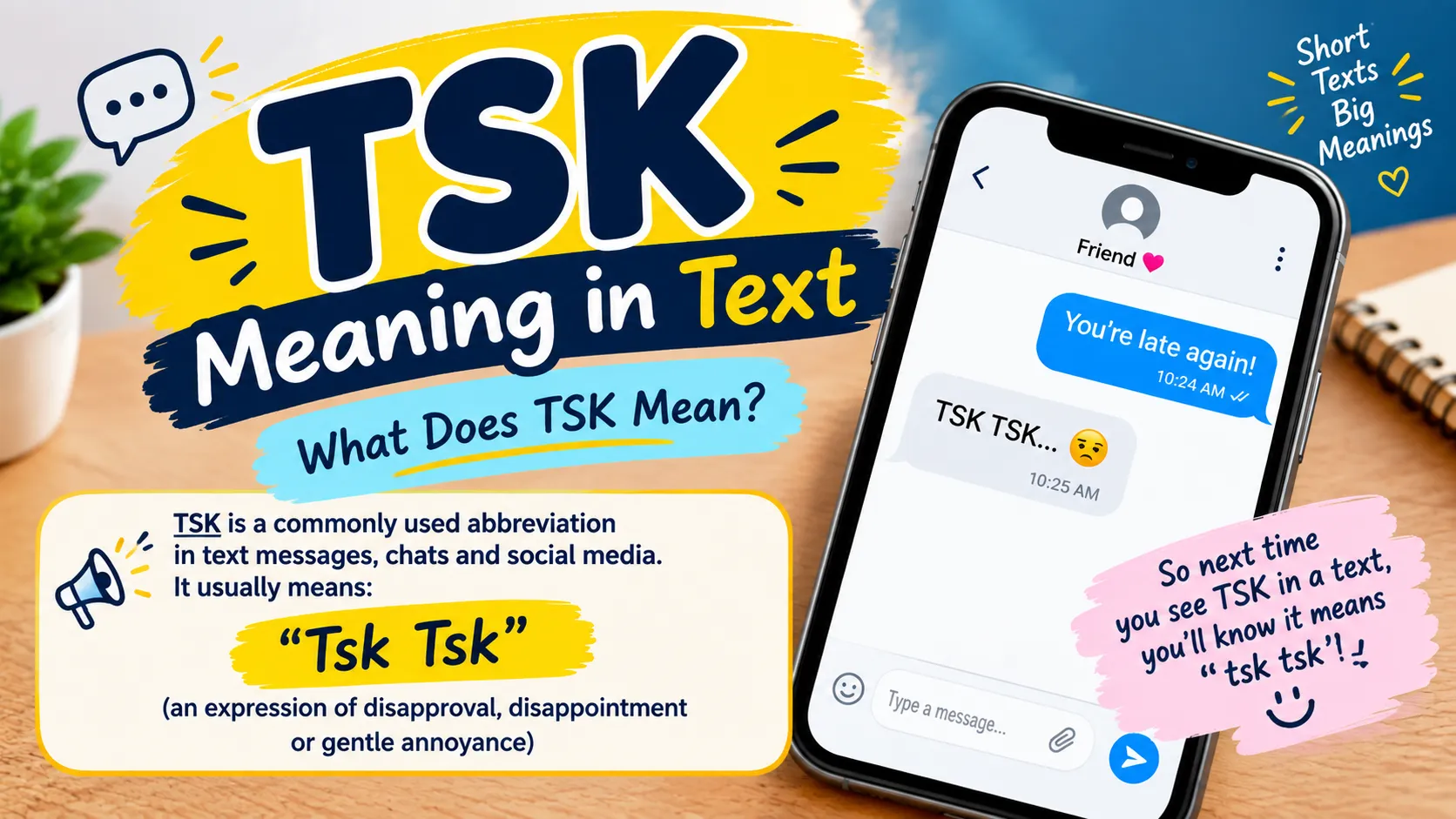
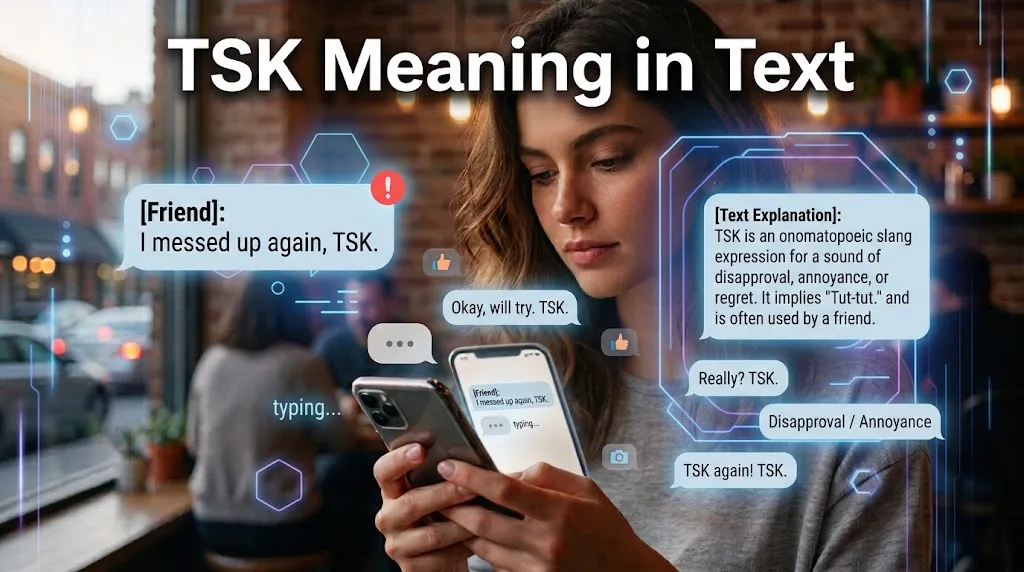
The TSK meaning in text is usually a written representation of a tongue-clicking sound used to express disapproval, disappointment, impatience, mild annoyance, or criticism. Depending on the situation, it can also be playful or teasing.
Unlike abbreviations such as LOL, BRB, or IDK, TSK normally does not stand for a longer phrase. It represents a sound and functions as an interjection or reaction.
For example:
“You forgot your homework again? Tsk.”
Depending on the relationship between the speakers, that could mean:
- “Come on.”
- “That’s disappointing.”
- “You should know better.”
- “Really?”
- “For shame.”
The exact interpretation depends on the context, punctuation, emojis, and relationship between the people chatting.
Quick Answer: What Does TSK Mean in Text?
TSK in text usually represents a tongue-clicking sound that expresses disapproval, disappointment, impatience, mild annoyance, or playful criticism.
It is generally not a conventional acronym with a fixed full form.
| Expression | Common meaning | Typical tone |
| TSK | Disapproval or mild criticism | Neutral to critical |
| TSK TSK | Emphasized disapproval | Critical, humorous, or playful |
| TSK 😅 | Light disapproval or teasing | Playful |
| TSK 😒 | Annoyance or disapproval | More serious |
| TSK 😂 | Mock disapproval | Humorous |
The same expression can communicate different shades of emotion depending on the conversation.
What Does TSK Mean in Text?
TSK is a written representation of a tongue-clicking sound.
People can make this short sound in spoken conversation to show that they disapprove of something or think something is undesirable. When the reaction is written down, it appears as tsk.
In a text conversation, someone might write:
“Tsk, you should have checked first.”
The sender isn’t necessarily angry. They could simply be expressing mild criticism.
Similarly:
“You ate the last cookie? Tsk 😂”
Could be nothing more than playful teasing.
This is why TSK should not always be translated into one fixed phrase such as “I’m annoyed.” Its meaning is broader and depends on context.
What Does TSK Mean in Chat?
In chat, TSK is a short emotional reaction.
Someone may type it when another person:
- Makes a mistake
- Does something disappointing
- Makes a questionable decision
- Behaves badly
- Says something silly
- Needs a gentle reminder
- Does something that invites playful teasing
For example:
A: I forgot my keys again.
B: Tsk 😅
Here, TSK probably communicates mild teasing or disappointment rather than serious anger.
Compare that with:
A: I blamed someone else for my mistake.
B: Tsk. That’s not fair.
In this case, the expression communicates more direct disapproval.
The letters are identical, but the context changes the emotional meaning.
Does TSK Have a Full Form?
No. TSK does not normally have a standard full form in texting.
This is one of the biggest points of confusion because many popular texting expressions are abbreviations.
For example:
- LOL = Laughing Out Loud
- BRB = Be Right Back
- IDK = I Don’t Know
TSK works differently.
It represents a sound, rather than a set of words whose first letters form an abbreviation.
So the simplest distinction is:
TSK is a sound expression, not normally a three-word texting acronym.
You may occasionally encounter humorous or invented “full forms” online. Those should not be treated as the standard meaning of TSK.
Is TSK an Acronym or an Interjection?
In ordinary English use, TSK is better understood as an interjection or written sound expression than as an acronym.
An acronym uses letters to represent words.
TSK instead represents a reaction that can be heard in spoken communication.
This is why someone can simply send:
“Tsk.”
without completing a sentence.
The expression itself communicates the reaction.
It is similar in this respect to written reactions such as “ugh,” “hmm,” or “tut”, although each has its own typical meaning and tone.
What Emotions Can TSK Express?
TSK has several closely related uses.
1. Disapproval
This is one of the clearest uses.
“Tsk. You shouldn’t have done that.”
Here, the sender is communicating that they do not approve of the action.
2. Disappointment
TSK can also express disappointment.
“You forgot again? Tsk.”
The implied message might be:
“I’m disappointed.”
3. Mild Annoyance
Someone may use TSK when something is irritating them.
“Tsk, why did you change the plan?”
This suggests irritation, although not necessarily serious anger.
4. Impatience
TSK can accompany an impatient reaction.
“Tsk… we’ve been waiting for an hour.”
The sound adds emotional emphasis to the message.
5. Playful Criticism
Friends may use TSK jokingly.
“You ate my fries? Tsk 😂”
The sender may pretend to disapprove without being genuinely upset.
6. Mock Sympathy
Sometimes tsk tsk can be used humorously to sound sympathetic or theatrically disapproving.
“You have to work tomorrow? Tsk tsk.”
The sender might be joking rather than expressing genuine concern.
How Context Changes the Meaning of TSK
The most important thing to understand about TSK is that context matters.
Consider these examples:
“Tsk 😂 You did it again.”
This sounds playful.
Now compare:
“Tsk. That’s completely unacceptable.”
This sounds serious.
The expression itself hasn’t changed. The surrounding language has.
When interpreting TSK, consider:
- What was said immediately before it?
- Is the conversation serious or playful?
- Is there an emoji?
- What punctuation is used?
- How well do the two people know each other?
- Is the sender responding to a mistake?
- Does the sender normally tease the other person?
A single “tsk” can therefore range from affectionate teasing to genuine disapproval.
Is TSK Rude?
TSK can sound rude or judgmental, but it is not automatically rude.
Its tone depends on the situation.
Playful:
“Tsk 😂 You stole my fries again.”
Mildly critical:
“Tsk. You should have checked the details.”
More serious:
“Tsk. That’s not acceptable.”
A close friend may use TSK jokingly, while someone in a serious conversation may use it to express genuine disapproval.
If someone sends only:
“Tsk.”
with no emoji or explanation, the message can feel more judgmental because there are fewer clues about the intended tone.
What Does TSK TSK Mean?
TSK TSK is the Repeated form of TSK.
Repeating the expression can make the reaction more noticeable, emphatic, dramatic, or humorous.
For example:
“Tsk tsk, you should know better.”
This might mean:
- “For shame.”
- “You really shouldn’t have done that.”
- “Come on.”
- “That’s not good.”
In playful conversations, tsk tsk can be deliberately exaggerated.
“You ate the entire cake? Tsk tsk 😂”
The sender probably isn’t delivering a serious reprimand.
TSK vs. TSK TSK
The two expressions have essentially the same underlying meaning, but repetition can change the emphasis.
| Expression | Typical effect |
| TSK | Short reaction or mild disapproval |
| TSK TSK | Stronger or more expressive reaction |
| TSK TSK TSK | Dramatic, exaggerated, or humorous reaction |
This isn’t a strict rule. People can use either version playfully or seriously.
The surrounding message remains more important than the number of repetitions.
TSK vs. Tut
Tut is closely related to TSK.
Both can represent a tongue sound associated with disapproval.
For example:
“Tut, you should have known better.”
and:
“Tsk, you should have known better.”
can communicate a similar reaction.
“Tut” and “tut-tut” are particularly associated with British English, while TSK is another written representation of the sound.
TSK vs. SMH
TSK and SMH can overlap in meaning, but they are not the same expression.
SMH stands for “shaking my head.”
TSK represents a tongue-clicking sound.
Compare:
“You did that again? SMH.”
with:
“You did that again? Tsk.”
Both can communicate disapproval or disbelief, but they express the reaction differently.
TSK vs. Sigh
A sigh can communicate several emotions, including frustration, tiredness, sadness, relief, or resignation.
TSK is more specifically associated with disapproval or a critical reaction.
For example:
“Sigh… I have to start over.”
Mainly communicates weariness or frustration.
Meanwhile:
“Tsk. You should have read the instructions.”
Communicates disapproval.
TSK vs. Ugh
Ugh generally Expresses annoyance, frustration, disgust, or reluctance.
TSK more commonly suggests disapproval, criticism, or disappointment.
For example:
“Ugh, this traffic is terrible.”
expresses frustration.
But:
“Tsk, you shouldn’t have said that.”
expresses disapproval.
The two expressions can overlap, but they are not interchangeable in every situation.
TSK Examples in Text Messages
Here are some natural examples showing how the expression can work.
Example 1: Forgetting Something
A: I forgot my wallet again.
B: Tsk. You need to be more careful.
Meaning: Mild criticism.
Example 2: Playful Teasing
A: I ate your chocolate.
B: Tsk 😂
Meaning: Playful annoyance.
Example 3: Disappointment
A: I didn’t finish the work.
B: Tsk. I was counting on you.
Meaning: Disappointment.
Example 4: A Silly Mistake
A: I sent the message to the wrong person.
B: Tsk tsk 😭
Meaning: Playful criticism or sympathy.
Example 5: Genuine Disapproval
A: I blamed someone else for my mistake.
B: Tsk. That’s not fair.
Meaning: Genuine disapproval.
Example 6: Lighthearted Reaction
A: I ordered dessert even though I said I wouldn’t.
B: Tsk 😏
Meaning: Playful teasing.
Why Do People Type TSK Instead of Writing a Full Sentence?
TSK is useful because it communicates a reaction quickly.
Instead of writing:
“I disapprove of what you just did.”
Someone can simply write:
“Tsk.”
It also gives written conversation a little of the emotional quality found in spoken communication.
In face-to-face conversation, people can communicate attitude through:
- Tone of voice
- Facial expressions
- Gestures
- Pauses
- Small sounds
Text removes many of those signals.
Expressions such as TSK help restore some of that emotional information.
TSK Meaning on WhatsApp, Instagram, TikTok, and Social Media
The basic meaning of TSK does not fundamentally change from one social platform to another.
You may encounter it in:
- WhatsApp chats
- Instagram comments
- Instagram DMs
- TikTok comments
- Facebook posts
- Discord conversations
- Gaming chats
- Reddit discussions
- Group messages
What changes is the context.
For example:
“Tsk 😂”
in a friend’s comment is likely to be playful.
But:
“Tsk. That’s irresponsible.”
In a serious discussion, it is more clearly critical.
Therefore, it is better to interpret TSK according to the conversation rather than assuming that each platform gives it a separate definition.
How to Respond When Someone Says TSK
Your response should match the tone of the original message.
If they are teasing you:
“Okay, okay 😂”
If you made a mistake:
“Yeah, my bad 😅”
If you’re unsure what they mean:
“What? 😂”
If they’re joking:
“Tsk right back at you 😂”
If they seem genuinely disappointed:
“I understand. Sorry about that.”
There is no universal response to TSK. The surrounding conversation tells you whether the sender is joking, criticizing, or genuinely disappointed.
Does TSK Mean Something Romantic or Flirty?
TSK does not inherently have a romantic or flirty meaning.
However, people can use almost any expression playfully in a romantic conversation.
For example:
“Tsk 😏 You know exactly what you’re doing.”
could sound teasing or flirtatious because of the surrounding words and emoji.
But the flirtatious tone comes from the context, not from TSK itself.
If someone sends you “tsk” in a romantic conversation, don’t assume it automatically means flirting.
What Does TSK Mean From a Girl?
There is no separate standard meaning of TSK based on whether the sender is a woman.
A girl sending:
“Tsk 😂”
could be teasing.
A girl sending:
“Tsk. That’s not okay.”
could be expressing genuine disapproval.
The conversation matters more than the sender’s gender.
What Does TSK Mean From a Guy?
Likewise, there is no special male-specific definition.
A guy might use TSK to:
- Tease a friend
- Express disappointment
- Show mild annoyance
- Joke about someone’s mistake
- Express disapproval
Look at the surrounding messages rather than assigning a special meaning based on gender.
Where Did TSK Come From?
TSK is not a new Expression invented for smartphones or social media.
It represents a tongue-clicking sound that predates modern digital communication.
Oxford’s entry for tsk tsk identifies its origin as imitative and dates it to the 1940s. In other words, the written expression developed as a representation of a sound rather than as an acronym formed from several words.
This helps explain why TSK behaves differently from modern texting abbreviations.
It wasn’t created by taking the first letters of a phrase.
Instead, people took a sound that could already be used in spoken communication and represented that sound with letters.
Is TSK Onomatopoeia?
TSK is commonly described as an imitative sound expression because its written form represents a sound.
It is therefore related to the broader idea of onomatopoeic or sound-symbolic writing.
However, for an ordinary reader, the most useful explanation is simply:
TSK is a written version of a tongue-clicking reaction.
You don’t need to treat it like an acronym to understand it.
Can TSK Have Other Meanings?
Yes.
Like many short letter combinations, TSK can have unrelated meanings in specialized contexts.
For example, TSK may appear as an abbreviation or name in technical, organizational, academic, or professional settings.
Therefore, context is essential.
If you see:
“Tsk 😂”
in a casual conversation, the tongue-click interpretation is the relevant one.
If you see:
“TSK”
in a technical document, it may represent something completely different.
For the search query “TSK meaning in text,” however, the conversational sound expression is the relevant meaning.
Common Misunderstandings About TSK
Misunderstanding 1: TSK must be an acronym
Not necessarily.
In ordinary texting, TSK represents a sound rather than a phrase.
Misunderstanding 2: TSK always means anger
No.
It can express mild disapproval, disappointment, teasing, impatience, or playful criticism.
Misunderstanding 3: TSK is always rude
Not necessarily.
Friends can use it jokingly.
Misunderstanding 4: TSK always means the same thing
The basic reaction is related to disapproval, but the emotional strength can change considerably with context.
Misunderstanding 5: TSK has a secret universal full form
There is no standard texting full form that TSK universally expands into.
People Also Ask
TSK is a written representation of a tongue-clicking sound usually associated with disapproval, disappointment, impatience, mild annoyance, or criticism.
In chat, TSK is generally a short emotional reaction. Depending on context, it can mean something like “come on,” “that’s disappointing,” “really?” or “you should know better.”
Usually, no. In ordinary texting, TSK is not a standard acronym with a fixed full form. It represents a sound.
TSK TSK is the repeated form of TSK. Repetition can make the reaction more emphatic, dramatic, humorous, or playful.
It can sound judgmental or rude in some situations, but it can also be completely playful. Context, punctuation, emojis, and the relationship between the speakers all matter.
Related Terms and Similar Expressions
If you’re researching TSK, you may also encounter these expressions:
| Expression | General meaning |
| TSK | Tongue-clicking reaction; disapproval or criticism |
| TSK TSK | Repeated or emphasized disapproval |
| Tut | Similar tongue sound associated with disapproval |
| SMH | Shaking my head |
| Ugh | Annoyance, frustration, disgust, or reluctance |
| Sigh | Weariness, frustration, sadness, relief, or resignation |
| Hmm | Thoughtfulness, uncertainty, doubt, or hesitation |
These expressions can overlap emotionally, but they are not interchangeable in every situation.
Conclusion
The TSK meaning in text is best Understood as a written tongue-clicking reaction.
It usually communicates:
- Disapproval
- Disappointment
- Mild annoyance
- Impatience
- Criticism
- Playful teasing
Most importantly, TSK is not normally an acronym with a standard full form.
The tone can range from playful to serious.
“Tsk 😂”
may simply mean:
“Come on 😂”
while:
“Tsk. That’s not okay.”
communicates genuine disapproval.
So when someone sends TSK, don’t interpret the three letters in isolation. Check the surrounding words, punctuation, emojis, situation, and relationship between the speakers.
That context usually reveals whether the sender is joking, teasing, disappointed, or genuinely criticizing something.