Finishing operations rarely get the attention they deserve in manufacturing cost reviews. They sit at the end of the production line, often treated as a fixed overhead rather than a variable cost center with meaningful room for improvement. Yet for manufacturers dealing with volume pressure, labor constraints, and tightening quality standards, the finishing stage is frequently where margins are quietly eroded — through material waste, rework, inconsistency, and slow throughput.
In 2025, US manufacturers are facing a specific set of conditions that make this question more practical than it has been in prior years. Labor availability in skilled trades remains tight across most industrial regions. Environmental compliance requirements have continued to tighten, particularly around volatile organic compound emissions. And the cost of raw materials — including paints, primers, and specialty coatings — has not returned to pre-2020 levels in most categories. Under these conditions, the finishing booth is no longer a background consideration. It is a line item worth serious examination.
The core comparison here is between conventional spray booths staffed by human operators and automated robotic finishing systems. Both are established technologies with real-world track records. The question is not which is more impressive — it is which produces better financial outcomes for a given manufacturing context.
What a Robotic Paint Booth Actually Changes About Your Operation
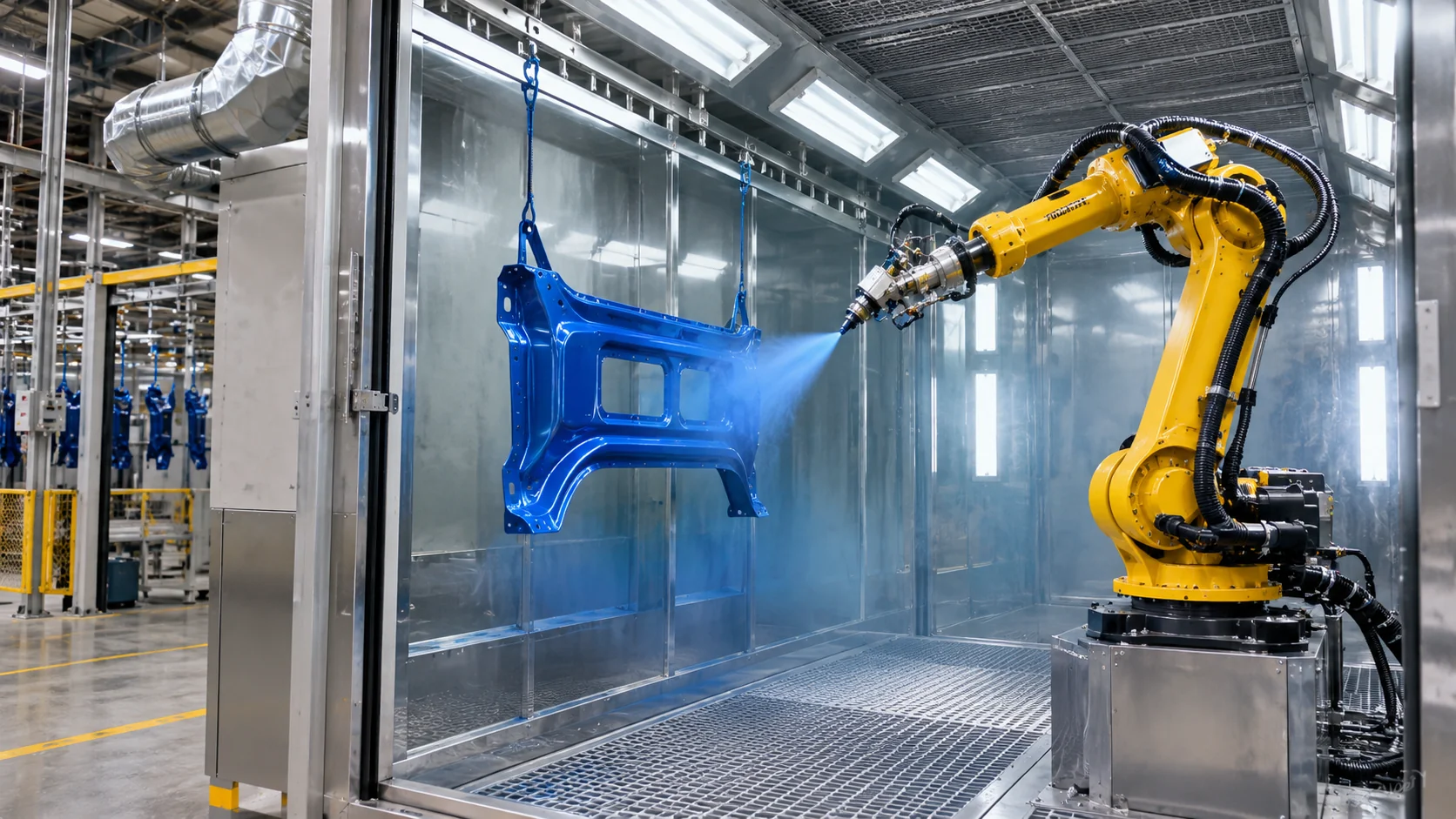
A robotic paint booth replaces human spray application with programmable, mechanized applicators that follow fixed or adaptive paths across a part’s surface. The system applies coating materials with consistent pressure, angle, distance, and speed — variables that human operators adjust intuitively but inconsistently across shifts, fatigue levels, and experience gaps. This consistency is not a minor operational footnote. It is the central financial argument for automation in finishing.
When evaluating whether a robotic paint booth is the right investment for a production environment, the first question to answer is not about the technology itself — it is about how much variability currently exists in your finishing output and what that variability is costing you in rework, overspray, and material consumption.
Material Consumption and Transfer Efficiency
One of the clearest financial separators between robotic and conventional spray finishing is transfer efficiency — the percentage of coating material that actually adheres to the part versus what is lost to overspray, dripping, or atmospheric dispersion. Human operators, even experienced ones, produce natural variation in this ratio. Gun distance drifts, overlap patterns shift, and application speed changes with fatigue or part complexity.
Robotic applicators maintain programmed parameters throughout an entire production run. The result is a meaningfully higher and more stable transfer efficiency rate. For operations running significant volumes of parts or using expensive specialty coatings, this difference in material utilization accumulates into a substantial cost variance over a quarter or fiscal year. The savings are not theoretical — they show up directly in coating material purchase volumes.
Rework and Rejection Rates
Finishing defects — runs, thin spots, orange peel texture, uneven gloss — almost always trace back to application inconsistency. In a conventional booth, these defects are part of a statistical reality tied to human performance. Quality control catches some at inspection; others make it to the customer and return as warranty claims or complaints.
Robotic systems reduce this variability substantially, which compresses the rework rate. The financial impact of rework is often underestimated in cost modeling because it carries both direct costs (materials, labor hours, booth time) and indirect costs (delayed shipments, disrupted scheduling, and customer relationship strain). When rework drops, those downstream effects decrease alongside it.
The True Cost of a Conventional Spray Booth in 2025
Conventional spray booths are not inherently inefficient. For low-volume, high-variability work — custom fabrication, prototype runs, complex architectural components — they remain appropriate tools. But in a production environment where the same part or family of parts moves through the booth repeatedly, the conventional model carries a cost structure that becomes harder to justify when examined fully.
Labor Costs Beyond the Wage Line
The visible cost of a conventional booth is the wage and benefits package of the spray technicians staffing it. The less visible costs are the ones that accumulate around that core figure. Training time for new operators adds to onboarding cost. Turnover in finishing roles — a persistent challenge in manufacturing — means periodic gaps in skilled coverage that affect throughput and quality consistency.
Beyond turnover, there are compliance costs tied to worker health and safety in finishing environments. Respiratory protection programs, medical monitoring requirements, and ventilation maintenance are all obligations that come with human presence in a spray environment. These are legitimate and necessary expenditures, but they are costs that robotic systems substantially reduce by removing personnel from direct coating exposure.
Environmental Compliance and Permit Complexity
US manufacturers operating spray booths are subject to regulations governing air emissions, particularly around volatile organic compounds and hazardous air pollutants. The EPA’s National Emission Standards for Hazardous Air Pollutants establish requirements that apply to surface coating operations, and state-level programs often layer additional obligations on top of federal minimums.
Conventional booths tend to generate higher total emissions because overspray volumes are larger and less controlled. Robotic systems, through tighter material application and reduced waste, often operate with a lower emission profile for the same production output. This can simplify permit compliance, reduce monitoring burdens, and in some cases allow manufacturers to use coating materials that would otherwise require additional controls under a higher-emission scenario.
Capital Investment and Payback: Reading the Numbers Honestly
The objection most commonly raised against robotic finishing systems is capital cost. The upfront investment in a robotic system is real and meaningful, particularly for smaller manufacturers. This objection deserves a direct response rather than a dismissal.
How Payback Periods Actually Develop
Payback analysis for finishing automation should account for the full cost comparison — not just the purchase price of the robot against the wage of the person it replaces. The analysis should include material savings, reduced rework labor, lower compliance overhead, reduced worker compensation exposure in finishing environments, and improved throughput consistency.
When the full picture is modeled rather than just the wage line, payback periods are frequently shorter than manufacturers expect at the outset. The speed of payback depends heavily on production volume. High-volume operations with consistent part families tend to see faster returns. Lower-volume operations with highly varied parts may find the economics less compelling, particularly if programming changes would be frequent and costly.
Maintenance Costs and System Reliability
A robotic finishing system introduces a maintenance obligation that a conventional booth does not carry in the same way. Mechanical systems require scheduled servicing, periodic calibration, and occasional component replacement. These are real costs that belong in any honest financial model.
What offsets them is predictability. A conventional booth’s output quality degrades unpredictably with operator fatigue, turnover, and training gaps. A robotic system’s performance degrades on a more predictable schedule tied to mechanical wear, which allows for planned maintenance rather than reactive quality intervention. For manufacturers who have experienced the downstream cost of inconsistent finishing quality, this predictability has real financial value.
When Conventional Booths Remain the Practical Choice
Not every manufacturing environment is a candidate for robotic finishing, and it is important to say that plainly. Conventional spray booths serve a genuine and ongoing purpose in several contexts.
Operations producing highly customized, low-volume parts — where each job differs significantly from the last — may not achieve enough programmed runs to recover automation investment. Shops doing decorative or artistic finishing work that depends on human judgment and hand skill are similarly poor candidates. Smaller facilities with limited floor space may find that the footprint requirements of a robotic system do not align with their physical layout.
The honest evaluation is production-environment specific. Manufacturers should assess their own finishing data before drawing conclusions from industry-level comparisons. Relevant factors include:
• The number of distinct part configurations that move through the booth in a given month and how frequently each repeats
• Current rework and rejection rates in finishing, and the documented cost of addressing them
• Coating material costs as a percentage of total production cost per unit
• The stability and availability of skilled finishing labor in the local market
• Environmental compliance complexity and the internal cost of managing it
These factors, taken together, provide a more reliable basis for a capital decision than any generalized comparison between technologies.
Conclusion: The Financial Answer Depends on the Production Context
The question of which finishing approach saves US manufacturers more money in 2025 does not have a single universal answer — but it does have a structured way of being answered for each specific operation. Robotic finishing systems offer consistent and measurable advantages in material efficiency, quality consistency, environmental compliance management, and long-term labor stability. These advantages translate directly into financial outcomes when production volume and part consistency are sufficient to support the investment.
Conventional spray booths retain their place in environments where customization, volume variability, or operational scale makes automation difficult to justify. They are not obsolete, but they carry a cost structure that becomes increasingly visible as labor markets tighten and compliance requirements expand.
What 2025 has clarified for many manufacturers is that the status quo in finishing is no longer cost-neutral. Keeping a conventional booth running requires active investment in labor, materials, and compliance — costs that accumulate whether or not they are tracked against an alternative. For operations that have not recently reviewed their finishing economics with that full picture in mind, this comparison is worth conducting with actual production data rather than general assumptions.
The manufacturers who will benefit most from this evaluation are not necessarily those with the largest operations — they are those with the clearest visibility into what their current finishing approach is actually costing them across all its dimensions.