Introduction
Artificial intelligence is transforming how modern software products and digital services operate. From intelligent chatbots and AI writing assistants to automated research tools and enterprise data analysis platforms, advanced AI systems are now embedded in thousands of applications used every day.
Organizations of every size—from small startups to multinational corporations—are integrating AI models to automate complex workflows, enhance productivity, and unlock deeper insights from data.
However, while the capabilities of modern AI models are impressive, one aspect often confuses developers and business decision-makers:
AI pricing.
Unlike traditional software platforms that charge a simple monthly subscription or fixed license fee, many AI providers rely on usage-based pricing models.
This means that the amount you pay depends on how much you actually use the AI system.
One of the most popular pricing models used by AI platforms today is token-based billing.
Instead of charging per user or per request, AI providers calculate the cost based on the number of tokens processed by the model.
Tokens represent pieces of text such as words, characters, or fragments of sentences.
The more text you send to the model and the more text the model generates in response, the higher the cost.
One AI model that has gained significant attention in recent years is Claude 2, developed by Anthropic.
Claude quickly became popular among developers because of its unique combination of capabilities, including:
- Extremely large context windows
- Advanced reasoning abilities
- Strong document analysis performance
- A safety-focused AI architecture
Because of these features, Claude has become a preferred AI model for many use cases such as document summarization, enterprise knowledge management, coding support, and customer service automation.
However, before integrating Claude into production systems or AI-powered products, developers must clearly understand one crucial factor:
Claude 2 pricing.
Since Claude operates using an API token billing system, every prompt sent to the model and every word generated by the AI contributes to the final cost.
If developers do not fully understand how token billing works, expenses can grow quickly—especially for high-traffic applications.
This comprehensive Claude 2 pricing guide will explain everything in simple and practical terms.
By the end of this guide, you will learn:
- Claude 2 API pricing explained
- Cost per token and realistic pricing examples
- Claude subscription plans vs API usage costs
- Claude 2 vs GPT-4 pricing comparison
- Cost calculation strategies for developers
- Methods to reduce Claude API expenses
Whether you are a software engineer building an AI product, a startup evaluating AI infrastructure, or a business leader exploring automation tools, this guide will help you clearly understand how much Claude 2 actually costs in 2026.
What Is Claude 2?
Claude 2 is a powerful, large Language model (LLM) created by the artificial intelligence research company Anthropic.
Large language models are advanced neural networks trained on massive datasets of text. These models learn linguistic patterns, contextual relationships, and semantic meaning, allowing them to generate human-like responses to prompts.
Claude 2 was designed as a major competitor to models such as GPT-4, focusing on three major goals:
- Safe and reliable AI behavior
- Long-context text processing
- High-quality reasoning and comprehension
One of the most distinctive aspects of Claude is its training methodology.
Anthropic uses a technique known as Constitutional AI.
This training approach uses predefined ethical guidelines to guide model behavior. Instead of relying entirely on human feedback, the model learns to evaluate its own responses based on safety principles.
The goal of Constitutional AI is to make AI outputs:
- Safer
- More reliable
- Less likely to produce harmful or biased content
Because of this design philosophy, Claude models are often chosen by companies that prioritize AI safety, compliance, and responsible deployment.
Claude 2 became especially popular among developers who needed to process very long documents.
Typical examples include:
- Academic research papers
- Legal contracts and case files
- Corporate reports and financial documents
- Technical manuals and engineering documentation
Thanks to its long context window, Claude can analyze significantly larger documents compared to many earlier AI models.
Key Features of Claude 2
Claude 2 introduced several major improvements compared with earlier AI systems.
These enhancements made the model more useful for real-world professional applications.
Below are some of the most important capabilities that helped Claude gain widespread adoption.
Large Context Window
One of the most impressive features of Claude 2 is its massive context window of up to 200,000 tokens.
A context window represents the amount of information the AI can process in a single prompt.
This allows Claude to analyze extremely long documents without needing to split them into smaller sections.
For example, developers can upload entire books, research papers, or technical reports and ask Claude to summarize or analyze them.
Advanced Reasoning and Comprehension
Claude 2 demonstrates strong reasoning abilities across a wide variety of tasks.
These include:
- Logical analysis
- Multi-step problem solving
- Research summarization
- Structured information extraction
The model can also maintain context across long conversations, making it suitable for complex discussions and analytical workflows.
Long-Document Processing
Many AI models struggle when processing very large inputs.
Claude was specifically designed to excel at long-document understanding.
This makes it especially valuable for industries such as:
- Legal services
- Academic research
- Corporate intelligence
- Healthcare documentation
Developers can use Claude to quickly summarize thousands of pages of information.
Powerful Summarization Ability
Claude is known for producing clear, coherent, and structured summaries.
Instead of generating vague or overly simplified summaries, the model can preserve key details and insights from long texts.
This is particularly useful for knowledge workers who need to quickly understand complex documents.
AI Safety and Alignment
Anthropic designed Claude with a strong focus on safety and alignment.
The model is trained to follow ethical guidelines, avoid harmful outputs, and produce more responsible responses.
For companies concerned about AI governance and compliance, this safety-focused approach can be a major advantage.
Coding Assistance
Claude can also assist developers with programming tasks.
Typical coding applications include:
- Debugging code
- Writing functions and scripts
- Explaining algorithms
- Generating documentation
While coding performance may vary compared with other models, Claude still provides strong support for software development workflows.
Enterprise Automation
Large organizations increasingly use AI models to automate complex processes.
Claude can help automate tasks such as:
- Knowledge base management
- Customer support responses
- Internal documentation analysis
- Research report generation
Because of its long context window, Claude is particularly useful for enterprise knowledge systems.
However, before companies adopt the model, they must understand how Claude 2 pricing works.
Claude 2 Pricing Overview
Claude 2 uses a token-based pricing system.
Instead of charging users per request or per user account, developers pay based on how many tokens the model processes.
This pricing approach is commonly used by AI providers because it reflects the computational resources required to generate responses.
To understand Claude pricing, it is important to understand what tokens represent.
Tokens are small pieces of text that the AI model processes.
A token may represent:
- A word
- Part of a word
- A character sequence
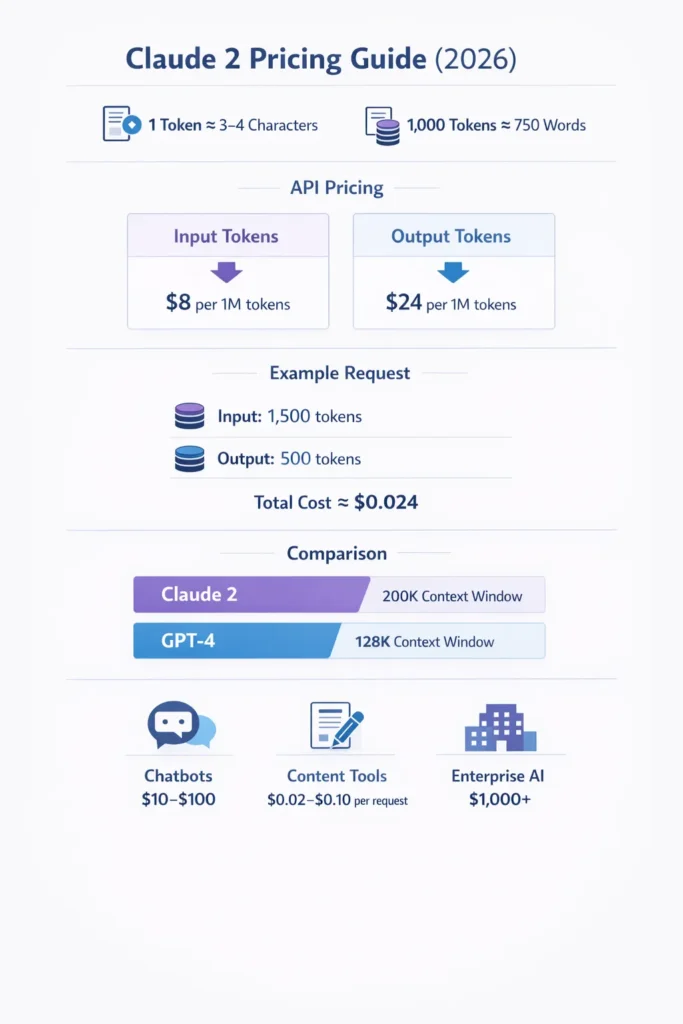
Approximate conversions are shown below.
| Token Conversion | Approximate Value |
| 1 token | 3–4 characters |
| 100 tokens | ~75 words |
| 1,000 tokens | ~750 words |
Every request sent to Claude contains two components:
Input tokens – the text sent to the AI
Output tokens – the text generated by the AI
Both types of tokens are billed separately.
Claude 2 API Pricing (2026)
Here is the standard pricing structure for the Claude 2 API.
| Token Type | Price per Million Tokens |
| Input Tokens | $8 |
| Output Tokens | $24 |
This means:
- 1 million input tokens cost $8
- 1 million output tokens cost $24
Output tokens are more expensive because generating text requires significantly more computational processing than reading input.
Simple Cost Breakdown
Below are some example token conversions to illustrate typical pricing.
| Tokens | Input Cost | Output Cost |
| 1,000 tokens | $0.008 | $0.024 |
| 10,000 tokens | $0.08 | $0.24 |
| 100,000 tokens | $0.80 | $2.40 |
For most individual AI requests, the cost is usually only a few cents.
However, large-scale applications can process millions of tokens per day.
This is why understanding AI pricing is extremely important for developers and product managers.
Claude 2 API Pricing Explained
Understanding Claude API pricing requires knowing exactly what counts as tokens.
Every piece of text involved in the request contributes to token usage.
Input Token Cost
Input tokens include everything sent to the AI model.
Examples include:
- User prompts
- Instructions or system messages
- Conversation history
- Uploaded documents
- Previous responses
The cost for input tokens is:
$8 per million tokens
Example costs:
| Input Tokens | Cost |
| 10,000 | $0.08 |
| 50,000 | $0.40 |
| 100,000 | $0.80 |
Large prompts and long documents significantly increase input costs.
Output Token Cost
Output tokens represent the text generated by the model.
These tokens are more expensive.
Output token pricing:
$24 per million tokens
Example costs:
| Output Tokens | Cost |
| 1,000 | $0.024 |
| 10,000 | $0.24 |
| 100,000 | $2.40 |
Because output tokens cost three times more, developers often try to control response length.
Claude 2 Pricing Example (Real Cost Calculation)
To better understand Claude pricing, let’s analyze a realistic scenario.
Example AI Interaction
User prompt:
1,500 input tokens
Claude’s response:
500 output tokens
Cost Calculation
Input cost:
1500 × $0.000008 = $0.012
Output cost:
500 × $0.000024 = $0.012
Total cost per request:
≈ $0.024
In other words, one AI request costs roughly two cents.
Monthly Cost Scenario
Now imagine an AI application that processes 1,000 requests per day.
| Requests | Daily Cost | Monthly Cost |
| 1,000 | $24 | $720 |
Even though each request costs only a few cents, costs can grow quickly when scaled across thousands of interactions.
This is why AI cost optimization is extremely important.
Claude 2 vs GPT-4 Pricing Comparison
One of the most common questions developers ask is:
Is Claude cheaper than GPT-4?
To answer this question, we must compare pricing structures between models.
Pricing Comparison Table
| Model | Input Price | Output Price | Context Window |
| Claude 2 | $8 / million | $24 / million | 200K |
| GPT-4 | Higher, depending onthe version | Higher | Up to 128K |
| Claude Sonnet | ~ $3 / million | ~ $15 / million | Large |
| Claude Haiku | Very low | Very low | Medium |
Key Differences
Claude Advantages
- Very large 200K token context window
- Efficient for long-document processing
- Strong summarization Performance
- Competitive pricing for analytical task
GPT-4 Advantages
- Huge ecosystem
- Large developer community
- Strong coding capabilities
- Wide range of integrations
For workloads involving long documents, Claude may often be more cost-efficient.
Claude Subscription Plans
In addition to API access, Claude also offers consumer subscription plans.
These plans are designed primarily for individual users rather than developers building software products.
Claude Subscription Pricing
| Plan | Price |
| Free | $0 |
| Pro | $20/month |
| Max | $100/month |
Features of Paid Plans
Paid plans typically include:
- Higher message limits
- Faster response times
- Priority model access
- Improved reliability during peak demand
However, developers should remember an important distinction.
Subscription plans are completely different from API pricing.
Claude API Pricing vs Subscription Pricing
Many beginners confuse Claude subscriptions with API usage.
The difference is shown below.
| Feature | API Pricing | Subscription |
| Payment Model | Pay per token | Monthly fee |
| Best For | Developers | Individuals |
| Cost Predictability | Variable | Fixed |
| Scalability | Unlimited | Limited |
Companies building AI software almost always rely on API pricing.
How Claude Token Pricing Works
Understanding token billing helps developers estimate infrastructure costs.
Every request includes:
- Input tokens
- Output tokens
Billing Formula
Total Cost =
(Input Tokens × Input Price)
(Output Tokens × Output Price)
Example Calculation
Prompt:
“Summarize this 3,000-word research paper.”
Token usage:
- 4,000 input tokens
- 800 output tokens
Cost:
Input cost:
$0.032
Output cost:
$0.0192
Total:
≈ $0.0512
Large documents, therefore, increase the total cost.
Claude 2 Pricing for Different Use Cases
Claude pricing varies depending on how the model is used.
Below are common real-world scenarios.
AI Chatbots
Chatbots usually generate short responses.
Estimated monthly cost:
$10 – $100
depending on traffic.
Content Generation
AI writing tools generating articles or summaries may cost:
$0.02 – $0.10 per request
depending on length.
Coding Assistants
AI coding tools process larger prompts.
Typical monthly cost:
$100–$200 per developer
Depending on usage.
Enterprise AI Systems
Large organizations processing millions of tokens daily may spend:
$1,000 – $10,000+ per month
depending on scale.
How to Reduce Claude API Costs
Token usage can grow rapidly in production environments.
Developers often use several optimization techniques.
Optimize Prompts
Shorter prompts reduce token usage.
Avoid unnecessary instructions.
Trim Conversation History
Chat history increases token counts.
Send only relevant context.
Limit Output Length
Set maximum token limits.
Shorter responses reduce cost.
Use Smaller Claude Models
Newer models, such as Claude Haiku, are significantly cheaper.
Batch Requests
Combining tasks into a single request reduces overhead.
Claude Pricing vs Other AI Models
Claude exists in a Rapidly evolving ecosystem of AI systems.
| Model | Pricing Level |
| Claude Haiku | Very cheap |
| Claude Sonnet | Mid-range |
| Claude Opus | Premium |
| Claude 2 | Older enterprise model |
As AI efficiency improves, developers often migrate to newer models with better cost-performance ratios.
Pros and Cons of Claude 2 Pricing
Pros
- Large context window
- Competitive pricing for document analysis
- Flexible token billing model
- Enterprise scalability
- Reliable infrastructure
Cons
- Output tokens are expensive
- Predicting cost can be difficult
- Newer models may offer better pricing
- Token systems may confuse beginners
Is Claude 2 Worth the Price?
Claude 2 can still be a powerful choice for businesses that need long-context document processing.
It works especially well for:
- document analysis systems
- legal research tools
- research summarization
- enterprise knowledge management
However, newer Claude models may offer better performance at a lower cost.
Developers should evaluate multiple models before making a final decision.
Future Claude Pricing Trends
AI pricing is evolving rapidly as competition increases across the industry.
Several trends are shaping the future of AI cost structures.
These include:
- Cheaper lightweight models
- Subscription tiers for heavy users
- Enterprise pricing discounts
- Optimized inference hardware
Companies such as Anthropic and OpenAI continuously improve model efficiency.
As a result, AI systems will likely become significantly cheaper over time.
FAQS
A: Claude 2 costs approximately:
$8 per million input tokens
$24 per million output tokens
Actual cost depends on token usage.
A: Claude offers a free plan for basic use, but API access is paid.
A: For long-context tasks like document analysis, Claude can be more cost-efficient than GPT-4.
A: Tokens represent pieces of text.
Approximate conversions:
1 token ≈ 3–4 characters
1,000 tokens ≈ 750 words
Both prompts and responses count toward billing
Conclusion
Understanding Claude 2 pricing is essential for developers, product managers, and businesses planning to integrate artificial intelligence into their applications.
Unlike traditional software pricing models, Claude relies on a token-based billing system. This means the final cost depends on how much text your application sends to the model and how much content the AI generates in response.
While this system may appear complicated at first, it provides significant flexibility and scalability.
Developers can start small with minimal cost and Gradually scale their AI applications as usage grows.
For projects involving long documents, research analysis, and enterprise knowledge workflows, Claude 2 remains a powerful and capable model.
However, as AI technology continues evolving, developers should regularly compare pricing and performance across newer models to ensure they are using the most cost-efficient solution available.