Introduction
Artificial intelligence is progressing at an Extraordinary pace. Over the last few years, large language models (LLMs) have evolved into the backbone of modern digital platforms, enabling smarter tools, intelligent assistants, automation systems, and next-generation software solutions.
From chatbots and coding copilots to data analysis platforms and enterprise automation tools, AI models are reshaping how individuals and organizations interact with technology. Businesses are increasingly integrating artificial intelligence into their workflows to increase productivity, accelerate decision-making, and deliver better customer experiences.
Among the most notable models in the modern AI ecosystem is Claude 3 Sonnet, a powerful AI system developed by Anthropic. This model was engineered with a clear objective: deliver an optimal balance between capability, efficiency, and cost.
While some artificial intelligence models prioritize maximum computational power and cutting-edge performance, they often require expensive infrastructure and slower processing speeds. Claude Sonnet was designed differently. It focuses on delivering robust reasoning ability, efficient processing speed, and scalable affordability.
This balance makes the model suitable for a wide variety of professional and technical tasks.
Today, Claude Sonnet is commonly used for:
- AI virtual assistants
- Software engineering support
- Large document interpretation
- Customer service automation
- Academic research analysis
- Knowledge management
- Content generation and editing
In this comprehensive 2026 guide, you will discover everything you need to know about Claude 3 Sonnet, including:
- Core features and capabilities
- Model architecture and technology
- Benchmarks and performance metrics
- Context window explanation
- Pricing structure and API availability
- Real-world use cases
- Developer integrations
- Claude Sonnet vs GPT-4 vs Gemini comparison
By the end of this guide, you will clearly understand how Claude Sonnet functions, who should use it, and why it has become one of the most influential AI models in the industry.
What is Claude 3 Sonnet?
Claude 3 Sonnet is a large language model (LLM) developed by Anthropic and introduced in 2024 as part of the Claude 3 artificial intelligence model suite.
The fundamental objective of Claude Sonnet is straightforward: provide high-quality intelligence while maintaining fast response speeds and economical pricing.
Many modern AI models focus exclusively on achieving the highest possible benchmark scores. However, these models can be expensive, slower to run, and difficult to deploy at scale.
Claude Sonnet addresses this challenge by delivering a balanced combination of performance, responsiveness, and affordability.
The model is capable of performing a wide variety of tasks related to language processing, reasoning, and data analysis.
Some of its primary capabilities include:
- Natural language comprehension
- Text generation and editing
- Software code generation
- Long-form document analysis
- Data interpretation
- Multimodal reasoning
- AI assistant functionality
Because of its versatility and adaptability, the model is widely adopted by several professional groups.
These include:
- Software developers
- Technology companies
- Researchers and academics
- SaaS startups
- Digital marketers
- Content creators
Today, Claude Sonnet is widely regarded as one of the most practical and accessible AI models for real-world deployment.
Claude 3 Model Family Overview
To better understand the significance of Claude Sonnet, it is helpful to explore the entire Claude 3 ecosystem.
Anthropic designed the Claude 3 family to provide multiple performance tiers, enabling organizations to choose the model that best suits their computational needs.
| Model | Performance Level | Speed | Ideal Use Case |
| Claude 3 Haiku | Lightweight | Fastest | Simple AI tasks |
| Claude 3 Sonnet | Balanced | Fast | Most applications |
| Claude 3 Opus | Highest intelligence | Slower | Advanced reasoning |
Each model in this lineup is optimized for a different level of complexity and computational demand.
Claude 3 Haiku
Claude 3 Haiku represents the lightweight model within the Claude ecosystem.
It is optimized for rapid processing and minimal latency, making it ideal for tasks where speed is more important than deep analytical reasoning.
Common applications include:
- Basic chatbots
- Short text generation
- Automated responses
- Customer service replies
- Real-time conversational interfaces
Although Haiku is extremely fast and efficient, its reasoning capabilities are more limited when compared with Sonnet or Opus.
Claude 3 Sonnet
Claude Sonnet occupies the middle tier of the Claude 3 lineup, offering an excellent balance between speed, intelligence, and cost efficiency.
This balanced architecture makes it suitable for a wide range of professional and commercial applications.
Common use cases include:
- AI assistants
- Software development support
- Long-document analysis
- Business automation systems
- Research workflows
Many companies consider Claude Sonnet to be the best value AI model because it delivers strong reasoning capabilities without the high cost associated with flagship models.
Claude 3 Opus
Claude 3 Opus is the most powerful and advanced model developed by Anthropic.
It is designed to handle extremely complex tasks requiring deep reasoning and extensive analytical processing.
Typical applications include:
- Scientific research
- Advanced data analysis
- Complex programming tasks
- Strategic problem solving
However, the increased performance of Opus also means higher operational costs and slower response speeds.
For many practical scenarios, Claude Sonnet offers a more efficient balance between power and performance.
Claude 3 Sonnet Key Features
Claude Sonnet includes a variety of advanced capabilities that allow it to compete with leading AI models across the industry.
Below are the most important features that define the model.
Massive Context Window
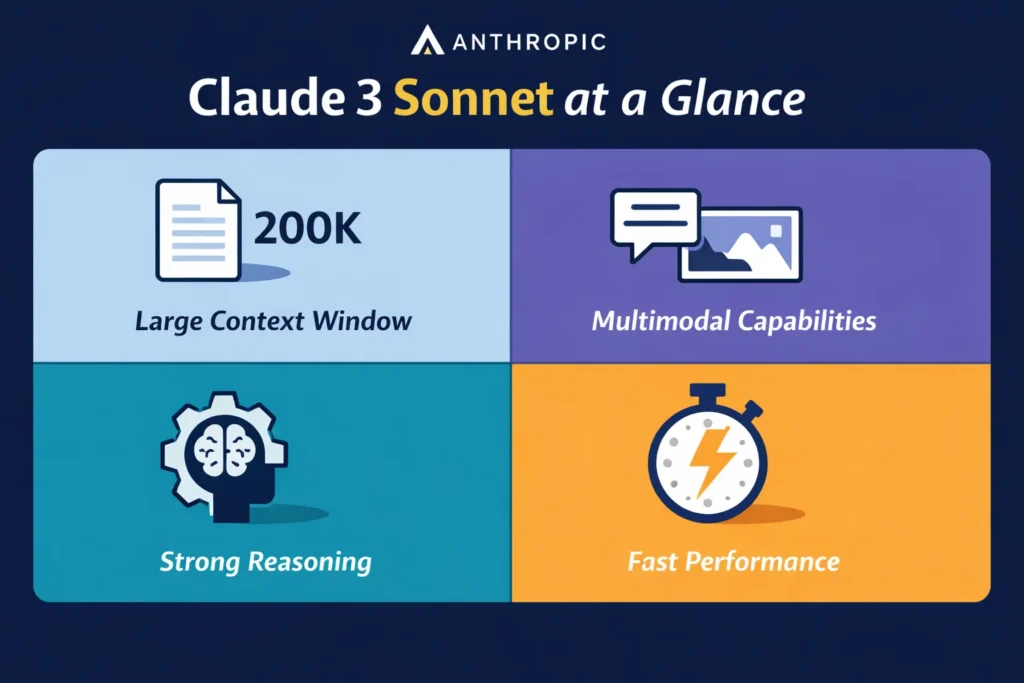
One of the most remarkable capabilities of Claude 3 Sonnet is its large context window, which can process up to 200,000 tokens in a single interaction.
A context window determines how much information an AI system can analyze simultaneously.
The larger the context window, the more data the model can evaluate in one request.
With a 200K token capacity, Claude Sonnet can analyze:
- Entire research papers
- Hundreds of pages of documentation
- Large programming codebases
- Extensive datasets
- Long conversations
For example, a legal professional could upload a complete contract and ask the model to summarize the agreement, highlight potential risks, and interpret complex clauses.
Similarly, developers can submit thousands of lines of code and request analysis or debugging suggestions.
This capability makes Claude Sonnet extremely valuable for knowledge-intensive tasks.
Multimodal Understanding
Claude Sonnet also supports multimodal input, meaning it can analyze both textual and visual data.
Multimodal AI systems are able to interpret different types of information simultaneously.
The model can evaluate:
- Images
- Graphs
- Charts
- Diagrams
- Screenshots
This enables a wide range of analytical tasks.
For example, users can upload a business dashboard and ask the AI to interpret performance metrics or identify patterns in financial charts.
Multimodal functionality is becoming an increasingly important capability in modern AI platforms.
Strong Reasoning Abilities
Claude Sonnet demonstrates strong reasoning capabilities across multiple domains.
The model performs well in Tasks involving:
- Logical deduction
- Problem solving
- Mathematical reasoning
- Knowledge retrieval
- Structured analysis
These capabilities make the model highly valuable for technical applications such as software development, research analysis, and data interpretation.
Many programmers rely on Claude Sonnet as a coding assistant because of its ability to understand complex programming logic.
Fast Response Speed
Speed is a critical factor in modern AI applications.
Many powerful AI systems are computationally intensive, which can lead to slower response times.
Claude Sonnet was engineered to maintain a rapid processing speed while still delivering high-quality results.
This makes it suitable for real-time applications such as:
- AI copilots
- Interactive chatbots
- Productivity assistants
- Customer service automation tools
Fast response time is essential for maintaining smooth user experiences in AI-powered products.
Safety-Focused AI Design
Anthropic places a strong emphasis on AI safety and ethical alignment.
Claude models are trained using techniques that help reduce harmful outputs and encourage responsible behavior.
One of the most important approaches used by Anthropic is known as Constitutional AI.
This training Method teaches the model to follow a set of guiding ethical principles when generating responses.
The goal is to produce AI systems that deliver:
- Safer outputs
- More reliable answers
- Reduced harmful content
This approach represents a major advancement in responsible AI development.
Claude 3 Sonnet Architecture and Technology
Claude Sonnet is built on a transformer-based neural network architecture, which is the foundation of most modern language models.
Transformers rely on attention mechanisms that allow the model to analyze relationships between words, concepts, and contextual patterns.
This architecture enables AI systems to:
- Understand contextual meaning
- Generate coherent language
- Analyze large datasets
- Process complex reasoning tasks
Claude Sonnet is also trained using large-scale datasets that include books, code repositories, academic papers, and publicly available web content.
This diverse training data helps the model understand a wide variety of topics and knowledge domains.
Constitutional AI
A key innovation introduced by Anthropic is Constitutional AI, which focuses on improving AI alignment.
Instead of relying solely on human feedback, the model is guided by a structured set of ethical principles.
These principles encourage the model to generate responses that are:
- Safe
- Honest
- Helpful
- Responsible
This methodology aims to create AI systems that are more reliable and trustworthy.
Claude 3 Sonnet Benchmarks and Performance
Benchmarks provide standardized tests for evaluating the performance of AI models.
Claude Sonnet performs strongly across multiple widely recognized benchmarks.
| Benchmark | What it Measures | Claude Sonnet Score |
| MMLU | Knowledge reasoning | ~79% |
| GSM8K | Math reasoning | ~92% |
| ARC-C | Scientific reasoning | ~93% |
| HellaSwag | Commonsense reasoning | ~89% |
These results place Claude Sonnet among the top-performing AI models in multiple categories.
The model demonstrates particularly strong performance in:
- reasoning tasks
- knowledge comprehension
- coding challenges
- language understanding
Because of these capabilities, Claude Sonnet competes closely with other leading AI systems such as GPT-4 and Gemini.
Claude 3 Sonnet Context Window Explained
The context window is one of the biggest advantages of Claude Sonnet.
It determines how much text the model can retain and analyze during a single interaction.
Earlier language models had extremely small context windows.
| Model | Context Window |
| GPT-3 | 4K tokens |
| GPT-4 | 128K tokens |
| Claude Sonnet | 200K tokens |
This large context capacity enables Claude Sonnet to analyze extensive Documents in a single prompt.
Developers can use it for:
- analyzing entire code repositories
- reviewing financial reports
- summarizing research papers
- Understanding technical documentation
This feature is one of the primary reasons why the model is popular among researchers and engineers.
Claude 3 Sonnet Pricing and API Access
Claude Sonnet is available through API access, allowing developers and businesses to integrate the model into their applications.
Pricing is typically calculated based on tokens, which represent segments of processed text.
| Token Type | Estimated Price |
| Input tokens | ~$3 per million |
| Output tokens | ~$15 per million |
Compared with many flagship AI models, Claude Sonnet offers competitive pricing while still delivering strong performance.
Developers can access the model through:
- cloud platforms
- enterprise APIs
- software integrations
Many SaaS companies use Claude Sonnet to power AI features inside their applications.
Claude 3 Sonnet vs GPT-4 vs Gemini
Users often compare Claude Sonnet with other major AI models.
Below is a simplified comparison.
| Feature | Claude Sonnet | GPT-4 | Gemini |
| Context Window | 200K tokens | 128K | Up to 1M |
| Speed | Fast | Moderate | Fast |
| Reasoning | Strong | Strong | Strong |
| Cost | Medium | High | Medium |
| Multimodal | Yes | Yes | Yes |
Key Differences
Claude Sonnet
Best suited for:
- long document analysis
- balanced performance
- cost-efficient AI applications
GPT-4
Best suited for:
- extensive ecosystem
- large developer community
- wide integration support
Gemini
Best suited for:
- integration with Google services
- extremely large context windows
Real-World Use Cases of Claude Sonnet
Claude Sonnet powers many real-world AI applications across industries.
Software Development
Developers use Claude Sonnet for tasks such as:
- code generation
- debugging assistance
- documentation creation
- code reviews
AI coding assistants powered by Claude help engineers build software more efficiently.
Business Automation
Organizations use Claude Sonnet to automate repetitive workflows.
Common examples include:
- customer support responses
- email automation
- data processing
- operational workflows
Automation improves productivity and reduces manual workload.
Research and Knowledge Work
Researchers rely on Claude Sonnet to Analyze large volumes of information.
Applications include:
- summarizing academic literature
- extracting insights from reports
- analyzing datasets
The large context window makes the model especially effective for knowledge-intensive tasks.
Content Creation
Content creators use Claude Sonnet for:
- blog writing
- marketing copy
- technical documentation
- educational resources
AI tools powered by Claude accelerate content production and improve efficiency.
How Developers Use Claude Sonnet
Developers integrate Claude Sonnet using API connections.
Typical workflow:
- Create an API account
- Obtain an API key
- Connect the API to an application
- Send prompts to the model
- Receive responses and optimize prompts
Developers build a variety of applications using Claude Sonnet.
Examples include:
- AI research assistants
- document analysis tools
- coding copilots
- SaaS automation platforms
Advantages of Claude 3 Sonnet
Pros
- Large context window
- Strong reasoning capability
- Fast response speed
- Competitive pricing
- Multimodal functionality
- Enterprise reliability
Cons
- Proprietary system
- Requires API access for full usage
- May produce hallucinated answers
- Large workloads can increase costs
Future of Claude AI Models
Anthropic continues to improve its AI technology.
Future Claude models may introduce:
- larger context windows
- improved reasoning accuracy
- persistent memory capabilities
- autonomous AI agents
- deeper enterprise integrations
As artificial intelligence adoption expands, models like Claude Sonnet will play a central role in powering intelligent software systems.
FAQs
A: Claude 3 Sonnet is used for tasks such as content creation, coding assistance, research analysis, document summarization, and AI automation.
A: It depends on the use case. Claude Sonnet is particularly strong for long document analysis and cost efficiency, while GPT-4 has a larger ecosystem and integrations.
A: Claude Sonnet supports a context window of up to 200,000 tokens, allowing it to process extremely large documents.
A: Developers can integrate Claude Sonnet into applications using API access provided by Anthropic.
A: Many companies use Claude Sonnet for AI assistants, workflow automation, research tools, and knowledge management systems.
Conclusion
Claude 3 Sonnet has rapidly become one of the most practical and versatile artificial intelligence models available today.
By combining strong reasoning capabilities, high processing speed, and cost efficiency, it delivers a balanced solution that works well for developers, Businesses, and researchers.
Its massive context window, multimodal understanding, and scalable API access make it suitable for a wide variety of professional applications.
From software development and research analysis to content generation and enterprise automation, Claude Sonnet is transforming the way organizations leverage artificial intelligence.
Although it may not be the most powerful model in the Claude ecosystem, it offers one of the best combinations of performance, efficiency, and affordability, making it an ideal choice for many real-world AI deployments.
As artificial intelligence continues to evolve, Claude Sonnet and future Claude models will play a critical role in shaping the next generation of intelligent digital systems.