Introduction
Artificial intelligence is advancing at an extraordinary pace, and the early Generations of AI assistants laid the groundwork for the systems we use today. Among the most widely discussed early models were Claude 1 and Claude Instant, both developed by Anthropic.
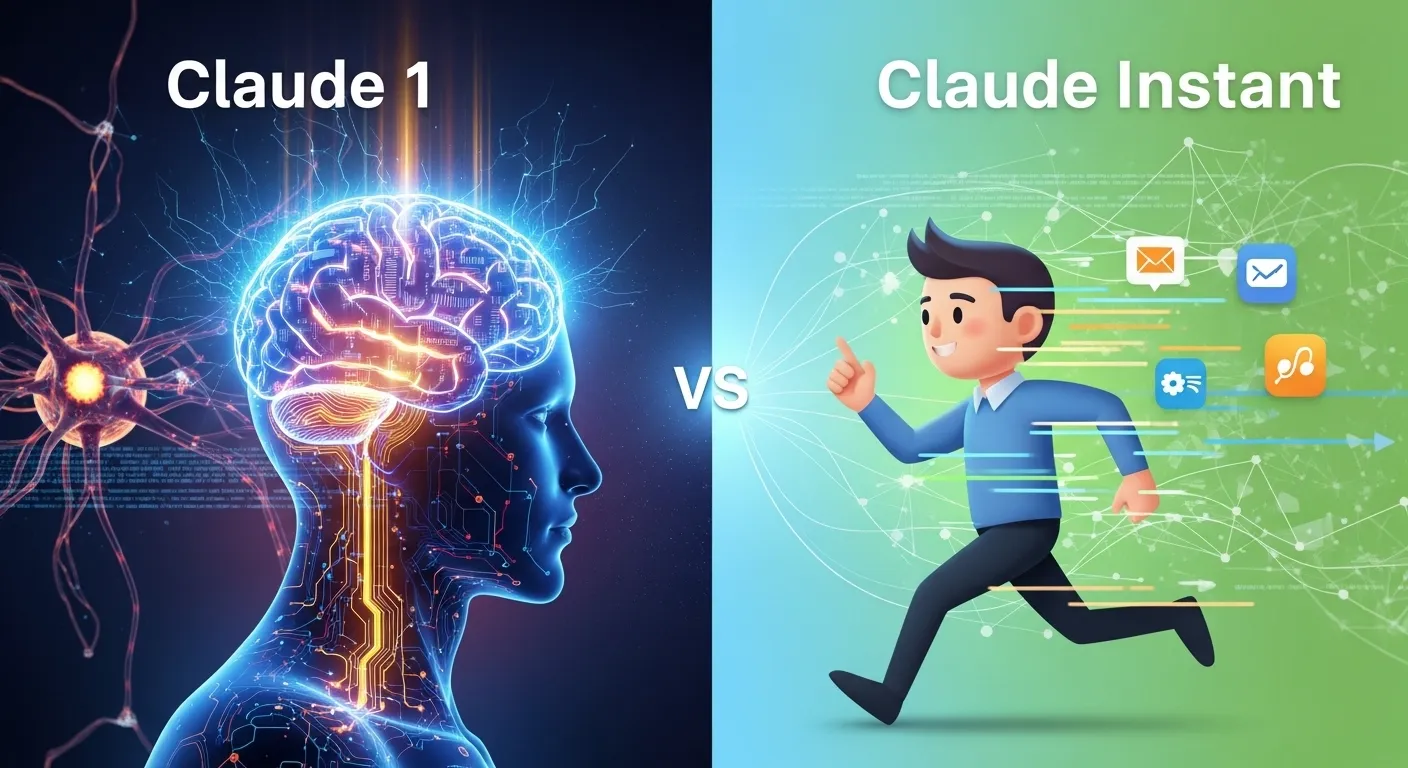
The discussion around Claude 1 vs Claude Instant remains relevant because these two models represent two distinct philosophies in artificial intelligence design:
- Maximum intelligence and deep reasoning
- Maximum speed and computational efficiency
Claude 1 was engineered as a powerful reasoning engine focused on producing high-quality responses, structured analysis, and advanced comprehension. The model emphasized intellectual performance and accuracy when handling complicated problems.
In contrast, Claude Instant was built with performance optimization and rapid response times in mind. Instead of prioritizing deep reasoning, it emphasized speed, scalability, and affordability, which made it suitable for real-time applications and large-scale deployments.
Understanding the differences between these models is important for several groups:
- Developers selecting the most appropriate AI system
- Businesses optimizing operational costs
- Researchers studying the evolution of AI assistants
- Technology enthusiasts exploring how AI models have developed over time
Although newer models such as Claude 2 and Claude 3 have surpassed them in capability, Claude 1 and Claude Instant remain important milestones in the development of conversational AI.
In this comprehensive 2026 guide, we will explore:
- What Claude AI is and how it operates
- The fundamental differences between Claude 1 and Claude Instant
- Performance comparisons including speed, reasoning, and efficiency
- Real-world applications for each model
- Advantages, limitations, and expert recommendations
By the end of this article, you will clearly understand which Claude model is better suited for specific scenarios.
What Is Claude AI?
Claude AI is a family of advanced large language models (LLMs) created by Anthropic. These models are designed to function as intelligent assistants capable of understanding natural language and generating coherent, human-like responses.
Large language models are trained on vast datasets consisting of books, websites, code repositories, and scientific material. Through this training process, they learn patterns in language and develop the ability to perform a wide variety of cognitive tasks.
Claude models can perform numerous tasks, including:
- Natural language conversations
- Content creation and copywriting
- Programming assistance and debugging
- Academic research analysis
- Document summarization
- Data interpretation and explanation
Unlike many other AI systems, Claude models place a strong emphasis on safety, reliability, and responsible AI behavior.
This philosophy distinguishes Claude from some competing systems developed by organizations such as OpenAI and Google DeepMind.
The Philosophy Behind Claude AI
The development of Claude models is guided by three foundational principles:
Helpful
Claude aims to provide answers that are genuinely useful and informative. The goal is not just to generate text but to deliver solutions that address real problems.
For example, Claude can assist users by:
- Explaining difficult programming concepts
- Writing structured articles or tutorials
- Summarizing complex academic studies
- Translating technical ideas into simple language
This focus on usefulness helps make Claude an effective productivity tool.
Harmless
Another central principle behind Claude AI is safety. The system is designed to avoid generating harmful, misleading, or dangerous outputs.
This includes:
- Preventing misinformation
- Avoiding harmful advice
- Filtering toxic or inappropriate responses
Safety has always been a core priority for Anthropic, which was founded specifically to create more reliable and responsible AI systems.
Honest
The third principle is honesty. Claude is designed to provide transparent and truthful responses whenever possible.
Instead of fabricating information, the model is encouraged to acknowledge uncertainty when it lacks sufficient knowledge.
This approach increases trust and reduces the risk of misleading users.
Constitutional AI: Claude’s Unique Training Method
One of the most innovative aspects of Claude’s development is a training approach known as Constitutional AI.
Traditional AI systems often rely heavily on human feedback during training. While effective, this process can be time-consuming and expensive.
Constitutional AI introduces an additional layer of learning. Instead of relying exclusively on human reviewers, the model learns from a predefined set of ethical guidelines or “constitutional rules.”
These rules guide the model toward generating responses that are:
- Safe
- Ethical
- Respectful
- Accurate
As a result, Claude models are better equipped to avoid harmful outputs and maintain responsible behavior.
This approach significantly contributed to Claude’s early reputation as a safer alternative to other conversational AI systems.
What Is Claude 1?
Claude 1 was the first widely available version of Anthropic’s AI assistant.
It was officially introduced in March 2023 and marked an important milestone in the evolution of large language models.
Claude 1 was designed to perform advanced reasoning tasks while maintaining safe and helpful responses.
At the time of its release, Claude 1 was considered a powerful AI system capable of handling a broad range of intellectual tasks.
Core Features of Claude 1
Claude 1 was engineered to support deep analytical tasks that required significant reasoning ability.
Some of its key capabilities included:
- Advanced natural language understanding
- High-quality long-form writing
- Technical and programming support
- Document analysis and summarization
- Multi-step logical reasoning
Because of these capabilities, Claude 1 quickly gained popularity among several professional groups:
- Academic researchers
- Software developers
- Technical writers
- Data analysts
- Corporate teams
The model was particularly valued for its ability to generate well-structured explanations and detailed responses.
Claude 1 Context Window
One important feature of Claude 1 was its relatively large context window.
The model supported approximately:
~9,000 tokens
A token is a unit of text used by language models to process information.
A larger context window allows the model to:
- Understand longer conversations
- Analyze large documents
- Maintain context across multiple messages
In 2023, this context size was considered impressive compared with many competing chatbot models.
Typical Applications of Claude 1
Claude 1 was widely used in situations that required deep reasoning and structured thinking.
Below are some of the most common applications.
Research Assistance
Researchers frequently used Claude 1 to analyze complex academic material.
Typical tasks included:
- Summarizing scientific papers
- Extracting insights from long reports
- Explaining technical concepts
The model’s strong reasoning abilities made it particularly useful in research environments.
Technical Writing
Claude 1 was also highly effective at producing technical documentation.
Examples included:
- Software tutorials
- Developer documentation
- Research summaries
- Long-form blog articles
Its ability to generate coherent and structured text made it valuable for writers and content creators.
Coding and Debugging
Many developers used Claude 1 as a programming assistant.
The model could help with tasks such as:
- Explaining unfamiliar code
- Detecting bugs in programs
- Generating example scripts
- Suggesting improvements to algorithms
This made Claude 1 an early competitor to coding assistants powered by OpenAI models.
Legal and Policy Analysis
Claude 1 was capable of processing large legal documents and extracting meaningful insights.
This allowed professionals to:
- Review lengthy contracts
- Summarize policy documents
- Identify key clauses or obligations
The ability to analyze structured information made Claude 1 valuable in law and compliance environments.
What Is Claude Instant?
Claude Instant was introduced as a lightweight and faster alternative to Claude 1.
Rather than maximizing reasoning ability, the Model prioritized:
- Rapid responses
- Lower computational cost
- High scalability
This made it ideal for high-traffic applications where response speed was critical.
Core Features of Claude Instant
Claude Instant was optimized for performance efficiency.
Key characteristics included:
- Extremely fast response times
- Lower operational cost
- Strong conversational ability
- High scalability for large systems
Because of these advantages, Claude Instant became widely used in chatbots and customer support systems.
Massive Context Window
One of the most impressive features of Claude Instant was its extremely large context window.
The model supported approximately:
~100,000 tokens
This enabled the model to process extremely large text inputs, including:
- Long documents
- Meeting transcripts
- Knowledge bases
- Extended conversations
This capability made it especially useful for document analysis and enterprise knowledge systems.
Typical Applications of Claude Instant
Claude Instant was widely adopted in applications requiring fast responses and high throughput.
AI Chatbots
Many organizations used Claude Instant to power conversational chatbots on their websites.
These systems could:
- Answer Common questions
- Provide product information
- Assist users in real time
Because of its speed, Claude Instant was ideal for interactive conversations.
Customer Service Automation
Businesses also deployed Claude Instant to automate customer support.
Typical functions included:
- Responding to frequently asked questions
- Troubleshooting basic issues
- Guiding customers through simple processes
Automation significantly reduced the workload for human support agents.
AI Knowledge Assistants
Claude Instant could also search and interpret internal documents.
Companies used it to help employees access information from:
- Corporate knowledge bases
- Training manuals
- Internal reports
This improved productivity by reducing the time needed to locate information.
Claude 1 vs Claude Instant: Key Differences
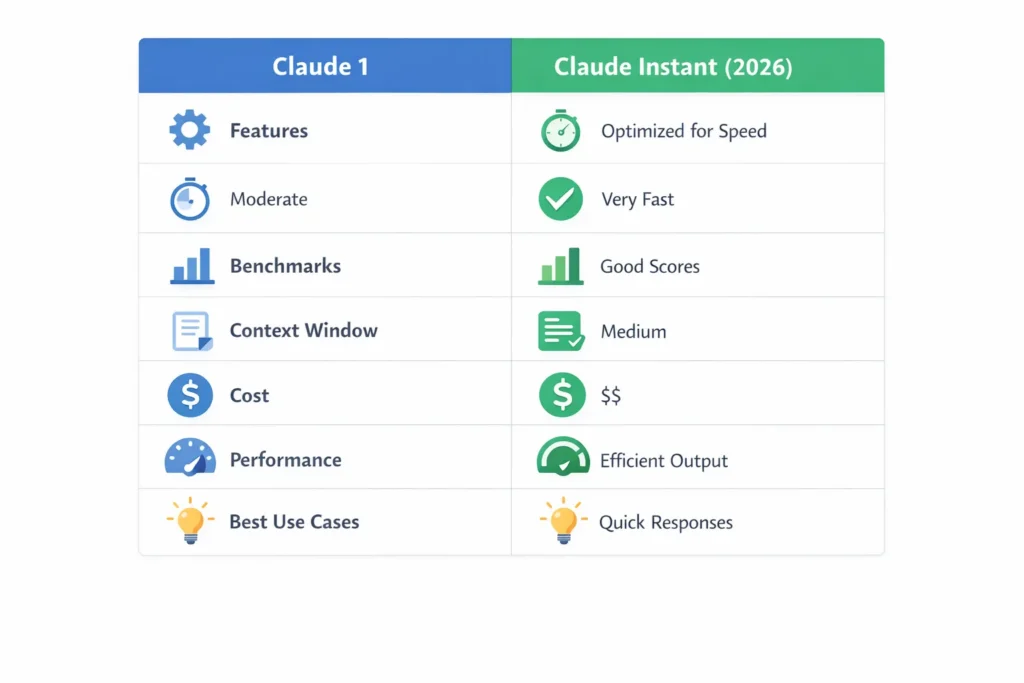
Although both models belong to the same family, they were designed with different priorities.
Claude 1 emphasizes reasoning and accuracy, while Claude Instant focuses on speed and efficiency.
| Feature | Claude 1 | Claude Instant |
| Release Year | 2023 | 2023 |
| Model Type | Flagship reasoning model | Lightweight fast model |
| Speed | Moderate | Very fast |
| Cost | Higher | Lower |
| Reasoning Ability | Strong | Moderate |
| Accuracy | Higher | Slightly lower |
| Scalability | Moderate | Very high |
| Context Window | ~9K tokens | Up to ~100K tokens |
| Best For | Complex analysis | Real-time applications |
This comparison highlights the fundamental design trade-off between intelligence and performance efficiency.
Claude Instant vs Claude 1: Feature Comparison
Below is a deeper examination of how both models perform across key performance metrics.
Accuracy
Accuracy is one of the most noticeable differences between the two models.
Claude 1 generally produces:
- More precise explanations
- More detailed reasoning
- More sophisticated responses
Claude Instant still delivers reliable answers, but they are often simpler and more concise.
Speed
Speed is where Claude Instant clearly dominates.
The model was specifically optimized for:
- Low-latency responses
- High conversation speed
- Fast processing of requests
This makes it ideal for interactive applications.
Cost Efficiency
Running large AI models can be expensive.
Claude Instant was designed to reduce infrastructure costs, making it attractive for companies handling thousands or millions of queries.
Claude 1 requires more computational resources due to its advanced reasoning capabilities.
Scalability
Claude Instant was designed for large-scale deployments.
It can support:
- Massive numbers of users
- High-volume messaging systems
- Large enterprise platforms
Claude 1 focuses more on the quality of reasoning rather than large-scale throughput.
Performance Comparison
The strengths of each model can be summarized as follows.
Claude 1 Strengths
- Superior logical reasoning
- Higher quality writing
- Better coding assistance
- Detailed explanations
Claude Instant Strengths
- Extremely fast responses
- Lower infrastructure costs
- High scalability
- Efficient for conversational applications
Speed and Cost Comparison
| Factor | Claude 1 | Claude Instant |
| Response Time | Moderate | Very fast |
| Infrastructure Cost | Higher | Lower |
| Latency | Higher | Low |
| Best Deployment | Research tools | Chatbots |
Organizations prioritizing quality outputs often select Claude 1, while those focused on scalability prefer Claude Instant.
Real-World Use Cases
Understanding real applications helps clarify the difference between the two models.
When to Use Claude 1
Claude 1 is best suited for complex intellectual tasks.
Examples include:
- Research analysis
- Academic writing
- Legal document review
- Advanced programming tasks
- Policy analysis
These activities require deeper reasoning and structured responses.
When to Use Claude Instant
Claude Instant performs best in real-time environments.
Examples include:
- Website chatbots
- Customer support assistants
- AI help desks
- Conversational AI tools
- AI search assistants
These systems prioritize speed and efficiency.
Advantages and Limitations
Every AI model has strengths and weaknesses.
Pros
- High accuracy
- Advanced reasoning
- Strong writing quality
- Ideal for deep analysis
Cons
- Slower responses
- Higher operational cost
- Less scalable for large traffic systems
Pros
- Extremely fast responses
- Lower cost
- Highly scalable
- Ideal for chat systems
Cons
- Slightly weaker reasoning
- Shorter responses
- Not optimal for complex analytical tasks
Evolution of Claude Models
Following the release of Claude 1 and Claude Instant, Anthropic continued improving its models.
Claude AI Timeline
2023
- Claude 1 released
- Claude Instantly introduce
Mid-2023
- Claude 2 launched with stronger reasoning
2023
- Claude 3 introduced major upgrades
2025 and beyond
Claude models gained:
- Multimodal capabilities
- Longer context windows
- Improved Reasoning Systems
These advancements positioned Claude models as strong competitors to systems such as GPT‑4 and Gemini.
Claude 1 vs Claude Instant vs Claude 2
| Model | Intelligence | Speed | Context Window |
| Claude 1 | High | Medium | ~9K |
| Claude Instant | Medium | Fast | ~100K |
| Claude 2 | Very High | Medium | ~100K |
Claude 2 significantly improved both reasoning and document analysis.
Future of Claude Models
The future of Claude AI is focused on several key areas:
- Larger context windows
- Multimodal capabilities (text, images, audio)
- Stronger reasoning systems
- Improved safety frameworks
Modern AI assistants are becoming increasingly powerful, capable of performing tasks that once required human expertise.
FAQs
A: Not necessarily. Claude Instant is faster and cheaper, while Claude 1 offers stronger reasoning and higher-quality responses.
A: Anthropic designed Claude Instant to provide a low-cost AI model capable of handling large volumes of requests, such as chatbots and customer support systems.
A: Most companies now use newer Claude models, but Claude 1 and Instant were important early models that shaped the Claude ecosystem.
A: Developers needing deep reasoning and coding help may prefer Claude 1. Developers building chatbots or scalable AI systems should consider Claude Instan.t
Conclusion
The comparison between Claude 1 and Claude Instant highlights a fundamental trade-off in artificial intelligence design: intelligence versus efficiency.
Claude 1 was engineered as a Sophisticated reasoning engine capable of handling complex tasks such as research analysis, writing, and programming. Its strength lies in producing detailed and well-structured responses.
Claude Instant, on the other hand, prioritized speed, scalability, and affordability, making it perfect for chatbots, customer service automation, and large-scale conversational systems.
Both models played a crucial role in the early development of Claude AI and laid the foundation for more advanced systems such as Claude 2 and Claude 3.