Introduction
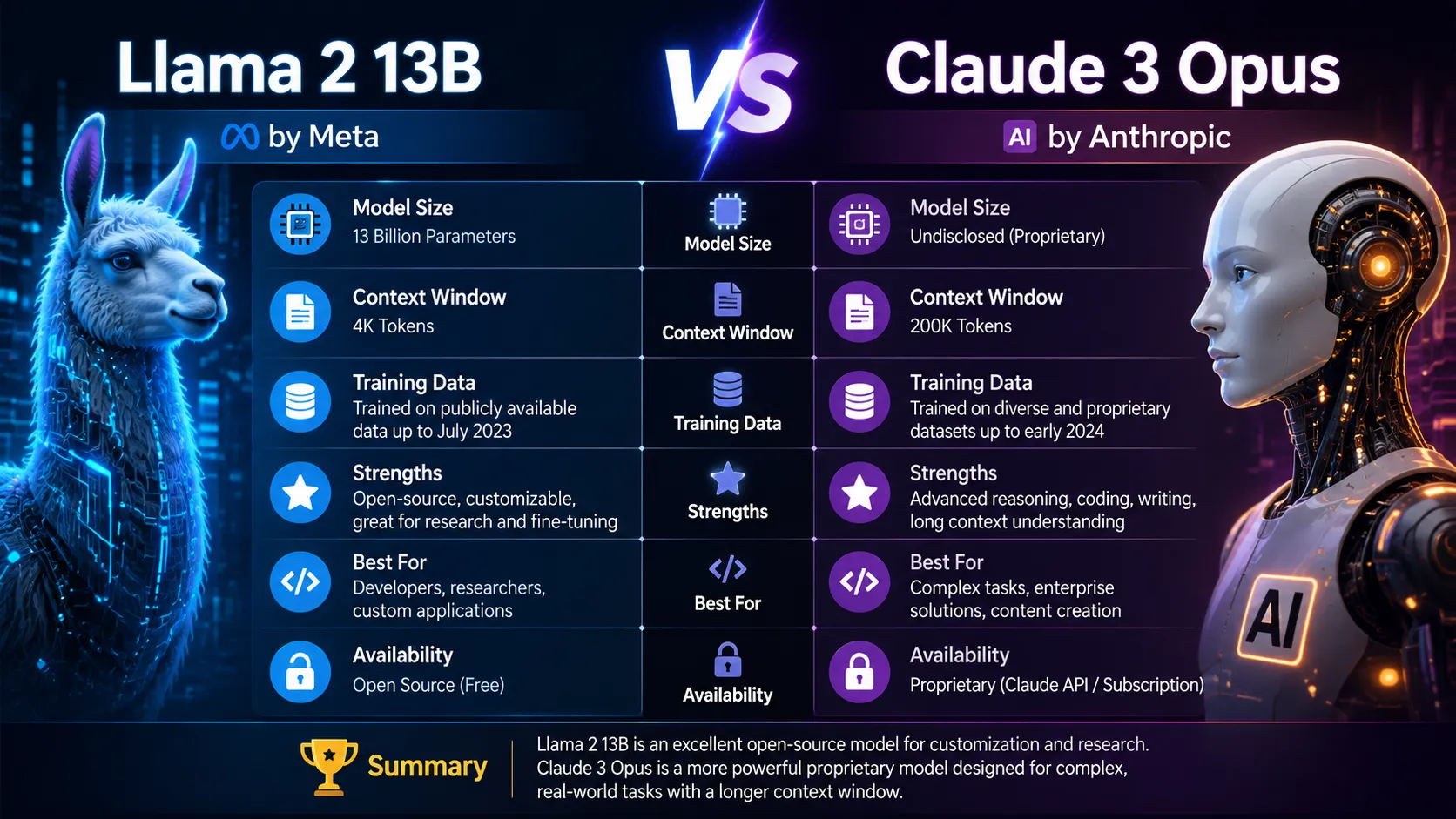
If you are searching for Llama 2 13B VS Claude 3 Opus, the short answer is surprisingly simple: Claude 3 Opus was the stronger model for raw capability, while Llama 2 13B offered much more control over deployment and customization.
But these models came from different generations and were designed around very different philosophies. Was a relatively compact model that developers could deploy themselves, while Claude 3 Opus was Anthropic’s high-end managed model built for difficult reasoning, coding, long-context work, and multimodal tasks.
That distinction matters more than a simple benchmark score.
Quick verdict: Claude 3 Opus wins for reasoning, coding, long-context processing, and general capability. Llama 2 13B wins for deployment flexibility, local experimentation,n and control.
Important 2026 note: Claude 3 Opus is now a historical model. Anthropic formally retired claude-3-opus-20240229 on January 5, 2026, although Anthropic later said Opus 3 remained accessible to paid Claude users and available by API request.
Llama 2 13B vs Claude 3 Opus at a Glance
The fastest way to understand the comparison is to separate capability from control. The models were never perfectly apples-to-apples.
- Llama 2 13B belongs to the 2023 generation of LLMs.
- Claude 3 Opus launched in March 2024.
- Llama 2 13B contains 13 billion parameters.
- Anthropic did not publicly disclose a parameter count for Claude 3 Opus.
- Llama 2 supports a 4K-token sequence length in Meta’s original implementation.
- Claude 3 Opus launched with a 200K-token context window.
- Claude 3 supports multimodal inputs.
- Llama 2’s biggest advantage was control over the model stack.
- Claude’s biggest advantage was high-end model capability.
- The best choice depends on whether you value capability or control.
| Feature | Llama 2 13B | Claude 3 Opus |
| Developer | Meta | Anthropic |
| Release | July 2023 | March 2024 |
| Parameters | 13B | Not publicly disclosed |
| Original context | 4K | 200K |
| Model type | Openly released model weights under Meta’s license | Proprietary managed model |
| Input modality | Text | Text + image |
| Coding | Capable for its generation | Much stronger |
| Reasoning | Moderate | Strong |
| Long documents | Limited | Excellent |
| Local deployment | Major advantage | Restricted |
| Raw benchmark capability | Strong for its era | Frontier-class for its era |
Meta’s model documentation confirms Llama 2’s 7B, 1,,3B and 70B variants and 4K context length, while Anthropic documented a 200K context window for Claude 3.
What Is Llama 2 13B?
Llama 2 13B is the 13-billion-parameter member of Meta’s Llama 2 family. Meta released Llama 2 in July 2023 with 7B, 13B, and 70B models, including pretrained and chat-tuned versions.
- Llama 2 13B was developed by Meta.
- Was released in July 2023.
- The 13B model contains roughly 13 billion parameters.
- Llama 2 was pretrained on 2 trillion tokens.
- Meta reports a September 2022 pretraining-data cutoff.
- Some fine-tuning data extended into 2023.
- The model uses a transformer architecture.
- Llama 2 has pretrained and chat variants.
- The Chat version was optimized for dialogue.
- Meta released model weights rather than only providing an API.
- The model can be used in local development environments.
- It became popular with researchers and developers experimenting with open models.
- Its 13B size made it more approachable than much larger models.
- Its 4K context window is small by modern standards.
- Its importance comes partly from making capable LLM development more accessible.
What Is Claude 3 Opus?
Claude 3 Opus was Anthropic’s flagship Claude 3 model when the family launched on March 4, 2024. Anthropic positioned Opus as its most capable Claude 3 model, particularly for complex reasoning and demanding workloads.
- Claude 3 Opus was developed by Anthropic.
- It launched in March 2024.
- Anthropic did not publish its parameter count.
- It offered a 200K-token context window.
- It supported multimodal input.
- It was designed for complex tasks.
- Anthropic emphasized reasoning performance.
- Anthropic emphasized improved accuracy.
- It was designed to follow complex instructions.
- It could produce structured outputs.
- It was suitable for coding workflows.
- It was useful for research and analysis.
- It was significantly larger in practical capability than Llama 2 13B.
- API pricing was historically $15 per million input tokens and $75 per million output tokens.
- It is now best understood as a historical high-end Claude model rather than Anthropic’s current flagship.
Anthropic’s original documentation lists 200K context and $15/$75 per-million-token input/output pricing for Claude 3 Opus.
Llama 2 13B vs Claude 3 Opus Parameters
- Llama 2 13B has approximately 13 billion parameters.
- Claude 3 Opus’s parameter count was not publicly disclosed.
- A larger parameter count does not automatically guarantee better output.
- Architecture influences model performance.
- Training data influences performance.
- Training quality matters.
- Fine-tuning matters.
- Alignment matters.
- Inference methods matter.
- Context handling matters.
- Tool use can influence practical performance.
- Multimodal capability adds another dimension.
- Benchmark results are more useful than guessing undisclosed parameters.
- Comparing parameter counts alone is therefore misleading.
- Claude’s benchmark performance provides stronger evidence of capability than speculation about its size.
For Llama 2, Meta officially documents the 13B parameter size. Anthropic’s published Claude 3 material focuses instead on capability benchmarks rather than a public parameter count.
Llama 2 13B vs Claude 3 Opus Context Window
Context length is one of the clearest technical differences between the two models.
- Llama 2 supports up to 4K tokens in Meta’s original implementation.
- Claude 3 launched with a 200K context window.
- 4K tokens is enough for relatively short conversations.
- 200K tokens can accommodate extremely long inputs.
- Long context helps document analysis.
- Long context helps research workflows.
- Long context helps large codebases.
- Long context can reduce document chunking.
- Long context can simplify multi-document analysis.
- Long context does not automatically guarantee perfect reasoning.
- Claude 3 Opus also demonstrated strong long-context recall.
- Anthropic reported over 99% accuracy on its Needle In A Haystack evaluation in some testing.
- Llama 2 requires much more aggressive context management for large documents.
- The difference becomes obvious when working with books, reports,s or large code files.
- Claude 3 Opus is the clear winner for original context capacity.
Anthropic documented a 200K context window and reported near-perfect recall in its long-context evaluation, while Meta’s Llama documentation lists 4K sequence length.
Llama 2 13B vs Claude 3 Opus Benchmarks
- Llama 2 13B reported 54.8% MMLU in the comparison research supplied for this article.
- Claude 3 Opus reported 86.8% MMLU under Anthropic’s published 5-shot setup.
- Claude 3 Opus reported 88.2% MMLU with 5-shot chain-of-thought in the model card.
- Claude 3 Opus achieved 60.1% on the reported 0-shot MATH evaluation.
- Claude 3 Opus achieved 84.9% on HumanEval.
- Claude 3 Opus achieved 92.3% on one reported GSM8K setup.
- Claude 3 Opus achieved 50.4% on GPQA Diamond under one reported setup.
- These benchmarks test different abilities.
- MMLU measures broad knowledge and reasoning.
- HumanEval focuses on Python coding.
- GSM8K focuses on grade-school mathematics.
- MATH evaluates mathematical problem solving.
- GPQA targets graduate-level questions.
- Different prompting and scoring methods can change results.
- The overall pattern still strongly favors Claude 3 Opus for raw capability.
Anthropic’s model card reports 86.8% MMLU, 60.1% MATH, 84.9% HumanEval, and other benchmark results for Opus.
| Benchmark | Llama 2 13B | Claude 3 Opus | Practical Winner |
| MMLU | 54.8% | 86.8%* | Claude 3 Opus |
| HumanEval | 18.3%* | 84.9% | Claude 3 Opus |
| GSM8K | 28.7%* | 92.3%* | Claude 3 Opus |
| MATH | — | 60.1% | Claude 3 Opus |
| GPQA Diamond | — | 50.4% | Claude 3 Opus |
Your supplied research also specifically recommends identifying the benchmark, score, methodology,ogy and source before making direct comparisons.
Llama 2 13B vs Claude 3 Opus for Coding
For coding, Claude 3 Opus had a major advantage in published benchmark performance.
- Claude 3 Opus produced stronger code-generation results.
- HumanEval strongly favored Claude 3 Opus.
- Claude was better suited to complex programming tasks.
- Claude was better at understanding lengthy instructions.
- Claude was stronger at debugging complex code.
- Claude was better for explaining complicated code.
- Claude handled large coding contexts more effectively.
- Llama 2 13B remained useful for lightweight coding experiments.
- Llama 2 could be attractive when local inference was important.
- Developers could customize their Llama-based workflows.
- Local deployment can matter more than benchmark scores for some projects.
- Claude’s managed environment reduces infrastructure complexity.
- Llama 2 provides greater control over infrastructure.
- For raw coding quality, Claude 3 Opus wins.
- For controllable local experimentation, Llama 2 13B remains interesting.
Coding winner: Claude 3 Opus.
The supplied research identifies Claude 3 Opus as the stronger coding model and cites the large HumanEval difference as supporting evidence.
Llama 2 13B vs Claude 3 Opus for Reasoning
Reasoning is another category where the two models are separated by generation and capability.
- Claude 3 Opus was designed for complex reasoning.
- Anthropic reported strong performance on MMLU.
- Claude performed strongly on GPQA.
- Claude performed strongly on mathematical evaluations.
- Claude followed complex multi-step instructions well.
- It was designed for open-ended problems.
- It handled complicated prompts more effectively.
- Llama 2 13B was capable for its generation.
- Llama 2 was not designed as a frontier reasoning model.
- Its smaller scale limited its ability on difficult tasks.
- Prompt engineering could improve Llama results.
- Fine-tuning could specialize Llama for specific tasks.
- Claude required less customization for many advanced workflows.
- The benchmark evidence favors Claude strongly.
- Claude 3 Opus is the clear reasoning winner.
Anthropic specifically described Opus as its most intelligent Claude 3 model and reported strong performance on complex cognitive benchmarks.
Llama 2 13B vs Claude 3 Opus for Long Documents
This is arguably the most dramatic practical difference.
- Llama 2’s original 4K context is relatively small.
- Claude 3 Opus offers200K context.
- A 4K context can become restrictive with large reports.
- A 200K context can accommodate much larger source material.
- Researchers benefit from larger context.
- Students can analyze longer documents.
- Developers can provide larger codebases.
- Businesses can process lengthy reports.
- Writers can analyze extensive drafts.
- Legal workflows can involve large document collections.
- Long-context AI reduces the need for aggressive chunking.
- Larger context can simplify retrieval workflows.
- Claude’s recall capabilities were a major selling point.
- Llama 2 is better suited to smaller input workloads.
- Claude 3 Opus wins decisively for long-document workflows.
Llama 2 13B vs Claude 3 Opus for Multimodal AI
This category changes the comparison because Llama 2 itself was text-focused.
- Llama 2 13B accepts text.
- Llama 2 13B generates text.
- The original Llama 2 model is not a vision-language model.
- Claude 3 introduced image understanding.
- Claude can reason about visual inputs.
- Users can combine images with textual instructions.
- This expands possible workflows.
- Visual analysis is useful for charts.
- Visual analysis is useful for screenshots.
- It can assist with image-based documents.
- It can support visual question answering.
- Llama 2 requires additional tooling for comparable multimodal workflows.
- A separate vision model may be needed.
- Claude therefore has a broader native modality advantage.
- Claude 3 Opus wins the multimodal comparison.
Anthropic launched Claude 3 as a multimodal family, while Meta’s Llama 2 model card describes the original model as text input and text output.
Llama 2 13B vs Claude 3 Opus for Cost
Cost requires more nuance than simply labeling one model “free.”
- Model weights were released for developers under Meta’s license.
- Self-hosting can avoid per-token API charges.
- Self-hosting does not mean zero cost.
- Hardware costs money.
- Electricity costs money.
- Storage costs money.
- Engineering time costs money.
- Cloud GPU rental also costs money.
- Claude 3 Opus historically used API pricing.
- Anthropic listed $15 per million input tokens.
- Anthropic listed $75 per million output tokens.
- Batch processing offered lower historical rates.
- API pricing is easier to calculate per workload.
- Self-hosting can become attractive at certain scales.
- The cheapest option depends on infrastructure and usage.
Cost winner: There is no universal winner. Llama offers more deployment flexibility; Claude offers a simpler managed pricing model.
Anthropic’s published pricing lists $15/MTok input and $75/MTok output for legacy Claude Opus 3, while the supplied research correctly warns against calling Llama 2 simply “free.”
Open Model vs Proprietary AI: Which Philosophy Wins?
This is where the comparison becomes more interesting than benchmark numbers.
- Llama 2 gives developers substantially more control.
- Weights can be used within Meta’s licensing framework.
- Developers can experiment locally.
- Organizations can build customized infrastructure.
- Fine-tuning workflows become more flexible.
- Deployment decisions remain in the developer’s hands.
- Claude 3 Opus is a managed proprietary model.
- Users interact through Anthropic’s services or approved platforms.
- Managed AI reduces infrastructure responsibilities.
- Managed AI can simplify scaling.
- Proprietary models can deliver stronger general capability.
- Open models can provide greater customization.
- Neither philosophy is automatically superior.
- Businesses may prefer managed intelligence.
- Developers may prefer control.
Control winner: Llama 2 13B.
Capability winner: Claude 3 Opus.
Who Should Choose Llama 2 13B?
Llama 2 13B makes more sense when the deployment environment matters as much as the model’s raw intelligence.
- Choose it for local experimentation.
- Choose it when model control matters.
- Choose it for open-model research.
- Choose it for custom inference pipelines.
- Choose it when self-hosting is important.
- Choose it for learning how LLM deployment works.
- Choose it for lightweight experimentation.
- Choose it when API dependence is undesirable.
- Choose it when customization matters.
- Choose it when infrastructure control matters.
- Choose it for educational model experimentation.
- Choose it for specialized fine-tuning research.
- Choose it when a 4K context is sufficient.
- Choose it when raw frontier-level capability is not essential.
- Choose it because openness itself is a product requirement.
Meta describes Llama 2 as a family available in 7B, 13B, and 70B sizes, with pretrained and fine-tuned variants and a model license intended for research and commercial use subject to its terms.
Who Should Choose Claude 3 Opus?
Historically, Claude 3 Opus was the better fit when maximum general capability was the priority.
- Choose Claude for complex reasoning.
- Choose it for difficult coding tasks.
- Choose it for long documents.
- Choose it for multimodal workflows.
- Choose it for advanced research.
- Choose it for complex instruction following.
- Choose it for structured-output tasks.
- Choose it for large-context analysis.
- Choose it for demanding mathematical reasoning.
- Choose it for advanced code explanation.
- Choose it for complicated business analysis.
- It when managed infrastructure is preferred.
- Choose it when deployment simplicity matters.
- Choose it when benchmark performance matters most.
- Remember that Claude 3 Opus itself is now a retired model.
Anthropic announced the retirement of Claude 3 Opus for January 5, 2026, and later confirmed the retirement while providing continued paid-user/API-request access under specific conditions.
Llama 2 13B vs Claude 3 Opus: Strengths and Weaknesses
A useful comparison should show where each model succeeds rather than turning the article into a one-sided winner announcement.
- Llama’s strength is deployment control.
- Claude’s strength is raw capability.
- Llama is smaller.
- Claude has a much larger context window.
- Llama supports local experimentation.
- Claude provides managed access.
- Llama is text-focused.
- Claude 3 supports multimodal input.
- Llama’s 4K context is restrictive.
- Claude’s 200K context is transformative for long documents.
- Can be customized within its license.
- Claude is easier for many users who do not want to manage infrastructure.
- Llama is historically significant in open-model development.
- Claude 3 Opus was historically significant in frontier-model performance.
- Neither should be evaluated without considering the use case.
| Category | Winner | Why |
| Raw reasoning | Claude 3 Opus | Stronger published benchmarks |
| Coding | Claude 3 Opus | Much stronger HumanEval result |
| Context | Claude 3 Opus | 200K vs 4K |
| Multimodal | Claude 3 Opus | Native image understanding |
| Local deployment | Llama 2 13B | Greater deployment control |
| Customization | Llama 2 13B | Openly released model weights |
| Infrastructure simplicity | Claude 3 Opus | Managed service |
| Historical openness | Llama 2 13B | Openly released model family |
| Overall capability | Claude 3 Opus | Stronger frontier performance |
| Current availability | Neither is a current flagship | Both are legacy models |
What This Comparison Means in 2026
A historical model comparison needs a current-status section because availability changes the practical answer.
- Llama 2 launched in 2023.
- Claude 3 Opus launched in 2024.
- Both are now older-generation models.
- Meta’s current Llama family has moved far beyond Llama 2.
- Meta’s model listings now include Llama 3, Llama 3.1, Llama 3.2, Llama 3.3, and Llama 4.
- Llama 4 launched in 2025.
- Anthropic has also moved beyond Claude 3.
- Was formally retired in January 2026.
- Anthropic’s current model lineup is substantially newer.
- Therefore, this comparison is primarily useful for historical analysis.
- It remains valuable for understanding model evolution.
- It can help developers evaluate legacy systems.
- It can help researchers studying LLM progress.
- It should not automatically be interpreted as a 2026 recommendation.
- For a new project, compare current models instead.
Anthropic’s current documentation lists newer active Opus models, while Meta’s current Llama model repository lists later generations including Llama 4.
People Also Ask
A: Yes, for raw model capability. Claude 3 Opus substantially outperformed Llama 2 13B on several published benchmark categories and offered a much larger context window.
A: Llama 2 13B has approximately 13 billion parameters.
A: Anthropic did not publicly disclose an official parameter count for Claude 3 Opus, so claims about its exact size should be treated as estimates rather than established specifications.
A: Meta’s original Llama 2 implementation supports up to 4,096 tokens.
A: Claude 3 Opus launched with a 200,000-token context window.
Conclusion
Llama 2 13B VS Claude 3 Opus is not really a battle between two equivalent models. It is a comparison between two different approaches to AI. Llama 2 13B represented the growing importance of openly released models that developers could experiment with, customize, and deploy within their own infrastructure. Claude 3 Opus represented the frontier-model approach: high-end managed Intelligence, very large context, multimodal input, and strong performance on difficult reasoning and coding tasks.