Introduction
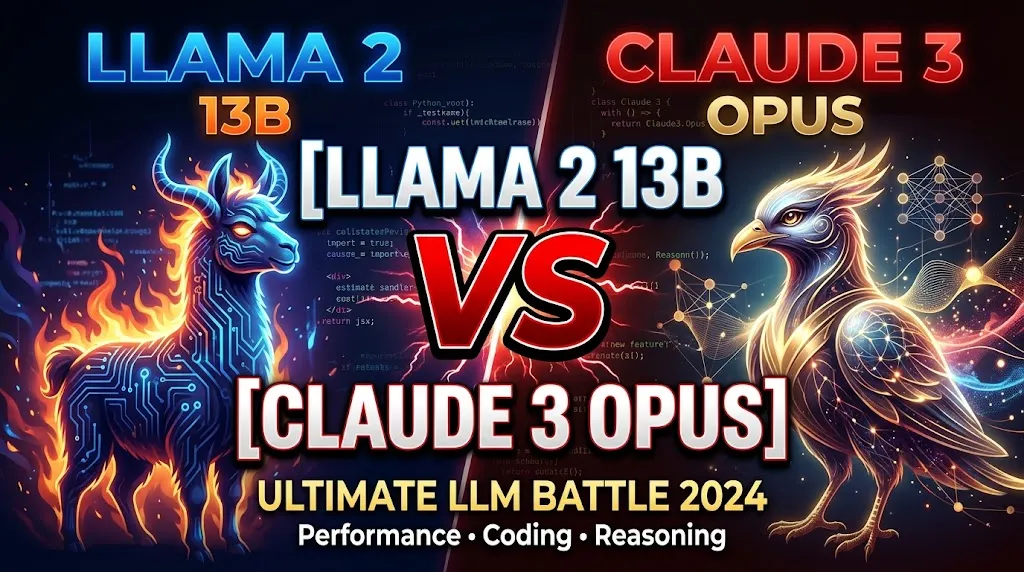
If you are searching for Llama 2 13B VS Claude 3 Opus, the short answer is surprisingly simple: Claude 3 Opus was the stronger model for raw capability, while Llama 2 13B offered much more control over deployment and customization.
That distinction matters more than a simple benchmark score.
Quick verdict: Claude 3 Opus wins for reasoning, coding, long-context processing and general capability. Llama 2 13B wins for deployment flexibility, local experimentation and control.
Important 2026 note: Claude 3 Opus is now a historical model. Anthropic formally retired claude-3-opus-20240229 on January 5, 2026, although Anthropic later said Opus 3 remained accessible to paid Claude users and available by API request.
Llama 2 13B vs Claude 3 Opus at a Glance
The fastest way to understand the comparison is to separate capability from control. The models were never perfectly apples-to-apples.
- Llama 2 13B belongs to the 2023 generation of LLMs.
- Claude 3 Opus launched in March 2024.
- Llama 2 13B contains 13 billion parameters.
- Anthropic did not publicly disclose a parameter count for Claude 3 Opus.
- Llama 2 supports a 4K-token sequence length in Meta’s original implementation.
- Claude 3 Opus launched with a 200K-token context window.
- Claude 3 supports multimodal inputs.
- Llama 2’s biggest advantage was control over the model stack.
- Claude’s biggest advantage was high-end model capability.
- The best choice depends on whether you value capability or control.
| Feature | Llama 2 13B | Claude 3 Opus |
| Developer | Meta | Anthropic |
| Release | July 2023 | March 2024 |
| Parameters | 13B | Not publicly disclosed |
| Original context | 4K | 200K |
| Model type | Openly released model weights under Meta’s license | Proprietary managed model |
| Input modality | Text | Text + image |
| Coding | Capable for its generation | Much stronger |
| Reasoning | Moderate | Strong |
| Long documents | Limited | Excellent |
| Local deployment | Major advantage | Restricted |
| Raw benchmark capability | Strong for its era | Frontier-class for its era |
Meta’s model documentation confirms Llama 2’s 7B, 13B and 70B variants and 4K context length, while Anthropic documented a 200K context window for Claude 3.
What Is Llama 2 13B?
Llama 2 13B is the 13-billion-parameter Member of Meta’s Llama 2 family. Meta released Llama 2 in July 2023 with 7B, 13B and 70B models, including pretrained and chat-tuned versions.
- The 13B model contains roughly 13 billion parameters.
- Meta reports a September 2022 pretraining-data cutoff.
- Some fine-tuning data extended into 2023.
- The model uses a transformer architecture.
- Llama 2 has pretrained and chat variants.
- The Chat version was optimized for dialogue.
- Meta released model weights rather than only providing an API.
- The model can be used in local development environments.
- It became popular with researchers and developers experimenting with open models.
- Its 13B size made it more approachable than much larger models.
- Its 4K context window is small by modern standards.
- Its importance comes partly from making capable LLM development more accessible.
Meta’s model card states that Llama 2 was pretrained on 2 trillion publicly available tokens and that the 13B version has a 4K context length.
What Is Claude 3 Opus?
Claude 3 Opus was Anthropic’s flagship Claude 3 model when the family launched on March 4, 2024. Anthropic positioned Opus as its most capable Claude 3 model, particularly for complex reasoning and demanding workloads.
- Claude 3 Opus was developed by Anthropic.
- It launched in March 2024.
- Anthropic did not publish its parameter count.
- It offered a 200K-token context window.
- It supported multimodal input.
- It was designed for complex tasks.
- Anthropic emphasized reasoning performance.
- Anthropic emphasized improved accuracy.
- It was designed to follow complex instructions.
- It could produce structured outputs.
- It was suitable for coding workflows.
- It was useful for research and analysis.
- It was significantly larger in practical capability than Llama 2 13B.
- Its API pricing was historically $15 per million input tokens and $75 per million output tokens.
- It is now best understood as a historical high-end Claude model rather than Anthropic’s current flagship.
Anthropic’s original documentation lists 200K context and $15/$75 per-million-token input/output pricing for Claude 3 Opus.
Llama 2 13B vs Claude 3 Opus Parameters
Parameter count is one of the most searched specifications in AI comparisons, but it should not be treated as a direct intelligence score.
- Llama 2 13B has approximately 13 billion parameters.
- Claude 3 Opus’s parameter count was not publicly disclosed.
- A larger parameter count does not automatically guarantee better output.
- Architecture influences model performance.
- Training data influences performance.
- Training quality matters.
- Fine-tuning matters.
- Alignment matters.
- Inference methods matter.
- Context handling matters.
- Tool use can influence practical performance.
- Multimodal capability adds another dimension.
- Benchmark results are more useful than guessing undisclosed parameters.
- Comparing parameter counts alone is therefore misleading.
- Claude’s benchmark performance provides stronger evidence of capability than speculation about its size.
For Llama 2, Meta officially documents the 13B parameter size. Anthropic’s published Claude 3 material focuses instead on capability benchmarks rather than a public parameter count.
Llama 2 13B vs Claude 3 Opus Context Window
Context length is one of the clearest technical differences between the two models.
- Llama 2 supports up to 4K tokens in Meta’s original implementation.
- Claude 3 launched with a 200K context window.
- 4K tokens is enough for relatively short conversations.
- 200K tokens can accommodate extremely long inputs.
- Long context helps document analysis.
- Long context helps research workflows.
- Long context helps large codebases.
- Long context can reduce document chunking.
- Long context can simplify multi-document analysis.
- Long context does not automatically guarantee perfect reasoning.
- Claude 3 Opus also demonstrated strong long-context recall.
- Anthropic reported over 99% accuracy on its Needle In A Haystack evaluation in some testing.
- Llama 2 requires much more aggressive context management for large documents.
- The difference becomes obvious when working with books, reports or large code files.
- Claude 3 Opus is the clear winner for original context capacity.
Anthropic documented a 200K context window and reported near-perfect recall in its long-context evaluation, while Meta’s Llama documentation lists 4K sequence length.
Llama 2 13B vs Claude 3 Opus Benchmarks
Benchmarks provide useful evidence, but Benchmark numbers should always be compared using the same evaluation methodology.
- Llama 2 13B reported 54.8% MMLU in the comparison research supplied for this article.
- Claude 3 Opus reported 86.8% MMLU under Anthropic’s published 5-shot setup.
- Claude 3 Opus reported 88.2% MMLU with 5-shot chain-of-thought in the model card.
- Claude 3 Opus achieved 60.1% on the reported 0-shot MATH evaluation.
- Claude 3 Opus achieved 84.9% on HumanEval.
- Claude 3 Opus achieved 92.3% on one reported GSM8K setup.
- Claude 3 Opus achieved 50.4% on GPQA Diamond under one reported setup.
- These benchmarks test different abilities.
- MMLU measures broad knowledge and reasoning.
- HumanEval focuses on Python coding.
- GSM8K focuses on grade-school mathematics.
- MATH evaluates mathematical problem solving.
- GPQA targets graduate-level questions.
- Different prompting and scoring methods can change results.
- The overall pattern still strongly favors Claude 3 Opus for raw capability.
Anthropic’s model card reports 86.8% MMLU, 60.1% MATH, 84.9% HumanEval and other benchmark results for Opus.
| Benchmark | Llama 2 13B | Claude 3 Opus | Practical Winner |
| MMLU | 54.8% | 86.8%* | Claude 3 Opus |
| HumanEval | 18.3%* | 84.9% | Claude 3 Opus |
| GSM8K | 28.7%* | 92.3%* | Claude 3 Opus |
| MATH | — | 60.1% | Claude 3 Opus |
| GPQA Diamond | — | 50.4% | Claude 3 Opus |
*Evaluation setups may differ, so these figures should not be treated as perfectly interchangeable. Your supplied research also specifically recommends identifying the benchmark, score, methodology and source before making direct comparisons.
Llama 2 13B vs Claude 3 Opus for Coding
For coding, Claude 3 Opus had a major advantage in published benchmark performance.
- Claude 3 Opus produced stronger code-generation results.
- HumanEval strongly favored Claude 3 Opus.
- Claude was better suited to complex programming tasks.
- Claude was better at understanding lengthy instructions.
- Claude was stronger at debugging complex code.
- Claude was better for explaining complicated code.
- Claude handled large coding contexts more effectively.
- Llama 2 13B remained useful for lightweight coding experiments.
- Llama 2 could be attractive when local inference was important.
- Developers could customize their Llama-based workflows.
- Local deployment can matter more than benchmark scores for some projects.
- Claude’s managed environment reduces infrastructure complexity.
- Llama 2 provides greater control over infrastructure.
- For raw coding quality, Claude 3 Opus wins.
- For controllable local experimentation, Llama 2 13B remains interesting.
Coding winner: Claude 3 Opus.
The supplied research identifies Claude 3 Opus as the stronger coding model and cites the large HumanEval difference as supporting evidence.
Reasoning Accuracy and Logical Thinking Compared
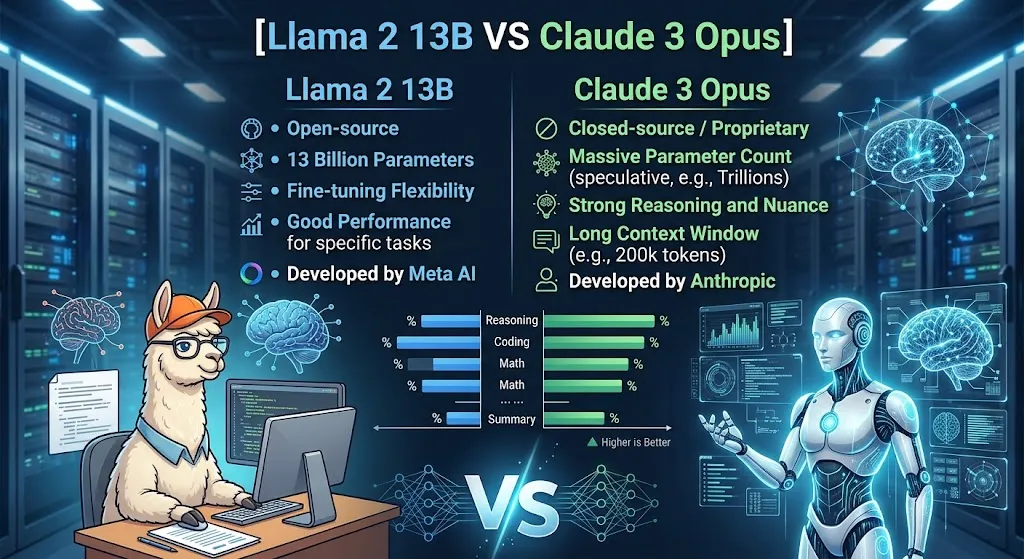
- Claude 3 Opus was designed for complex reasoning.
- Anthropic reported strong performance on MMLU.
- Claude performed strongly on GPQA.
- Claude performed strongly on mathematical evaluations.
- Claude followed complex multi-step instructions well.
- It was designed for open-ended problems.
- It handled complicated prompts more effectively.
- Llama 2 13B was capable for its generation.
- Llama 2 was not designed as a frontier reasoning model.
- Its smaller scale limited its ability on difficult tasks.
- Prompt engineering could improve Llama results.
- Fine-tuning could specialize Llama for specific tasks.
- Claude required less customization for many advanced workflows.
- The benchmark evidence favors Claude strongly.
- Claude 3 Opus is the clear reasoning winner.
Llama 2 13B vs Claude 3 Opus for Long Documents
This is arguably the most Dramatic practical difference.
- Llama 2’s original 4K context is relatively small.
- Claude 3 Opus offered 200K context.
- A 4K context can become restrictive with large reports.
- A 200K context can accommodate much larger source material.
- Researchers benefit from larger context.
- Students can analyze longer documents.
- Developers can provide larger codebases.
- Businesses can process lengthy reports.
- Writers can analyze extensive drafts.
- Legal workflows can involve large document collections.
- Long-context AI reduces the need for aggressive chunking.
- Larger context can simplify retrieval workflows.
- Claude’s recall capabilities were a major selling point.
- Llama 2 is better suited to smaller input workloads.
- Claude 3 Opus wins decisively for long-document workflows.
Llama 2 13B vs Claude 3 Opus for Multimodal AI
- Llama 2 13B accepts text.
- Llama 2 13B generates text.
- The original Llama 2 model is not a vision-language model.
- Claude 3 introduced image understanding.
- Claude can reason about visual inputs.
- Users can combine images with textual instructions.
- This expands possible workflows.
- Visual analysis is useful for charts.
- Visual analysis is useful for screenshots.
- It can assist with image-based documents.
- It can support visual question answering.
- Llama 2 requires additional tooling for comparable multimodal workflows.
- A separate vision model may be needed.
- Claude therefore has a broader native modality advantage.
- Claude 3 Opus wins the multimodal comparison.
Anthropic launched Claude 3 as a multimodal family, while Meta’s Llama 2 model card describes the original model as text input and text output.
Llama 2 13B vs Claude 3 Opus for Cost
Cost requires more nuance than simply labeling one model “free.”
- Llama 2 model weights were released for developers under Meta’s license.
- Self-hosting can avoid per-token API charges.
- Self-hosting does not mean zero cost.
- Hardware costs money.
- Electricity costs money.
- Storage costs money.
- Engineering time costs money.
- Cloud GPU rental also costs money.
- Claude 3 Opus historically used API pricing.
- Anthropic listed $15 per million input tokens.
- Anthropic listed $75 per million output tokens.
- Batch processing offered lower historical rates.
- API pricing is easier to calculate per workload.
- Self-hosting can become attractive at certain scales.
- The cheapest option depends on infrastructure and usage.
Cost winner: There is no universal winner. Llama offers more deployment flexibility; Claude offers a simpler managed pricing model.
Anthropic’s published pricing lists $15/MTok input and $75/MTok output for legacy Claude Opus 3, while the supplied research correctly warns against calling Llama 2 simply “free.”
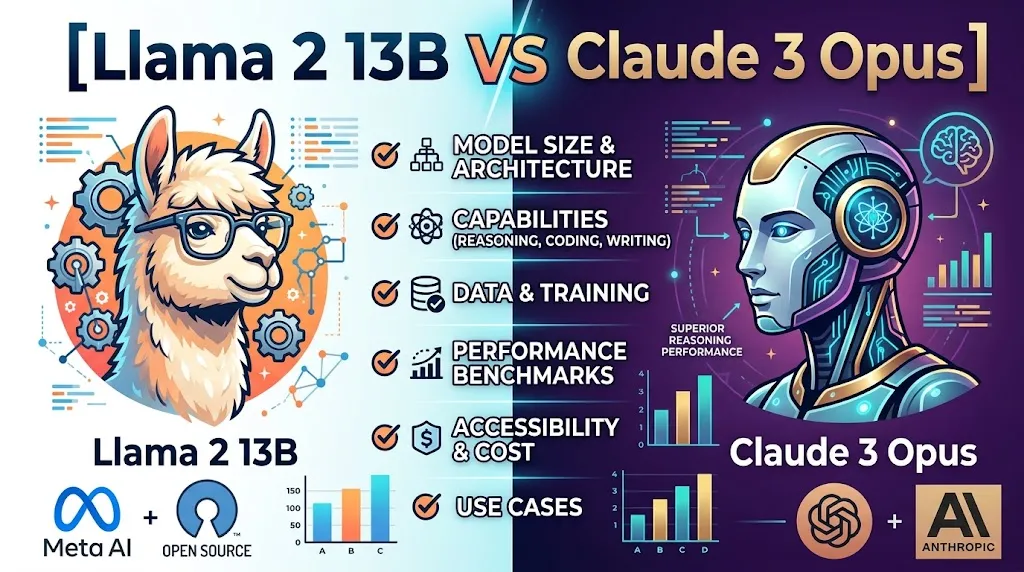
Open Model vs Proprietary AI: Which Philosophy Wins?
This is where the comparison becomes more interesting than benchmark numbers.
- Llama 2 gives developers substantially more control.
- Its weights can be used within Meta’s licensing framework.
- Developers can experiment locally.
- Organizations can build customized infrastructure.
- Fine-tuning workflows become more flexible.
- Deployment decisions remain in the developer’s hands.
- Claude 3 Opus is a managed proprietary model.
- Users interact through Anthropic’s services or approved platforms.
- Managed AI reduces infrastructure responsibilities.
- Managed AI can simplify scaling.
- Proprietary models can deliver stronger general capability.
- Open models can provide greater customization.
- Neither philosophy is automatically superior.
- Businesses may prefer managed intelligence.
- Developers may prefer control.
Control winner: Llama 2 13B.
Capability winner: Claude 3 Opus.
Related To Another Article: https://ultraaiguide.com/deepseek-coder-1-3b-vs-grok-0/
Who Should Choose Claude 3 Opus?
Historically, Claude 3 Opus was the better fit when maximum general capability was the priority.
- Choose Claude for complex reasoning.
- Choose it for difficult coding tasks.
- Choose it for long documents.
- Choose it for multimodal workflows.
- Choose it for advanced research.
- Choose it for complex instruction following.
- Choose it for structured-output tasks.
- Choose it for large-context analysis.
- Choose it for demanding mathematical reasoning.
- Choose it for advanced code explanation.
- Choose it for complicated business analysis.
- Choose it when managed infrastructure is preferred.
- Choose it when deployment simplicity matters.
- Choose it when benchmark performance matters most.
- Remember that Claude 3 Opus itself is now a retired model.
Anthropic announced the retirement of Claude Opus 3 for January 5, 2026, and later confirmed the retirement while providing continued paid-user/API-request access under specific conditions.
Llama 2 13B vs Claude 3 Opus: Strengths and Weaknesses
A useful comparison should show where each model succeeds rather than turning the article into a one-sided winner announcement.
- Llama’s strength is deployment control.
- Claude’s strength is raw capability.
- Llama is smaller.
- Claude has a much larger context window.
- Llama supports local experimentation.
- Claude provides managed access.
- Llama is text-focused.
- Claude 3 supports multimodal input.
- Llama’s 4K context is restrictive.
- Claude’s 200K context is transformative for long documents.
- Llama can be customized within its license.
- Claude is easier for many users who do not want to manage infrastructure.
- Llama is historically significant in open-model development.
- Claude 3 Opus was historically significant in frontier-model performance.
- Neither should be evaluated without considering the use case.
| Category | Winner | Why |
| Raw reasoning | Claude 3 Opus | Stronger published benchmarks |
| Coding | Claude 3 Opus | Much stronger HumanEval result |
| Context | Claude 3 Opus | 200K vs 4K |
| Multimodal | Claude 3 Opus | Native image understanding |
| Local deployment | Llama 2 13B | Greater deployment control |
| Customization | Llama 2 13B | Openly released model weights |
| Infrastructure simplicity | Claude 3 Opus | Managed service |
| Historical openness | Llama 2 13B | Openly released model family |
| Overall capability | Claude 3 Opus | Stronger frontier performance |
| Current availability | Neither as a current flagship | Both are legacy models |
Llama 2 13B VS Claude 3 Opus: Which Is Better?
The answer depends on what “better” means.
Better means raw intelligence, Claude 3 Opus wins.
If better means coding performance, Claude 3 Opus wins.
Better means reasoning, Claude 3 Opus wins.
If better means handling huge documents, Claude 3 Opus wins.
Better means native multimodal capability, Claude 3 Opus wins.
If better means deployment control, Llama 2 13B wins.
Better means experimenting with an openly released model, Llama 2 13B wins.
If better means controlling your own infrastructure, Llama 2 13B wins.
Better means modern 2026 availability, neither should be your first choice.
The fairest overall verdict is therefore:
Claude 3 Opus was the more capable AI model, while Llama 2 13B was the more flexible model for developers who valued control and self-deployment.
That conclusion matches the central distinction identified in the supplied research: Claude wins on capability, while Llama’s major advantage is openness and deployment flexibility.
What This Comparison Means in 2026
A historical model comparison needs a current-status section because availability changes the practical answer.
- Llama 2 launched in 2023.
- Claude 3 Opus launched in 2024.
- Both are now older-generation models.
- Meta’s current Llama family has moved far beyond Llama 2.
- Meta’s model listings now include Llama 3, Llama 3.1, Llama 3.2, Llama 3.3 and Llama 4.
- Llama 4 launched in 2025.
- Anthropic has also moved beyond Claude 3.
- Claude Opus 3 was formally retired in January 2026.
- Anthropic’s current model lineup is substantially newer.
- Therefore, this comparison is primarily useful for historical analysis.
- It remains valuable for understanding model evolution.
- It can help developers evaluate legacy systems.
- It can help researchers studying LLM progress.
- It should not automatically be interpreted as a 2026 recommendation.
- For a new project, compare current models instead.
Anthropic’s current documentation lists newer active Opus models, while Meta’s current Llama model repository lists later generations including Llama 4.
People Also Ask
A: Yes, for raw model capability. Claude 3 Opus substantially outperformed Llama 2 13B on several published benchmark categories and offered a much larger context window.
A: Llama 2 13B has approximately 13 billion parameters.
A: Anthropic did not publicly disclose an official parameter count for Claude 3 Opus, so claims about its exact size should be treated as estimates rather than established specifications.
A: Meta’s original Llama 2 implementation supports up to 4,096 tokens.
A: Claude 3 Opus launched with a 200,000-token context window.
Conclusion
Llama 2 13B VS Claude 3 Opus is not really a battle between two equivalent models. It is a comparison between two different approaches to AI.
Llama 2 13B represented the growing Importance of openly released models that developers could experiment with, customize, and deploy within their own infrastructure.
Claude 3 Opus represented the frontier-model approach: high-end managed intelligence, very large context, multimodal input, and strong performance on difficult reasoning and coding tasks.
So the winner depends on the question:
- Best raw capability: Claude 3 Opus
- Best reasoning: Claude 3 Opus
- Best coding: Claude 3 Opus
- Best long-context capability: Claude 3 Opus
- Best multimodal capability: Claude 3 Opus
- Best deployment control: Llama 2 13B
- Best local experimentation: Llama 2 13B
- Best customization flexibility: Llama 2 13B
- Best historical frontier performance: Claude 3 Opus
Claude 3 Opus was the stronger model. Llama 2 13B gave developers more control.