Introduction
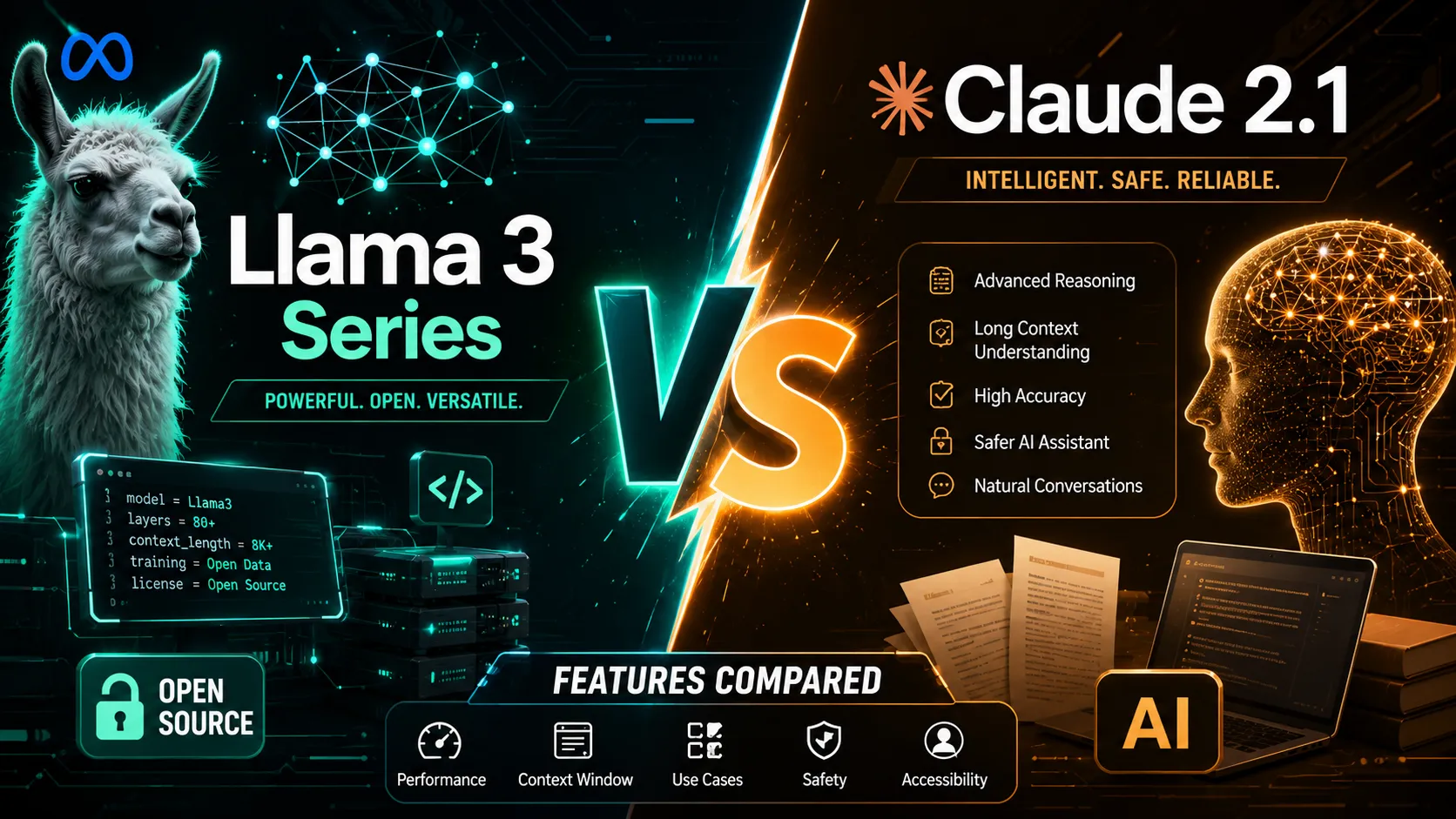
Llama 3 Series VS Claude 2.1 Features is a useful AI model comparison because these systems represent two very different approaches to generative AI.
Meta’s original Llama 3 family launched with 8B and 70B parameter models, an 8K context length, Grouped-Query Attention, and downloadable model weights under Meta’s applicable license. Claude 2.1, released by Anthropic in November 2023, took a different route with a 200,000-token context window, system prompts, API tool use, and improvements aimed at long-document analysis and reliability.
That creates an important question:
Is the more flexible Llama 3 better, or does Claude 2.1’s enormous context window make it the stronger model?
The answer depends on your workload.
Llama 3 is generally the better choice for developers who value model-weight access, self-hosting, customization, and deployment control. Claude 2.1 is the stronger choice for extremely long documents and workflows built around its 200K context window.
Llama 3 VS Claude 2.1: Quick Comparison
| Feature | Llama 3 8B | Llama 3 70B | Claude 2.1 |
| Developer | Meta | Meta | Anthropic |
| Release | April 2024 | April 2024 | November 2023 |
| Parameters | 8B | 70B | Not publicly disclosed |
| Original context | 8K | 8K | 200K |
| Model access | Open weights | Open weights | Proprietary |
| Self-hosting | Yes, subject to license and infrastructure | Yes, subject to license and infrastructure | No equivalent model-weight deployment |
| Architecture transparency | Higher | Higher | More limited |
| Model customization | High | High | More limited |
| Long-document processing | Limited by original context | Limited by original context | Major strength |
| Tool use | Depends on application stack | Depends on application stack | Built-in API tool-use capability |
| Best advantage | Efficiency | Capability + flexibility | Huge context |
| Best suited to | Lightweight/custom deployments | Advanced open deployments | Long-context hosted workflows |
Meta’s model card confirms that the original Llama 3 family contained 8B and 70B models with an 8K sequence length, while Anthropic announced Claude 2.1 with a 200K context window.
What Is Llama 3?
Llama 3 is Meta’s third major generation of the Llama family.
The original release included two primary sizes:
- Llama 3 8B
- Llama 3 70B
Meta describes Llama 3 as an autoregressive language model using an optimized Transformer architecture. The model uses a 128K-token vocabulary and Grouped-Query Attention (GQA), while the instruction-tuned versions were trained using supervised fine-tuning and reinforcement learning from human feedback.
The original Llama 3 models were trained on sequences of up to 8,192 tokens. That limitation is important because newer members of the Llama family subsequently expanded context substantially. Meta’s model repository lists Llama 3.1 at 128K, for example, so readers should not accidentally apply later Llama specifications to the original Llama 3 release.
The biggest practical advantage of Llama 3 is control.
Developers can obtain the model weights, deploy them through compatible infrastructure, optimize inference, and build applications around the models instead of relying exclusively on a proprietary hosted interface.
What Is Claude 2.1?
Claude 2.1 is an Anthropic language model released in November 2023.
Its most famous feature is its 200,000-token context window. Anthropic described that capacity as roughly 150,000 words or more than 500 pages of information. The company specifically highlighted use cases involving codebases, financial documents, technical documentation, and long literary works.
Claude 2.1 also introduced several important product capabilities:
- 200K context
- System prompts
- API tool use
- Improved long-document comprehension
- Improved summarization
- Lower reported hallucination rates
- Better handling of complex documents
Anthropic reported a twofold reduction in false statements compared with Claude 2.0 and a 30% reduction in incorrect answers in one of its internal evaluations. These are Anthropic’s own evaluation results, so they should be presented as vendor-reported findings rather than universal benchmark facts.
Claude 2.1 was therefore less about giving developers a downloadable model and more about providing a powerful hosted AI service with an unusually large context window.
Llama 3 Series VS Claude 2.1 Features: Architecture and Model Design
Llama 3 provides substantially more public information about its architecture.
Meta describes the model as an optimized autoregressive Transformer with GQA. The family contains 8B and 70B parameter versions, allowing developers to choose between efficiency and greater model capacity.
Claude 2.1 does not expose a comparable public parameter-size lineup.
That difference matters to researchers and developers who care about deployment, optimization, and model experimentation.
Llama 3 advantages
- Publicly documented model architecture
- 8B and 70B choices
- GQA
- Downloadable weights
- Greater deployment flexibility
Claude 2.1 advantages
- Managed hosted experience
- 200K context
- System prompts
- API tool use
- Strong focus on long-document workflows
Winner for architecture and deployment transparency: Llama 3.
Llama 3 8B VS Claude 2.1
The 8B version of Llama 3 and Claude 2.1 serve very different purposes.
Llama 3 8B is designed for situations where developers need a relatively compact model that can be deployed with considerably less infrastructure than a 70B model.
Claude 2.1 is not positioned as a compact downloadable model. Its primary attraction is its hosted capabilities and huge context window.
This produces a simple trade-off:
| Requirement | Better choice |
| Lower model size | Llama 3 8B |
| Local experimentation | Llama 3 8B |
| Custom deployment | Llama 3 8B |
| Huge document input | Claude 2.1 |
| 200K context | Claude 2.1 |
| Hosted API workflow | Claude 2.1 |
For a lightweight application, Llama 3 8B is generally more flexible.
For an application that routinely consumes hundreds of pages of source material, Claude 2.1 has the structural advantage.
Llama 3 70B VS Claude 2.1
The comparison becomes more interesting when Llama 3 70B enters the picture.
Llama 3 70B was the largest original Llama 3 model and was designed for substantially more demanding workloads than the 8B version. Meta reported strong results across several standard benchmarks in its model documentation.
Third-party comparison databases list Llama 3 70B Instruct at approximately 82% on MMLU in a 5-shot setup and 51% on MATH in a 0-shot setup. However, those figures should not be treated as a direct universal ranking against Claude 2.1 because benchmark availability, prompting, and evaluation conditions differ.
The practical comparison is therefore more useful:
Llama 3 70B is stronger when you need an open-weight model with substantial capability and deployment control.
Claude 2.1 is stronger when the task depends heavily on its 200K context window and long-document workflow.
Context Window: The Biggest Difference
This is the category where Claude 2.1 has an overwhelming specification advantage.
The original Llama 3 models support an 8K sequence length.
Claude 2.1 supports 200K tokens. Anthropic described that as roughly 150,000 words or more than 500 pages.
That difference changes what users can practically do.
Consider a task involving:
- A long legal contract
- Multiple financial reports
- A technical manual
- A large collection of research notes
- A long book
- A substantial codebase
- Several business documents
Claude 2.1 can process more source material dramatically within one context.
Anthropic also published a long-context experiment showing that Claude 2.1 could retrieve information across its 200K context, while noting that prompt formulation affected performance. In one internal experiment, a prompt adjustment raised retrieval accuracy from 27% to 98%.
Winner: Claude 2.1.
This is its defining advantage.
Coding: Llama 3 VS Claude 2.1
Coding is more complicated than simply asking which model has the higher benchmark number.
Llama 3 is attractive for developers because it can be deployed within a custom application stack. Llama 3 70B provides substantially more capacity than the 8B model and can be Integrated into self-controlled development environments.
Claude 2.1 is attractive for coding tasks where the model needs to understand a very large amount of source material at once.
For example, imagine debugging a project where the relevant information is spread across many files. A 200K context can make long-context analysis much easier than an 8K context.
Choose Llama 3 when:
- You need self-hosting.
- You want model-level customization.
- You control the inference stack.
- You want to build a specialized coding assistant.
Choose Claude 2.1 when:
- You need extremely long code context.
- You want a hosted API.
- You are analyzing large documentation sets.
- Your workflow benefits from long-context reasoning.
Winner: Depends on the development environment.
Long-Document Analysis: Claude 2.1 Wins
Claude 2.1 was specifically positioned around long-document use cases.
Anthropic highlighted contracts, financial statements, technical specifications, and long literary works as examples of material Claude could process with its 200K context.
This gives Claude 2.1 an obvious advantage for:
- Contract analysis
- Financial-document review
- Research synthesis
- Technical documentation
- Long-form summarization
- Multi-document comparison
The original Llama 3’s 8K context is dramatically smaller.
Winner: Claude 2.1.
Tool Use and API Capabilities
Claude 2.1 introduced API tool use as a beta capability.
Anthropic described the feature as allowing Claude to work with developer-defined functions and APIs, including calculators, database searches, web-search APIs, private API,s and product datasets.
Llama 3 itself should be understood as a model rather than a complete agent platform.
Developers can certainly build tool-calling and agent systems around Llama 3, but the final experience depends on the inference provider, orchestration framework,rk and application architecture.
That distinction is important.
This is where Llama 3 has a major strategic advantage.
Meta released the original Llama 3 models as downloadable weights under its applicable license. Meta’s documentation identifies the family as 8B and 70B models and provides a custom commercial license.
That makes Llama 3 suitable for applications such as:
- Private AI assistants
- Internal enterprise chatbots
- Custom coding assistants
- Research systems
- Specialized language applications
- On-premise AI deployments
- Custom inference pipelines
Claude 2.1 does not offer an equivalent downloadable model-weight deployment approach.
Important terminology note
Calling Llama 3 simply “open source” can be misleading.
A more precise description is an open-weight model with a custom license. Organizations should review Meta’s current Applicable license and acceptable-use requirements before commercial deployment.
Winner: Llama 3.
Writing, Reasoning and General-Purpose Use
Both models can handle general language tasks, but their strengths should be interpreted in context.
Llama 3 was trained for general text and code generation, and Meta’s instruction-tuned versions were optimized for dialogue applications.
Claude 2.1 emphasized enterprise use cases, long documents, comprehension, summarization,n and reliability.
For ordinary tasks such as:
- Email drafting
- Summarization
- Brainstorming
- Explanations
- General writing
- Basic coding
the difference may be less important than the surrounding application.
The better choice often comes down to deployment requirements rather than the model’s name.
Best general strategy: choose the model that fits your workflow, not simply the one with the more impressive specification.
Benchmarks: Which Model Performs Better?
Benchmark comparisons need careful handling.
Some third-party comparison pages report Llama 3 70B Instruct at 82% MMLU and 51% MATH under specific evaluation setups.
However, a benchmark should not be presented as a universal declaration that one model is “smarter.”
A meaningful benchmark comparison should account for:
- Model version
- Prompt format
- Few-shot or zero-shot setup
- Dataset version
- Evaluation methodology
- Tool availability
- Context length
- Fine-tuning
- Sampling settings
This is especially important when comparing models from different companies and generations.
Better SEO-friendly interpretation
Instead of writing:
“Llama 3 destroys Claude 2.1.”
a trustworthy comparison should say:
“Llama 3 70B has strong publicly reported benchmark results, while Claude 2.1’s standout practical advantage is its enormous context window.”
That distinction improves both credibility and usefulness.
Cost, Efficiency and Deployment Economics
Historical API pricing can be useful, but it should always be labeled with its date.
Third-party comparison data lists historical Claude 2.1 pricing at $8 per million input tokens and $24 per million output tokens.
Llama 3 pricing is different because the model can be deployed through different providers or on user-controlled infrastructure.
That means there is no single universal “Llama 3 price.”
Your real cost may depend on:
- GPU hardware
- Cloud provider
- Quantization
- Batch size
- Throughput
- Model size
- Token volume
- Hosting architecture
- Inference optimization
Therefore, Llama 3 can offer greater cost-control flexibility, but self-hosting does not automatically mean zero cost.
Winner for deployment flexibility: Llama 3.
Privacy and Enterprise Deployment
Privacy requirements can strongly influence model selection.
If an organization wants to maintain greater control over its AI infrastructure, an open-weight model can provide architectural options that a proprietary hosted model cannot.
Llama 3 can be deployed within controlled infrastructure, subject to the relevant license and technical requirements.
Claude 2.1 is more dependent on hosted service infrastructure.
This makes Llama 3 attractive for organizations that prioritize:
- Infrastructure control
- Internal deployment
- Custom security architecture
- Data governance
- Specialized inference
- On-premise workloads
Claude 2.1 can still be attractive to businesses that prioritize a managed API and long-context functionality over model-level control.
Winner for self-controlled deployment: Llama 3.
Which Model Is Better for Businesses?
There is no single business winner.
Choose Llama 3 if your business needs:
- Self-hosting
- Model customization
- Deployment control
- Flexible infrastructure
- Open-weight experimentation
- Specialized AI applications
Choose Claude 2.1 if your business needs:
- Very long documents
- Large-context analysis
- Hosted AI infrastructure
- Tool-connected workflows
- Enterprise document processing
Anthropic explicitly positioned Claude 2.1 around enterprise workflows involving long and complex documents.
The correct question is therefore not:
“Which company has the better AI?”
It is:
“Which model creates the better economics and workflow for my specific application?”
Llama 3 VS Claude 2.1: Pros and Cons
Pros
- 8B and 70B model choices
- Open-weight access
- Self-hosting possibilities
- Custom deployment
- Greater developer control
- Strong 70B capability
- Flexible inference ecosystem
- Useful for specialized applications
Cons
- Original 8K context is small compared with Claude 2.1
- 70B requires substantially more infrastructure
- Self-hosting requires technical expertise
- License requirements need to be reviewed
- It is not automatically a complete agent platform
Claude 2.1 Pros
- 200K context
- Excellent long-document use case
- System prompts
- API tool use
- Strong summarization capabilities
- Vendor-reported improvements in factual reliability
- Hosted API experience
- Enterprise-oriented design
Claude 2.1 Cons
- Proprietary model
- No equivalent downloadable model-weight deployment
- Less underlying model control
- Historical API pricing was relatively high
- Large context does not guarantee perfect retrieval
Anthropic itself documented that Claude 2.1 could require careful prompting for certain long-context retrieval tasks, demonstrating why context size alone should not be confused with perfect context utilization.
Llama 3 VS Claude 2.1: Which One Should You Choose?
Use this quick decision guide:
| If you need… | Choose |
| Self-hosting | Llama 3 |
| Open-weight access | Llama 3 |
| Customization | Llama 3 |
| Infrastructure control | Llama 3 |
| Lightweight deployment | Llama 3 8B |
| Higher original Llama 3 capability | Llama 3 70B |
| 200K-token context | Claude 2.1 |
| Very long documents | Claude 2.1 |
| Hosted enterprise workflow | Claude 2.1 |
| Native API tool use | Claude 2.1 |
| Large code/document context | Claude 2.1 |
Final Verdict: Is Llama 3 Better Than Claude 2.1?
Llama 3’s biggest advantage is its open-weight deployment model, 8B/70B flexibility,ity and developer control. Meta’s official model documentation confirms the original family’s 8B and 70B sizes, 8K sequence length, Transformer architecture, and GQA.
Claude 2.1’s biggest advantage is its 200K-token context window, supported by system prompts, API tool use, and improvements targeted at long-document comprehension and reliability.
So the practical verdict is:
| Category | Winner |
| Open-weight development | Llama 3 |
| Self-hosting | Llama 3 |
| Customization | Llama 3 |
| Model-size flexibility | Llama 3 |
| Developer control | Llama 3 |
| Lightweight deployment | Llama 3 8B |
| Maximum original Llama 3 capacity | Llama 3 70B |
| Long documents | Claude 2.1 |
| Context window | Claude 2.1 |
| Hosted workflow | Claude 2.1 |
| Native tool-use capability | Claude 2.1 |
| Overall winner | Depends on workload |
The Bottom Line
Llama 3 is the better choice for developers who want control, customization, ion and self-hosting.
Claude 2.1 is the better choice for users whose primary requirement is extremely long-context analysis.
That is the most useful way to understand the Llama 3 Series VS Claude 2.1 features comparison.
The real battle is not simply Meta vs Anthropic.
It is control vs context.
People Also Ask
A: Llama 3 is generally better for open-weight deployment, customization, and self-hosting, while Claude 2.1 has a major advantage for long-context workflows because of its 200K-token context window.
A: The original Llama 3 models were trained on sequences of up to 8,192 tokens.
A: Claude 2.1 supports a 200,000-token context window, which Anthropic described as roughly 150,000 words or more than 500 pages.
A: Llama 3 is more accurately described as an open-weight model released under Meta’s custom license rather than conventional open-source software. Developers should review the applicable license before commercial deployment.
A: Llama 3 70B is attractive for developers who want a customizable and self-hostable model. Claude 2.1 can be preferable when coding requires processing very large amounts of source code or documentation.
Conclusion
The Llama 3 Series VS Claude 2.1 features comparison reveals two very different philosophies of AI development. Llama 3 focuses on model access, deployment flexibility, customization, and developer control. Its original 8B and 70B models give developers a choice between Efficiency and greater capacity.
Claude 2.1 focuses on long-context intelligence and hosted enterprise workflows, with its 200K-token context window standing out as its defining feature. If you are building a private or customized AI application, Llama 3 is usually the more flexible foundation. If you are analyzing huge documents or need to place an enormous amount of information into one context, Claude 2.1 is the more compelling option.