Introduction
The artificial intelligence ecosystem in 2026 has progressed far beyond basic Conversational assistants. What once started as simple chatbot utilities has now evolved into highly advanced, specialized AI infrastructures engineered for distinct operational purposes. Today, organizations, engineers, and product teams are no longer choosing “an AI tool”—they are selecting intelligent systems optimized for specific outcomes.
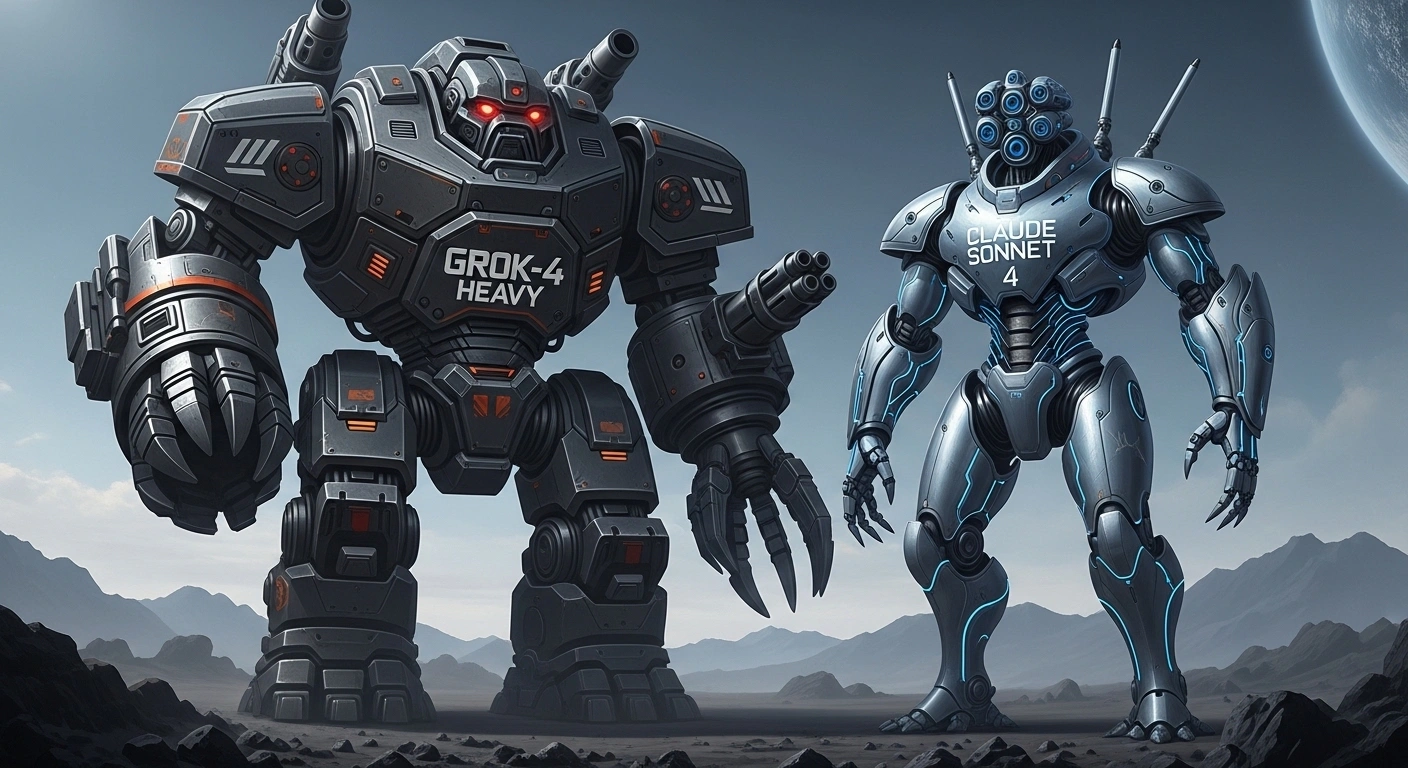
At the forefront of this transformation are Grok-4 Heavy and Claude Sonnet 4—two exceptionally powerful AI models that embody fundamentally different design philosophies and technological directions.
Grok-4 Heavy, developed by xAI, is architected as a multi-agent reasoning framework capable of solving deeply complex, research-intensive, and computationally demanding challenges. It is not merely reactive—it is exploratory, iterative, and analytical in nature.
In contrast, Claude Sonnet 4, created by Anthropic, is engineered with a strong emphasis on efficiency, alignment, stability, and real-world deployment readiness. It is designed to perform consistently across production environments, making it a preferred choice for SaaS platforms, enterprise systems, and scalable applications.
Whether you are:
- A developer building advanced applications
- A SaaS founder optimizing operational efficiency
- A business leader scaling AI-powered workflows globally
Your selection between these two models will directly influence:
- Operational costs
- System performance
- Development velocity
- Long-term return on investment (ROI)
In this comprehensive guide, you will explore:
- Real benchmark interpretations (beyond surface-level metrics)
- Deep architectural distinctions
- Cost vs performance trade-offs
- Practical real-world use case analysis
- A clear, actionable decision-making framework
Let’s dive deeper into the comparison.
Quick Comparison
| Feature | Grok-4 Heavy | Claude Sonnet 4 |
| Core Strength | Advanced reasoning & deep cognition | Efficiency, speed & reliability |
| Architecture | Multi-agent intelligence system | Constitutional AI framework |
| Coding Ability | Strong in complex logic | Excellent in structured workflows |
| Context Window | ~128K–256K tokens | ~200K tokens |
| Pricing | Premium / expensive | Cost-effective |
| Real-Time Data | Native integration | Limited (tool-assisted) |
| Best Use Cases | Research, automation agents | SaaS, enterprise applications |
Architecture Deep Dive
Grok-4 Heavy: Multi-Agent Intelligence System
Grok-4 Heavy represents a paradigm shift in AI system design. Instead of functioning as a single monolithic model, it operates as a coordinated network of intelligent agents working collaboratively.
Key Capabilities:
- Executes parallel reasoning processes
- Investigates multiple solution pathways simultaneously
- Performs internal validation across agents
- Iteratively refines outputs through cross-verification
- Designed for high-dimensional, multi-step problem solving
Real-World Implications:
- Superior for scientific discovery and academic research
- Highly effective in autonomous AI systems
- Excels in long-chain reasoning and analytical workflows
- Capable of handling ambiguity and uncertainty
Strategic Insight:
Grok does not simply generate answers—it constructs solutions through layered reasoning.
Bottom Line:
Grok behaves like a team of experts collaborating internally rather than a single responder.
Claude Sonnet 4: Constitutional AI Framework
Claude Sonnet 4 is built upon Anthropic’s Constitutional AI methodology, which prioritizes alignment, predictability, safety, and structured reasoning.
Key Capabilities:
- Rule-guided reasoning mechanisms
- Strong alignment with human intent and ethical boundaries
- Stable and consistent outputs
- Optimized for production-grade environments
- High reliability across repeated tasks
Real-World Implications:
- Ideal for customer-facing systems
- Strong in content generation and documentation
- Reliable for enterprise-grade deployments
- Reduces risk in regulated industries
Strategic Insight:
Claude is engineered not just to think—but to deliver dependable and repeatable outcomes.
Bottom Line:
Claude functions as a precision-focused system optimized for consistency and scalability.
Benchmark Comparison
Reasoning & Intelligence
Grok-4 Heavy significantly outperforms in advanced reasoning benchmarks:
- Humanity’s Last Exam (HLE): 50%+
- Strong performance in ARC-AGI evaluations
- Superior abstraction and conceptual reasoning
What This Means:
Grok is ideal for:
- Research laboratories
- Complex simulations
- Autonomous decision-making systems
- Advanced problem-solving environments
Insight:
Grok prioritizes depth, exploration, and analytical rigor over speed.
Coding Performance
| Task Type | Winner |
| Real-world development workflows | Claude Sonnet 4 |
| Complex algorithm design | Grok-4 Heavy |
| Code readability & maintainability | Claude |
| Deep debugging & optimization | Grok |
Developer Perspective:
Claude Sonnet 4:
- Produces cleaner, well-structured code
- Enhances collaboration across teams
- Ideal for production pipelines
Grok-4 Heavy:
- Solves highly complex coding challenges
- Excels in debugging intricate issues
- Handles algorithmic depth effectively
Verdict:
Claude = Efficiency & productivity
Grok = Depth & problem-solving power
Real-Time Knowledge
Grok-4 Heavy:
- Native real-time internet integration
- ~94% accuracy in live query processing
- Dynamic knowledge retrieval
Claude Sonnet 4:
- Static knowledge base
- Requires external integrations for updates
Use Cases:
- Financial analytics
- Market intelligence
- News aggregation
- Real-time monitoring systems
Winner: Grok-4 Heavy
Pricing & Cost Efficiency
Cost Breakdown
| Factor | Grok-4 Heavy | Claude Sonnet 4 |
| API Pricing | High | Moderate |
| Compute Consumption | Very high | Optimized |
| Cost per Task | Expensive | Affordable |
| Scalability | Cost-limited | Highly scalable |
| ROI | High (complex tasks) | High (business use) |
Key Insight:
- Grok = High capability, high expenditure
- Claude = Balanced performance, lower operational cost
For startups and SMEs, Claude typically offers better cost efficiency and scalability.

Real-World Use Case Winners
For Developers
Winner: Claude Sonnet 4
- Cleaner syntax generation
- Faster iteration cycles are better for large-scale codebases
Research & Advanced Reasoning
Winner: Grok-4 Heavy
- Multi-agent reasoning advantage
- Ideal for academic and scientific environments
AI Agents & Automation
Winner: Grok-4 Heavy
- Handles complex workflows
- Strong decision-making capabilities
Startups & SaaS
Winner: Claude Sonnet 4
- Lower operational costs
- Stable outputs
- Easier integration into existing systems
Real-Time Data Tasks
Winner: Grok-4 Heavy
- Native real-time capabilities
- Faster dynamic insights
Pros & Cons
Grok-4 Heavy
Pros:
- Exceptional reasoning capabilities
- Multi-agent system design
- Real-time data access
- Superior for complex analytical tasks
Cons:
- Very high cost
- Less predictable outputs
- Not optimized for simple workflows
Claude Sonnet 4
Pros:
- Cost-efficient and scalable
- Reliable and consistent performance
- Excellent for coding and documentation
- Easy deployment in production
Cons:
- Limited deep reasoning capabilities
- Restricted real-time functionality
- Less suitable for research-heavy tasks
How to Use These AI Tools Effectively
Using Grok-4 Heavy
Best For:
- Complex research problems
- Multi-step reasoning workflows
- AI agent development
Avoid:
- Simple repetitive tasks (cost inefficiency)
Using Claude Sonnet 4
Best For:
- SaaS platforms
- Content generation
- Coding workflows
Best Practices:
- Integrate into CI/CD pipelines
- Use for collaborative development
- Optimize for scalable deployment
Tips to Write High-Impact AI Tool Captions
- Prioritize clarity over complexity
- Emphasize real-world use cases
- Highlight unique advantages
- Focus on tangible benefits
Recommended Formats:
- “Best for…”
- “Ideal for…”
- “Top choice for…”
Example:
“Claude Sonnet 4 is the ideal AI solution for scalable SaaS platforms due to its efficiency and consistent output quality.”
Europe Market Insight
AI adoption across Europe is influenced by:
- GDPR compliance requirements
- Cost optimization strategies
- Enterprise-grade reliability
Market Trends:
- Startups prefer Claude Sonnet 4 for scalability
- Research institutions favor Grok-4 Heavy for innovation
Insight:
Claude dominates business ecosystems, while Grok leads in cutting-edge innovation.
Final Verdict
Choose Grok-4 Heavy if:
- You require deep reasoning capabilities
- You are building AI agents
- You operate in research-intensive domains
Choose Claude Sonnet 4 if:
- You need scalable AI solutions
- You run a SaaS or startup
- You prioritize cost efficiency
Simple Rule:
- Power → Grok
- Practicality → Claude
Future Outlook
- Grok is evolving toward autonomous AI systems
- Claude is becoming the enterprise AI standard
Expected Trends:
- Grok → AGI-style breakthroughs
- Claude → ecosystem-wide adoption
FAQs
A: It depends on your use case. Grok excels in reasoning and research, while Claude is better for coding, SaaS, and business applications.
A: But only for complex tasks. For everyday use, it may be unnecessarily expensive.
A: Claude Sonnet 4 is generally better for developers due to its structured output and cost efficiency.
A: Not natively. It requires external tools or integrations for real-time updates.
A: Claude Sonnet 4 is usually the better choice due to affordability, scalability, and compliance-friendly design.
Conclusion
Grok-4 Heavy and Claude Sonnet 4 are not simply competing AI tools—they represent two distinct paradigms of artificial intelligence evolution.
Grok is engineered for raw computational intelligence, deep reasoning, and exploratory problem-solving, making it ideal for research and advanced AI development.
Claude, on the other hand, is optimized for efficiency, reliability, and scalability, making it the preferred choice for real-world business applications.
For most users—especially startups and developers—Claude Sonnet 4 provides the best balance between performance, cost, and usability. However, for cutting-edge innovation and complex reasoning tasks, Grok-4 Heavy remains unmatched.