Introduction
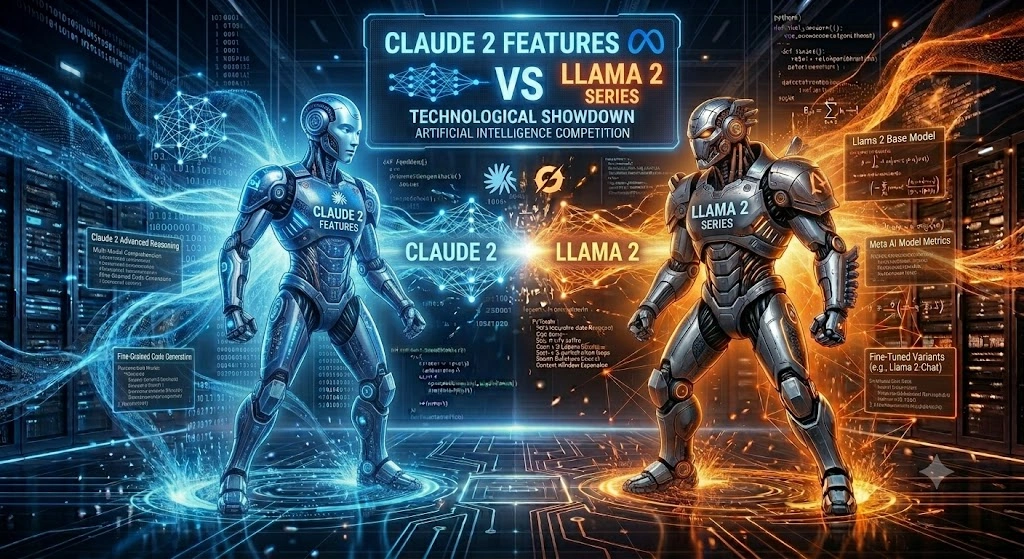
Artificial Intelligence changed dramatically after 2023, but some model releases continue influencing today’s AI landscape more than others. Two of the most discussed names are Claude 2 and the Llama 2 Series. Although newer generations now exist, these two models remain important because they introduced two different philosophies that still shape how organizations adopt AI. Claude 2 focused on creating a safer, more controlled conversational experience with unusually large context handling and strong document processing capabilities. Llama 2 focused on broader commercial accessibility, deployment flexibility, and giving developers more ownership over infrastructure.
Many comparison articles only focus on benchmark scores. That approach misses the real decision. Businesses, startups, developers, and content teams rarely choose AI based only on benchmark charts. They choose based on workflow fit, infrastructure control, long-document capability, operational cost, governance requirements, and future scalability. This guide explains Claude 2 features vs Llama 2 Series in practical terms so you can understand which approach still makes more sense depending on your goals.
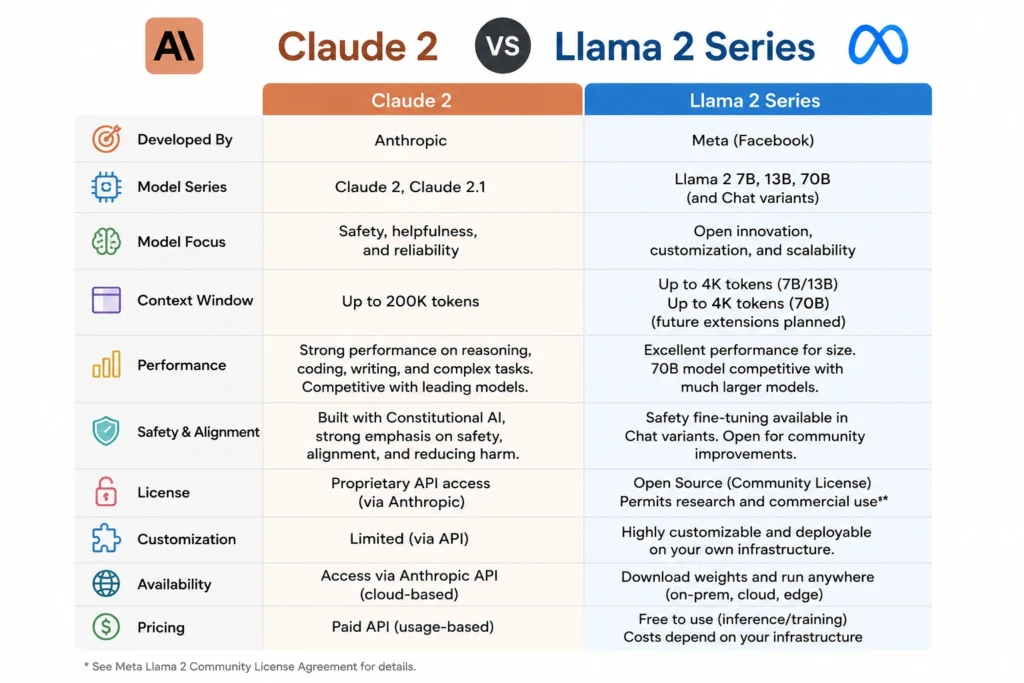
Quick Comparison Table
| Category | Claude 2 | Llama 2 Series |
| Release Year | 2023 | 2023 |
| Developer | Anthropic | Meta |
| Availability | Hosted platform/API | Source-available |
| Context Capacity | Up to 100K | Standard context |
| Hosting | Cloud-first | Self-host possible |
| Fine-Tuning | Limited | Extensive |
| Infrastructure Control | Moderate | High |
| Writing Quality | Excellent | Strong |
| Custom Deployment | Limited | Excellent |
| Best For | Long-form workflows | AI product development |
What Is Claude 2?
Claude 2 was introduced to improve conversational quality while enabling users to work with significantly larger amounts of information in one session.
At launch, long-context processing became its most recognizable feature.
Rather than forcing users to split documents into many parts, Claude 2 made large-scale document interaction easier.
Typical use cases included:
- Research analysis
- Business reporting
- Contract review
- Content production
- Knowledge management
- Customer support workflows
Claude 2 became known for balancing reasoning quality with more structured output.
Key Claude 2 Features
Large Context Window
Claude 2 became widely recognized for supporting long inputs.
Practical benefits:
- Analyze large PDFs
- Compare multiple documents
- Summarize reports
- Review technical material
This reduced workflow friction.
Strong Writing Quality
Many users adopted Claude 2 because outputs felt organized and readable.
Ideal for:
- Blog creation
- Business writing
- Documentation
- Professional communication
Better Multi-Step Tasks
Claude 2 showed stronger consistency in:
- Following instructions
- Long responses
- Maintaining structure
Safety-Oriented Model Design
A major objective behind Claude was reducing unreliable or harmful responses while preserving usefulness.
Benefits:
- Enterprise confidence
- Better governance
- More controlled outputs
Enterprise Workflow Support
Claude 2 fit teams needing:
- Internal assistants
- Search systems
- Content operations
- Documentation workflows
What Is Llama 2 Series?
Llama 2 represented a different AI strategy.
Instead of focusing on managed experiences, it emphasized accessibility and infrastructure flexibility.
Organizations gained more direct control.
Llama 2 introduced multiple model sizes that allowed scaling across different budgets and technical requirements.
Key Llama 2 Features
Source-Available Access
Organizations could work with model weights more directly.
Advantages:
- Greater ownership
- Infrastructure flexibility
- Reduced dependency
Multiple Sizes
Available variants:
- 7B
- 13B
- 70B
This enabled broader deployment options.
Self-Hosting Possibilities
Teams could run deployments:
- Private cloud
- Local infrastructure
- Hybrid environments
Fine-Tuning Capabilities
Useful for:
- Custom assistants
- Internal search
- Vertical applications
Large Ecosystem Growth
Benefits included:
- Community optimization
- Tool expansion
- Faster experimentation
Claude 2 Features VS Llama 2 Series: Detailed Head-to-Head Comparison
Context Handling
Claude 2 performs better for large document workflows.
Winner: Claude 2
Deployment Flexibility
Llama 2 offers significantly more deployment freedom.
Winner: Llama 2
Content Creation
Claude 2 generally produces more polished long-form outputs.
Winner: Claude 2
Developer Experience
Llama 2 provides greater infrastructure ownership.
Winner: Llama 2
Enterprise Governance
Depends on organizational priorities.
Managed operations → Claude 2
Infrastructure ownership → Llama 2
Proprietary AI vs Source-Available AI: Why It Changes Everything
This is where most comparison articles fail.
Claude 2 and Llama 2 are not simply competing models.
They represent different business philosophies.
Proprietary Model Approach
Benefits:
- Faster setup
- Managed updates
- Lower operational overhead
Tradeoffs:
- Platform dependency
- Less infrastructure control
Source-Available Approach
Benefits:
- Greater ownership
- Deployment flexibility
- Custom workflows
Tradeoffs:
- Higher technical responsibility
Long Context Explained: What Most Guides Miss
Large context does not automatically mean better AI.
Context becomes valuable when:
- Reviewing long reports
- Processing multiple documents
- Maintaining conversation continuity
Context becomes expensive when:
- Inputs become unnecessarily large
- Infrastructure requirements grow
Smart AI usage focuses on efficiency rather than maximum limits.
Real Business Use Cases
Choose Claude 2 If You:
- Produce long-form content
- Process large documents
- Need strong conversational quality
- Prefer managed environments
Typical Industries
- Legal support
- Marketing
- Consulting
- Research
Choose Llama 2 If You:
- Build AI products
- Need infrastructure ownership
- Want custom fine-tuning
- Require flexible deployment
Typical Industries
- SaaS
- Enterprise technology
- Internal automation
- AI startups
Europe-Focused AI Adoption Considerations
Organizations across Europe increasingly evaluate:
- Governance requirements
- Data handling expectations
- Infrastructure control
- Vendor flexibility
Llama 2 often attracts teams prioritizing deployment control.
Claude-style managed workflows remain attractive for faster adoption and lower operational burden.
The best decision depends on internal requirements.
How to Use These AI Tools Effectively
Define Workflow Goals
Ask:
- Content creation?
- Internal automation?
- Product development?
Understand Data Requirements
Document-heavy workflows benefit differently from application workflows.
Estimate Cost Structure
Include:
- Hosting
- Infrastructure
- Maintenance
- Usage growth
Test Small Before Scaling
Pilot projects reduce implementation risk.
Pros and Cons
Claude 2
Pros
- Excellent long-form output
- Strong document processing
- Better structured responses
- Lower setup complexity
Cons
- Less deployment freedom
- More platform dependency
- Limited customization
Llama 2
Pros
- Greater control
- Flexible deployment
- Customization options
- Strong ecosystem
Cons
- Higher technical effort
- Additional infrastructure requirements
- More operational responsibility
Tips to Write Your Own AI Tools Captions
If you publish AI content:
- Lead with outcomes
- Focus on business value
- Avoid benchmark overload
- Keep captions benefit-driven
- Explain real use cases
Example:
Instead of:
“Advanced AI model.”
Use:
“Analyze long documents and automate workflows faster.”
Do’s and Don’ts
Do
- Match AI to workflow
- Consider governance
- Test before rollout
Don’t
- Chase benchmarks blindly
- Ignore infrastructure costs
- Choose based on hype
People Also Ask
A: Not universally. Claude 2 works better for long-context and managed workflows, while Llama 2 offers more deployment flexibility.
A: Depending on infrastructure and configuration, local or controlled deployments are possible.
A: Claude 2 generally performs better for polished long-form writing.
A: Yes, especially organizations needing greater control.
A: No. Large context helps only when workflows actually require large information windows.
Conclusion
Claude 2 And Llama 2 Series changed AI adoption in different ways. Claude 2 emphasized long-context understanding, polished writing, and easier enterprise workflows. Llama 2 emphasized openness, flexibility, and infrastructure ownership. The biggest lesson is that benchmark scores alone rarely decide success. Teams succeed when they choose technology that matches operational goals. If your priority is large-document productivity and simplified workflows, Claude 2 remains historically influential. If your priority is building, controlling, and customizing AI systems, Llama 2 remains one of the most impactful releases of its generation. Bookmark this guide and explore additional AI comparisons to make better long-term decisions.