Introduction
The Artificial Intelligence landscape in 2026 is no longer just about who has the largest model; it’s about who delivers the best real-world performance at the right cost and architecture.
Two models stand at the center of this shift:
- DeepSeek V2, a cost-efficient, open-source Mixture-of-Experts (MoE) model built for scalable deployment and strong coding performance
- Grok 2.5, a proprietary reasoning-focused model designed for real-time intelligence and advanced conversational understanding
While both are powerful, they represent two completely different AI philosophies:
efficiency vs intelligence depth, open vs closed ecosystems, and scalability vs reasoning power.
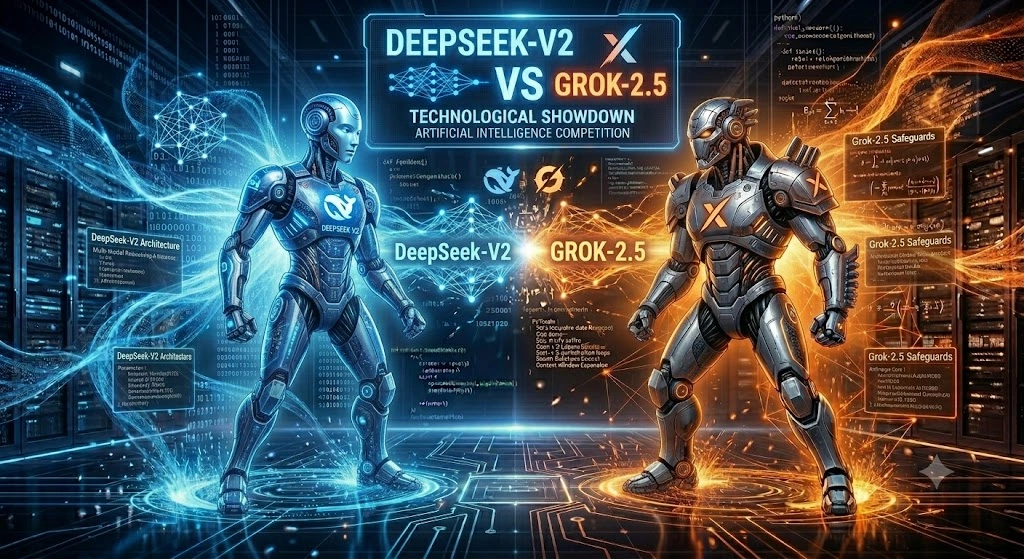
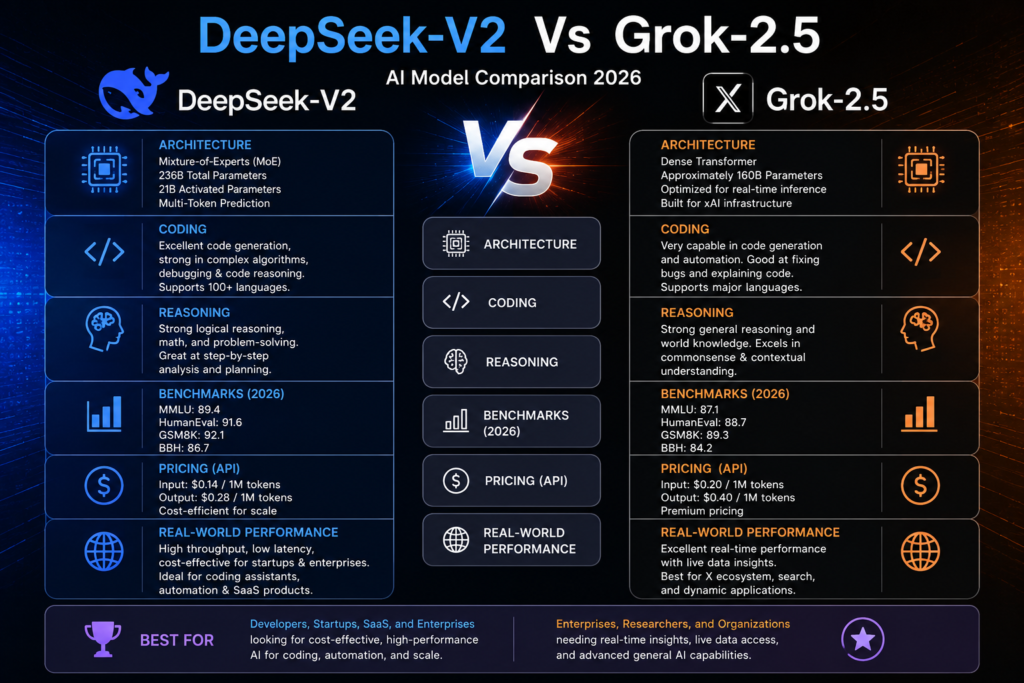
In this guide, we break down DeepSeek V2 vs Grok 2.5 across architecture, benchmarks, coding ability, reasoning, pricing, and real-world use cases—so you can confidently choose the right model for your needs in Europe and beyond.
DeepSeek V2 vs Grok 2.5 Overview
DeepSeek V2 is a Mixture-of-Experts (MoE) large language model designed for:
- High performance at low cost
- Open-source deployment flexibility
- Strong mathematical and coding capabilities
- Efficient inference scaling
Key Idea:
“Deliver maximum intelligence with minimum compute cost”
Grok 2.5 Overview
Grok 2.5 is a reasoning-optimized proprietary AI model developed for advanced intelligence tasks, focusing on:
- Real-time information processing
- Deep reasoning and multi-step logic
- Conversational intelligence
- Ecosystem integration (especially X platform data streams)
Key Idea:
“Live intelligence + deep reasoning in real time”
AI Architecture Comparison
Understanding architecture is critical because it directly affects cost, speed, and the quality of intelligence.
DeepSeek V2 Architecture
DeepSeek V2 uses a Mixture-of-Experts (MoE) architecture:
How it works:
- Only selected “expert networks” are activated per token
- Reduces unnecessary computation
- Improves efficiency dramatically
Benefits:
- Lower inference cost
- Faster scaling for enterprises
- Strong task specialization
Limitations:
- Less unified reasoning flow
- Can feel fragmented in long reasoning chains
Grok 2.5 Architecture
Grok 2.5 uses a dense transformer-based architecture optimized for reasoning performance:
Key characteristics:
- All parameters are active during inference
- Optimized for multi-step reasoning
- Strong contextual memory handling
Benefits:
- Excellent logical reasoning
- Strong conversational consistency
- Better long-context understanding
Limitations:
- High computational cost
- Less efficient at scale compared to MoE models
Architecture Summary Table
| Feature | DeepSeek V2 | Grok 2.5 |
| Model Type | MoE | Dense Transformer |
| Efficiency | ⭐⭐⭐⭐⭐ | ⭐⭐ |
| Reasoning Depth | ⭐⭐⭐ | ⭐⭐⭐⭐⭐ |
| Cost | Low | High |
| Scalability | Excellent | Moderate |
Benchmark Performance
Instead of only raw benchmark numbers, let’s interpret how these models behave in practical environments.
| Category | DeepSeek V2 | Grok 2.5 |
| Coding Ability | Very Strong | Strong |
| Logical Reasoning | Strong | Excellent |
| Math Problem Solving | Strong | Strong |
| Context Handling | Moderate | Very High |
| Real-Time Knowledge | No | Yes |
| Cost Efficiency | Excellent | Low |
Key Insight:
Benchmarks alone don’t reflect real usage.
- DeepSeek V2 wins in efficiency-heavy workloads
- Grok 2.5 wins in reasoning-heavy environments
Coding Performance Comparison
DeepSeek V2 in Coding
DeepSeek V2 is highly optimized for developers:
Strengths:
- Python automation scripts
- Competitive programming tasks
- Code generation speed
- API integration tasks
Ideal for:
- Startups
- SaaS tools
- Backend development automation
Grok 2.5 in Coding
Grok 2.5 performs differently—it focuses on understanding systems:
Strengths:
- Multi-file debugging
- Complex architecture design
- System-level reasoning
- Real-world software logic
Ideal for:
- Enterprise systems
- Large-scale applications
- Engineering teams solving complex problems
Verdict:
- DeepSeek V2 → Faster coding assistant
- Grok 2.5 → Smarter system architect
Reasoning Ability
Winner: Grok 2.5
Grok 2.5 clearly leads in reasoning tasks:
Why?
- Better long-context coherence
- Strong logical chain building
- Improved decision-making patterns
Use cases:
- Research analysis
- Strategic planning
- Complex problem-solving
DeepSeek V2 Reasoning Style
DeepSeek V2 focuses on:
- Fast responses
- Efficient task completion
- Structured outputs
It is powerful but less of a “deep thinker” compared to Grok.
Pricing & Cost Efficiency
DeepSeek V2
- Extremely low operational cost
- Ideal for scaling AI apps
- Perfect for startups in Europe (especially SaaS companies)
Key Advantage:
Best cost-to-performance ratio in the market
Grok 2.5
- Premium pricing model
- High compute requirements
- Enterprise-focused deployment
Key Advantage:
Premium intelligence quality
Verdict:
- Budget-sensitive users → DeepSeek V2
- Enterprise intelligence systems → Grok 2.5
Real-World Use Cases
Best Uses for DeepSeek V2
- AI coding assistants
- Bulk content generation tools
- SaaS automation systems
- Cost-efficient AI APIs
Best Uses for Grok 2.5
- Research assistants
- AI-powered decision systems
- Real-time intelligence platforms
- Enterprise-grade chatbots
Pros & Cons
DeepSeek V2
Pros:
- Extremely cost-efficient
- Open-source flexibility
- Great for developers
- Fast inference
Cons:
- No real-time knowledge
- Weaker deep reasoning
- Less conversational depth
Grok 2.5
Pros:
- Excellent reasoning ability
- Real-time intelligence integration
- Strong conversational flow
- High contextual awareness
Cons:
- Expensive
- Closed ecosystem
- Less customizable
Decision Framework
Choose DeepSeek V2 if:
- You are building scalable AI applications
- You need low-cost API usage
- You prefer open-source systems
- You focus on coding automation
Choose Grok 2.5 if:
- You need a deep reasoning AI
- You work with complex decision systems
- You want real-time intelligence
- You are an enterprise user
Future of Both AI Models
The AI industry is shifting toward two major directions:
DeepSeek Future Direction:
- More efficient MoE systems
- Wider open-source adoption
- Developer-first ecosystem expansion
Grok Future Direction:
- Real-time multimodal intelligence
- Stronger reasoning engines
- Deeper integration with live data systems
Europe-Focused AI Adoption Insight
In Europe, AI adoption is strongly influenced by:
- Data privacy regulations (GDPR)
- Cost efficiency for startups
- Enterprise-level AI governance
What this means:
- DeepSeek V2 is more attractive for EU startups and developers
- Grok 2.5 is preferred in enterprise intelligence and research institutions
People Also Ask
A: It depends on the use case. DeepSeek is better for cost efficiency, while Grok is better for reasoning and depth of intelligence.
A: DeepSeek V2 is significantly more affordable and scalable compared to Grok 2.5.
A: DeepSeek V2 is better for fast coding tasks, while Grok 2.5 excels in complex system-level debugging.
A: Yes, Grok 2.5 is designed for real-time intelligence integration, unlike DeepSeek V2.
A: Startups generally prefer DeepSeek V2 due to its low cost and open-source flexibility.
Conclusion
The comparison between DeepSeek V2 and Grok 2.5 is not about superiority—it is about strategy.
DeepSeek V2 dominates in:
- Cost efficiency
- Scalability
- Developer-friendly ecosystems
Grok 2.5 dominates in:
- Deep reasoning
- Real-time intelligence
- Enterprise-grade AI performance
If you are building AI systems in Europe or globally, the right choice depends on whether you prioritize efficiency or intelligence depth.