Introduction
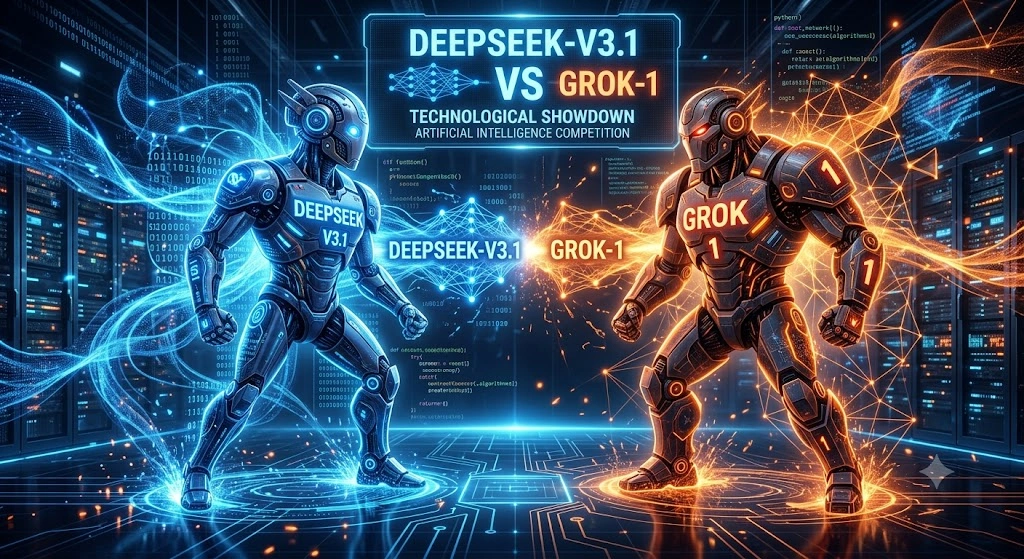
The open-source AI industry is moving faster than ever before. What once required a billion-dollar Infrastructure is now becoming accessible to developers, startups, enterprises, and researchers worldwide. Among the most discussed large language models today are DeepSeek-V3.1 and Grok-1.
Both models have attracted significant attention, but they represent very different approaches to artificial intelligence. Grok-1 emerged from xAI’s mission to create a powerful open-weight language model capable of competing with leading proprietary systems. DeepSeek-V3.1, on the other hand, focuses heavily on efficiency, reasoning, coding performance, and enterprise-scale deployment through a sophisticated Mixture-of-Experts architecture.
For businesses, developers, content creators, researchers, and AI enthusiasts, selecting the right model is no longer simply about benchmark scores. Factors such as coding capabilities, reasoning quality, context length, deployment costs, licensing, scalability, and ecosystem support all play an important role.
This comprehensive DeepSeek-V3.1 vs Grok-1 comparison explores architecture, benchmarks, coding performance, reasoning abilities, context windows, pricing, real-world applications, and future potential to help you determine which AI model delivers the best value in 2026.
What Is DeepSeek-V3.1?
DeepSeek-V3.1 is an advanced open-weight large language model developed by DeepSeek AI. The model is designed to maximize intelligence while reducing computational overhead through an efficient Mixture-of-Experts (MoE) architecture.
Instead of activating all parameters simultaneously, DeepSeek selectively activates only the most relevant expert networks during inference. This approach allows the model to achieve stronger performance while maintaining lower operational costs.
Key highlights include:
- Advanced Mixture-of-Experts architecture
- Strong coding and software engineering capabilities
- Long-context processing
- Improved reasoning performance
- Enterprise-friendly deployment
- Agent workflow optimization
- Commercial usage support
DeepSeek-V3.1 has rapidly become a favorite among developers due to its ability to generate, debug, explain, and optimize code efficiently.
What Is Grok-1?
Grok-1 is the first major open-weight language model released by xAI, the artificial intelligence company founded by Elon Musk.
The model was created to provide greater transparency and openness within the AI industry. At the time of its release, Grok-1 demonstrated that large-scale open models could compete with many closed-source alternatives.
Key strengths include:
- Large-scale language understanding
- Open-weight accessibility
- Commercial-friendly licensing
- Strong conversational performance
- Research and experimentation support
- Broad knowledge capabilities
Although Grok-1 was highly influential when introduced, it now faces increasing competition from newer-generation models such as DeepSeek-V3.1.
DeepSeek-V3.1 vs Grok-1 Quick Comparison
| Feature | DeepSeek-V3.1 | Grok-1 |
| Release Generation | New Generation | Earlier Generation |
| Architecture | Mixture of Experts | Large Dense / Hybrid |
| Total Parameters | 685B | 314B |
| Active Parameters | 37B | 78B |
| Context Window | Up to 128K | 8K |
| Coding Performance | Excellent | Good |
| Reasoning Ability | Excellent | Moderate |
| Tool Usage | Advanced | Limited |
| AI Agents | Strong Support | Basic Support |
| Enterprise Readiness | Excellent | Moderate |
| Open Weights | Yes | Yes |
| Commercial Usage | Yes | Yes |
The Evolution of Open-Source AI
Understanding the historical context helps explain why this comparison matters.
In 2024, Grok-1 helped prove that open-weight AI could challenge proprietary systems. It represented an important milestone in the movement toward AI transparency.
DeepSeek-V3.1 arrived during a different phase of AI development. The focus shifted from simply building larger models to creating more efficient, scalable, and cost-effective systems capable of real-world deployment.
This evolution explains why DeepSeek-V3.1 emphasizes:
- Efficiency
- Agent workflows
- Coding performance
- Long-context understanding
- Enterprise automation
while Grok-1 focuses more on foundational language capabilities.
Architecture Comparison
DeepSeek-V3.1 Architecture
DeepSeek-V3.1 uses a sophisticated Mixture-of-Experts system.
In a traditional model, every parameter participates in every computation. DeepSeek activates only a subset of experts for each token.
Benefits include:
- Faster inference
- Lower operational costs
- Better scalability
- Improved efficiency
- Reduced hardware requirements
- Stronger performance-per-dollar
This architecture has become increasingly popular among modern AI developers because it balances intelligence with efficiency.
Grok-1 Architecture
Grok-1 relies on a larger active computation approach.
Instead of routing tokens through selected experts, Grok-1 performs more extensive calculations during inference.
Advantages include:
- Consistent reasoning behavior
- Strong foundational understanding
- Simpler architecture
- Easier research analysis
However, this approach generally requires more computational resources.
Architecture Winner
DeepSeek-V3.1 wins due to its modern design, better scalability, and significantly improved efficiency.
Benchmark Performance Comparison
Benchmarks provide useful insights into model capabilities.
| Category | DeepSeek-V3.1 | Grok-1 |
| Reasoning | Excellent | Good |
| Coding | Excellent | Moderate |
| Mathematics | Excellent | Good |
| Long Context | Excellent | Limited |
| Tool Calling | Excellent | Basic |
| Agent Tasks | Excellent | Moderate |
| Enterprise Use | Excellent | Moderate |
Across most modern evaluations, DeepSeek-V3.1 consistently demonstrates stronger results.
The model benefits from newer training methodologies and more advanced optimization techniques.
Coding Capabilities
For many users, coding performance is the most important category.
DeepSeek-V3.1 for Coding
DeepSeek-V3.1 was heavily optimized for software development.
It excels at:
- Python development
- JavaScript generation
- React applications
- SQL queries
- API integration
- Debugging
- Refactoring
- Documentation writing
Developers frequently report strong performance in real-world engineering workflows.
Grok-1 for Coding
Grok-1 can generate code effectively but lacks many of the specialized optimizations found in newer models.
It performs reasonably well for:
- Basic coding tasks
- Code explanations
- Small projects
- Learning programming concepts
However, it often falls behind DeepSeek-V3.1 on complex engineering tasks.
Coding Winner
DeepSeek-V3.1 is the clear winner for developers, software engineers, startups, and technical teams.
Reasoning and Problem Solving
Reasoning ability directly impacts productivity.
DeepSeek-V3.1 Reasoning
The model introduces improved reasoning modes that allow it to:
- Solve multi-step problems
- Analyze large datasets
- Perform complex logic
- Generate structured plans
- Handle advanced workflows
Grok-1 Reasoning
Grok-1 provides strong conversational reasoning but reflects the limitations of an earlier AI generation.
It remains useful for:
- General discussions
- Brainstorming
- Simple analysis
- Educational assistance
Reasoning Winner
DeepSeek-V3.1 demonstrates stronger analytical and logical performance.
Context Window Comparison
Context length is becoming increasingly important.
A larger context window allows AI to process more information simultaneously.
DeepSeek-V3.1
Supports context windows up to 128K tokens.
Benefits include:
- Entire books
- Large reports
- Enterprise documents
- Long conversations
- Extensive codebases
Grok-1
Provides approximately 8K tokens.
Suitable for:
- Short documents
- Standard chats
- Smaller projects
Context Winner
DeepSeek-V3.1 wins by a significant margin.
Speed and Efficiency
Speed affects user experience and infrastructure costs.
DeepSeek-V3.1
Advantages:
- Lower inference costs
- Faster scaling
- Better resource allocation
- Improved throughput
Grok-1
Advantages:
- Simpler architecture
- Stable behavior
Disadvantages:
- Higher compute requirements
- Greater infrastructure demands
Efficiency Winner
DeepSeek-V3.1 provides better performance-per-dollar.
Pricing Comparison
Pricing depends on deployment methods, hardware requirements, and cloud providers.
| Factor | DeepSeek-V3.1 | Grok-1 |
| Infrastructure Cost | Lower | Higher |
| Scalability | Excellent | Moderate |
| Enterprise Deployment | Strong | Moderate |
| Cost Efficiency | Excellent | Good |
| Resource Usage | Lower | Higher |
Organizations looking to optimize budgets often favor DeepSeek-V3.1.
Open-Source Ecosystem Comparison
Open-source communities significantly impact long-term model success.
DeepSeek-V3.1 Ecosystem
Strengths include:
- Rapid innovation
- Frequent updates
- Active developer community
- Strong GitHub adoption
- Enterprise integrations
Grok-1 Ecosystem
Strengths include:
- Historical importance
- Strong xAI branding
- Research interest
- Open-weight availability
Ecosystem Winner
DeepSeek-V3.1 currently enjoys stronger momentum.
Real-World Use Cases
DeepSeek-V3.1 Best Use Cases
- Software development
- AI agents
- Enterprise automation
- Customer support
- Research analysis
- Document processing
- Content generation
- Workflow automation
Grok-1 Best Use Cases
- General AI chat
- Research projects
- Educational learning
- Open-source experimentation
- AI testing
Europe-Focused Perspective
European organizations increasingly prioritize:
- AI transparency
- Cost efficiency
- Compliance
- Data control
- Open-source flexibility
DeepSeek-V3.1 aligns particularly well with these priorities because its efficiency reduces infrastructure costs while maintaining strong performance.
For startups in Germany, France, the Netherlands, Spain, Italy, Sweden, and Switzerland, efficient deployment often matters as much as raw benchmark scores.
How to Use These AI Tools
Using DeepSeek-V3.1
- Deploy through supported providers.
- Configure API access.
- Connect workflows and tools.
- Use structured prompts.
- Optimize agent-based automation.
Using Grok-1
- Access supported deployment environments.
- Configure model settings.
- Test conversational workflows.
- Build experimental applications.
- Monitor resource consumption.
Tips to Write Better AI Prompts
To maximize results from either model:
- Be specific.
- Define the desired output format.
- Provide examples.
- Use step-by-step instructions.
- Include context.
- Request structured responses.
- Refine prompts iteratively.
Do’s
- Use clear instructions.
- Provide background information.
- Ask focused questions.
- Break complex tasks into steps.
Don’ts
- Use vague prompts.
- Overload requests.
- Ignore context.
- Expect perfect results without refinement.
Pros and Cons
DeepSeek-V3.1 Pros
- Exceptional coding performance
- Massive context window
- Efficient MoE architecture
- Enterprise-ready
- Strong reasoning abilities
- Active ecosystem
- Lower deployment costs
DeepSeek-V3.1 Cons
- Newer ecosystem in some regions
- Advanced features may require tuning
Grok-1 Pros
- Open-weight accessibility
- Strong foundational model
- Commercial-friendly licensing
- Historical significance
- Good conversational performance
Grok-1 Cons
- Smaller context window
- Older architecture
- Higher infrastructure costs
- Weaker coding performance
- Less efficient reasoning
Which Model Should You Choose?
Choose DeepSeek-V3.1 if:
- You are a developer.
- You need coding assistance.
- You process long documents.
- You build AI agents.
- You want lower operational costs.
- You require modern reasoning capabilities.
Choose Grok-1 if:
- You prefer the xAI ecosystem.
- You need a historically important open-weight model.
- Your workloads are relatively simple.
- Long-context processing is not required.
For most users in 2026, DeepSeek-V3.1 delivers greater overall value.
People Also Ask
A: For most modern use cases, yes. DeepSeek-V3.1 offers stronger coding performance, better reasoning, larger context windows, and greater efficiency.
A: DeepSeek-V3.1 is widely considered the stronger coding model due to its software engineering optimizations and developer-focused capabilities.
A: Yes. Commercial usage is supported, making it suitable for startups, enterprises, and SaaS companies.
A: Yes. Grok-1 remains important for research, experimentation, and understanding the evolution of open-source AI models.
A: DeepSeek-V3.1 generally provides better performance-per-dollar because of its efficient Mixture-of-Experts architecture.
Conclusion
The battle between DeepSeek-V3.1 and Grok-1 highlights how quickly the open-source AI industry is evolving. Grok-1 deserves recognition for helping accelerate the movement toward transparent and accessible AI, proving that open-weight models could compete with proprietary alternatives. However, the market has changed significantly since its release. DeepSeek-V3.1 represents the next generation of AI development. Its advanced Mixture-of-Experts architecture, superior coding capabilities, larger context window, stronger reasoning performance, and improved efficiency make it one of the most compelling open-source language models available today.
For developers, startups, enterprises, researchers, and content creators, DeepSeek-V3.1 is the stronger overall choice in 2026. It delivers better performance, lower operational costs, and greater flexibility across real-world applications. If your goal is long-term scalability, productivity, and return on investment, DeepSeek-V3.1 stands out as the clear winner. Bookmark this guide, share it with your team, and explore more AI model comparisons on UltraAIGuide.com and ToolKitByAI to stay ahead of the rapidly evolving AI landscape.