Introduction
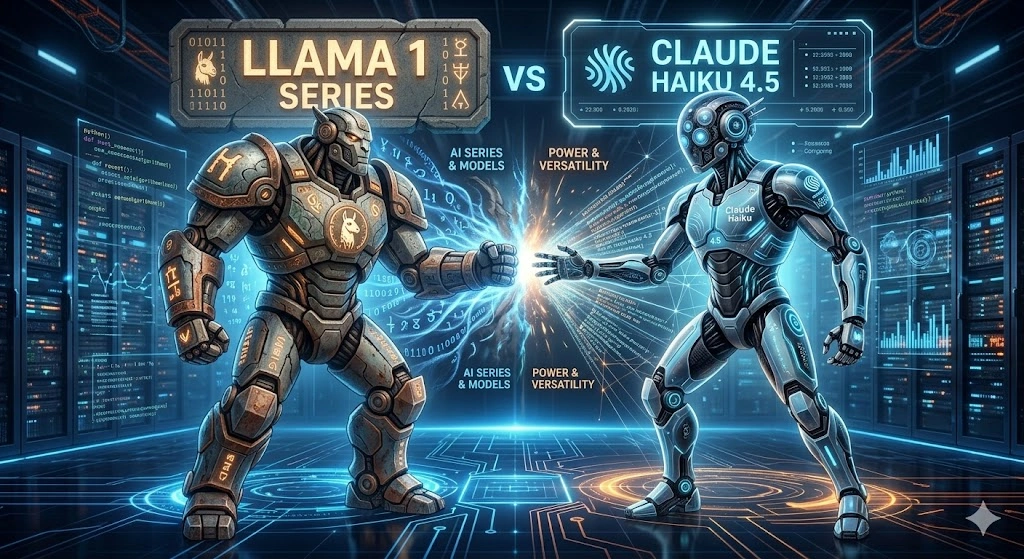
Artificial Intelligence moved faster between 2023 and 2026 than most technology categories move in an entire decade. The comparison between Llama 1 Series VS Claude Haiku 4.5 is unusual because these models represent two completely different generations of AI thinking. Llama 1 helped ignite the modern open-model movement. It introduced a future where developers could run language models independently, customize them, and experiment without depending entirely on large AI providers.
Claude Haiku 4.5 reflects what AI evolved into afterward: production-grade intelligence designed for speed, long-context workloads, low operational overhead, and enterprise deployment. Many comparison articles focus only on benchmark charts. That misses the real question. When teams choose AI today, they care about deployment speed, ownership cost, infrastructure requirements, developer productivity, scalability, latency, and business outcomes. This guide goes deeper. You will understand architecture differences, real-world workflows, pricing logic, long-context capability, ownership economics, and practical recommendations for choosing the right AI stack in 2026.
Quick Verdict
If you want a short answer:
Choose Llama 1 Series if you want:
• Self-hosting
• Full infrastructure ownership
• Local deployment
• Fine-tuning experiments
• Learning how LLM systems work
Choose Claude Haiku 4.5 if you want:
• Fast production deployment
• Better reasoning
• Strong coding performance
• Long-context workflows
• Lower maintenance overhead
For most businesses in 2026:
Claude Haiku 4.5 is the stronger production choice.
For researchers and infrastructure enthusiasts:
Llama 1 remains historically important.
What is the Llama 1 Series?
Llama 1 launched during the early acceleration phase of open language models.
Its importance extends beyond raw capability.
Llama changed how developers thought about AI ownership.
Instead of relying entirely on external APIs, teams could host models internally and customize behavior.
Core Strengths
• Open ecosystem
• Greater deployment flexibility
• Fine-tuning opportunities
• Infrastructure ownership
• Research accessibility
Current Limitations
• Older reasoning architecture
• Smaller effective context handling
• Limited coding compared to newer systems
• Higher operational burden
Today, Llama 1 serves more as an educational and infrastructure-experimentation platform than as a direct production competitor.
What Is Claude Haiku 4.5?
Claude Haiku 4.5 belongs to the lightweight performance-focused category of modern AI systems.
Its objective is simple:
Deliver high-quality outputs at lower latency and lower operational complexity.
Instead of managing GPUs and infrastructure, teams connect through APIs and scale quickly.
Core Positioning
• Fast inference
• Efficient deployment
• Large context support
• Production automation
• Strong developer workflows
Claude Haiku aims to maximize business outcomes rather than maximize infrastructure freedom.
Architecture Philosophy
Llama 1: Ownership First
The workflow:
Download → Configure → Host → Deploy
Advantages:
• Complete control
• Custom pipelines
• Offline operation
• Flexible integration
Tradeoffs:
• Infrastructure complexity
• Hardware requirements
• Monitoring responsibility
• Scaling challenges
Claude Haiku 4.5: Production First
Workflow:
Connect → Integrate → Launch → Scale
Advantages:
• Minimal setup
• Immediate deployment
• Strong defaults
• Easier maintenance
Tradeoffs:
• Vendor dependence
• Less infrastructure control
• API-based operation
Head-to-Head Comparison
| Category | Llama 1 Series | Claude Haiku 4.5 |
| Release Generation | Early Open LLM | Modern Production AI |
| Reasoning | Moderate | Strong |
| Coding | Basic | Advanced |
| Context | Limited | Large Context |
| Deployment | Self-hosted | API |
| Latency | Hardware dependent | Excellent |
| Setup | Complex | Easy |
| Maintenance | High | Low |
| Scaling | Infrastructure dependent | Excellent |
| Enterprise Ready | Moderate | High |
Performance Analysis
General Intelligence
Modern AI performance is no longer about benchmark scores.
Teams care about output consistency.
Claude Haiku performs better across:
• Multi-step reasoning
• Workflow execution
• Business automation
• Long document understanding
Llama remains usable but reflects an earlier generation.
Coding Performance
Developer productivity has become one of the biggest AI purchasing factors.
Claude Haiku typically performs better for:
• Refactoring
• Code generation
• API creation
• Documentation
• Debugging
Llama remains useful for experimentation but requires more engineering effort.
Context Window Capability
Long-context support changes workflows.
Modern teams process:
• Entire repositories
• Contracts
• Reports
• Large datasets
Claude Haiku handles larger workflows more naturally.
Llama was built before context became central.
Deployment Reality
Llama Deployment Stack
Typical requirements:
GPU
Model hosting
Inference server
Monitoring
Security layer
Storage
Estimated complexity:
High
Claude Deployment Stack
Typical requirements:
API access
Authentication
Application integration
Estimated complexity:
Low
Total Cost of Ownership (TCO)
One of the biggest mistakes in AI comparisons is ignoring ownership cost.
Llama Hidden Costs
Infrastructure
Engineering
Maintenance
Fine-tuning
Scaling
Claude Visible Costs
API consumption
Token usage
Platform subscription
Cost Comparison
| Cost Area | Llama 1 | Claude Haiku |
| Hardware | High | None |
| Operations | High | Low |
| Scaling | Complex | Easy |
| Predictability | Moderate | High |
| Initial Cost | High | Low |
For small and medium teams, API economics frequently outperform self-hosting.
Real Workflow Testing
Content Teams
Winner: Claude Haiku 4.5
Reasons:
• Faster output
• Better consistency
• Less prompt engineering
Software Teams
Winner: Claude Haiku 4.5
Reasons:
• Coding quality
• Workflow speed
• Lower setup burden
Research Teams
Winner: Llama 1
Reasons:
• Model access
• Experiment freedom
• Reproducibility
Enterprise Teams
Winner: Claude Haiku 4.5
Reasons:
• Operational efficiency
• Scalability
• Faster ROI
Open Source AI vs Closed AI
This comparison is ultimately philosophical.
Open AI Approach:
Own everything.
Closed AI Approach:
Optimize outcomes.
Questions to ask:
Do you need infrastructure control?
Or do you need results quickly?
That answer usually determines the winner.
Long Context and Agent Workflows
Agent systems changed AI deployment.
Modern workflows involve:
Planning
Execution
Memory
Iteration
Claude Haiku fits these workflows more naturally.
Llama predates agent-first architecture patterns.
How to Use These AI Tools
Using Llama 1
- Prepare hosting infrastructure
- Download model files
- Configure inference
- Fine-tune if needed
- Deploy internally
Using Claude Haiku
- Create account
- Generate API access
- Connect application
- Build workflows
- Scale gradually
Europe and Global Deployment Relevance
European organizations increasingly evaluate:
Data governance
Operational cost
Vendor risk
Compliance
For startups across Germany, France, the Netherlands, Spain, Italy, Switzerland, Sweden, and the UK, API-first AI often reduces deployment friction.
For universities and research institutions, open deployment remains attractive.
Pros and Cons
Llama 1 Pros
• Infrastructure ownership
• Open ecosystem
• Fine-tuning flexibility
• Research-friendly
Llama 1 Cons
• Higher complexity
• Limited modern performance
• More maintenance
Claude Haiku 4.5 Pros
• Fast deployment
• Excellent latency
• Better coding
• Lower operational burden
Claude Haiku 4.5 Cons
• Vendor dependency
• Less customization
• API usage costs
Decision Framework
Choose Llama 1 if:
✓ You need ownership
✓ You operate locally
✓ You enjoy experimentation
✓ You want AI infrastructure experience
Choose Claude Haiku 4.5 if:
✓ You build products
✓ You need speed
✓ You scale workloads
✓ You prioritize ROI
Tips to Write Your Own AI Tool Comparisons
Focus on:
Real workflows
Economics
Developer experience
Deployment effort
Long-term ownership
Avoid:
Benchmark obsession
Marketing claims
Feature lists without context
People Also Ask
A: For most production use cases in 2026, yes. It generally offers stronger reasoning, better coding, and easier deployment.
A: Yes. It remains valuable for research, experimentation, and self-hosting education.
A: For smaller teams, API-based deployment is often cheaper. Large-scale custom infrastructure can change economics.
A: Yes. It is designed for fast iteration, coding support, and production workflows.
A: Claude Haiku generally provides faster implementation and lower operational burden.
Conclusion
Llama 1 Series VS Claude Haiku 4.5 is not simply a benchmark battle. It is a comparison between two eras of AI. Llama 1 introduced openness, experimentation, and ownership. Claude Haiku 4.5 reflects the evolution toward fast, scalable, production-ready intelligence. If your goal is infrastructure freedom, Llama still offers educational value and flexibility. If your goal is to build products, reduce operational overhead, improve developer speed, and achieve better business outcomes, Claude Haiku 4.5 is the stronger choice. The best AI model is not the most powerful one. It is the one that aligns with your workflow, budget, and long-term strategy. Bookmark this guide and explore more AI comparisons on Ultraaiguide.com.