Introduction
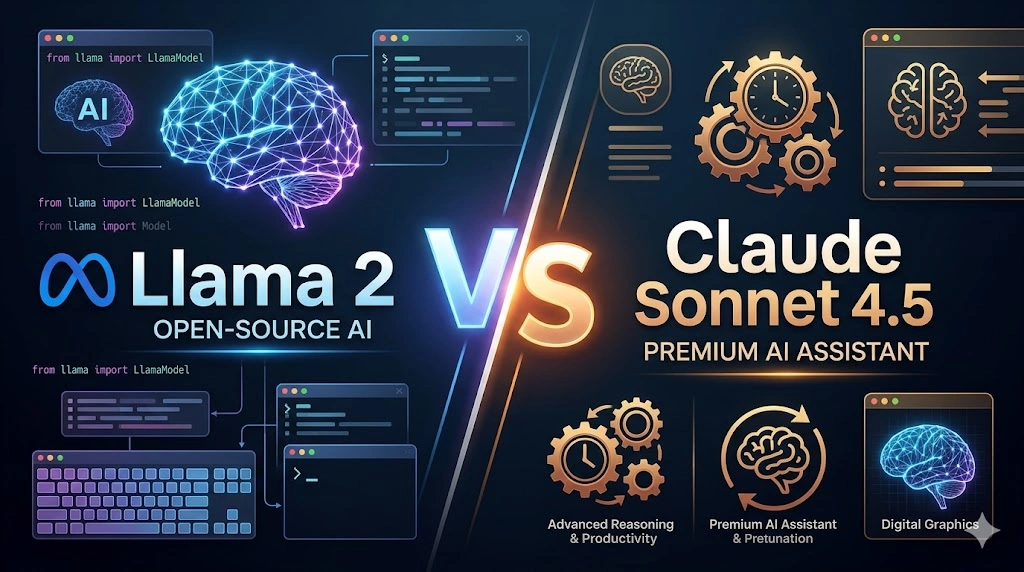
Artificial intelligence decisions in 2026 are no longer made by looking at benchmark charts alone.That is exactly why the Comparison between Llama 2 Series and Claude Sonnet 4.5 matters. Llama 2 became one of the most influential open-weight model families and accelerated self-hosted AI adoption across Europe and North America. Claude Sonnet 4.5 represents a newer generation of production-focused AI designed for long-context reasoning, coding workflows, and enterprise execution. This guide compares both from practical angles, including architecture, performance, deployment, economics, developer workflows, and long-term ROI. By the end, you will know exactly which model fits your environment.
Teams, developers, startups, and enterprises now care about different questions:
Which AI model generates measurable business value?
Which model scales economically?
Platform delivers better coding performance?
Option supports real production environments?
Llama 2 Series and Claude Sonnet 4.5 at a Glance
| Category | Llama 2 Series | Claude Sonnet 4.5 |
| Model Type | Open-weight | Proprietary |
| Deployment | Self-hosted | API-first |
| Context Handling | Smaller default context | Long-context optimized |
| Custom Training | Strong | Limited |
| Infrastructure Control | Full ownership | Managed |
| Coding Experience | Flexible | Excellent |
| Maintenance | Internal | Provider-managed |
| Best For | Ownership | Productivity |
Quick Verdict
Choose Llama 2 if ownership and customization matter.
Choose Claude Sonnet 4.5 if productivity and faster execution matter.
What Is Llama 2 Series?
Llama 2 is a family of large language models built around open deployment flexibility.
Unlike closed platforms, organizations can run models inside their own infrastructure.
The family includes:
Llama 2 Variants
- Llama 2 7B
- Llama 2 13B
- Llama 2 70B
- Chat-tuned variants
This flexibility made Llama a preferred option for:
- European compliance teams
- Internal enterprise AI projects
- Research environments
- Private AI deployments
Core Strengths of Llama 2
- Infrastructure ownership
- Fine-tuning capability
- Lower vendor lock-in
- Flexible deployment
Main Tradeoffs
- Higher operational complexity
- Hardware requirements
- Ongoing maintenance
What Is Claude Sonnet 4.5?
Claude Sonnet 4.5 is designed for high-output business execution.
Instead of infrastructure management, users focus on outcomes.
It emphasizes:
- Long-context understanding
- Coding performance
- Tool integration
- Workflow automation
- Production reliability
Claude appeals strongly to teams that want rapid deployment without maintaining infrastructure.
Architecture Differences
Architecture directly affects Operating cost and user experience.
Llama 2 Architecture Philosophy
Llama follows a platform ownership model.
You control:
- Servers
- Security
- Monitoring
- Fine-tuning
- Inference stack
This model works well for organizations with engineering resources.
Claude Sonnet 4.5 Architecture Philosophy
Claude follows managed intelligence.
Users focus on:
- Prompting
- Integrations
- Product delivery
- Business workflows
This reduces operational burden.
Architecture Winner
For flexibility:
Llama 2
For simplicity:
Claude Sonnet 4.5
Benchmarks vs Real-World Performance
Benchmarks are useful but incomplete.
Real-world performance increasingly depends on:
- Workflow quality
- Prompt engineering
- Memory systems
- Agent orchestration
Performance Comparison
| Scenario | Llama 2 | Claude Sonnet 4.5 |
| General Reasoning | Good | Excellent |
| Long Documents | Moderate | Excellent |
| Multi-step Tasks | Good | Strong |
| Business Writing | Strong | Excellent |
| Coding | Strong | Excellent |
Production Reality
Organizations rarely select models using benchmark charts.
Most choose based on:
- reliability
- deployment speed
- integration quality
- operational cost
Coding and Developer Experience
Coding is one of the biggest buying factors.
Choose Llama 2 If You Need
- Local inference
- Full-stack ownership
- Custom engineering
- Controlled environments
Choose Claude Sonnet 4.5 If You Need
- Faster iteration
- Repository understanding
- Agent workflows
- Large project support
Coding Comparison Table
| Area | Llama 2 | Claude Sonnet 4.5 |
| Code Generation | Excellent | Excellent |
| Repo Understanding | Moderate | Excellent |
| Speed to Deploy | Moderate | Excellent |
| Agent Workflows | Strong | Excellent |
Coding Winner
Claude Sonnet 4.5
Context Window and Long Documents
Context windows increasingly determine practical usefulness.
Long inputs affect:
- legal analysis
- repositories
- RAG systems
- enterprise documentation
Llama 2
Best for:
- focused prompts
- smaller workflows
- tuned deployments
Claude Sonnet 4.5
Best for:
- contracts
- large repositories
- knowledge bases
- long business workflows
Winner:
Claude Sonnet 4.5
Pricing and Total Cost of Ownership
Price is where many comparisons fail.
Token cost alone never tells the full story.
Llama 2 Cost Components
- GPUs
- cloud compute
- storage
- engineering
- maintenance
Claude Sonnet Cost Components
- input tokens
- output tokens
- API usage
Cost Comparison
| Factor | Llama 2 | Claude Sonnet 4.5 |
| Startup Cost | High | Low |
| Scaling | Flexible | Predictable |
| Maintenance | Higher | Lower |
| Long-Term Ownership | Strong | Moderate |
Cost Winner
Small teams:
Claude
Large infrastructure:
Llama
Enterprise Deployment
Llama 2 Works Better For
- compliance-heavy industries
- internal hosting
- private AI
Claude Sonnet 4.5 Works Better For
- fast launches
- managed AI
- product teams
Open Source vs Proprietary AI
This is the bigger strategic debate.
Open AI Deployment Benefits
- ownership
- flexibility
- infrastructure control
Proprietary AI Benefits
- stronger managed experience
- faster innovation
- lower maintenance
Decision question:
Do you optimize for ownership or output?
Europe Perspective: Why This Comparison Matters
European organizations increasingly prioritize:
- GDPR awareness
- operational transparency
- vendor flexibility
- deployment sovereignty
For regulated environments, self-hosting remains attractive.
For growth-focused teams, managed AI often wins.
Pros and Cons
Llama 2 Pros
- Open deployment
- Flexible infrastructure
- Strong customization
- Lower lock-in
Llama 2 Cons
- Complex operations
- Higher maintenance
- Infrastructure requirements
Claude Sonnet 4.5 Pros
- Excellent coding
- Long context
- Easy deployment
- Fast productivity
Claude Sonnet 4.5 Cons
- Less ownership
- Usage-based pricing
- API dependence
Who Should Choose Which?
Choose Llama 2 Series if:
Need ownership
Require a custom deployment
You have engineering resources
Choose Claude Sonnet 4.5 if:
Want productivity
Need strong coding
You prioritize fast execution
Tips to Write Your Own AI Tool Comparisons
- Compare outcomes, not benchmarks
- Include deployment costs
- Test real workflows
- Consider long-term ownership
- Evaluate ROI
People Also Ask
A: For productivity and managed workflows, often yes. For ownership and customization, Llama remains attractive.
A: It depends on infrastructure capability and deployment goals.
A: Claude Sonnet 4.5 generally provides stronger out-of-the-box coding workflows.
A: At scale, potentially yes. For small teams, managed APIs can be more economical.
A: Organizations prioritizing control may prefer Llama, while fast-moving teams may prefer managed AI.
Conclusion
Llama 2 Series and Claude Sonnet 4.5 represent two different futures of AI. Llama focuses on ownership, infrastructure freedom, and customization. Claude focuses on execution, productivity, and managed intelligence. There is no universal winner. If your organization values rapid deployment and immediate business output, Claude Sonnet 4.5 is usually the stronger choice. If your strategy prioritizes infrastructure control and long-term flexibility, Llama 2 remains highly relevant. The best AI model is the one that fits your real deployment environment, not the one with the highest benchmark score. Bookmark this guide and explore more AI comparisons on Ultraaiguide.com.