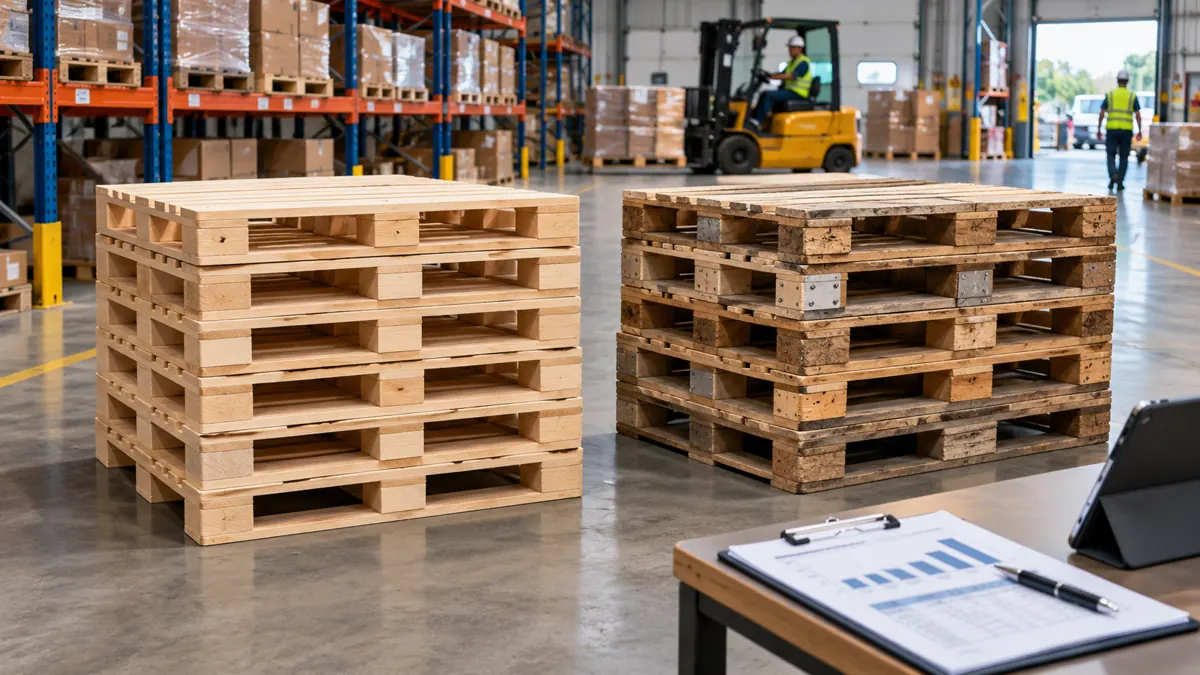
Pallet procurement decisions rarely get the attention they deserve until something goes wrong. A shipment is rejected by a retail partner because of inconsistent pallet sizing. A load shifts in transit because deck boards were weakened from previous use. A warehouse team spends unplanned hours sorting through incoming stock because pallet condition varies too widely to run efficiently through automated systems. These are not edge cases. They are the kinds of friction points that quietly erode operational margins in distribution-heavy environments.
As warehousing costs continue to rise across the United States in 2025, driven by tighter labor markets, rising storage rates, and increased retailer compliance demands, procurement managers and operations directors are revisiting pallet strategy with more scrutiny than before. The question of whether to buy new or recycled pallets is no longer just a cost-per-unit calculation. It now involves a fuller accounting of what each option actually costs across receiving, storage, transit, compliance, and returns.
What New Pallets Actually Offer Beyond the Unit Price
When warehouses evaluate new pallets, the conversation often starts and ends at cost per unit. That framing misses a significant part of the picture. New pallets are built to a consistent specification, which means every unit that arrives on a loading dock is structurally the same as the last. There is no sorting required, no inspection for cracks or missing deck boards, and no guesswork about load capacity.
This consistency has real operational value in environments where pallets move through automated conveyor systems, robotic picking lines, or tight racking configurations. A pallet that is even slightly out of dimension or weakened in one corner can cause jams, misalignments, or safety risks that require manual intervention. In high-throughput facilities, that kind of disruption compounds quickly.
Compliance and Retail Vendor Requirements
Retail and grocery supply chains in the United States have become increasingly prescriptive about pallet standards. Major retailers and third-party logistics platforms often specify acceptable pallet grades, maximum allowable damage thresholds, and in some cases, pallet origin requirements. These requirements are not advisory. Shipments arriving on non-compliant pallets can be refused, charged back, or flagged in vendor scorecards.
New pallets, particularly those meeting heat treatment certification standards required for international shipping under ISPM 15, tend to satisfy these compliance conditions without additional inspection or documentation effort. Facilities that ship internationally or work with compliance-sensitive retail partners often find that using new inventory reduces administrative overhead and chargeback risk in ways that offset the higher unit cost.
Predictable Load Performance Over Time
New pallets carry a known structural history, which means they perform predictably under load from the first use. This matters most in cold chain operations, where pallets may carry heavy frozen or refrigerated product and are expected to remain stable across multiple temperature transitions. It also matters in stacking environments where load calculations depend on consistent deck board integrity.
The absence of prior damage, repair, or fatigue means that new pallets typically perform closer to their rated capacity throughout their early lifecycle, reducing the probability of mid-transit failure or in-warehouse collapse that can result in product loss, worker injury, or both.
Where Recycled Pallets Deliver Genuine Value
Recycled pallets, when sourced responsibly and graded properly, are a legitimate and economically sound option for many warehouse operations. The category covers a wide range of quality levels, from Grade A recycled pallets that have been repaired, inspected, and returned to near-new condition, to lower-grade units that are suitable for internal material movement but should not enter outbound supply chains.
For operations that primarily use pallets within a closed-loop internal environment, such as manufacturing plants moving components between production stations, or distribution centers managing product staging and short-distance movement, recycled pallets can significantly reduce pallet spend without meaningful operational risk. In these contexts, the pallet is not subject to external compliance scrutiny and does not need to survive multiple carrier handoffs or retail receiving inspections.
The Grade Distinction That Procurement Teams Often Overlook
Not all recycled pallets are the same, and this distinction is the single most important variable in the recycled pallet decision. A low-cost pallet sourced without any grading process introduces unpredictability into operations that can cost more to manage than the savings justify. A properly graded, inspected, and repaired recycled pallet, on the other hand, often performs adequately across a range of moderate-duty applications.
Operations teams that do not have a clear grading standard for incoming recycled inventory, or that purchase in bulk from suppliers who do not sort by grade, frequently discover the real cost of that approach through damaged product, rejected shipments, and higher labor for inspection and sorting at receiving. The procurement savings on the front end are absorbed by operational costs further into the process.
Volume Flexibility and Short-Term Needs
Recycled pallets are often more readily available in large volumes on short notice, which makes them a practical choice for operations managing seasonal surges, unexpected volume spikes, or temporary warehousing arrangements. When the need is immediate and the use case is internal or short-haul, sourcing recycled inventory can bridge a supply gap without committing to the lead times or minimum order quantities sometimes associated with new pallet orders.
This flexibility is a genuine advantage, particularly for smaller regional warehouses or businesses that do not have the purchasing volume to negotiate strong terms on new pallet contracts. The key is matching the pallet grade to the actual application rather than defaulting to the lowest cost unit regardless of operational context.
The Hidden Costs That Change the Calculation
Total cost of ownership in pallet procurement is rarely captured in the unit price alone. The real cost includes the time spent inspecting incoming inventory, the labor required to sort and segregate damaged units, the product losses from pallet failures in transit, the administrative work involved in managing vendor chargebacks, and the replacement costs when pallets are condemned mid-cycle.
Warehouses that track these costs with any precision consistently find that the gap between new and recycled pallet total cost is narrower than the unit price differential suggests. In some cases, particularly where compliance requirements are strict or automated handling systems are in use, new pallets deliver a lower total cost per pallet cycle despite the higher purchase price.
Labor as the Often-Uncosted Variable
Inspection and sorting labor is one of the most consistently underestimated costs in pallet procurement. When recycled pallets arrive at a facility without a reliable grading standard, receiving staff must spend time evaluating each unit before it enters the workflow. In facilities where labor is already stretched, that time comes at a meaningful cost, either in overtime, delayed receiving, or reduced throughput during peak periods.
New pallet inventory eliminates this step almost entirely. The assumption of consistent quality at the point of receipt means receiving staff can move product into the warehouse system without diverting time to condition assessment. For high-volume facilities processing dozens of inbound loads per day, the cumulative labor savings can be substantial over a full fiscal year.
Product Loss and Liability Exposure
When a pallet fails under a loaded product and results in damage, the cost accounting extends beyond the product itself. There is the pallet replacement, the damaged goods write-off, potential carrier claims, and in worst cases, a worker safety incident. These outcomes are statistically more likely with lower-grade recycled pallets that have not been properly inspected or repaired before reuse.
The liability dimension is particularly relevant for operations handling high-value goods, fragile product categories, or temperature-sensitive inventory where secondary damage from a pallet failure is difficult to recover. In these environments, the structural predictability of new pallets is not a premium feature but a risk management decision with measurable financial implications.
Making the Right Choice for Your Specific Operation
The most accurate answer to the new versus recycled pallet question is that neither option universally saves more money. The right choice depends on the operational environment, the supply chain requirements, and the actual costs being tracked across the full pallet lifecycle.
Facilities with strict retail compliance obligations, automated material handling systems, or high-value product categories will generally find that new pallets deliver better total cost performance even at a higher unit price. Facilities with internal-only pallet use, manual handling environments, and flexible compliance requirements can often operate cost-effectively with properly graded recycled pallets, provided they purchase from sources that apply consistent quality standards.
The procurement teams that make the most informed decisions in this area are the ones that have moved beyond per-unit price comparisons and begun tracking the downstream costs that each pallet type introduces into their operation. That shift in how the data is captured tends to produce clearer answers than any general industry guidance can offer.
Warehouse efficiency depends on more than choosing the right pallets. Businesses also benefit from understanding how modern technology, operational planning, and digital tools can improve everyday processes. For more insights into technology and practical business solutions, explore the latest articles on UltraAIGuide.
Conclusion
Pallet decisions in 2025 carry more operational weight than they did even five years ago. Tighter compliance standards, faster warehouse throughput requirements, and increased scrutiny of total operating costs have made this a more consequential procurement category than many organizations historically treated it as.
The comparison between new and recycled pallets is not best framed as a question of which is inherently better. It is more accurately a question of which is better suited to a specific operational context, and whether the true cost of each option, including labor, risk, and compliance exposure, has been honestly evaluated alongside the unit price. Operations that do this analysis with precision tend to find a clearer path to the choice that actually serves their bottom line.