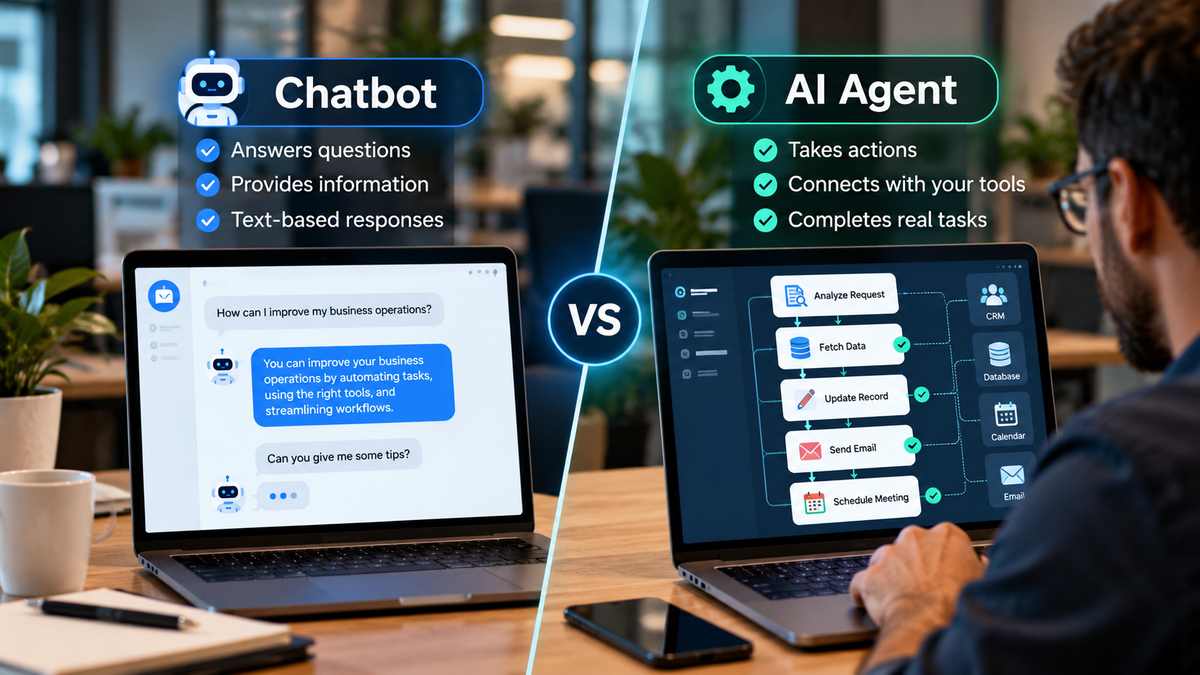
Ask ten companies what an AI agent is and you will get ten answers, most of which describe a chatbot. The marketing has outrun the engineering, and the word now covers everything from a support widget with a better prompt to software that books freight and moves money.
The distinction that matters is not intelligence. Both run on the same underlying models, and the agent is not smarter. The difference is permission. A chatbot produces words. An agent produces consequences.
That single change rewrites almost everything about how the software has to be built, and it is the part that gets discovered late. Companies now arrive at a mobile app development company in Dallas or anywhere else asking for an AI agent inside their product, having scoped it as a feature when it is closer to a new category of system.
The Real Difference, Stated Plainly
A chatbot reads, reasons and replies. Every output is text, and a wrong answer is a bad experience the user can ignore.
An agent reads, reasons, and then calls something. It queries a database, writes a record, sends an email, issues a refund, schedules a technician. A wrong answer is now an event in your systems that somebody has to undo.
Put side by side:
● Chatbot failure: the user gets an unhelpful reply and rephrases the question
● Agent failure: a customer gets refunded twice, or a job gets dispatched to the wrong address, and nobody notices until reconciliation
● Chatbot testing: does it answer well
● Agent testing: does it do the right thing, and what happens when it does the wrong one
● Chatbot scope: a conversation
● Agent scope: every system it is permitted to touch
Everything below follows from that.
How Agents Actually Work Under the Hood
The mechanism is less mysterious than the marketing suggests, and understanding it clarifies where the engineering effort goes.
The model does not execute anything. It cannot. What it does is emit a structured request, commonly called a tool call or function call: a named action with parameters, such as “issue_refund” with an order number and an amount. Your own code receives that request, decides whether to run it, runs it, and hands the result back to the model so it can continue.
This is the important part. The model proposes. Your software disposes. Every guardrail, permission check and validation lives in the layer you write, not in the model.
Understanding how AI models connect to external systems makes this distinction clearer. For example, our guide to Claude API integration explains how developers connect AI models with applications, APIs, and automated workflows.
These integrations are the foundation of many AI agents, but reliable execution still depends on permissions, validation, and proper system controls.
A typical loop:
1. The user states a goal
2. The model selects a tool and supplies parameters
3. Your code validates the request against permissions and business rules
4. Your code executes it, or refuses it, or pauses for human approval
5. The result returns to the model
6. The model decides whether the goal is met or another step is needed
Standards such as the Model Context Protocol have made step two more portable by giving models a consistent way to discover and call tools. They have not changed steps three and four, which remain yours to build and are where agent projects succeed or fail.
Four Things That Get Hard Immediately
Repeated actions. Models are not deterministic. The same request can produce a different sequence of calls on a second attempt, and retries after a timeout are routine. Without unique identifiers attached to each action, an agent that times out mid-refund can cheerfully issue a second one. Idempotency stops being a nicety and becomes the thing standing between you and duplicate transactions.
Identity and permission. Whose authority does the agent act with? If it runs on a service account with broad access, a user who could never see payroll data can ask a question that causes the agent to read it. Agents should inherit the permissions of the person they are acting for, enforced server side, not merely be instructed in a prompt to behave. An instruction is a suggestion. A permission check is a control.
Partial completion. A three-step task that fails at step two leaves the system in a state no one designed. The booking exists, the payment did not process, the confirmation already went out. Every multi-step agent action needs a defined answer to what gets rolled back and what gets flagged for a human.
Explaining what happened. When a customer asks why they were charged, “the model decided to” is not an answer anyone can work with. Agent actions need logging that captures the request, the reasoning, the parameters and the outcome, in a form a support agent or an auditor can read months later.
None of these are AI problems. They are distributed systems problems, which is why the work usually lands with a platform or software engineering team rather than with a data science group. It is also why mature enterprise AI solutions tend to be described as layered systems, with the model sitting above separate orchestration, integration and governance layers that carry most of the real weight. The model is the easy part. The transactional integrity around it is the project.
The Integration Layer Is the Actual Product
An agent with no tools is a chatbot. An agent is only as useful as the systems it can reach, which means most of the build is integration work: connecting to the CRM, the ERP, the scheduling system, the payment processor, the internal database that someone wrote in 2014.
Each connection raises the same questions any integration raises. What happens at the rate limit. What happens when the third party changes a field. Which system is the source of truth when two records disagree. How stale can cached data be before an agent acting on it causes harm.
This is why agent pilots demo beautifully and deploy badly. The demo connects to one clean API. Production connects to seven systems with inconsistent data and differing uptime.
Design the Human Checkpoints Deliberately
The useful question is not whether a human reviews agent actions, but which ones.
A workable default:
● Autonomous: read-only actions, internal lookups, drafting anything a person will review anyway
● Approval required: anything that moves money, contacts a customer externally, or changes a record that is expensive to reverse
● Blocked entirely: deletions, permission changes, and anything with regulatory weight
Approval gates are not a sign of an immature system. Plenty of mature deployments keep them permanently, because the value was always in the agent assembling the work, not in removing the person who signs it off.
Questions Worth Asking Before Building One
● What specific actions will this agent take, named individually, not described as a category
● Which of those can it take alone, and which need a human
● What does each action cost if it happens wrongly, and can it be reversed
● Whose permissions does it act with, and where is that enforced
● What does the audit record look like for a single action
● What happens when a connected system is down
● How will you measure whether it worked, beyond the demo
A vendor who answers these with enthusiasm about the model rather than specifics about the control layer has not built one of these before.
When a Chatbot Is the Better Answer
Agents are expensive to build correctly and carry real operational risk. A substantial share of the problems companies bring to them do not need one.
If the goal is answering questions from documentation, summarizing information, drafting content a person will edit, or helping someone find something, a well-built retrieval chatbot delivers most of the value at a fraction of the cost and almost none of the risk. Nothing it produces changes state.
Reach for an agent when the bottleneck is genuinely the doing rather than the knowing, when the actions are well defined, and when you are prepared to engineer the controls around them. That combination is rarer than the current enthusiasm suggests, and recognizing when it does not apply is worth more than a sophisticated build nobody trusts enough to switch on.
Contributed by the engineering team at Software Orca, a software development firm in Dallas, Texas.