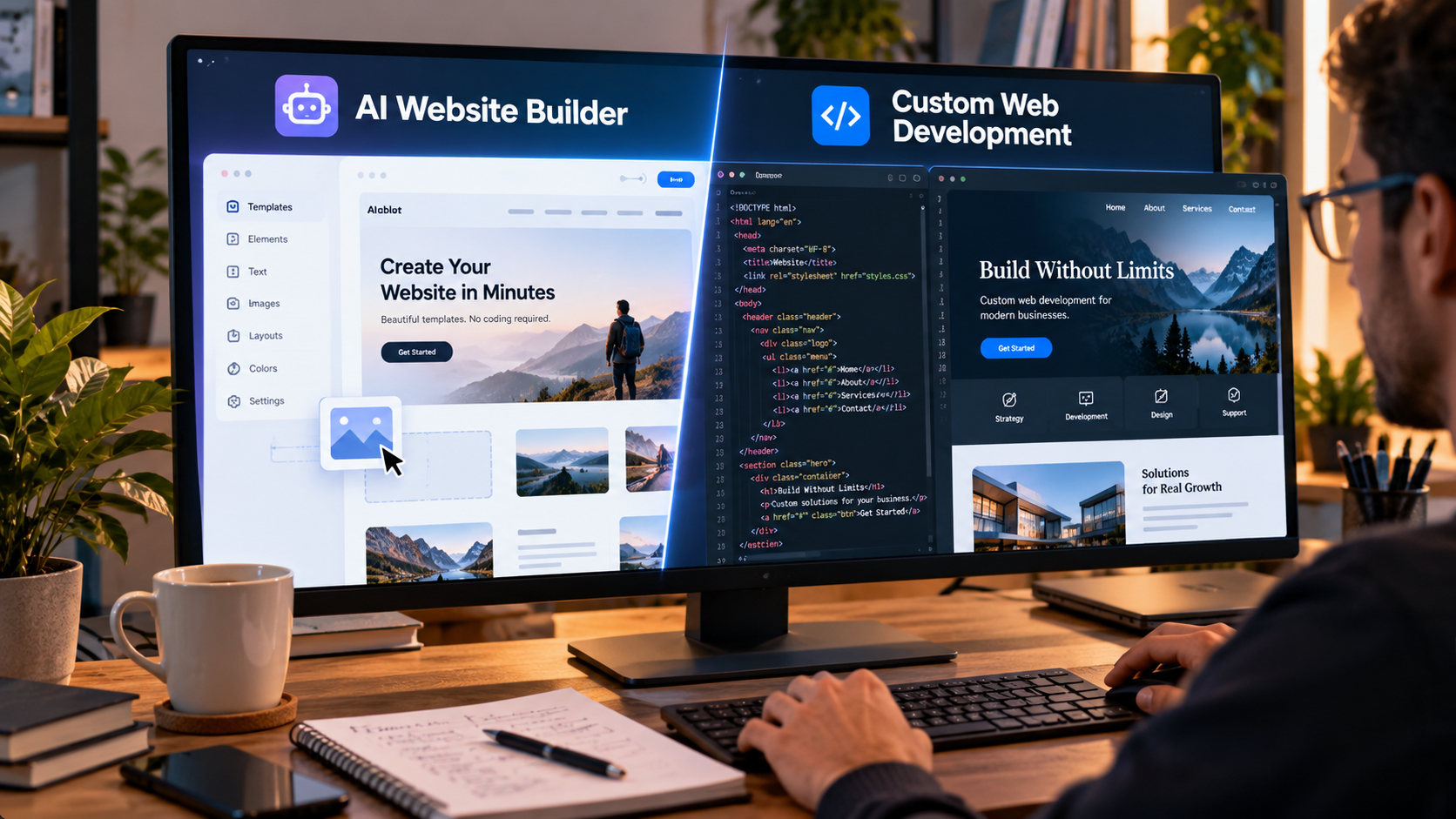
AI website builders have made it easier to create websites without extensive coding knowledge. They can generate layouts, content, and basic functionality within minutes, while custom development requires more planning and technical work.
The better choice depends on what the website needs to do. AI tools may work well for simple business websites, but complex platforms often require custom development, integrations, and ongoing technical support.
Main Differences Between Custom Development and AI Website Builders
AI website builders use automated tools to generate websites from prompts, templates, and predefined components. Custom web development involves planning and building a website around specific business requirements.
Businesses working with ThoughtLabs can assess functionality, performance, integrations, and future growth before deciding which approach suits their needs.
Design Flexibility
AI website builders can generate layouts, colour schemes, and page structures from simple instructions. Custom development provides greater design control, particularly for unusual layouts, complex interactions, and unique brand experiences.
Development Time
AI tools can produce a basic website within minutes, although editing and testing still take time. Custom development usually takes longer because it involves planning, design, coding, testing, and deployment.
Initial Cost
AI website builders often charge monthly subscriptions and require less upfront investment. Custom development generally costs more initially because businesses pay for specialised design, engineering, and testing.
Functionality and Features
AI builders can create standard pages, contact forms, blogs, and basic online stores. Custom development offers greater flexibility when businesses need advanced workflows, account permissions, or specialised features.
Website Performance
AI-generated websites may include unnecessary scripts, components, or third-party dependencies. However, performance depends on implementation, and a well-optimised AI-built website can outperform poorly written custom code.
Security and Maintenance
AI website platforms typically manage hosting, infrastructure, and some security updates. Custom websites require clear maintenance responsibilities for software updates, vulnerability management, backups, and technical support.
Scalability
AI website builders can support growing businesses, particularly when their needs remain within the platform’s capabilities. Custom architecture offers more flexibility when businesses require complex integrations, large datasets, or specialised functionality.
When Are AI Website Builders the Better Choice?
AI website builders are useful for businesses that need a professional online presence without investing heavily in development. They can simplify website creation for small businesses, freelancers, and startups.
AI website builders are often suitable for straightforward projects where speed, affordability, and ease of use matter most.
● Small business websites with basic service information.
● Personal portfolios and professional profiles.
● Landing pages for marketing campaigns.
● Simple blogs and informational websites.
● Startup websites used to test business ideas.
● Small online stores with standard features.
● Websites with limited integration requirements.
● Businesses without dedicated development teams.
However, AI-generated websites still need human review. Content accuracy, mobile usability, accessibility, search engine optimisation, and security should be checked before launch.
Google’s guidance on AI-generated content focuses on quality, usefulness, and originality, rather than whether content was produced using artificial intelligence. Businesses should therefore review automatically generated website copy instead of publishing it without checking accuracy.
When Does Custom Web Development Offer More Value?
Custom development becomes more useful when a website must support specific business operations, customer interactions, or technical requirements. AI tools can assist developers, but they do not automatically replace the planning and engineering needed for complex projects.
Businesses seeking custom web development services can build websites around specific workflows, integrations, and technical requirements rather than relying entirely on predefined platform features.
Complex Business Workflows
Some businesses need approval processes, custom pricing, user permissions, or detailed reporting. Custom workflows can handle these requirements without forcing employees to use unsuitable standard features.
Integration With Business Systems
Companies often connect websites with CRM, ERP, inventory, payment, and customer support platforms. Custom integrations allow better control over how information moves between systems and how errors are handled.
Unique Customer Experiences
AI builders often rely on standard layouts and predefined interactions. Custom development supports tailored user journeys based on customer preferences, account types, locations, or specific business rules.
Advanced Performance Requirements
Web applications handling large datasets, frequent transactions, or complex interactions need careful performance planning. Custom development allows targeted optimisation of databases, APIs, caching, and application architecture.
Greater Control Over Data
Some businesses have specific requirements for data storage, processing, access, and retention. Custom systems provide more architectural control over these decisions, although compliance still depends on proper implementation.
Security and Compliance Requirements
Businesses handling sensitive information may need advanced authentication, audit logs, access controls, and security monitoring. Custom development can accommodate specialised security requirements that standard website builders may not fully support.
Long-Term Product Development
Digital platforms often expand with new services, user roles, integrations, and features. Custom architecture can support planned growth without depending entirely on a website builder’s available features or product roadmap.
Can AI and Custom Web Development Work Together?
AI website builders and custom development do not have to be competing approaches. Developers increasingly use AI tools to assist with coding, testing, documentation, and design while retaining responsibility for the final product.
Combining AI assistance with professional development can improve efficiency without sacrificing control over important technical decisions.
Some practical applications include:
● Code generation: Use AI to draft components and repetitive code.
● Design exploration: Generate layout ideas and interface variations.
● Testing assistance: Draft test cases and identify potential edge cases.
● Content creation: Prepare initial copy for human review and editing.
● Documentation: Summarise technical processes and code functionality.
● Accessibility checks: Identify possible issues for further manual testing.
● Code review: Highlight potential bugs and areas requiring optimisation.
● Prototyping: Build early versions of features before full development.
AI-generated code still requires testing and security review. The OWASP Top 10 provides a useful reference for common web application security risks, including broken access control, injection vulnerabilities, and insecure design.
AI-assisted coding tools can also support developers working on custom websites and applications. These tools can help generate code, complete functions, identify possible errors, and streamline repetitive programming tasks while leaving final testing and implementation decisions to developers.
For a practical example, explore this DeepSeek Coder 1.3B guide for developers to understand how AI coding assistants fit into modern software development workflows.
Custom Development vs. AI Website Builders
| Feature | AI Website Builders | Custom Development |
| Development speed | Faster for simple sites | Depends on complexity |
| Initial cost | Usually lower | Usually higher |
| Design flexibility | Platform-dependent | Highly flexible |
| Custom functionality | Often limited | Extensive |
| Integrations | Available connectors | Custom integrations |
| Maintenance | Mostly platform-managed | Developer-managed |
| Scalability | Depends on platform | Depends on architecture |
| Best suited for | Simple business websites | Complex digital platforms |
Conclusion
AI website builders are useful for launching simple websites quickly and affordably. Custom web development is often better for complex functionality, integrations, and long-term flexibility. Neither approach guarantees a successful website on its own. Businesses should evaluate their requirements, budget, maintenance needs, and future plans before deciding whether to use AI tools, custom development, or a combination of both.