Introduction
If Claude suddenly stops responding, the Obvious question is: is Claude AI down, or is something wrong with your connection, browser, account, or API?
The answer can change quickly. As of August 21, 2026, Anthropic’s official status page reports Claude.ai, Claude API, Claude Code, Claude Console, and Claude Cowork as operational. However, Anthropic’s incident history shows several disruptions in August, including a service-wide incident on August 16 and model-specific degradation on August 17.
At the same time, another major AI story often appears alongside Claude-related searches: Scale AI and Meta.
Meta invested approximately $14.3 billion for a 49% stake in Scale AI in 2025, while Scale founder Alexandr Wang joined Meta to work on its AI efforts. The deal valued Scale at more than $29 billion.
But here is the important part:
Scale AI and Claude are not direct competitors.
Claude is Anthropic’s AI platform and model ecosystem, while Scale AI operates primarily around AI data, evaluation, infrastructure, and enterprise AI applications. Anthropic describes Claude as an AI platform designed for language, reasoning, analysis, coding, and related tasks.
This guide explains both topics clearly, including how to check Claude’s status, troubleshoot problems, understand the Scale AI–Meta deal, and see how these companies fit into the larger AI ecosystem.
Is Claude AI Down Right Now?
As of August 21, 2026, Anthropic’s official status page reports that Claude services are operational.
That includes:
- Claude.ai
- Claude Console
- Claude API
- Claude Code
- Claude Cowork
- Claude for Government
However, “operational” does not necessarily mean every individual user will have a perfect experience.
You may still encounter:
- Login failures
- Slow responses
- Failed generations
- API errors
- Rate-limit messages
- Claude Code problems
- Browser-related issues
- Network problems
- Account-specific errors
The best first step is therefore to check Anthropic’s official status page rather than assuming Claude is globally unavailable.
Quick answer
Is Claude down today?
Currently, the official status page says no major system outage is active.
If Claude is not working for you, continue with the troubleshooting steps below.
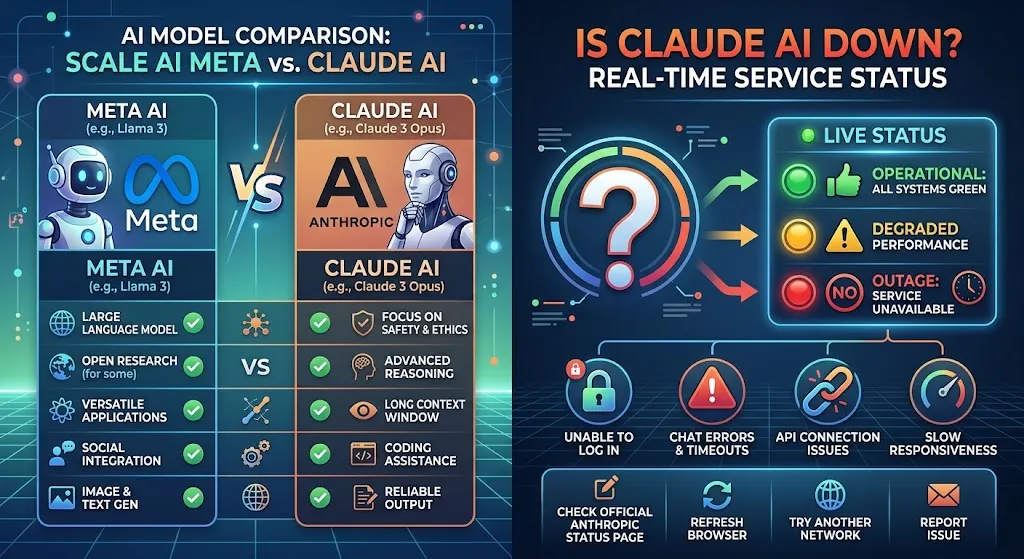
How to Check Claude’s Official Status
When Claude stops working, do not immediately reinstall the application or change your API configuration.
First, determine whether the problem is global or local.
Step 1: Check Anthropic’s status page
Look for:
- Operational
- Degraded Performance
- Partial Outage
- Major Outage
- Maintenance
Anthropic’s status page also provides historical incidents, which can help you determine whether a problem is isolated to a particular Claude model or service.
Step 2: Identify the affected service
Claude’s ecosystem contains several components.
A problem with Claude Code does not necessarily mean Claude.ai is unavailable.
Likewise, an API incident may not prevent the consumer website from loading.
Step 3: Check whether the problem is account-specific
Try:
- Another browser
- Private/incognito mode
- Another device
- Another network
Step 4: Test again after a few minutes
Temporary infrastructure problems can resolve before you finish troubleshooting.
Step 5: Developers should test the API separately
Anthropic provides a separate API and developer environment for building applications with Claude.
Why Is Claude AI Not Working?
There are several possible explanations for Claude not working.
| Possible Cause | What You May Notice |
| Anthropic outage | Many users experience failures |
| Model degradation | One or more models produce errors |
| Authentication issue | Login or OAuth problems |
| Browser problem | Page fails to load correctly |
| Network problem | Connection or timeout errors |
| Rate limits | Requests are temporarily restricted |
| API configuration | Developer requests fail |
| Claude Code issue | Coding workflow fails while Chat may work |
| Account issue | Problem occurs only for your account |
| Temporary overload | Slow responses or repeated failures |
The distinction between “Claude is down“ and “Claude isn’t working for me” is critical.
If Anthropic reports an incident affecting your service, waiting is often the correct solution.
If the official status page says everything is operational and only your account is affected, local troubleshooting makes more sense.
Common Claude AI Outage Symptoms
Searches for Claude AI down can represent many different problems.
Claude won’t load
The website may remain blank, repeatedly refresh, or fail to complete authentication.
Claude isn’t responding
The interface loads but generation fails or remains stuck.
Claude login isn’t working.
Authentication problems can prevent access even when the underlying AI models are functioning.
Claude is extremely slow
High latency does not necessarily mean a complete outage.
Claude API isn’t working.g
Developers may receive API errors even while the consumer Claude website remains available.
Claude Code isn’t working.
Claude Code can experience service-specific problems independent of the standard Claude interface.
One Claude model is failing
A model-specific incident can occur while other models remain operational.
Anthropic’s August 2026 status history illustrates why this distinction matters: some incidents affected multiple services, while others were limited to particular models.
Is Claude API Down Too?
Not necessarily.
Claude’s consumer experience and developer infrastructure are related but should not be treated as one identical service.
Anthropic offers an API through which developers can build applications using Claude models, with usage-based access, rate limits, documentation, and developer tooling.
If you are a developer, check:
- Anthropic’s status page.
- API response status codes.
- API authentication.
- API key configuration.
- Rate limits.
- Billing/account status.
- Your application’s network connection.
- Whether the issue affects one model or multiple models.
Important distinction
Claude website down ≠ automatically Claude API down.
The reverse can also happen.
A developer should therefore diagnose the API independently instead of assuming that a problem with Claude.ai explains every API failure.
Is Claude Code Down?
Claude Code is another part of Anthropic’s developer ecosystem.
It can experience issues involving:
- Authentication
- Remote sessions
- Model requests
- Tool execution
- Network connectivity
- Service availability
Anthropic’s documentation identifies Claude Code as part of its developer tooling and provides dedicated resources for getting started.
A useful diagnostic pattern is:
Claude Chat works + Claude Code fails → investigate Claude Code specifically.
Claude Chat + Claude Code + API fail → investigate a broader Anthropic incident.
Everything works for other people + your account fails → investigate your local/account configuration.
This simple distinction can save developers significant troubleshooting time.
What Happened During Recent Claude Outages?
Claude has experienced multiple service incidents during August 2026.
Anthropic’s official incident history records a service disruption on August 16, 2026, affecting Claude.ai, platform.claude.com, the Claude API, Claude Code, and Claude Cowork. The incident was resolved after Anthropic deployed a fix.
On August 17, Anthropic also recorded degraded performance involving Claude Opus 5 and Claude Sonnet 5.
Other August incidents affected individual models or groups of models.
This tells us something important about Claude reliability:
A Claude outage is not always an all-or-nothing event.
One model may experience elevated errors while other services continue operating.
That is why a good Claude status article should always identify:
- Date
- Affected service
- Affected model
- Severity
- Whether the incident is active
- Whether Anthropic has resolved it
Rather than simply publishing “Claude is down.”
What Is Scale AI?
Scale AI is an AI technology company focused heavily on the data and infrastructure required to develop, test, and improve advanced AI systems.
Its work has historically included areas such as:
- Data labeling
- AI training data
- Model evaluation
- Human feedback
- Data curation
- AI applications
- Enterprise AI
- Government AI applications
Scale itself describes its data business as helping AI labs and technology companies train, test, and improve advanced models using high-quality data.
This makes Scale important to the AI industry even though it is not itself a consumer chatbot comparable to Claude.
Simple explanation
Think of the AI ecosystem as a stack.
Scale AI → data and evaluation infrastructure
Anthropic → AI models and Claude
Users/developers → applications and workflows
Different companies can operate at different layers of this stack.
Why Did Meta Invest in Scale AI?
Meta invested approximately $14.3 billion for a 49% stake in Scale AI, according to Reuters reporting, in a transaction that valued Scale at roughly $29 billion.
The deal also brought Scale founder Alexandr Wang into Meta’s AI efforts. Scale officially confirmed that Wang would join Meta while remaining on Scale’s board.
Why does that matter?
Because advanced AI is not only about building a bigger model.
It also depends on:
- High-quality training data
- Evaluation datasets
- Human feedback
- Model testing
- AI infrastructure
- Specialized talent
- Enterprise deployment
Meta was aggressively investing in its AI capabilities, and the Scale relationship gave it a strategic connection to one of the companies working on the data side of the AI stack.
Reuters described the deal as part of Meta’s broader push to strengthen its AI strategy and superintelligence efforts.
What Does Scale AI Actually Do?
Scale AI is best understood by looking at the problems it helps AI developers solve.
AI training data
AI models need enormous quantities of useful data.
Raw data alone is not necessarily enough.
Organizations often need data to be:
- Structured
- Labeled
- Filtered
- Evaluated
- Categorized
- Reviewed
Model evaluation
An AI model must be tested before organizations can confidently deploy it.
Evaluation can measure:
- Accuracy
- Reasoning
- Safety
- Reliability
- Task performance
- Domain-specific behavior
Human feedback
Humans can evaluate AI outputs and provide signals that help organizations understand where models perform well or poorly.
Enterprise AI
Scale has also expanded beyond its original data-labeling identity toward AI applications for businesses and government organizations. Reuters’ 2026 reporting described the company as providing data for advanced AI models while developing AI applications for businesses and government.
How the Scale AI–Meta Deal Changed the AI Industry
The deal was significant because it demonstrated how valuable AI data and talent had become.
Meta did not simply purchase another chatbot.
Instead, the transaction strengthened its relationship with an organization deeply involved in the data layer of AI development.
Scale announced that the Meta transaction valued the company at more than $29 billion and would expand their commercial relationship around AI data solutions.
At the same time, Scale emphasized that it remained an independent company and said Meta would not receive access to Scale’s internal systems or customers’ confidential information.
That distinction matters for enterprise customers.
Another important development
Scale’s leadership has continued to evolve.
Reuters reported in July 2026 that Scale appointed Francis DeSouza, a former Google Cloud executive, as CEO effective August 10, 2026. The change points toward continued emphasis on data and AI applications.
So the Scale story is no longer simply:
“Meta invested in Scale AI.”
It is now also about how Scale evolves as an independent AI company after the investment.
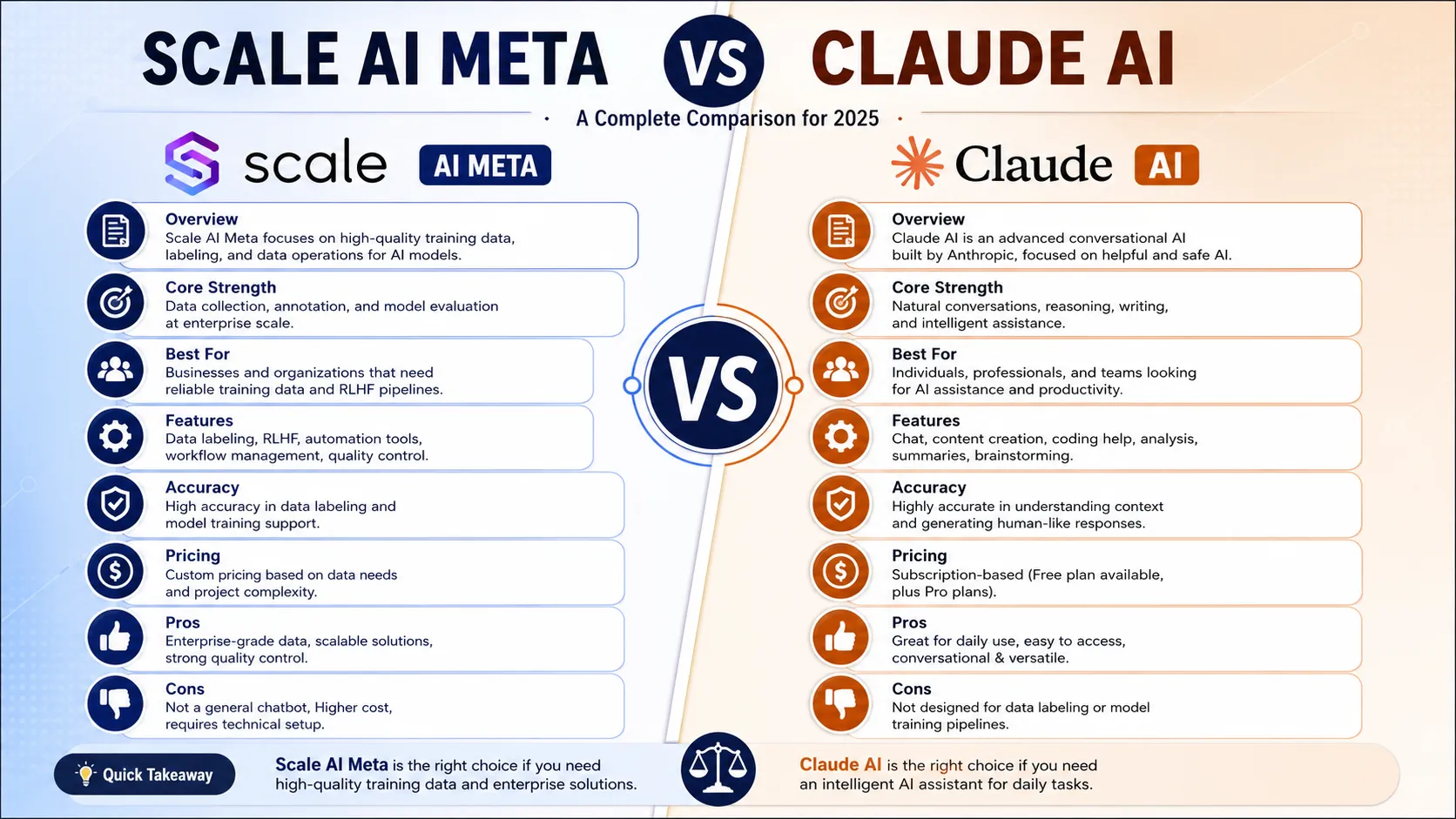
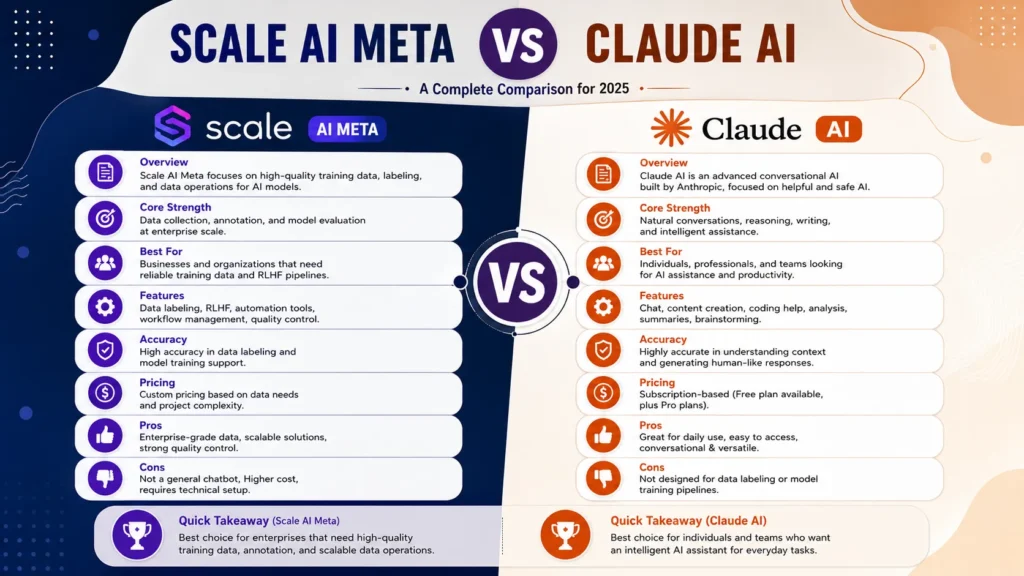
Scale AI vs Claude: They Are Not Direct Competitors
This is where many articles become confusing.
| Category | Scale AI | Claude |
| Company | Scale AI | Anthropic |
| Main role | AI data, evaluation and applications | AI models and assistant |
| Consumer chatbot | No | Yes |
| AI training data | Core business area | Part of model-development ecosystem |
| Developer API | Not its primary identity | Major Claude offering |
| Model provider | No | Yes |
| Enterprise AI | Yes | Yes |
| Coding workflows | Supporting AI ecosystem | Claude Code |
| Primary user | AI organizations, enterprises, governments | Consumers, developers, enterprises |
Anthropic describes Claude as an AI platform capable of language, reasoning, analysis, coding, and other tasks.
Scale, by contrast, focuses on the infrastructure, data, and applications that help organizations build and deploy AI.
The simplest way to remember it
Claude is something you use to work with AI.
Scale AI helps organizations build, evaluate, and deploy AI systems.
That is why “Scale AI vs Claude” is not really a traditional product comparison.
Does Meta’s Scale AI Investment Affect Claude?
Not directly.
Meta’s investment in Scale AI does not mean Meta owns Claude, Anthropic, or the Claude platform.
These are separate organizations.
The relationship can be simplified as:
Meta → Scale AI
Meta holds a minority stake in Scale and expanded its commercial relationship with the company. Scale says it remains independent.
Meanwhile:
Anthropic → Claude
Claude is Anthropic’s AI platform and model ecosystem.
Therefore, if Claude is unavailable, the Scale AI–Meta investment is not a logical explanation for the outage.
A Claude outage should be investigated through Anthropic’s service status and the user’s own environment.
What Can You Use When Claude Is Down?
If Claude is unavailable and your work cannot wait, use an alternative based on the task rather than choosing a replacement randomly.
For general AI chat
Consider another major AI assistant.
For coding
Use another AI coding assistant or model API.
For research
Use an AI search or research platform capable of citing sources.
For enterprise API workloads
Consider another commercial model provider with suitable API limits and compliance requirements.
For open-source workflows
Consider open-weight models when your infrastructure and technical skills support them.
Best practice for businesses
Do not wait for an outage before creating a fallback strategy.
For important workflows, consider:
Primary model + secondary model + monitoring + human review
This is especially useful when AI is involved in:
- Customer support
- Software development
- Content production
- Research
- Document processing
- Business automation
- Internal knowledge systems
A multi-model architecture can reduce dependency on a single AI provider.
Related To Another Article: https://ultraaiguide.com/deepseek-vibe-coding-vs-grok-coin/
What the Scale AI–Meta Deal Means for the Future of AI
The biggest lesson from these two stories is that the AI industry is much larger than chatbots.
Claude represents the model and assistant layer.
Scale AI represents an important part of the data, evaluation, and AI application layer.
Meta represents a massive technology platform investing across multiple layers of the AI ecosystem.
The future competition will involve more than:
Which chatbot gives the best answer?
It will also involve:
- Training data
- AI evaluation
- Compute
- Model architecture
- AI agents
- Enterprise deployment
- Security
- Reliability
- Data privacy
- AI infrastructure
- Talent
- Automation
Claude’s recent outages also highlight another increasingly important issue:
AI reliability is becoming part of product quality.
A model can be extremely capable, but if a business depends on it every day, uptime, latency, API reliability, rate limits, and disaster recovery also matter.
For everyday users, the practical lesson is simple:
Check Claude’s official status before assuming something is wrong with your account.
For businesses and developers, the bigger lesson is:
Build AI workflows that can survive temporary service interruptions.
And for people following the AI industry, the Scale AI–Meta deal shows that the competitive advantage behind future AI systems may depend just as much on data, evaluation, infrastructure, and talent as on the chatbot users see on screen.
People Also Ask
As of August 21, 2026, Anthropic’s official status page reports all listed Claude services as operational.
Check Anthropic’s official status page first. It shows current service health and historical incidents.
Possible causes include an Anthropic incident, browser problems, network issues, authentication errors, rate limits, API configuration, or an account-specific problem.
Not necessarily. Claude.ai and the API are separate services, so check the status of each service independently.
It can experience service-specific problems. Anthropic’s incident history shows that Claude Code can be affected independently or alongside other Claude services.
Scale AI provides data, evaluation, and AI-related technology services used by organizations developing and deploying AI systems.
Meta invested approximately $14.3 billion for a 49% stake in Scale AI as part of a broader strategy around AI data, talent, and advanced AI development.
Meta holds a 49% stake, but Scale says it remains an independent company rather than becoming fully integrated into Meta.
No. They operate at different layers of the AI ecosystem. Scale focuses on AI data, evaluation, and applications, while Claude is Anthropic’s model and assistant ecosystem.
Check Anthropic’s status page, identify which service is affected, retry after the incident is resolved, and use a backup AI provider if your workflow is urgent.
Conclusion
Claude and Scale AI represent two different but Important parts of the modern AI ecosystem. If Claude is not working, first check Anthropic’s official status page and determine whether the issue affects Claude.ai, the API, Claude Code, or only your account. Meanwhile, Meta’s investment in Scale AI highlights the growing importance of AI training data, evaluation, infrastructure, and enterprise applications.
The key takeaway is simple: Scale AI and Claude are not direct competitors, and Meta’s Scale AI investment does not directly control Claude or cause Claude outages. For reliable AI workflows, users and businesses should monitor service status and maintain suitable alternatives when critical work depends on a single AI platform.