Introduction
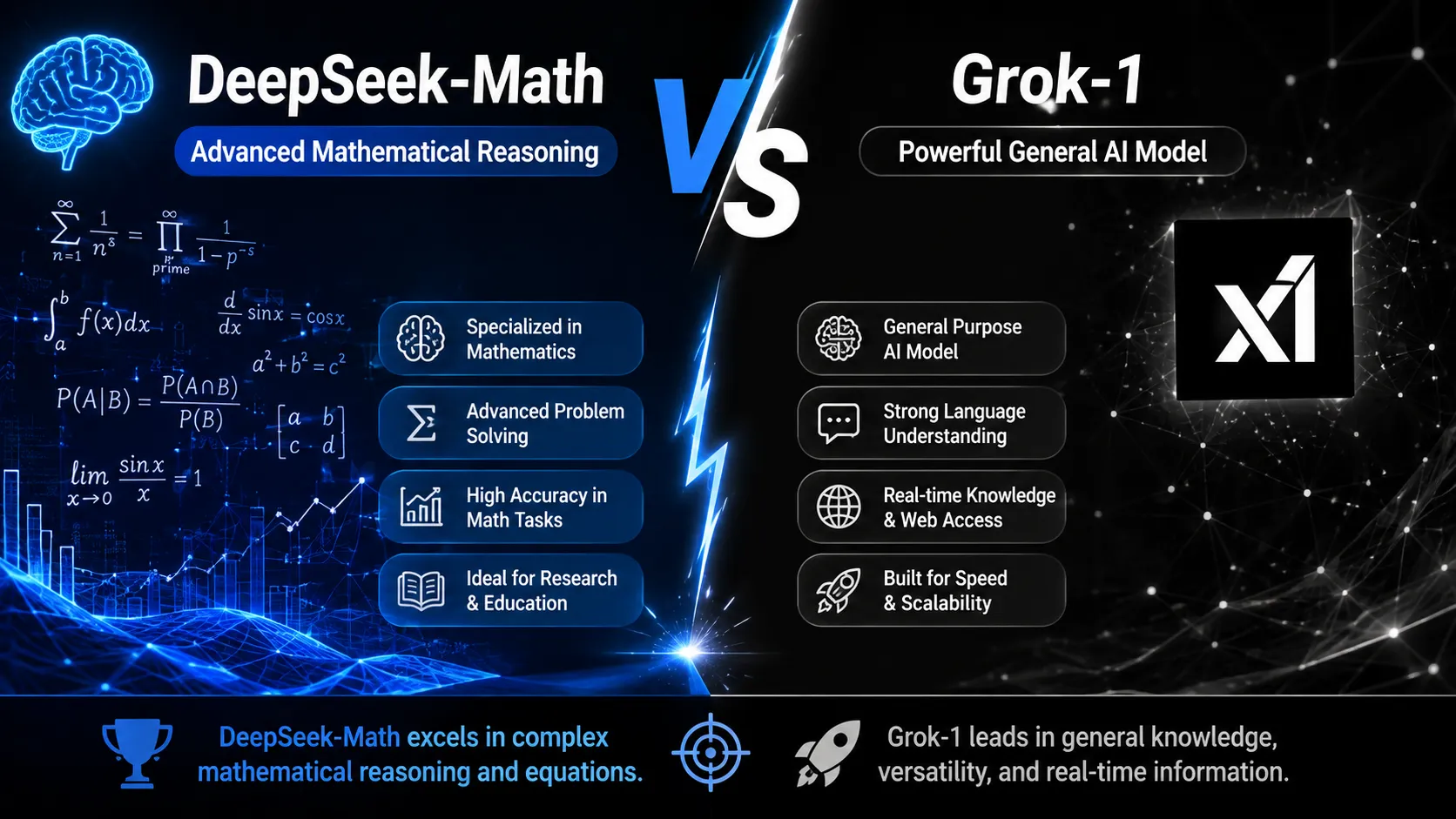
DeepSeek-Math VS Grok-1 is an unusually interesting AI comparison because the two models represent very different approaches to language-model development.
DeepSeekMath 7B was heavily optimized for mathematical reasoning, while Grok-1 uses a huge 314-billion-parameter Mixture-of-Experts architecture designed as a broader language model.
The surprising part? The much smaller DeepSeekMath can outperform Grok-1 on important mathematics benchmarks.
That makes this comparison less about “which model is bigger?” and more about whether specialization can beat raw scale on a focused task.
DeepSeekMath vs Grok-1 at a Glance
Before getting into the technical details, here is the quick answer.
| Feature | DeepSeekMath | Grok-1 |
| Developer | DeepSeek | xAI |
| Model family | DeepSeekMath | Grok |
| Parameters | 7B | 314B |
| Primary orientation | Mathematical reasoning | General-purpose language modeling |
| Architecture | Transformer-based 7B model | Mixture of Experts |
| Total experts | — | 8 |
| Active experts/token | — | 2 |
| Original context | Model-specific | 8,192 tokens |
| MATH | 51.7% reported for DeepSeekMath 7B | 23.9% |
| GSM8K | 88.2% reported for DeepSeekMath-7B | 62.9% |
| HumanEval | Not the central headline benchmark | 63.2% |
| Open weights | Yes | Yes |
| Best fit | Mathematics/reasoning research | Large-scale general LLM research |
| Main advantage | Specialization | Scale and MoE design |
The benchmark figures are reported results, not a controlled modern head-to-head test. DeepSeekMath’s paper reports 51.7% MATH for DeepSeekMath 7B, while xAI reports 23.9% for Grok-1 using four-shot evaluation. Similarly, the reported GSM8K figures are 88.2% and 62.9%, respectively.
What Is DeepSeekMath?
DeepSeekMath is a 7-billion-parameter model family developed specifically to push mathematical reasoning in open language models.
It was initialized from DeepSeek-Coder-Base-v1.5 7B and continued pretraining using a large quantity of math-related web data, alongside natural-language and code data. The research paper describes 120B math-related tokens in the mathematical corpus.
Its development involved more than simply collecting equations.
The research focused on:
- Mathematical web-data selection
- Data filtering
- Continued pretraining
- Mathematical instruction tuning
- Reinforcement learning
- GRPO
- Tool-assisted mathematical reasoning
DeepSeekMath’s researchers specifically identify its data pipeline and Group Relative Policy Optimization (GRPO) as important contributors to its reasoning performance.
Why that matters
A model does not need hundreds of billions of parameters to become useful at a specialized task.
If training data, optimization, and reinforcement learning are strongly aligned with that task, a smaller model can become remarkably capable.
That is the central lesson of DeepSeekMath.
What Is Grok-1?
Grok-1 is an open-weight language model released by xAI.
Its architecture is dramatically larger than DeepSeekMath.
The official model repository describes Grok-1 as a 314B-parameter Mixture-of-Experts model with eight experts, of which two are used per token. It has 64 layers, 48 query heads, eight key/value heads, and an 8,192-token sequence length.
Grok-1’s scale is therefore not comparable to a conventional 7B dense model.
Its MoE architecture allows different experts to process different tokens instead of activating every parameter for every token.
The released model was also a base model rather than a dialogue-finetuned assistant, an important distinction when comparing it with consumer-facing AI products.
DeepSeekMath VS Grok-1 Architecture
Architecture is where this comparison becomes especially interesting.
DeepSeekMath: Small and Specialized
DeepSeekMath is built around a 7B foundation and was optimized heavily for mathematical reasoning.
Its approach emphasizes:
- Specialized data
- Mathematical reasoning
- Instruction tuning
- Reinforcement learning
- Efficient reasoning
The original research describes the model as continuing from DeepSeek-Coder-Base-v1.5 7B.
Grok-1: Huge and Sparse
Grok-1 takes a completely different route.
Its total parameter count is 314B, but it uses a Mixture-of-Experts architecture in which two of eight experts are selected per token.
This means the statement:
“Grok-1 has 314B parameters”
does not mean every token passes through all 314B parameters.
That distinction is crucial when discussing MoE models.
7B vs 314B
The raw parameter comparison is dramatic:
314B ÷ 7B ≈ 44.9×
So Grok-1 has roughly 45 times as many total parameters as DeepSeekMath.
Yet parameter count alone does not Determine performance on a specialized benchmark.
And that is exactly where DeepSeekMath becomes interesting.
DeepSeekMath VS Grok-1 MATH Benchmark
This is arguably the most important section of the comparison.
The original DeepSeekMath paper reports 51.7% on the MATH benchmark for DeepSeekMath 7B without external toolkits or voting techniques.
xAI reported 23.9% on MATH for Grok-1 using four-shot evaluation.
| Model | MATH |
| DeepSeekMath 7B | 51.7% |
| Grok-1 | 23.9% |
On these reported results, DeepSeekMath has a substantial advantage.
But there is an important caveat:
These figures should not be presented as a perfectly controlled head-to-head experiment.
The models come from different research efforts and use different evaluation protocols.
So the correct conclusion is:
DeepSeekMath’s published MATH result is substantially higher than the original published Grok-1 result.
That is more accurate than claiming that researchers performed a single standardized DeepSeekMath-vs-Grok-1 test.
DeepSeekMath VS Grok-1 GSM8K Performance
GSM8K focuses on grade-school mathematical word problems.
The reported results again favor DeepSeekMath.
| Model | GSM8K |
| DeepSeekMath 7B | 88.2% |
| Grok-1 | 62.9% |
DeepSeekMath’s reported 88.2% result appears in benchmark comparisons of the model, while xAI reports 62.9% for Grok-1 using eight-shot evaluation.
The gap is approximately 25.3 percentage points.
That is significant.
However, the same methodological warning applies: benchmark numbers from separate papers should be interpreted as reported evidence, not as a laboratory-controlled contest.
Why Does DeepSeekMath Perform So Well at Mathematics?
The answer is not simply “because DeepSeek is smarter.”
Its training strategy was highly targeted.
The DeepSeekMath research describes a data pipeline built around math-related web content. The research corpus contained approximately 120B math-related tokens, and the broader collection process ultimately identified tens of millions of mathematical web pages.
The model then received additional mathematical optimization.
This creates an important principle:
Specialization can compensate for scale.
Imagine two students.
One studies everything.
The other spends most of their preparation solving mathematics problems.
If you give them a difficult mathematics exam, the second student’s specialization may matter more than the first student’s broader knowledge.
DeepSeekMath essentially applies that idea to model training.
DeepSeekMath VS Grok-1 Mathematical Reasoning
For mathematical reasoning, DeepSeekMath is the stronger choice based on the published benchmark evidence.
Its research objective was directly aligned with mathematics.
The model’s training incorporated:
- Mathematical documents
- Mathematical reasoning
- Instruction tuning
- Reinforcement learning
- GRPO
- Program-assisted reasoning
- Tool-integrated evaluation
The paper reports that DeepSeekMath-RL achieved strong results across mathematical benchmarks, demonstrating that reinforcement learning could further improve mathematical reasoning.
Grok-1, meanwhile, was not created as a dedicated mathematics model.
That does not mean Grok-1 cannot solve mathematics.
It means mathematics was not the central specialization around which the model was designed.
Verdict
Winner for specialized mathematical reasoning: DeepSeekMath.
DeepSeekMath VS Grok-1 for Coding
Coding creates a more nuanced comparison.
DeepSeekMath inherited its foundation from DeepSeek-Coder, giving it a meaningful connection to code-oriented pretraining.
Grok-1, meanwhile, achieved a reported 63.2% on HumanEval in xAI’s original benchmark table.
Therefore, it would be misleading to say:
“DeepSeekMath destroys Grok-1 at coding.”
The available evidence does not justify that conclusion.
Instead:
| Task | Better interpretation |
| Pure mathematical reasoning | DeepSeekMath |
| Math-heavy programming | DeepSeekMath may be attractive |
| Broad coding benchmark evidence | Grok-1 has strong published evidence |
| General programming use | Depends on checkpoint, prompting and deployment |
| Specialized mathematical code | DeepSeekMath is particularly relevant |
Coding Verdict
Grok-1 has a stronger direct published HumanEval result, while DeepSeekMath is particularly interesting for math-heavy programming and reasoning.
DeepSeekMath VS Grok-1 Model Size
This is where the numbers become almost comical.
DeepSeekMath: 7B parameters.
Grok-1: 314B parameters.
That makes Grok-1 approximately 44.9 times larger in total parameter count.
Yet its published MATH score is substantially lower than DeepSeekMath’s.
This gives us one of the most useful lessons from this comparison:
More parameters do not automatically produce better performance on every specialized task.
Grok-1’s MoE architecture changes the interpretation because only selected experts are activated per token.
The official repository specifies eight experts and two selected experts per token.
Still, the overall model remains extremely large, and xAI’s repository explicitly notes that substantial GPU memory is required to run it.
DeepSeekMath VS Grok-1 Efficiency
For researchers and developers, efficiency can matter more than raw benchmark scores.
DeepSeekMath’s 7B size gives it an enormous practical advantage over a 314B model in terms of model footprint and deployment complexity.
Grok-1’s MoE architecture improves conditional computation, but it does not transform a 314B model into a small model.
The official repository warns that a machine with sufficient GPU memory is required to run Grok-1.
Practical takeaway
If you want to experiment with a mathematical model on comparatively modest infrastructure, DeepSeekMath is the much more approachable option.
If your research specifically concerns enormous MoE systems, Grok-1 becomes more interesting.
DeepSeekMath VS Grok-1 Open-Source Availability
Both projects are valuable for open AI research, but their releases should be described carefully.
DeepSeek’s official repository provides base, instruct, and RL checkpoints and states that the code is MIT licensed, while the models are subject to their model license.
Grok-1’s released model and code are associated with the Apache 2.0 license, and the model repository provides its architecture and implementation.
| Area | DeepSeekMath | Grok-1 |
| Public model checkpoints | Yes | Yes |
| Research implementation | Yes | Yes |
| Mathematical specialization | Strong | Limited |
| MoE research value | Lower | Very high |
| Smaller-scale experimentation | Easier | Difficult |
| Large-model architecture study | Moderate | Strong |
One important distinction is that open weights do not automatically mean training code, data, and every component are open.
That is why “open-source” should be used precisely when discussing AI models.
DeepSeekMath VS Grok-1 Tool Use
Tool use is another reason DeepSeekMath is interesting.
The DeepSeekMath research explicitly investigates reasoning with tools, including mathematical problem solving and program-assisted approaches. Its project repository also includes evaluation resources for reasoning and tool-integrated reasoning.
This makes DeepSeekMath particularly relevant to workflows where an LLM can:
- Understand a problem.
- Generate a mathematical plan.
- Write or invoke code.
- Calculate a result.
- Check the answer.
- Produce a final explanation.
For difficult mathematics, this can be more useful than relying entirely on internal token generation.
Practical lesson
A strong mathematical AI system is not necessarily the one with the largest parameter count.
It may be the one that combines:
good training + reasoning + verification + tools.
Pros and Cons
DeepSeekMath Pros
- 7B parameter scale
- Strong mathematical specialization
- Strong published MATH result
- Strong published GSM8K result
- Math-focused training corpus
- GRPO-based reasoning optimization
- Multiple released checkpoints
- Useful for mathematical AI research
- More approachable than a 314B model
DeepSeekMath Cons
- Specialized rather than broadly optimized
- Not the obvious choice for every general-purpose task
- Benchmark comparisons require careful methodology
- Older model generation
- Deployment depends on the specific checkpoint
Grok-1 Pros
- 314B total parameters
- Large-scale MoE architecture
- Eight experts
- Two experts selected per token
- Strong published general-language benchmark results
- Strong published HumanEval result
- Open model release
- Valuable for large-scale MoE research
Grok-1 Cons
- Extremely large
- Heavy hardware requirements
- 8,192-token original sequence length
- Original MATH score below DeepSeekMath’s reported result
- Released checkpoint is a base model rather than a dialogue-finetuned assistant
DeepSeekMath VS Grok-1: Which Is Better for Students?
For students whose main goal is mathematical reasoning, DeepSeekMath is the more logical choice based on its design and reported benchmark performance.
It was created around mathematics rather than treating math as merely one capability among many.
For broader research, writing, language modeling, or experimentation with huge MoE architectures, Grok-1 may be more interesting.
Simple answer
Math student → DeepSeekMath
Large-model researcher → Grok-1
DeepSeekMath VS Grok-1: Which Is Better for Developers?
The answer depends heavily on what the developer is building.
Choose DeepSeekMath when:
- Your application is math-heavy.
- You need a smaller model.
- You are researching mathematical reasoning.
- You want to experiment with GRPO-related research.
- You want mathematical problem-solving capabilities.
Choose Grok-1 when:
- You are studying large MoE architectures.
- Your infrastructure can handle an enormous model.
- You want to experiment with a 314B model.
- Your project is broader than mathematics.
- Large-scale language-model research is the objective.
The biggest mistake would be choosing based solely on parameter count.
DeepSeekMath VS Grok-1: What the Benchmarks Really Tell Us
Here is the most important interpretation.
| Observation | What it means |
| DeepSeekMath is 7B | It is comparatively small |
| Grok-1 is 314B | It is enormously larger |
| DeepSeekMath has strong MATH results | Specialization matters |
| DeepSeekMath has strong GSM8K results | Math reasoning was a central design target |
| Grok-1 uses MoE | Total parameters are not equivalent to active parameters |
| Grok-1 has strong HumanEval results | It has meaningful coding capability |
| Benchmark settings differ | Scores should not be treated as a controlled duel |
The comparison therefore teaches something broader than which model wins.
It demonstrates that architecture, data quality, training objectives, and task specialization can matter enormously.
DeepSeekMath VS Grok-1: Final Verdict
If the question is:
“Which is better specifically for mathematics?”
DeepSeekMath wins.
Its 7B architecture was trained and optimized around mathematical reasoning, and its published MATH and GSM8K results substantially exceed the original Grok-1 results under their respective reported evaluation setups.
If the question is:
“Which is the more interesting enormous general-purpose model?”
Grok-1 wins for that use case.
Its 314B MoE architecture makes it a fundamentally different research object. The model uses eight experts and selects two per token, giving researchers a large-scale example of sparse expert-based language modeling.
People Also Ask
A: For mathematical reasoning, the published benchmark evidence favors DeepSeekMath. DeepSeekMath 7B reported 51.7% on MATH, while xAI reported 23.9% for Grok-1.
A: The original DeepSeekMath model is a 7B-parameter model.
A: Grok-1 has 314 billion total parameters and uses a Mixture-of-Experts architecture.
A: No. Grok-1 is a general-purpose language model rather than a model specifically built around mathematical reasoning.
A: The DeepSeekMath paper reports 51.7% on MATH without external toolkits and voting techniques.
Conclusion
The DeepSeekMath vs. Grok-1 comparison is ultimately a story about specialization versus scale. Grok-1 is the giant: 314B parameters, eight experts, and a large-scale MoE design. DeepSeekMath is the specialist: just 7B parameters but trained and optimized specifically to become strong at Mathematical reasoning.
And the benchmark results make the contrast especially interesting. DeepSeekMath’s reported 51.7% MATH result and 88.2% GSM8K result are substantially above the original reported Grok-1 scores of 23.9% MATH and 62.9% GSM8K. But those numbers should never be interpreted as a perfect controlled head-to-head experiment because the evaluation settings originate from different research reports.