Introduction
If someone suddenly texts you “aye,” you might wonder what they actually mean. Are they saying yes, yeah, okay, or simply trying to get your attention?
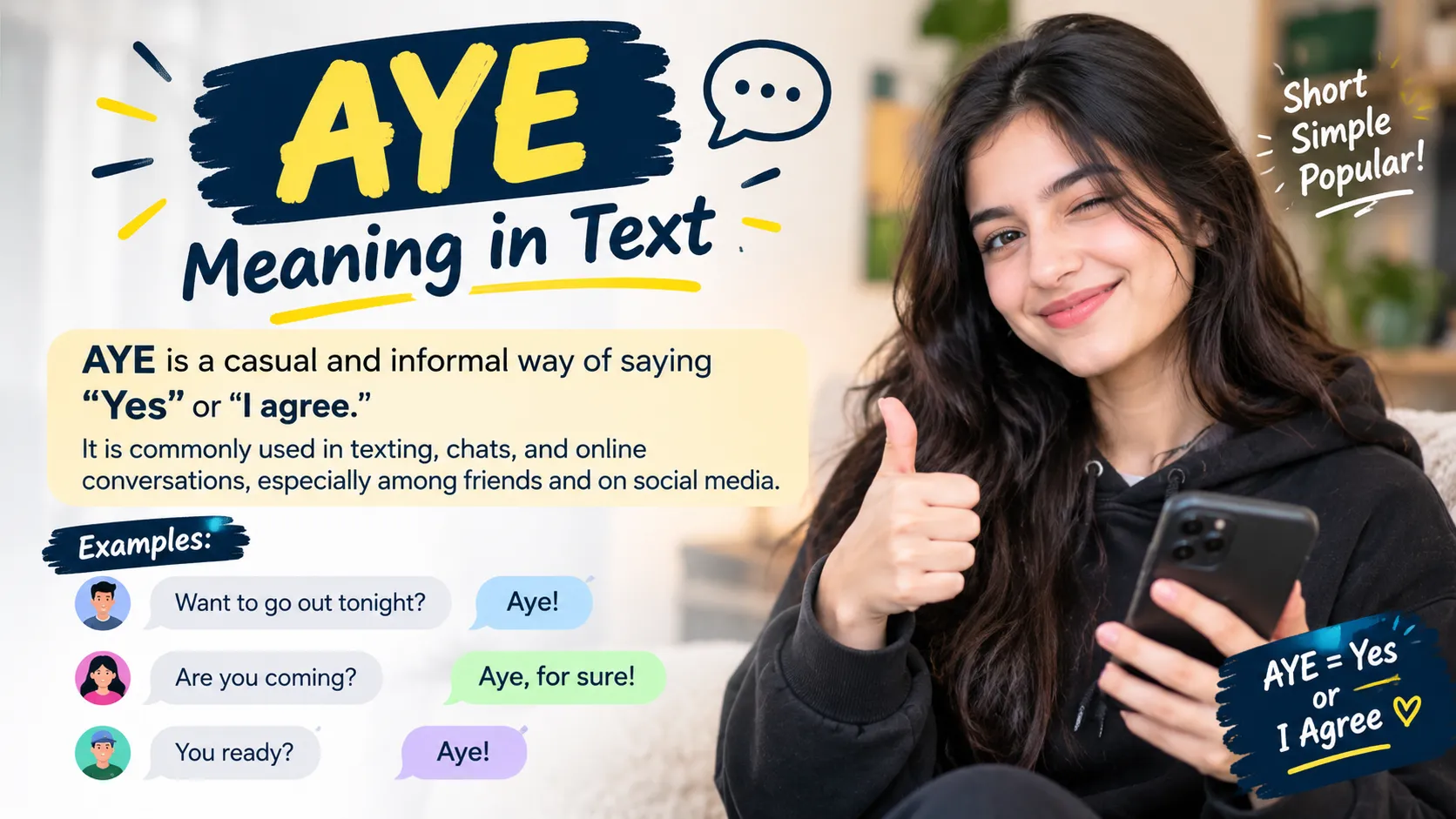
In most casual text conversations, AYE means “yes,” “yeah,” “okay,” or “I agree.” However, its exact meaning can change depending on the sentence, tone, punctuation, capitalization, emojis, and the relationship between the people talking.
For example:
“Are you coming tonight?”
“Aye.”
Here, aye simply means “yes.”
But compare that with:
“AYEEE! We won!”
In this case, the word Expresses Excitement, celebration, or hype rather than simply answering a question.
You may also see variations such as aye, Aye, AYE, ayee, ayeee, aye…, and aye aye. These forms can communicate different levels of emotion or emphasis.
So, if you want to understand AYE meaning in text, the safest rule is simple: don’t interpret the word completely on its own. Look at the context around it.
Quick Answer: What Does AYE Mean in Text?
AYE usually means “yes,” “yeah,” “okay,” or “I agree” in texting and online conversations.
It is generally casual and conversational.
Examples:
- “You coming?” → “Aye.” = Yes.
- “Aye, I agree.” = Yeah, I agree.
- “Aye, I got you.” = Okay, understood.
- “AYE! We won!” = Excitement or celebration.
- “Aye, check this out.” = An attention-getter, similar to “hey.”
Importantly, aye is not normally a texting acronym or abbreviation. It is an established English word with older regional and formal uses as well.
AYE Meaning at a Glance
| Form | Common Meaning | Typical Tone |
| aye | Yes/yeah | Casual |
| Aye | Yes / I agree | Neutral-casual |
| AYE | Strong agreement or emphasis | Energetic |
| Aye! | Yes / excitement | Enthusiastic |
| ayee | Excitement / playful reaction | Playful |
| ayeee | Strong excitement/hype | Very expressive |
| aye… | Agreement with possible hesitation | Context-dependent |
| aye aye | Understood / accepted | Playful or traditional |
The capitalization and extra letters usually affect tone, rather than creating a completely new dictionary definition.
What Does “Aye” Mean in Text Messages?
The most common meaning of aye in text messages is “yes.”
It can also express agreement or acknowledgment.
Example 1
Person 1: Are you coming to dinner?
Person 2: Aye.
Meaning: Yes.
Example 2
Person 1: That movie was really good.
Person 2: Aye, definitely.
Meaning: Yeah, I agree.
Example 3
Person 1: Send me the file when you’re finished.
Person 2: Aye, I got you.
Meaning: Okay, understood. I’ll do it.
Therefore, while “yes” is the simplest translation, the natural interpretation can change slightly depending on how the word is used.
Does AYE Mean Yes?
Yes. In many casual conversations, “aye” means “yes.”
The word has a long history in English and is especially associated with older, Northern English, and Scottish usage. Cambridge Dictionary also records aye as a word used for an affirmative vote.
So:
“Aye, I’ll be there.”
can simply mean:
“Yes, I’ll be there.”
However, aye isn’t necessarily modern internet slang. Someone might use it because of their regional speech, personal vocabulary, cultural background, or because they prefer its casual sound.
That distinction is important when interpreting a message.
Different Meanings of AYE in Text
Although yes/agreement is the most common interpretation in a short text response, “aye” can perform several conversational functions.
1. AYE Means “Yes”
This is the most straightforward use.
Example:
“Are you free tomorrow?”
“Aye.”
Meaning: Yes, I am.
2. AYE Means “I Agree”
Someone can use “aye” to agree with an opinion or statement.
Example:
“That restaurant was amazing.”
“Aye, it really was.”
Meaning: Yes, I agree.
3. AYE Means “Okay” or “Got It”
Sometimes “aye” acknowledges an instruction or confirms understanding.
Example:
“Meet me outside at 7.”
“Aye, I’ll be there.”
Meaning: Okay, understood.
4. AYE Can Show Excitement
When written with an exclamation mark or capital letters, “aye” can become much more energetic.
Example:
“AYE! We finally did it!”
Here it may communicate:
- Yes!
- Let’s go!
- Absolutely!
- We did it!
- That’s right!
The punctuation and capitalization add much of the emotional tone.
5. AYE Can Get Someone’s Attention
In informal communication, “aye” can sometimes function as an attention-getter.
Example:
“Aye, look at this!”
Here, the meaning is closer to:
“Hey, look at this!”
This is different from:
“Are you coming?” → “Aye.”
The first is an attention-getter; the second is an affirmative answer.
What Does “Aye!” Mean?
An “Aye!” with an exclamation mark can express stronger emotion than a simple “aye.”
Depending on the situation, it may mean:
- Yes!
- Absolutely!
- I agree!
- Let’s go!
- That’s right!
- Great!
For example:
“We passed the exam!”
“Aye!”
This sounds more like an enthusiastic reaction than a simple neutral “yes.”
The punctuation is important because:
“Aye.”
and
“Aye!”
can feel quite different even though the underlying word is the same.
What Does “AYE” Mean in All Caps?
When someone writes:
AYE
the capital letters generally add emphasis.
For example:
“AYE! THAT’S CRAZY!”
This probably communicates strong excitement or emotion.
However, capitalization does not necessarily create a completely different dictionary meaning. It mainly changes the tone, intensity, or visual emphasis.
Think of it this way:
aye → normal
Aye! → stronger
AYE! → highly emphasized
The exact interpretation still depends on the conversation.
What Does “Ayee” Mean?
Ayee is usually an expressive spelling of “aye.”
People may add letters to make the message sound more playful, excited, surprised, or energetic.
For example:
“Ayee, you actually came!”
This could express surprise or excitement.
Another example:
“AYEE 😂”
Could communicate a playful reaction.
The additional e does not create a formal new definition. Instead, it acts as a tone marker.
What Does “Ayeee” Mean?
Ayeee generally adds even more emotion or emphasis than “ayee.”
For example:
“AYEEE WE WON!”
sounds much more excited than:
“Aye.”
You may see even longer versions such as:
- ayeee
- ayeeee
- ayeeeee
- ayyyy
These spellings are highly informal and expressive.
They are best understood as internet-style tone variations, not separate dictionary words.
What Does “Aye…” Mean?
The ellipsis in:
“Aye…”
can make the message feel very different.
Depending on context, it may sound:
- hesitant
- uncertain
- reluctant
- disappointed
- tired
- thoughtful
- unconvinced
For example:
“Aye, that’s true.”
sounds like straightforward agreement.
But:
“Aye…”
may suggest that the person has something more to say or is not completely enthusiastic.
Still, punctuation alone cannot tell you exactly what someone feels. The surrounding conversation matters.
What Does “Aye Aye” Mean?
“Aye aye” has a different feel from a simple “aye.”
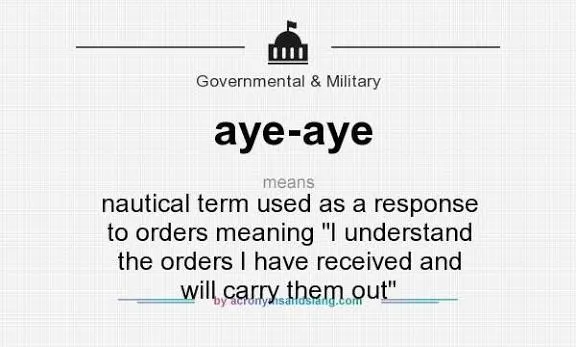
It is traditionally associated with acknowledging an instruction, especially in the familiar expression:
“Aye aye, captain!”
It can communicate:
- Understood.
- Yes, I will.
- I accept the instruction.
- Okay, I’ll do it.
In modern conversations, it is often used humorously.
Example:
“Clean your room.”
“Aye aye, boss 😂”
Meaning:
“Okay, okay, I will.”
Is AYE an Acronym or Does It Have a Full Form?
No. “Aye” is not normally a texting acronym.
This is one of the most Important points for people searching for an AYE full form.
Unlike:
- LOL = Laughing Out Loud
- BRB = Be Right Back
- IDK = I Don’t Know
AYE is generally an actual English word, not a phrase made from three words.
So if someone asks:
“What is the full form of AYE in texting?”
the best answer is:
Aye normally has no texting full form. It is a word meaning “yes” or agreement.
There may be specialized acronyms using the letters AYE in particular industries or organizations, but that is separate from the ordinary texting meaning.
Is AYE Slang?
Aye can be used informally like slang, but it is not simply a modern internet slang invention.
The word has older English and regional uses.
Modern texting has simply given people another place to use it.
This distinction is useful:
Aye as a word: Established English usage.
Aye in casual texting: Informal conversational usage.
AYEEE online: Highly expressive internet-style spelling.
Therefore, calling “aye” purely an internet slang word would be incomplete.
AYE Meaning on Social Media
The meaning of “aye” does not fundamentally change from one platform to another. However, the style of communication can affect how people use it.
AYE Meaning on WhatsApp
On WhatsApp, aye can commonly mean:
- yes
- okay
- yeah
- I agree
- got it
Example:
“You coming to the party?”
“Aye, I’ll be there.”
Meaning:
“Yes, I’ll be there.”
But:
“AYEEE 😂”
would usually carry a more excited or playful tone.
AYE Meaning on Instagram
On Instagram, the context is particularly important because “aye” may appear in DMs, comments, or replies.
In a DM
“Aye, what’s up?”
may function like:
“Hey, what’s up?”
In a comment
“AYEEE 🔥”
may communicate excitement, approval, or hype.
In a reply
“Aye, that’s true.”
Usually means:
“Yeah, I agree.”
The platform itself does not create one fixed meaning.
AYE Meaning on TikTok
TikTok comments often use expressive forms such as:
- AYE!
- AYEE!
- AYEEE!
- AYYYY!
These can express:
- excitement
- approval
- surprise
- celebration
- hype
For example:
“AYEEE THIS IS FIRE 🔥”
is an enthusiastic reaction rather than a simple “yes.”
AYE Meaning on Snapchat
On Snapchat, “aye” is generally used in casual conversations.
For example:
“Aye, you home?”
may function as an attention-getter similar to:
“Hey, are you home?”
But:
“You coming?”
“Aye.”
is much more clearly:
“Yes.”
AYE Meaning in Gaming
Gaming chats often rely on short messages because players need to communicate quickly.
For example:
“Ready?”
“Aye.”
Meaning:
“Yes, I’m ready.”
Another example:
“AYEEE! WE WON!”
means something closer to:
“Let’s go! We won!”
The same basic word can therefore communicate either confirmation or excitement.
What Does AYE Mean From a Guy?
If a guy texts you “aye,” don’t automatically assume it has a romantic meaning.
Depending on the conversation, it may simply mean:
- yes
- yeah
- okay
- I agree
- got it
- hey
- an excited reaction
For example:
You: “Are you coming?”
Him: “Aye.”
This is simply an affirmative response.
Compare that with:
Him: “Ayee 😏 what’s up?”
The second message has a more playful tone because of the extended spelling, emoji, and surrounding wording.
The word “aye” itself does not establish romantic interest.
What Does AYE Mean From a Girl?
The basic interpretation is the same.
If a girl texts:
“Are you free later?”
“Aye.”
the most natural meaning is:
“Yes.”
It could also mean:
- yeah
- okay
- I agree
- understood
Depending on the sentence, “aye” can sometimes work as an attention-getter.
The safest approach is to interpret the whole message and conversation, rather than assigning a special meaning based only on whether the sender is a guy or a girl.
Is “Aye” Flirty?
Not by itself.
“Aye” is not inherently a flirting term.
It can appear in a flirtatious conversation, but the surrounding words, emojis, punctuation, and relationship provide the relevant context.
Compare:
“Aye, I’ll see you tomorrow.”
This is neutral.
But:
“Ayeee 😏 you look good.”
has a more playful or potentially flirtatious tone because of the complete message.
Therefore, if someone sends you “aye,” don’t treat the word alone as evidence of flirting.
AYE vs Yes vs Yeah vs Yup vs Yep vs Hey
| Word | Common Meaning | Typical Tone |
| Aye | Yes / I agree | Casual, sometimes regional |
| Yes | Affirmative | Neutral/formal |
| Yeah | Yes / agreement | Casual |
| Yup | Yes | Casual/playful |
| Yep | Yes | Casual |
| Hey | Greeting/attention | Casual |
| Ayy | Excitement/greeting/reaction | Very informal |
| Ayee | Excited/playful reaction | Very informal |
One important distinction:
Aye and hey are not automatically interchangeable.
Commonly has an affirmative meaning, while “hey” primarily functions as a greeting or attention-getter.
AYE vs AY vs AYY vs AYEE
These spellings can look similar, but they should not automatically be treated as identical.
| Form | Typical Use |
| aye | Yes / agreement |
| ay | Can have several informal or regional uses |
| ayy | Casual reaction, greeting, excitement |
| ayee | Playful or excited reaction |
| ayeee | Stronger expressive reaction |
In online communication, spelling is often flexible.
That means the same person may use different forms simply to change the mood of a message.
Examples of AYE in Text Conversations
Example 1: Simple Agreement
Alex: Are you coming with us?
Sam: Aye.
Meaning: Yes.
Example 2: Confirming a Plan
Alex: Meet me at 8?
Sam: Aye, sounds good.
Meaning: Yes, that works.
Example 3: Showing Agreement
Alex: That game was amazing.
Sam: Aye, definitely.
Meaning: I agree.
Example 4: Showing Excitement
Alex: We won!
Sam: AYEEE!
Meaning: Excitement and celebration.
Example 5: Getting Attention
Alex: Aye, check this out.
Meaning: Hey, look at this.
Example 6: Acknowledging an Instruction
Alex: Send it when you’re finished.
Sam: Aye, I got you.
Meaning: Okay, understood.
Example 7: Playful Compliance
Alex: Don’t forget your homework.
Sam: Aye aye 😂
Meaning: Okay, I will.
How to Reply When Someone Says “Aye”
Your response depends on what the person means.
If “Aye” Means Yes
You can respond:
- “Great!”
- “Perfect.”
- “Sounds good.”
- “Okay 👍”
- “See you then.”
If “Aye” Is an Excited Reaction
You can match the energy:
- “AYEEE 😂”
- “Let’s go!”
- “Haha exactly!”
- “🔥🔥”
If “Aye” Is Being Used Like “Hey”
You can respond normally:
- “Hey!”
- “What’s up?”
- “Yo, what’s going on?”
If You’re Unsure
Look at the sentence immediately before it.
“You coming?” → “Aye.”
Almost certainly means yes.
But:
“Aye, look at this.”
is more likely functioning as an attention-getter.
The History and Origin of “Aye”
“Aye” was not created by TikTok, Instagram, or modern texting.
It has a much longer history in English and regional varieties of English.
Dictionaries document aye as an older or regional form meaning yes, particularly in Northern English and Scottish English. It also has a formal voting sense.
The Scots language has another important use: aye can mean always, ever, or continually.
This creates an important distinction:
Texting “aye” → usually “yes” or agreement.
Scots “aye” → can mean “always” or “ever.”
Therefore, the meaning depends heavily on Linguistic and conversational context.
Aye in Scottish and Northern English
In Scottish and some Northern English varieties, aye can naturally mean yes.
For example:
“Are you coming?”
“Aye.”
means:
“Yes.”
But Scots also has a separate use of aye meaning always, ever, or continually.
For example:
“She’s aye early.”
can mean:
“She’s always early.”
This is a different meaning from the common texting response:
“Aye.”
= “Yes.”
That distinction is one reason it is useful to separate modern texting usage from dictionary and regional usage.
Aye as a Voting Term
“Aye” also has a formal political and parliamentary meaning: an affirmative vote.
For example:
“All those in favor, say aye.”
Here, “aye” means a vote in favor.
You may also hear:
“The ayes have it.”
This means that the votes in favor have outnumbered the votes against under the relevant voting procedure.
This is a formal use and should not be confused with internet slang.
What Does “The Ayes Have It” Mean?
“The ayes have it” is a phrase used in parliamentary or meeting contexts.
It means that the votes in favor have won over the votes against.
For example:
“The ayes have it.”
means the proposal has received sufficient affirmative support under the applicable voting procedure.
What Does “Aye Aye, Captain” Mean?
“Aye aye, captain!” is a familiar nautical-style expression associated with acknowledging an instruction.
It can mean:
- Understood.
- Yes, I will.
- I accept the instruction.
- I’ll follow the instruction.
Today, people also use it humorously.
For example:
“Please clean the kitchen.”
“Aye aye, captain! 😂”
Here, the speaker is playfully saying:
“Okay, I’ll do it.”
Common Misunderstandings About AYE
Is AYE the Same as AY?
Not necessarily.
Aye is an established word with its own dictionary meanings.
Ay can have different historical, regional, or informal uses.
Online, people may also use different spellings casually, so context matters.
Is AYE the Same as HEY?
Not always.
Hey primarily works as a greeting or attention-getter.
Aye most commonly means yes or agreement, although it can also be used as an attention-getter in informal speech.
Is AYE Always Slang?
No.
“Aye” has established dictionary meanings and historical/regional uses.
Its use in texting can be informal, but the word itself is not exclusively internet slang.
Does AYE Always Mean Yes?
No.
Yes is the most common Interpretation when “aye” appears as a short response to a question.
But context can create other meanings.
For example:
“Aye, look at this.”
may function as an attention-getter.
In Scots, “aye” can also mean always or ever.
AYE Meaning in Different Contexts
| Context | Likely Meaning |
| Reply to a question | Yes |
| Agreeing with an opinion | I agree |
| Confirming instructions | Okay / understood |
| “AYE!” | Strong agreement/excitement |
| “AYEEE!” | Excitement/hype |
| “Aye, look at this” | Attention-getter |
| “Aye aye” | Understood / will comply |
| Parliamentary vote | Vote in favor |
| Scottish usage | Yes, or in another sense, always/ever |
| Casual social media reaction | Excitement/approval/agreement |
Why Context Matters So Much
A single word can perform different conversational jobs.
Consider these three messages:
“Aye.”
“AYEEE!”
“Aye, look at this.”
They all contain the same basic word, but their communicative purpose is different.
The easiest way to decode “aye” is to check five things:
1. What came before it?
Was the person answering a question?
2. How was it spelled?
Did they write aye, AYE, or ayeee?
3. What punctuation was used?
An exclamation mark can add excitement, while an ellipsis can introduce hesitation.
4. Were emojis included?
For example:
“AYEEE 😂🔥”
is much more expressive than:
“Aye.”
5. What is the relationship?
A friend, gaming teammate, coworker, partner, or stranger may use the same word differently.
Is “Aye” Formal or Informal?
In modern everyday texting, aye usually feels casual.
It may sound:
- conversational
- relaxed
- regional
- playful
- expressive
A simple “yes” is generally more neutral and universally understood.
For professional communication, “yes,” “certainly,” “agreed,” or another clear response may be more appropriate depending on the situation.
That does not make “aye” incorrect. It simply means that register matters.
Does AYE Have a Romantic Meaning?
Not inherently.
There is no universal romantic definition of “aye.”
If someone sends:
“Aye.”
The word itself doesn’t tell you whether they are interested romantically.
A romantic interpretation would need to come from the broader interaction, such as:
- the rest of the message
- previous conversations
- emojis
- compliments
- flirting
- the relationship between the people
- the overall tone
So don’t try to decode someone’s intentions from “aye” alone.
People Also Ask
Aye usually means “yes,” “yeah,” “okay,” or “I agree” in text messages. It is generally casual, although it also has older and regional uses outside internet communication.
Yes. Aye commonly means “yes” or agreement, especially when it is used as a short answer to a question.
No. Aye is normally an established English word rather than a texting acronym. It does not usually stand for a longer phrase like LOL or BRB.
It can be used informally in texting, but aye is much older than internet slang. It has established dictionary and regional meanings.
Usually yes, yeah, okay, or I agree, depending on the conversation. The word by itself does not establish romantic interest.
Conclusion
Understanding the meaning of “AYE” in text can help you follow casual Conversations more easily. Depending on the context, “AYE” may be used as a casual way to say “yes,” show agreement, get someone’s attention, or express excitement. The exact meaning can change based on the conversation, tone, and the person using it.
If you see “AYE” in a text message or social media chat, look at the surrounding words to understand what the sender means. Like many texting abbreviations and slang terms, context is the key to interpreting “AYE” correctly.